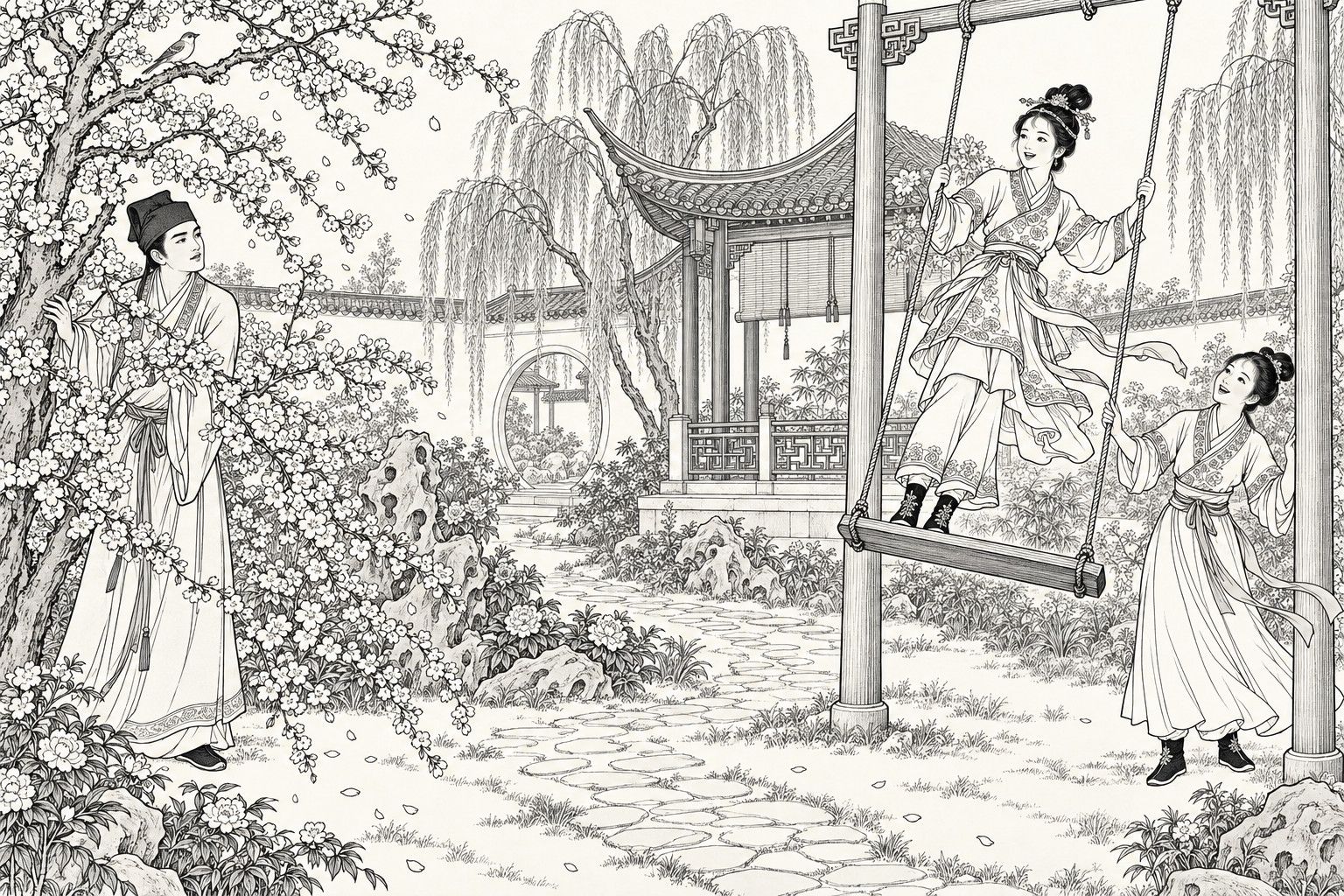
陳生弼教,字明允,燕人也。家貧,從副將軍賈綰作記室。泊舟洞庭。適豬婆龍浮水面,賈射之中背。有魚啣龍尾不去,並獲之。鎖置桅間,奄存氣息;而龍吻張翕,似求援拯。生惻然心動,請於賈而釋之。攜有金創藥,戲敷患處,縱之水中,浮沉踰刻而沒。後年餘,生北歸,復經洞庭,大風覆舟。幸扳一竹簏,漂泊終夜,絓木而止。援岸方升,有浮尸繼至,則其僮僕。力引出之,已就斃矣。慘怛無聊,坐對憩息。但見小山聳翠,細柳搖青,行人絕少,無可問途。自遲明以及辰後,悵悵靡之。忽僮僕肢體微動,喜而捫之。無何,嘔水數斗,醒然頓蘇。相與曝衣石上,近午始燥可著。而枵腸轆轆,飢不可堪。於是越山疾行,冀有村落。纔至半山,聞鳴鏑聲。方疑聽所,有二女郎乘駿馬來,騁如撒菽。各以紅綃抹額,髻插雉尾;著小袖紫衣,腰束綠錦;一挾彈,一臂青鞲。度過嶺頭,則數十騎獵於榛莽,並皆姝麗,裝束若一。生不敢前。有男子步馳,似是馭卒,因就問之。答曰:「此西湖主獵首山也。」生述所來,且告之餒。馭卒解裹糧授之。囑云:「宜即遠避,犯駕當死!」生懼,疾趨下山。茂林中隱有殿閣,謂是蘭若。近臨之,粉垣圍沓,溪水橫流;朱門半啟,石橋通焉。攀扉一望,則臺榭環雲,擬於上苑,又疑是貴家園亭。逡巡而入,橫藤礙路,香花撲人。過數折曲欄,又是別一院宇,垂楊數十株,高拂朱簷。山鳥一鳴,則花片齊飛;深苑微風,則榆錢自落。怡目快心,殆非人世。穿過小亭,有鞦韆一架,上與雲齊;而罥索沉沉,杳無人蹟。因疑地近閨閣,恇怯未敢深入。俄聞馬騰於門,似有女子笑語。生與僮潛伏叢花中。未幾,笑聲漸近。聞一女子曰:「今日獵興不佳,獲禽絕少。」又一女曰:「非是公主射得雁落,幾空勞僕馬也。」無何,紅裝數輩,擁一女郎至亭上坐。禿袖戎裝,年可十四五。鬟多斂霧,腰細驚風,玉蕊瓊英未足方喻。諸女子獻茗熏香,燦如堆錦。移時,女起,歷階而下。一女曰:「公主鞍馬勞頓,尚能鞦韆否?」公主笑諾。遂有駕肩者,捉臂者,褰裙者,持履者,挽扶而上。公主舒皓腕,躡利屣,輕如飛燕,蹴入雲霄。已而扶下。群曰:「公主真仙人也!」嘻笑而去。生睨良久,神志飛揚。迨人聲既寂,出詣鞦韆下,徘徊凝想。見籬下有紅巾,知為群美所遺,喜內袖中。登其亭,見案上設有文具,遂題巾曰:
「雅戲何人擬半仙?分明瓊女散金蓮。廣寒隊裏應相妒,莫信凌波上九天。」
題已,吟誦而出。復尋故徑,則重門扃錮矣。踟躕罔計,返而樓閣亭臺,涉歷幾盡。一女掩入,驚問:「何得來此?」生揖之曰:「失路之人,幸能垂救。」女問:「拾得紅巾否?」生曰:「有之。然已玷染,如何?」因出之。女大驚曰:「汝死無所矣!此公主所常御,塗鴉若此,何能為地?」生失色,哀求脫免。女曰:「竊窺宮儀,罪已不赦。念汝儒冠蘊藉,欲以私意相全;今孽乃自作,將何為計!」遂皇皇持巾去。生心悸肌慄,恨無翅翎,惟延頸俟死。
陈生弼教,字明允,燕人也。家贫,从副将军贾绾作记室。泊舟洞庭。适猪婆龙浮水面,贾射之中背。有鱼啣龙尾不去,并获之。锁置桅间,奄存气息;而龙吻张翕,似求援拯。生恻然心动,请于贾而释之。携有金创药,戏敷患处,纵之水中,浮沉逾刻而没。后年余,生北归,复经洞庭,大风覆舟。幸扳一竹簏,漂泊终夜,絓木而止。援岸方升,有浮尸继至,则其僮仆。力引出之,已就毙矣。惨怛无聊,坐对憩息。但见小山耸翠,细柳摇青,行人绝少,无可问途。自迟明以及辰后,怅怅靡之。忽僮仆肢体微动,喜而扪之。无何,呕水数斗,醒然顿苏。相与曝衣石上,近午始燥可着。而枵肠辘辘,饥不可堪。于是越山疾行,冀有村落。才至半山,闻鸣镝声。方疑听所,有二女郎乘骏马来,骋如撒菽。各以红绡抹额,髻插雉尾;着小袖紫衣,腰束绿锦;一挟弹,一臂青鞲。度过岭头,则数十骑猎于榛莽,并皆姝丽,装束若一。生不敢前。有男子步驰,似是驭卒,因就问之。答曰:「此西湖主猎首山也。」生述所来,且告之馁。驭卒解裹粮授之。嘱云:「宜即远避,犯驾当死!」生惧,疾趋下山。茂林中隐有殿阁,谓是兰若。近临之,粉垣围沓,溪水横流;朱门半启,石桥通焉。攀扉一望,则台榭环云,拟于上苑,又疑是贵家园亭。逡巡而入,横藤碍路,香花扑人。过数折曲栏,又是别一院宇,垂杨数十株,高拂朱檐。山鸟一鸣,则花片齐飞;深苑微风,则榆钱自落。怡目快心,殆非人世。穿过小亭,有秋千一架,上与云齐;而罥索沉沉,杳无人迹。因疑地近闺阁,恇怯未敢深入。俄闻马腾于门,似有女子笑语。生与僮潜伏丛花中。未几,笑声渐近。闻一女子曰:「今日猎兴不佳,获禽绝少。」又一女曰:「非是公主射得雁落,几空劳仆马也。」无何,红装数辈,拥一女郎至亭上坐。秃袖戎装,年可十四五。鬟多敛雾,腰细惊风,玉蕊琼英未足方喻。诸女子献茗熏香,灿如堆锦。移时,女起,历阶而下。一女曰:「公主鞍马劳顿,尚能秋千否?」公主笑诺。遂有驾肩者,捉臂者,褰裙者,持履者,挽扶而上。公主舒皓腕,蹑利屣,轻如飞燕,蹴入云霄。已而扶下。群曰:「公主真仙人也!」嘻笑而去。生睨良久,神志飞扬。迨人声既寂,出诣秋千下,徘徊凝想。见篱下有红巾,知为群美所遗,喜内袖中。登其亭,见案上设有文具,遂题巾曰:
「雅戏何人拟半仙?分明琼女散金莲。广寒队里应相妒,莫信凌波上九天。」
题已,吟诵而出。复寻故径,则重门扃锢矣。踟蹰罔计,返而楼阁亭台,涉历几尽。一女掩入,惊问:「何得来此?」生揖之曰:「失路之人,幸能垂救。」女问:「拾得红巾否?」生曰:「有之。然已玷染,如何?」因出之。女大惊曰:「汝死无所矣!此公主所常御,涂鸦若此,何能为地?」生失色,哀求脱免。女曰:「窃窥宫仪,罪已不赦。念汝儒冠蕴藉,欲以私意相全;今孽乃自作,将何为计!」遂皇皇持巾去。生心悸肌栗,恨无翅翎,惟延颈俟死。
Chen Bijiao, styled Mingyun, was a man of Yan, in the north. His family was poor, and he served as secretary to Jia Wan, an assistant general. Once they moored their boat on Lake Dongting. An alligator happened to come up to the surface, and Jia shot it in the back. A fish had the alligator’s tail in its mouth and would not let go, and they caught it as well. They chained the alligator to the mast. It was barely breathing, but its jaws kept opening and closing, as if it were begging to be saved. Chen was moved to pity and asked Jia to let it go. He had some salve for wounds with him, and half in play he dabbed it on the wound and set the creature back in the water. It floated and sank for a quarter of an hour, and then it was gone. More than a year later Chen was going home to the north and passed Dongting again. A great wind overturned the boat. By luck he caught hold of a bamboo basket and drifted all night, until it snagged on a tree and stopped. He was pulling himself up the bank when a floating corpse came drifting after him: it was his servant boy. He dragged him out with all his strength, but the boy was already dead. Wretched and at a loss, Chen sat down beside him to rest. All he could see were small hills rising green and slender willows waving. There was hardly anyone about, and no one to ask the way. From daybreak until well into the morning he sat there forlorn, with nowhere to go. Suddenly the boy’s limbs twitched. Overjoyed, Chen felt him all over. Before long the boy vomited up several pecks of water and came back to life. Together they spread their clothes on the rocks to dry, and not until nearly noon were they dry enough to wear. But their empty bellies rumbled and their hunger was more than they could bear. So they set off over the hills at a fast pace, hoping to find a village. They were only halfway up when they heard the whistle of arrows. While Chen was still wondering where the sound came from, two young women came riding up on fine horses, galloping like scattered beans. Each wore a band of red silk round her forehead and pheasant tail feathers in her hair; they wore purple jackets with narrow sleeves, belted with green brocade. One carried a pellet bow; the other wore a blue falconer’s guard on her arm. When he came over the ridge, there were dozens of riders hunting in the thickets, all of them lovely girls, all dressed alike. Chen did not dare go nearer. A man came running along on foot, a groom by the look of him, so Chen went up and asked him. “This is the Princess of West Lake hunting on Mount Shou,” the man answered. Chen told him how he had come there, and that they were starving. The groom untied his bundle of food and gave it to him. “Get well away from here, and quickly,” he warned. “Anyone who crosses the royal party must die!” Chen was frightened and hurried down the mountain. In a dense wood he glimpsed halls and pavilions and took them for a temple. When he came closer, there were whitewashed walls all round and a stream flowing across in front; a red gate stood half open, with a stone bridge leading to it. He held on to the door and looked in: terraces and towers were ringed with cloud, like an imperial park. Then he thought it might be the garden of some noble family. He hesitated, then went in. Trailing vines blocked the path, and the scent of the flowers came at him in waves. Past several turns of winding balustrade there was another courtyard, where dozens of weeping willows brushed the high red eaves. When a mountain bird called, the petals flew up all together; when a breeze stirred in the deep garden, the elm seeds fell of themselves. It delighted the eye and gladdened the heart; this could hardly be the world of men. Passing through a small pavilion, he came to a swing that rose level with the clouds. Its ropes hung heavy and still, and there was no trace of anyone. He suspected he was close to the women’s quarters, and in his fear he did not dare go further in. Soon he heard horses prancing at the gate, and what sounded like women laughing and talking. Chen and the boy hid among the flowering bushes. Before long the laughter came closer. He heard a girl say, “The hunting was poor today. We hardly took any game.” Another said, “If the Princess hadn’t shot down that wild goose, we’d have worn out men and horses for nothing.” Presently a crowd of girls in red brought a young lady up to the pavilion and seated her. She was in riding dress with short sleeves, and was perhaps fourteen or fifteen. Her thick hair was gathered like mist, her waist so slender the wind might startle it; jade blossoms were no comparison. The girls served her tea and burned incense, dazzling as heaped brocade. After a while she rose and went down the steps. One girl said, “Princess, you are tired from riding. Could you still manage the swing?” The Princess laughed and said she could. Then one offered her shoulders, one took her arm, one held up her skirts and one held her shoes, and they helped her up. The Princess stretched out her white wrists and, in her pointed slippers, light as a flying swallow, kicked off into the clouds. Then they helped her down. “The Princess is truly an immortal!” they all said, and went off laughing. Chen had watched sidelong for a long time, his spirit soaring. When the voices had died away, he came out and went to the swing, and lingered there, lost in thought. Under the hedge he saw a red kerchief and knew one of the beauties had dropped it. Delighted, he tucked it into his sleeve. He climbed up into the pavilion, and seeing writing things set out on the table, he wrote on the kerchief:
“Who devised this elegant game of ‘half an immortal’? Plainly it is a jade maiden scattering golden lotuses.The ranks of the Palace of Vast Cold must envy her;never let her tread the waves up to the Ninth Heaven.”
When he had written it, he went out chanting it aloud. He looked for the path he had come by, but gate after gate was locked fast. He paced back and forth with no idea what to do, then turned back and wandered through nearly every tower, hall and pavilion. A girl slipped in and asked in alarm, “How did you get in here?” Chen bowed to her. “I have lost my way. I hope you will be kind enough to help me.” “Did you pick up a red kerchief?” she asked. “I did,” said Chen. “But I have soiled it. What shall I do?” And he took it out. She was horrified. “You are a dead man! The Princess uses this every day. You have scrawled all over it like this — how can anything be done for you?” Chen turned pale and begged her to get him off. “Spying on the palace ladies is already a crime beyond pardon,” she said. “Still, seeing you are a refined scholar, I wanted to save you on my own account. But now you have brought this on yourself. What can I do?” And she hurried off in a fluster with the kerchief. Chen’s heart pounded and his flesh crept. He wished he had wings; all he could do was stretch out his neck and wait for death.