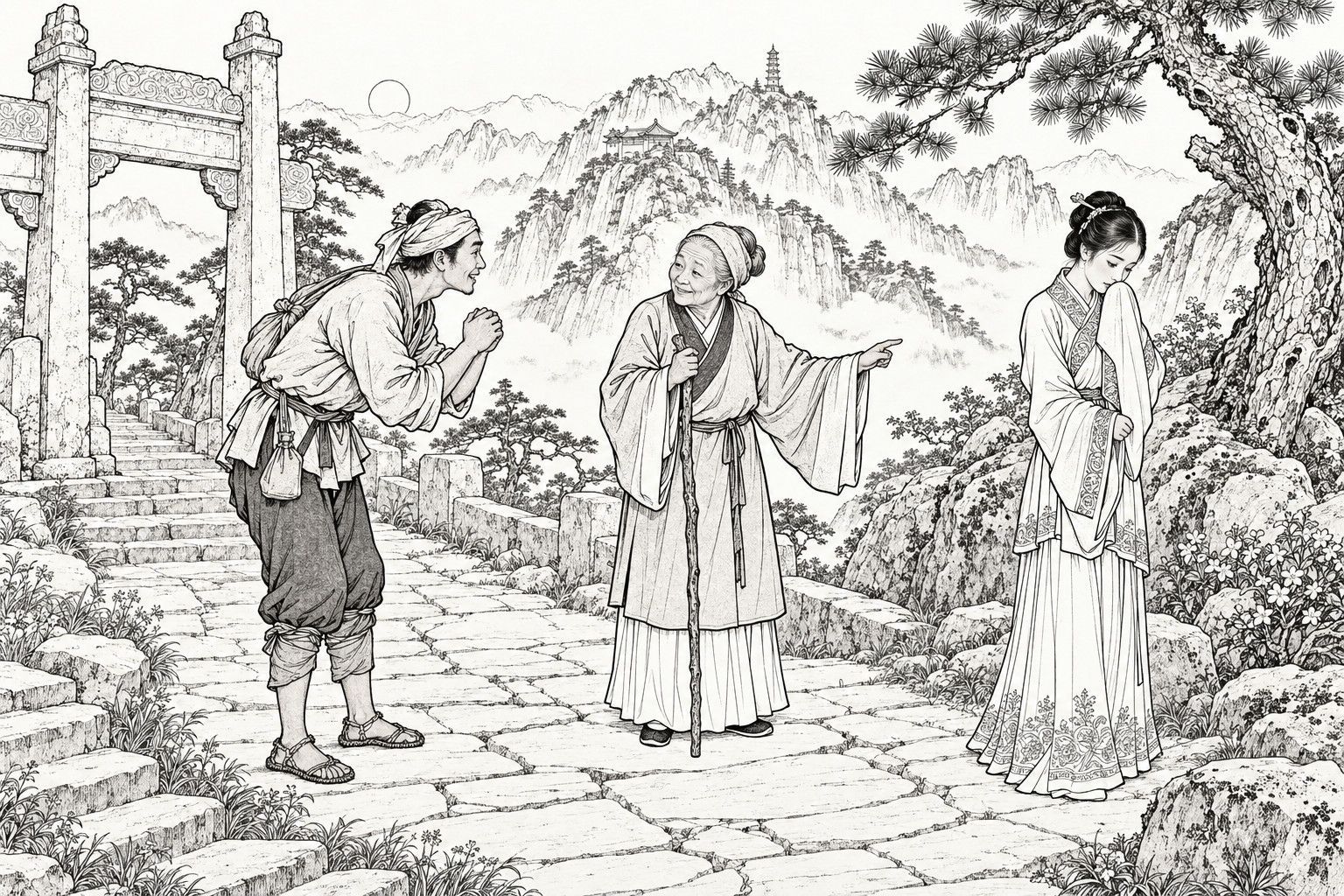
梁有才,故晉人,流寓於濟,作小負販。無妻子田產。從村人登岱。岱,四月交,香侶雜沓。又有優婆夷、塞,率眾男子以百十,雜跪神座下,視香炷為度,名曰「跪香」。才視眾中有女郎,年十七八而美,悅之。詐為香客,近女郎跪;又偽為膝困無力狀,故以手據女郎足。女回首似嗔,膝行而遠之。才又膝行近之;少間,又據之。女郎覺,遽起,不跪,出門去。才亦起,出履其跡,不知其往。心無望,怏怏而行。途中見女郎從媼,似為女也母者,才趨之。媼女行且語。媼云:「汝能參禮娘娘,大好事!汝又無弟妹,但獲娘娘冥加護,護汝得快婿,但能相孝順,都不必貴公子、富王孫也。」才竊喜,漸漬詰媼。媼自言為雲氏,女名翠仙,其出也。家西山四十里。才曰:「山路濇,母如此蹜蹜,妹如此纖纖,何能便至?」曰:「日已晚,將寄舅家宿耳。」才曰:「適言相婿,不以貧嫌,不以賤鄙,我又未婚,頗當母意否?」媼以問女,女不應。媼數問,女曰:「渠寡福,又蕩無行,輕薄之心,還易翻覆。兒不能為遢伎兒作婦!」才聞,樸誠自表,切矢皦日。媼喜,竟諾之。女不樂,勃然而已。母又強拍咻之。才殷勤,手於橐,覓山兜二,舁媼及女。己步從,若為僕。過隘,輒訶兜夫不得顛搖動,良殷。俄抵村舍,便邀才同入舅家。舅出翁,妗出媼也。雲兄之嫂之。謂:「才吾婿。日適良,不須別擇,便取今夕。」舅亦喜,出酒肴餌才。既,嚴妝翠仙出,拂榻促眠。女曰:「我固知郎不義,迫母命,漫相隨。郎若人也,當不須憂偕活。」才唯唯聽受。明日早起,母謂才:「宜先去,我以女繼至。」才歸,掃戶闥。媼果送女至。入視室中,虛無有。便云:「似此何能自給?老身速歸,當小助汝辛苦。」遂去。次日,有男女數輩,各攜服食器具,布一室滿之。不飯俱去,但留一婢。才由此坐溫飽,惟日引里無賴,朋飲競賭,漸盜女郎簪珥佐博。女勸之,不聽;頗不耐之,惟嚴守箱匳,如防寇。一日,博黨款門訪才,窺見女,適適驚。戲謂才曰:「子大富貴,何憂貧耶?」才問故。答曰:「曩見夫人,實仙人也。適與子家道不相稱。貨為媵,金可得百;為妓,可得千。──千金在室,而聽飲博無貲耶?」才不言,而心然之。歸輒向女欷歔,時時言貧不可度。女不顧,才頻頻擊桌,拋匕箸,罵婢,作諸態。一夕,女沽酒與飲。忽曰:「郎以貧故,日焦心。我又不能御窮,分郎憂,中豈不愧怍?但無長物,止有此婢,鬻之,可稍稍佐經營。」才搖首曰:「其直幾許!」又飲少時,女曰:「妾於郎,有何不相承?但力竭耳。念一貧如此,便死相從,不過均此百年苦,有何發跡?不如以妾鬻貴家,兩所便益,得直或較婢多。」才故愕言:「何得至此!」女固言之,色作莊。才喜曰:「容再計之。」遂緣中貴人,貨隸樂籍。中貴人親詣才,見女大悅。恐不能即得,立券八百緡,事濱就矣。女曰:「母日以婿家貧,常常縈念,今意斷矣,我將暫歸省;且郎與妾絕,何得不告母?」才慮母阻。女曰:「我顧自樂之,保無差貸。」才從之。夜將半,始抵母家。撾闔入,見樓舍華好,婢僕輩往來憧憧。才日與女居,每請詣母,女輒止之。故為甥館年餘,曾未一臨岳家。至此大駭,以其家巨,恐媵妓所不甘也。女引才登樓上。媼驚問夫妻何來。女怨曰:「我固道渠不義,今果然!」乃於衣底出黃金二鋌置几上,曰:「幸不為小人賺脫,今仍以還母。」母駭問故。女曰:「渠將鬻我,故藏金無用處。」乃指才罵曰:「豺鼠子!曩日負肩擔,面沾塵如鬼。初近我,熏熏作汗腥,膚垢欲傾塌,足手皴一寸厚,使人終夜惡。自我歸汝家,安坐餐飯,鬼皮始脫。母在前,我豈誣耶?」才垂首,不敢少出氣。女又曰:「自顧無傾城姿,不堪奉貴人;似若輩男子,我自謂猶相匹。有何虧負,遂無一念香火情?我豈不能起樓宇、買良沃,念汝儇薄骨、乞丐相,終不是白頭侶!」言次,婢嫗連衿臂,旋旋圍繞之。聞女責數,便都唾罵,共言:「不如殺卻,何須復云云!」才大懼,據地自投,但言知悔。女又盛氣曰:「鬻妻子已大惡,猶未便是劇;何忍以同衾人賺作娼!」言未已,眾眥裂,悉以銳簪翦刀股攢刺脅。才號悲乞命。女止之曰:「可暫釋卻。渠便無仁義,我不忍其觳觫。」乃率眾下樓去。才坐聽移時,語聲俱寂,思欲潛遁。忽仰視見星漢,東方已白,野色蒼莽;燈亦尋滅。並無屋宇,身坐削壁上。俯瞰絕壑,深無底。駭絕,懼墮。身稍移,塌然一聲,隨石崩墜。壁半有枯橫焉,罥不得墮。以枯受腹,手足無著。下視茫茫,不知幾何尋丈。不敢轉側,嗥怖聲嘶,一身盡腫,眼耳鼻舌身力俱竭。日漸高,始有樵人望見之;尋綆來,縋而下,取置崖上,奄將溘斃。舁歸其家。至則門洞敞,家荒荒如敗寺,床簏什器俱杳,惟有繩床敗案,是己家舊物,零落猶存。嗒然自臥。飢時,日一乞食於鄰。既而腫潰為癩。里黨薄其行,悉唾棄之。才無計,貨屋而穴居,行乞於道,以刀自隨。或勸以刀易餌,才不肯曰:「野居防虎狼,用自衛耳。」後遇向勸鬻妻者於途,近而哀語,遽出刀摮而殺之,遂被收。官廉得其情,亦未忍酷虐之,繫獄中,尋瘐死。
梁有才,故晋人,流寓于济,作小负贩。无妻子田产。从村人登岱。岱,四月交,香侣杂沓。又有优婆夷、塞,率众男子以百十,杂跪神座下,视香炷为度,名曰「跪香」。才视众中有女郎,年十七八而美,悦之。诈为香客,近女郎跪;又伪为膝困无力状,故以手据女郎足。女回首似嗔,膝行而远之。才又膝行近之;少间,又据之。女郎觉,遽起,不跪,出门去。才亦起,出履其迹,不知其往。心无望,怏怏而行。途中见女郎从媪,似为女也母者,才趋之。媪女行且语。媪云:「汝能参礼娘娘,大好事!汝又无弟妹,但获娘娘冥加护,护汝得快婿,但能相孝顺,都不必贵公子、富王孙也。」才窃喜,渐渍诘媪。媪自言为云氏,女名翠仙,其出也。家西山四十里。才曰:「山路濇,母如此蹜蹜,妹如此纤纤,何能便至?」曰:「日已晚,将寄舅家宿耳。」才曰:「适言相婿,不以贫嫌,不以贱鄙,我又未婚,颇当母意否?」媪以问女,女不应。媪数问,女曰:「渠寡福,又荡无行,轻薄之心,还易翻覆。儿不能为遢伎儿作妇!」才闻,朴诚自表,切矢皦日。媪喜,竟诺之。女不乐,勃然而已。母又强拍咻之。才殷勤,手于橐,觅山兜二,舁媪及女。己步从,若为仆。过隘,辄诃兜夫不得颠摇动,良殷。俄抵村舍,便邀才同入舅家。舅出翁,妗出媪也。云兄之嫂之。谓:「才吾婿。日适良,不须别择,便取今夕。」舅亦喜,出酒肴饵才。既,严妆翠仙出,拂榻促眠。女曰:「我固知郎不义,迫母命,漫相随。郎若人也,当不须忧偕活。」才唯唯听受。明日早起,母谓才:「宜先去,我以女继至。」才归,扫户闼。媪果送女至。入视室中,虚无有。便云:「似此何能自给?老身速归,当小助汝辛苦。」遂去。次日,有男女数辈,各携服食器具,布一室满之。不饭俱去,但留一婢。才由此坐温饱,惟日引里无赖,朋饮竞赌,渐盗女郎簪珥佐博。女劝之,不听;颇不耐之,惟严守箱匳,如防寇。一日,博党款门访才,窥见女,适适惊。戏谓才曰:「子大富贵,何忧贫耶?」才问故。答曰:「曩见夫人,实仙人也。适与子家道不相称。货为媵,金可得百;为妓,可得千。──千金在室,而听饮博无赀耶?」才不言,而心然之。归辄向女欷歔,时时言贫不可度。女不顾,才频频击桌,抛匕箸,骂婢,作诸态。一夕,女沽酒与饮。忽曰:「郎以贫故,日焦心。我又不能御穷,分郎忧,中岂不愧怍?但无长物,止有此婢,鬻之,可稍稍佐经营。」才摇首曰:「其直几许!」又饮少时,女曰:「妾于郎,有何不相承?但力竭耳。念一贫如此,便死相从,不过均此百年苦,有何发迹?不如以妾鬻贵家,两所便益,得直或较婢多。」才故愕言:「何得至此!」女固言之,色作庄。才喜曰:「容再计之。」遂缘中贵人,货隶乐籍。中贵人亲诣才,见女大悦。恐不能即得,立券八百缗,事滨就矣。女曰:「母日以婿家贫,常常萦念,今意断矣,我将暂归省;且郎与妾绝,何得不告母?」才虑母阻。女曰:「我顾自乐之,保无差贷。」才从之。夜将半,始抵母家。挝阖入,见楼舍华好,婢仆辈往来憧憧。才日与女居,每请诣母,女辄止之。故为甥馆年余,曾未一临岳家。至此大骇,以其家巨,恐媵妓所不甘也。女引才登楼上。媪惊问夫妻何来。女怨曰:「我固道渠不义,今果然!」乃于衣底出黄金二铤置几上,曰:「幸不为小人赚脱,今仍以还母。」母骇问故。女曰:「渠将鬻我,故藏金无用处。」乃指才骂曰:「豺鼠子!曩日负肩担,面沾尘如鬼。初近我,熏熏作汗腥,肤垢欲倾塌,足手皴一寸厚,使人终夜恶。自我归汝家,安坐餐饭,鬼皮始脱。母在前,我岂诬耶?」才垂首,不敢少出气。女又曰:「自顾无倾城姿,不堪奉贵人;似若辈男子,我自谓犹相匹。有何亏负,遂无一念香火情?我岂不能起楼宇、买良沃,念汝儇薄骨、乞丐相,终不是白头侣!」言次,婢妪连衿臂,旋旋围绕之。闻女责数,便都唾骂,共言:「不如杀却,何须复云云!」才大惧,据地自投,但言知悔。女又盛气曰:「鬻妻子已大恶,犹未便是剧;何忍以同衾人赚作娼!」言未已,众眦裂,悉以锐簪翦刀股攒刺胁。才号悲乞命。女止之曰:「可暂释却。渠便无仁义,我不忍其觳觫。」乃率众下楼去。才坐听移时,语声俱寂,思欲潜遁。忽仰视见星汉,东方已白,野色苍莽;灯亦寻灭。并无屋宇,身坐削壁上。俯瞰绝壑,深无底。骇绝,惧堕。身稍移,塌然一声,随石崩坠。壁半有枯横焉,罥不得堕。以枯受腹,手足无着。下视茫茫,不知几何寻丈。不敢转侧,嗥怖声嘶,一身尽肿,眼耳鼻舌身力俱竭。日渐高,始有樵人望见之;寻绠来,缒而下,取置崖上,奄将溘毙。舁归其家。至则门洞敞,家荒荒如败寺,床簏什器俱杳,惟有绳床败案,是己家旧物,零落犹存。嗒然自卧。饥时,日一乞食于邻。既而肿溃为癞。里党薄其行,悉唾弃之。才无计,货屋而穴居,行乞于道,以刀自随。或劝以刀易饵,才不肯曰:「野居防虎狼,用自卫耳。」后遇向劝鬻妻者于途,近而哀语,遽出刀摮而杀之,遂被收。官廉得其情,亦未忍酷虐之,系狱中,寻瘐死。
Liang Youcai came from Shanxi. He had drifted to Jinan, where he lived as a petty peddler, with no wife, no children and no land. Once he went with some people from his village to climb Mount Tai. Around the turn of the fourth month the mountain is thronged with pilgrims. There were also lay devotees, women and men, each leading followers by the hundred, who knelt all mixed together below the holy image and stayed on their knees until a stick of incense had burned down. This was called “kneeling incense.” Among the crowd Liang saw a girl of seventeen or eighteen, and she was beautiful. He took a fancy to her. Passing himself off as a pilgrim, he knelt close beside her; then, making out that his knees had given way, he put a hand on her foot on purpose, as if to steady himself. She looked round, seemingly annoyed, and shuffled away on her knees. Liang shuffled after her; a little later he leaned on her foot again. This time she understood. She got up at once, knelt no more, and went out of the gate. Liang got up too and followed her out, but could not tell where she had gone. Giving up hope, he walked on, downcast. On the road he caught sight of her walking behind an old woman who seemed to be her mother, and he hurried after them. Mother and daughter talked as they went. “It’s a very good thing you’ve paid your respects to the Lady,” the old woman was saying. “You’ve no younger brothers or sisters. If only the Lady will watch over you unseen and send you a good husband — so long as he’s dutiful to us, he needn’t be some noble young lord or rich man’s grandson.” Liang was secretly delighted, and little by little he worked his way into questioning the old woman. She told him her family name was Yun; the girl was her own daughter, and her name was Cuixian. Their home was forty li off, in the western hills. “The mountain roads are rough,” said Liang, “and you, Mother, take such small steps, and my little sister is so dainty. How will you ever get there?” “It’s late in the day,” she said. “We’ll stay the night at her uncle’s.” “Just now you were talking of a son-in-law,” said Liang, “one you wouldn’t scorn for being poor or look down on for being lowly. I’m not married. Would I suit you, Mother?” The old woman asked her daughter. The girl made no answer. Her mother asked again and again, and at last she said, “He has no luck, and he’s a loose, worthless fellow. A shallow heart like that turns over at the slightest thing. I can’t be wife to a good-for-nothing like him!” Hearing this, Liang protested his simple honesty and swore earnestly by the bright sun. The old woman was pleased and actually agreed. The girl was unhappy, but only flushed with anger, and that was all. Her mother patted her and soothed her and pressed her again. Liang was all attentiveness. He put his hand into his purse and hired two mountain litters to carry the old woman and the girl, and walked behind them himself, like a servant. At every narrow pass he shouted at the bearers not to jolt or sway them — most attentive. Before long they reached a village house, and the old woman invited Liang in with them to the uncle’s. The uncle who came out was an old man, and the aunt who came out an old woman. Cuixian’s mother greeted them as brother and sister-in-law. “Youcai here is my son-in-law,” she told them. “Today happens to be a lucky day. There’s no need to pick another: let it be tonight.” The uncle was pleased too, and brought out wine and food to treat Liang. Afterwards they dressed Cuixian in her finery and brought her out, made up the bed, and hurried the two of them off to sleep. “I knew all along you were no good,” she said. “I’m going with you only because my mother makes me. If you act like a decent man, you won’t have to worry about how we’ll live.” Liang said yes, yes, and meekly took it all in. Early the next morning her mother said to him, “You’d better go on ahead. I’ll bring the girl after you.” Liang went home and swept the place out. Sure enough, the old woman brought the girl. She came in and looked around the room: it was bare, there was nothing in it. “How can you live like this?” she said. “I’ll hurry home and send a little something to help you through.” And she left. The next day several men and women came, each carrying clothes, food or household things, and filled the room with them. They all left without staying to eat, except one maid, who was kept on. From then on Liang sat warm and well fed. All he did was bring the village wastrels home day after day to drink together and gamble, and by degrees he took to stealing Cuixian’s hairpins and earrings for stakes. She remonstrated with him; he would not listen. At last she could bear it no longer and kept a strict watch over her boxes and dressing-case, as if against thieves. One day one of his gambling cronies knocked at the door to call on Liang, caught a glimpse of Cuixian, and stood staring, dumbfounded. “You’re a rich man,” he said to Liang, half joking. “What’s all this worry about being poor?” Liang asked what he meant. “I saw your lady just now,” the man said. “She’s a real immortal — far too good for a household like yours. Sell her as a concubine and you’d get a hundred taels of silver; to a brothel, a thousand. A thousand taels sitting in your house, and you let yourself go short for drink and dice?” Liang said nothing, but in his heart he agreed. When he got home he took to sighing at his wife, always saying they were too poor to get by. She paid him no attention, so he banged the table, threw down his spoon and chopsticks, cursed the maid, and put on every kind of show. One evening Cuixian bought wine and drank with him. Suddenly she said, “You fret every day because we’re poor, and I can’t keep poverty off or share your worries. Don’t you think I feel ashamed? But I own nothing of value except this maid. Sell her, and it will help a little toward getting by.” Liang shook his head. “What would she fetch?” They drank a while longer. Then she said, “Is there anything I haven’t done for you? It’s only that my strength has run out. When I think how poor we are — if I stayed with you till I died, we’d only share a lifetime of hardship. How would we ever rise in the world? Better to sell me to some great house. It would be good for us both, and I might fetch more than the maid.” Liang put on a startled look. “How could it come to that?” She insisted, her face grave. Delighted, Liang said, “Let me think it over.” Then, through a palace eunuch, he arranged to sell her onto the register of entertainers. The eunuch came to see Liang in person, and when he saw Cuixian he was very pleased. Afraid he might not get her at once, he drew up a contract on the spot for eight hundred strings of cash, and the deal was all but done. Cuixian said, “My mother is forever worrying because your family is poor. Now that it’s settled, I’d like to go home for a short visit. Besides, if you and I are to part, how can we not tell my mother?” Liang was afraid her mother would stand in the way. “It’s what I want myself,” she said. “I promise nothing will go wrong.” Liang agreed. It was nearly midnight when they reached her mother’s house. They knocked at the gate and went in, and Liang saw fine halls and towers, with maids and menservants hurrying to and fro. In all the time he had lived with her, whenever he asked to visit her mother she had put him off, so in more than a year as a son-in-law he had never once set foot in his wife’s family home. Now he was astonished. With a family this rich, he feared they would never stand for her being sold as a concubine or a courtesan. Cuixian led him upstairs. The old woman asked in surprise why the two of them had come. “I always said he was no good,” Cuixian said bitterly, “and now it’s proved!” From under her clothes she took two ingots of gold and set them on the table. “Lucky I didn’t let this low creature cheat me out of them. Now I’m giving them back to you, Mother.” Her mother, alarmed, asked what had happened. “He’s going to sell me,” said Cuixian, “so there’s no use in my keeping the gold hidden.” Then she pointed at Liang and cursed him. “You jackal! You rat! In the old days you carried a pole on your shoulder, with dust caked on your face like a ghost’s. When you first came near me you reeked of stale sweat, the dirt on your skin was ready to fall off in flakes, and your hands and feet were cracked an inch thick. It sickened me all night long. Since I came to your house you’ve sat at ease and eaten your fill, and only then did that ghost’s hide of yours start to peel. My mother is here — am I lying?” Liang hung his head and did not dare so much as breathe. “I know I’m no beauty to topple cities,” she went on, “not fit to serve great men. But for the likes of you, I thought I was a fair match. What wrong did I ever do you, that you hadn’t one thought for the bond between us? Couldn’t I have built you a house with towers, bought you good rich fields? But I thought of your shifty, shallow bones and your beggar’s face, and I knew you would never be the one to grow old with me!” As she spoke, the maids and serving-women, arm in arm and sleeve to sleeve, closed round him in a ring. Hearing her list his wrongs, they all spat and cursed and said together, “Better kill him! Why waste any more words?” Liang, terrified, threw himself on the floor, saying only that he was sorry. Her anger rising, Cuixian said, “Selling a wife is wicked enough, but that isn’t the worst of it. How could you bear to trick the woman who shares your bed into whoring?” Before she had finished, the women, their eyes bursting with rage, all fell to jabbing at his ribs with sharp hairpins and the points of scissors. Liang howled and wept and begged for his life. Cuixian stopped them. “Let him go, for now. He may have no heart and no decency, but I can’t bear to see him shake like that.” And she led them all downstairs. Liang sat listening for a while. When every voice had died away, he thought of slipping off. Suddenly, looking up, he saw the stars and the Milky Way. The east was already pale; the wild country lay grey and vast around him; and the lamp, too, soon went out. There was no house at all. He was sitting on a sheer cliff, looking down into a gorge with no bottom. Terrified out of his wits, he dreaded falling. He shifted ever so slightly — there was a crash, and down he went with the crumbling rock. Halfway down the cliff a dead tree jutted out; he caught on it and fell no further. It held him by the belly, his hands and feet clutching at nothing. Below was only a blur, and there was no knowing how many fathoms it went down. He dared not turn or shift. He howled in terror until his voice was gone. His whole body swelled, and his eyes, ears, nose, tongue and body were all spent. Only when the sun was well up did a woodcutter spot him. He went and found a rope, let himself down on it, and brought Liang back to the top of the cliff, more dead than alive. Liang was carried home. When he got there the door stood wide open, and the place was as desolate as a ruined temple. Beds, chests, household things — all were gone. Only a rope cot and a broken table, his own old belongings, were still lying about. He lay down, dazed and empty. When he was hungry he begged food from the neighbours, once a day. Soon the swellings broke open and turned to leprosy. The villagers despised what he had done, and every one of them spurned him. At his wits’ end, Liang sold the house and lived in a cave, begging on the roads and carrying a knife with him. Someone advised him to trade the knife for food. Liang would not. “I live out in the wilds,” he said. “It’s to protect myself from tigers and wolves.” Later, on the road, he met the man who had urged him to sell his wife. He went up close and spoke to him piteously — then whipped out the knife and struck him dead. He was arrested. The magistrate looked into the case and learned the whole story, and he too could not bring himself to deal harshly with Liang. He merely held him in prison, where Liang soon died of sickness.