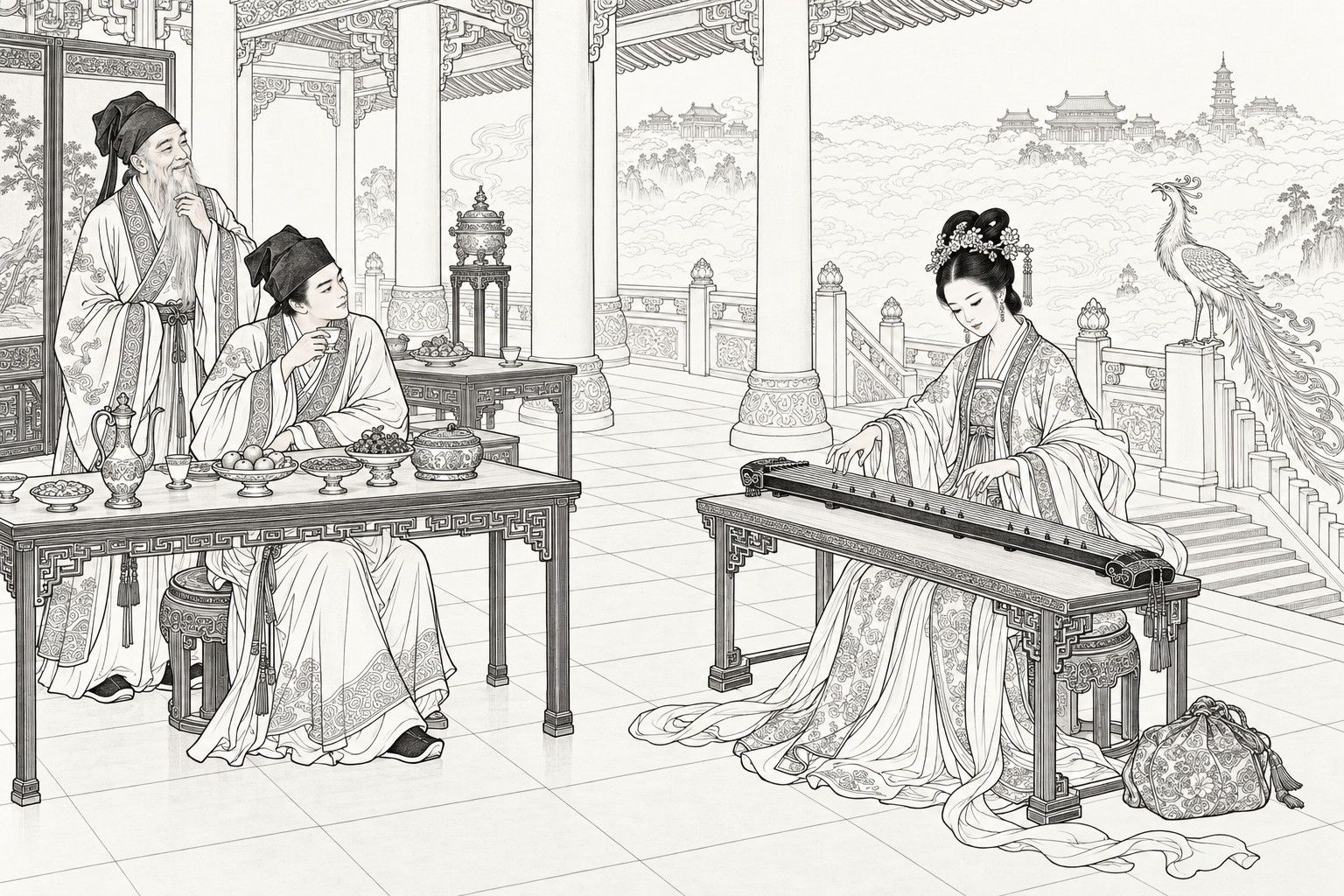
王勉,字黽齋,靈山人。有才思,屢冠文場,心氣頗高,善誚罵,多所凌折。偶遇一道士,視之曰:「子相極貴,然被『輕薄孽』折除幾盡矣。以子智慧,若反身修道,尚可登仙籍。」王嗤曰:「福澤誠不可知,然世上豈有仙人!」道士曰:「子何見之卑?無他求,即我便是仙耳。」王乃益笑其誣。道士曰:「我何足異。能從我去,真仙數十,可立見之。」問:「在何處?」曰:「咫尺耳。」遂以杖夾股間,即以一頭授生,令如己狀。囑合眼,呵曰:「起!」覺杖粗如五斗囊,凌空翕飛,潛捫之,鱗甲齒齒焉。駭懼,不敢復動。移時,又呵曰:「止!」即抽杖去,落巨宅中,重樓延閣,類帝王居。有臺高丈餘,臺上殿十一楹,弘麗無比。道士曳客上,即命童子設筵招賓。殿上列數十筵,鋪張炫目。道士易盛服以伺。少頃,諸客自空中來,所騎,或龍、或虎、或鸞鳳,不一類。又各攜樂器。有女子,有丈夫,有赤其兩足。中獨一麗者,跨彩鳳,宮樣妝束;有侍兒代抱樂具,長五尺以來,非琴非瑟,不知其名。酒既行,珍肴雜錯,入口甘芳,並異常饈。王默然寂坐,惟目注麗者,然心愛其人,而又欲聞其樂,竊恐其終不一彈。酒闌,一叟倡言曰:「蒙崔真人雅召,今日可云盛會,自宜盡懽。請以器之同者,共隊為曲。」於是各合配旅。絲竹之聲,響徹雲漢。獨有跨鳳者,樂伎無偶。群聲既歇,侍兒始啟繡囊,橫陳几上。女乃舒玉腕,如搊箏狀,其亮數倍於琴,烈足開胸,柔可蕩魄。彈半炊許,合殿寂然,無有欬者。既闋,鏗爾一聲,如擊清磬。共贊曰:「雲和夫人絕技哉!」大眾皆起告別,鶴唳龍吟,一時並散。道士設寶榻錦衾,備生寢處。王初睹麗人,心情已動;聞樂之後,涉想尤勞。念己才調,自合芥拾青紫,富貴後何求弗得。頃刻百緒,亂如蓬麻。道士似已知之,謂曰:「子前身與我同學,後緣意念不堅,遂墜塵網。僕不自他於君,實欲拔出惡濁;不料迷晦已深,夢夢不可提悟。今當送君行。未必無復見之期,然作天仙須再劫矣。」遂指階下長石,令閉目坐,堅囑無視。已,乃以鞭驅石。石飛起,風聲灌耳,不知所行幾許。
王勉,字黾斋,灵山人。有才思,屡冠文场,心气颇高,善诮骂,多所凌折。偶遇一道士,视之曰:「子相极贵,然被『轻薄孽』折除几尽矣。以子智慧,若反身修道,尚可登仙籍。」王嗤曰:「福泽诚不可知,然世上岂有仙人!」道士曰:「子何见之卑?无他求,即我便是仙耳。」王乃益笑其诬。道士曰:「我何足异。能从我去,真仙数十,可立见之。」问:「在何处?」曰:「咫尺耳。」遂以杖夹股间,即以一头授生,令如己状。嘱合眼,呵曰:「起!」觉杖粗如五斗囊,凌空翕飞,潜扪之,鳞甲齿齿焉。骇惧,不敢复动。移时,又呵曰:「止!」即抽杖去,落巨宅中,重楼延阁,类帝王居。有台高丈余,台上殿十一楹,弘丽无比。道士曳客上,即命童子设筵招宾。殿上列数十筵,铺张炫目。道士易盛服以伺。少顷,诸客自空中来,所骑,或龙、或虎、或鸾凤,不一类。又各携乐器。有女子,有丈夫,有赤其两足。中独一丽者,跨彩凤,宫样妆束;有侍儿代抱乐具,长五尺以来,非琴非瑟,不知其名。酒既行,珍肴杂错,入口甘芳,并异常馐。王默然寂坐,惟目注丽者,然心爱其人,而又欲闻其乐,窃恐其终不一弹。酒阑,一叟倡言曰:「蒙崔真人雅召,今日可云盛会,自宜尽懽。请以器之同者,共队为曲。」于是各合配旅。丝竹之声,响彻云汉。独有跨凤者,乐伎无偶。群声既歇,侍儿始启绣囊,横陈几上。女乃舒玉腕,如搊筝状,其亮数倍于琴,烈足开胸,柔可荡魄。弹半炊许,合殿寂然,无有欬者。既阕,铿尔一声,如击清磬。共赞曰:「云和夫人绝技哉!」大众皆起告别,鹤唳龙吟,一时并散。道士设宝榻锦衾,备生寝处。王初睹丽人,心情已动;闻乐之后,涉想尤劳。念己才调,自合芥拾青紫,富贵后何求弗得。顷刻百绪,乱如蓬麻。道士似已知之,谓曰:「子前身与我同学,后缘意念不坚,遂坠尘网。仆不自他于君,实欲拔出恶浊;不料迷晦已深,梦梦不可提悟。今当送君行。未必无复见之期,然作天仙须再劫矣。」遂指阶下长石,令闭目坐,坚嘱无视。已,乃以鞭驱石。石飞起,风声灌耳,不知所行几许。
Wang Mian, styled Mianzhai, was a man of Lingshan. He was gifted and quick-witted and had often come first in the examination halls. He was very proud, fond of sneering and abuse, and put a great many people down. Once he happened to meet a Daoist, who looked at him and said, “Your face shows the highest nobility, but the ‘karma of frivolity’ has worn it almost all away. With your wits, if you turned back and cultivated the Way, you could still get your name on the register of immortals.” Wang sneered. “My fortune I truly cannot know. But how can there be immortals in this world?” “How low your view is!” said the Daoist. “Look no further. I myself am an immortal.” At this Wang laughed all the more at the man’s lies. “I am nothing remarkable,” said the Daoist. “Come with me, and you can see dozens of true immortals at once.” “Where are they?” “Only a step away.” He put his staff between his thighs, handed Wang the other end and told him to do as he did. He told him to shut his eyes and shouted, “Rise!” Wang felt the staff grow as thick as a five-peck sack and soar off into the air. He felt it stealthily: it was covered with row upon row of scales. He was terrified and did not dare move again. After a while the Daoist shouted again, “Stop!” He pulled the staff away, and they came down in a huge mansion, tier on tier of towers and long galleries, like an emperor’s dwelling. There was a terrace more than ten feet high, with a hall of eleven bays on it, grand and splendid beyond compare. The Daoist pulled his guest up and at once had a boy set out a feast and invite the guests. Dozens of tables were laid in the hall, dazzlingly arrayed. The Daoist changed into formal dress and waited. Presently the guests came through the air. Some rode dragons, some tigers, some luan birds and phoenixes, of various kinds. Each carried a musical instrument. There were women and men; some went barefoot. Among them was one beauty above all, who rode a phoenix of many colours and was dressed in palace fashion. A maid carried her instrument for her. It was more than five feet long, neither zither nor harp, and Wang did not know its name. The wine went round, with rare delicacies of every kind, sweet and fragrant in the mouth, all unlike ordinary food. Wang sat silent, his eyes only on the beauty. He was taken with her, and he also longed to hear her play, and secretly feared she would never play a note. When the wine was nearly done, an old man spoke up: “Perfected Cui has kindly invited us, and today may truly be called a great gathering. We ought to enjoy ourselves to the full. I propose that those whose instruments are alike should join together and play.” So they all paired off into groups. The sound of strings and pipes rang up to the Milky Way. Only the lady who rode the phoenix had no partner for her instrument. When all the others had fallen silent, her maid at last opened an embroidered bag and laid the instrument across a low table. The lady stretched out her jade-white wrists, as though plucking a zither. Its tone was several times as bright as a zither’s; at its fiercest it could burst the breast open, at its gentlest it could melt the soul. She played for about half the time it takes to cook a meal, and the whole hall was hushed, without a single cough. When she finished there was a clear ring, like the striking of a chime stone. All praised her together: “Superb, Lady Yunhe!” Then they all rose and took their leave. With cries of cranes and roars of dragons, they scattered all at once. The Daoist had a precious couch and brocade quilts set out for Wang to sleep on. From his first sight of the beauty Wang’s heart had been stirred; since hearing her music, his fancies had grown more fevered. He thought that with his talents he would pick up the blue and purple sashes of high office as easily as mustard seeds, and once he was rich and noble, what could he not have? In a moment a hundred thoughts were tangled in his head like hemp. The Daoist seemed to know already. “In your former life you studied with me,” he said, “but later your will was not firm, and you fell into the net of the dusty world. I do not count you a stranger, and I truly wanted to pull you out of the filth. I never thought your delusion was so deep, so dark and muddled that you cannot be woken. Now I must send you on your way. We may yet meet again, but to become a heavenly immortal you will need another kalpa.” He pointed to a long stone at the foot of the steps and had Wang sit on it with his eyes shut, warning him firmly not to look. Then he drove the stone with a whip. The stone flew up. The wind roared in Wang’s ears, and he had no idea how far he travelled.
忽念下方景界,未審何似;隱將兩眸微開一線,則見大海茫茫,渾無邊際。大懼,即復合,而身已隨石俱墮,砰然一聲,汨沒若鷗。幸夙近海,略諸泅浮。聞人鼓掌曰:「美哉跌乎!」危殆方急,一女子援登舟上,且曰:「吉利,吉利,秀才『中溼』矣!」視之,年可十六七,顏色豔麗。王出水寒慄,求火燎之。女子言:「從我至家,當為處置。苟適意,勿相忘。」王曰:「是何言哉!我中原才子,偶遭狼狽,過此圖以身報,何但不忘!」女子以棹催艇,疾如風雨,俄已近岸。於艙中攜所采蓮花一握,導與俱去。半里許入村,見朱戶南開,進歷數重門,女子先馳入。少間,一丈夫出,是四十許人,揖王升階,命侍者取冠袍襪履,為王更衣。既,詢邦族。王曰:「某非相欺,才名略可聽聞。崔真人切切眷戀,招昇天闕。自分功名反掌,以故不願棲隱。」丈夫起敬曰:「此名仙人島,遠絕人世。文若,姓桓。世居幽僻,何幸得近名流。」因而殷懃置酒。又從容而言曰:「僕有二女,長者芳雲,年十六矣,祗今未遭良匹。欲以奉侍高人,如何?」王意必采蓮人,離席稱謝。桓命於鄰黨中,招二三齒德來。顧左右,立喚女郎。無何,異香濃射,美姝十餘輩,擁芳雲出,光豔明媚,若芙蕖之映朝日。拜已,即坐,群姝列侍,則采蓮人亦在焉。酒數行,一垂髫女自內出,僅十餘齡,而姿態秀曼,笑依芳雲肘下,秋波流動。桓曰:「女子不在閨中,出作何務?」乃顧客曰:「此綠雲,即僕幼女。頗惠,能記典、墳矣。」因令對客吟詩。遂誦竹枝詞三章,嬌婉可聽。便令傍姊隅坐。桓因謂:「王郎天才,宿搆必富,可使鄙人得聞教乎?」王即慨然誦近體一作,顧盼自雄,中二句云:「一身剩有鬚眉在,小飲能令塊磊消。」鄰叟再三誦之。芳雲低告曰:「上句是孫行者離火雲洞,下句是豬八戒過子母河也。」一座撫掌。桓請其他。王述水鳥詩云:「瀦頭鳴格磔,……」忽忘下句。甫一沉吟,芳雲向妹咕咕耳語,遂掩口而笑。綠雲告父曰:「渠為姊夫續下句矣。云:『狗腚響弸巴。』」合席粲然。王有慙色。桓顧芳雲,怒之以目。王色稍定,桓復請其文藝。王意世外人必不知八股業,乃炫其冠軍之作,題為孝哉閔子騫二句,破云:「聖人贊大賢之孝……」綠雲顧父曰:「聖人無字門人者,『孝哉……』一句,即是人言。」王聞之,意興索然。桓笑曰:「童子何知!不在此,只論文耳。」王乃復誦。每數句,姊妹必相耳語,似是月旦之詞,但嚅囁不可辨。王誦至佳處,兼述文宗評語,有云:「字字痛切。」綠雲告父曰:「姊云:『宜刪「切」字。』」眾都不解。桓恐其語嫚,不敢研詰。王誦畢,又述總評,有云:「羯鼓一撾,則萬花齊落。」芳雲又掩口語妹,兩人皆笑不可仰。綠雲又告曰:「姊云:『羯鼓當是四撾。』」眾又不解。綠雲啟口欲言,芳雲忍笑訶之曰:「婢子敢言,打煞矣!」眾大疑,互有猜論。綠雲不能忍,乃曰:「去『切』字,言『痛』則『不通』。鼓四撾,其聲云『不通又不通』也。」眾大笑。桓怒訶之。因而自起泛卮,謝過不遑。王初以才名自詡,目中實無千古;至此,神氣沮喪,徒有汗淫。桓諛而慰之曰:「適有一言,請席中屬對焉:『王子身邊,無有一點不似玉。』」眾未措想,綠雲應聲曰:「黽翁頭上,再著半夕即成龜。」芳雲失笑,呵手扭脅肉數四。綠雲解脫而走,回顧曰:「何預汝事!汝罵之頻頻,不以為非;寧他人一句,便不許耶?」桓咄之,始笑而去。鄰叟辭別。諸婢導夫妻入內寢,燈燭屏榻,陳設精備。又視洞房中,牙籤滿架,靡書不有。略致問難,響應無窮。王至此,始覺望洋堪羞。女喚「明璫」,則采蓮者趨應,由是始識其名。屢受誚辱,自恐不見重於閨闥;幸芳雲語言雖虐,而房幃之內,猶相愛好。王安居無事,輒復吟哦。女曰:「妾有良言,不知肯嘉納否?」問:「何言?」曰:「從此不作詩,亦藏拙之一道也。」王大慚,遂絕筆。久之,與明璫漸狎。告芳雲曰:「明璫與小生有拯命之德,願少假以辭色。」芳雲乃即許之。每作房中之戲,招與共事,兩情益篤,時色授而手語之。芳雲微覺,責詞重疊;王惟喋喋,強自解免。
忽念下方景界,未审何似;隐将两眸微开一线,则见大海茫茫,浑无边际。大惧,即复合,而身已随石俱堕,砰然一声,汨没若鸥。幸夙近海,略诸泅浮。闻人鼓掌曰:「美哉跌乎!」危殆方急,一女子援登舟上,且曰:「吉利,吉利,秀才『中湿』矣!」视之,年可十六七,颜色艳丽。王出水寒栗,求火燎之。女子言:「从我至家,当为处置。苟适意,勿相忘。」王曰:「是何言哉!我中原才子,偶遭狼狈,过此图以身报,何但不忘!」女子以棹催艇,疾如风雨,俄已近岸。于舱中携所采莲花一握,导与俱去。半里许入村,见朱户南开,进历数重门,女子先驰入。少间,一丈夫出,是四十许人,揖王升阶,命侍者取冠袍袜履,为王更衣。既,询邦族。王曰:「某非相欺,才名略可听闻。崔真人切切眷恋,招升天阙。自分功名反掌,以故不愿栖隐。」丈夫起敬曰:「此名仙人岛,远绝人世。文若,姓桓。世居幽僻,何幸得近名流。」因而殷懃置酒。又从容而言曰:「仆有二女,长者芳云,年十六矣,祗今未遭良匹。欲以奉侍高人,如何?」王意必采莲人,离席称谢。桓命于邻党中,招二三齿德来。顾左右,立唤女郎。无何,异香浓射,美姝十余辈,拥芳云出,光艳明媚,若芙蕖之映朝日。拜已,即坐,群姝列侍,则采莲人亦在焉。酒数行,一垂髫女自内出,仅十余龄,而姿态秀曼,笑依芳云肘下,秋波流动。桓曰:「女子不在闺中,出作何务?」乃顾客曰:「此绿云,即仆幼女。颇惠,能记典、坟矣。」因令对客吟诗。遂诵竹枝词三章,娇婉可听。便令傍姊隅坐。桓因谓:「王郎天才,宿搆必富,可使鄙人得闻教乎?」王即慨然诵近体一作,顾盼自雄,中二句云:「一身剩有须眉在,小饮能令块磊消。」邻叟再三诵之。芳云低告曰:「上句是孙行者离火云洞,下句是猪八戒过子母河也。」一座抚掌。桓请其他。王述水鸟诗云:「潴头鸣格磔,……」忽忘下句。甫一沉吟,芳云向妹咕咕耳语,遂掩口而笑。绿云告父曰:「渠为姊夫续下句矣。云:『狗腚响弸巴。』」合席粲然。王有慙色。桓顾芳云,怒之以目。王色稍定,桓复请其文艺。王意世外人必不知八股业,乃炫其冠军之作,题为孝哉闵子骞二句,破云:「圣人赞大贤之孝……」绿云顾父曰:「圣人无字门人者,『孝哉……』一句,即是人言。」王闻之,意兴索然。桓笑曰:「童子何知!不在此,只论文耳。」王乃复诵。每数句,姊妹必相耳语,似是月旦之词,但嚅嗫不可辨。王诵至佳处,兼述文宗评语,有云:「字字痛切。」绿云告父曰:「姊云:『宜删「切」字。』」众都不解。桓恐其语嫚,不敢研诘。王诵毕,又述总评,有云:「羯鼓一挝,则万花齐落。」芳云又掩口语妹,两人皆笑不可仰。绿云又告曰:「姊云:『羯鼓当是四挝。』」众又不解。绿云启口欲言,芳云忍笑诃之曰:「婢子敢言,打煞矣!」众大疑,互有猜论。绿云不能忍,乃曰:「去『切』字,言『痛』则『不通』。鼓四挝,其声云『不通又不通』也。」众大笑。桓怒诃之。因而自起泛卮,谢过不遑。王初以才名自诩,目中实无千古;至此,神气沮丧,徒有汗淫。桓谀而慰之曰:「适有一言,请席中属对焉:『王子身边,无有一点不似玉。』」众未措想,绿云应声曰:「黾翁头上,再着半夕即成龟。」芳云失笑,呵手扭胁肉数四。绿云解脱而走,回顾曰:「何预汝事!汝骂之频频,不以为非;宁他人一句,便不许耶?」桓咄之,始笑而去。邻叟辞别。诸婢导夫妻入内寝,灯烛屏榻,陈设精备。又视洞房中,牙签满架,靡书不有。略致问难,响应无穷。王至此,始觉望洋堪羞。女唤「明珰」,则采莲者趋应,由是始识其名。屡受诮辱,自恐不见重于闺闼;幸芳云语言虽虐,而房帏之内,犹相爱好。王安居无事,辄复吟哦。女曰:「妾有良言,不知肯嘉纳否?」问:「何言?」曰:「从此不作诗,亦藏拙之一道也。」王大惭,遂绝笔。久之,与明珰渐狎。告芳云曰:「明珰与小生有拯命之德,愿少假以辞色。」芳云乃即许之。每作房中之戏,招与共事,两情益笃,时色授而手语之。芳云微觉,责词重叠;王惟喋喋,强自解免。
Suddenly he wondered what the world below looked like, and secretly opened his eyes a crack. He saw the vast sea spread out without end. Terrified, he shut them again at once — but he was already falling with the stone. With a great crash he went under like a gull. Luckily he had always lived near the sea and could swim a little. He heard someone clap and say, “What a lovely fall!” Just as his danger was at its worst, a girl pulled him up into her boat, saying, “Good luck, good luck! The licentiate has passed — with a splash!” He looked at her: she was perhaps sixteen or seventeen, and very lovely. Wang came out of the water shivering with cold and asked for a fire to dry himself. “Come home with me,” the girl said, “and something will be done for you. If it suits you, don’t forget me.” “What are you saying!” said Wang. “I am a man of talent from the Central Plain, who has met with a mishap. After this I mean to repay you with my whole self — far more than not forgetting!” The girl drove the boat with her oar, swift as wind and rain, and soon they were near the shore. She took a handful of the lotus flowers she had picked from the cabin and led him off with her. Half a li on they came into a village, where he saw a red gate facing south. They went in through several gates, and the girl ran in ahead. A little later a man of about forty came out. He bowed Wang up the steps and had servants bring a cap, a robe, socks and shoes, and change Wang’s clothes. That done, he asked his country and family. “I would not deceive you,” said Wang. “My name for talent is not entirely unheard of. Perfected Cui was so devoted to me that he invited me up to the gates of Heaven. But I reckoned rank and office were mine for the turn of a hand, and so I did not care to live in seclusion.” The man rose in respect. “This place is called the Isle of Immortals, far cut off from the world of men. My name is Wenruo, my surname Huan. My family has lived in this remote place for generations. What fortune to come near so famous a man!” And he set out wine most attentively. Then, at his ease, he said, “I have two daughters. The elder, Fangyun, is sixteen, and has not yet met a good match. I would like to give her to wait on a man of distinction. What do you say?” Wang thought it must be the girl who had picked the lotuses, and left his seat to thank him. Huan had two or three elders of age and virtue invited from among the neighbours. He turned to his attendants and at once had the young lady called. Before long a rich fragrance poured out, and ten or more beautiful girls came out escorting Fangyun. She was radiant and lovely, like a lotus shining in the morning sun. She bowed and sat down, and the girls stood in attendance; the lotus picker was among them. After a few rounds of wine, a girl with her hair still hanging loose came out from the inner rooms. She was only ten or so, but graceful and lovely; she leaned laughing at Fangyun’s elbow, her bright eyes darting. “A girl not in her own room — what are you doing out here?” said Huan. And he turned to his guest: “This is Lüyun, my younger daughter. She is quite clever, and can already recite the most ancient classics.” He had her recite poems for the guest, and she chanted three Bamboo Branch songs, sweet and charming to hear. Then he had her sit in the corner beside her sister. Huan said, “Master Wang, with your genius you must have a rich store of poems already made. May I have the benefit of hearing them?” Wang readily recited a poem in the modern style, looking about him with great self-satisfaction. Its middle couplet ran: “Of all my body, only beard and brows remain; a little wine can melt my lumps away.” An old neighbour repeated it again and again. Fangyun said in a low voice, “The first line is Monkey leaving Fire-Cloud Cave; the second is Pigsy crossing the Mother-and-Child River.” The whole table clapped. Huan asked for another. Wang recited a poem on a water bird: “At the pool’s head it cries ge-zhe…” — and suddenly forgot the next line. He had barely paused to think when Fangyun whispered in her sister’s ear, then covered her mouth and laughed. Lüyun told her father, “She has finished it for her brother-in-law. It goes: ‘At the dog’s rear it goes peng-ba.’” The whole table burst out laughing. Wang looked ashamed. Huan turned to Fangyun and glared at her angrily. When Wang had composed himself a little, Huan asked to hear his prose. Wang supposed that people outside the world would know nothing of the eight-legged essay, so he showed off the essay that had won him first place. Its topic was the two lines beginning ‘How filial was Min Ziqian!’, and its opening ran: “The Sage praises the filial piety of a great worthy…” Lüyun turned to her father. “The Sage never calls a disciple by his courtesy name. ‘How filial…’ is what other people said.” Hearing this, Wang lost all heart. Huan laughed. “What does a child know! That isn’t the point. Let us just consider the writing.” So Wang went on reciting. Every few sentences the sisters whispered to each other, as if passing judgment, but their murmurs could not be made out. When Wang came to a fine passage, he quoted the examiner’s comment as well: “Every word painfully incisive.” Lüyun told her father, “Sister says, ‘Better delete incisive.’” None of them understood. Huan feared it was something rude and did not dare press her. When Wang had finished reciting, he quoted the general comment too: “One stroke of the Jie drum, and ten thousand flowers fall together.” Again Fangyun covered her mouth and spoke to her sister, and both laughed so hard they could not sit up. Lüyun told them again, “Sister says, ‘The Jie drum should have four strokes.’” Again no one understood. Lüyun opened her mouth to explain, but Fangyun, holding back her laughter, scolded her: “Dare to say it, you little wretch, and I’ll beat you to death!” Everyone was thoroughly puzzled, and they traded guesses. Lüyun could not hold back. “Take away incisive, and ‘painful’ means ‘it doesn’t get through.’ Four strokes of the drum go ‘butong, butong’ — ‘it doesn’t get through, and it doesn’t get through again!’” Everyone laughed aloud. Huan scolded her angrily. Then he rose himself to fill the cups, apologizing over and over. At first Wang had prided himself on his name for talent, and truly thought no one in all the ages his equal. Now his spirit was crushed, and he could only sweat. Huan flattered and comforted him: “I have a line just now. Let someone at the table match it: ‘At Wang’s side, there is not a single dot that is not jade.’” Before anyone could think, Lüyun answered at once: “On Old Mian’s head, add half an evening and he becomes a turtle.” Fangyun burst out laughing, blew on her fingers and pinched her sister’s side several times. Lüyun wriggled free and ran, looking back to say, “What business is it of yours? You’ve mocked him over and over and saw no harm in it. Is no one else allowed a single line?” Huan shouted at her, and only then did she go off laughing. The old neighbours took their leave. Maids led husband and wife into the inner bedroom. Lamps and candles, screens and bed, everything was finely arranged. In the bridal chamber he saw shelves full of ivory-tagged scrolls; there was no book they lacked. He put a few hard questions to her, and the answers came back without end. Only now did Wang begin to feel small and ashamed, like the river gazing out at the ocean. Fangyun called, “Mingdang!” and the girl who had picked the lotuses hurried to answer, and that was how he first learned her name. Mocked and humiliated so often, he was afraid he would not be respected in the women’s rooms; but luckily, though Fangyun’s tongue was cruel, within the bed curtains she was loving. Wang lived at ease with nothing to do, and kept falling back into chanting verses. “I have some good advice,” Fangyun said. “I wonder if you will be willing to take it?” “What is it?” “Stop writing poetry from now on. That too is a way of hiding your clumsiness.” Wang was deeply ashamed, and gave up writing altogether. As time went on, he and Mingdang grew more and more familiar. He told Fangyun, “Mingdang saved my life. I wish you would be a little kinder to her.” Fangyun agreed at once. Whenever they played their bedroom games, she called Mingdang to join in, and the feeling between Wang and Mingdang grew stronger; often they spoke with their eyes and talked with their hands. Fangyun began to notice and scolded him again and again; Wang could only babble, struggling to excuse himself.