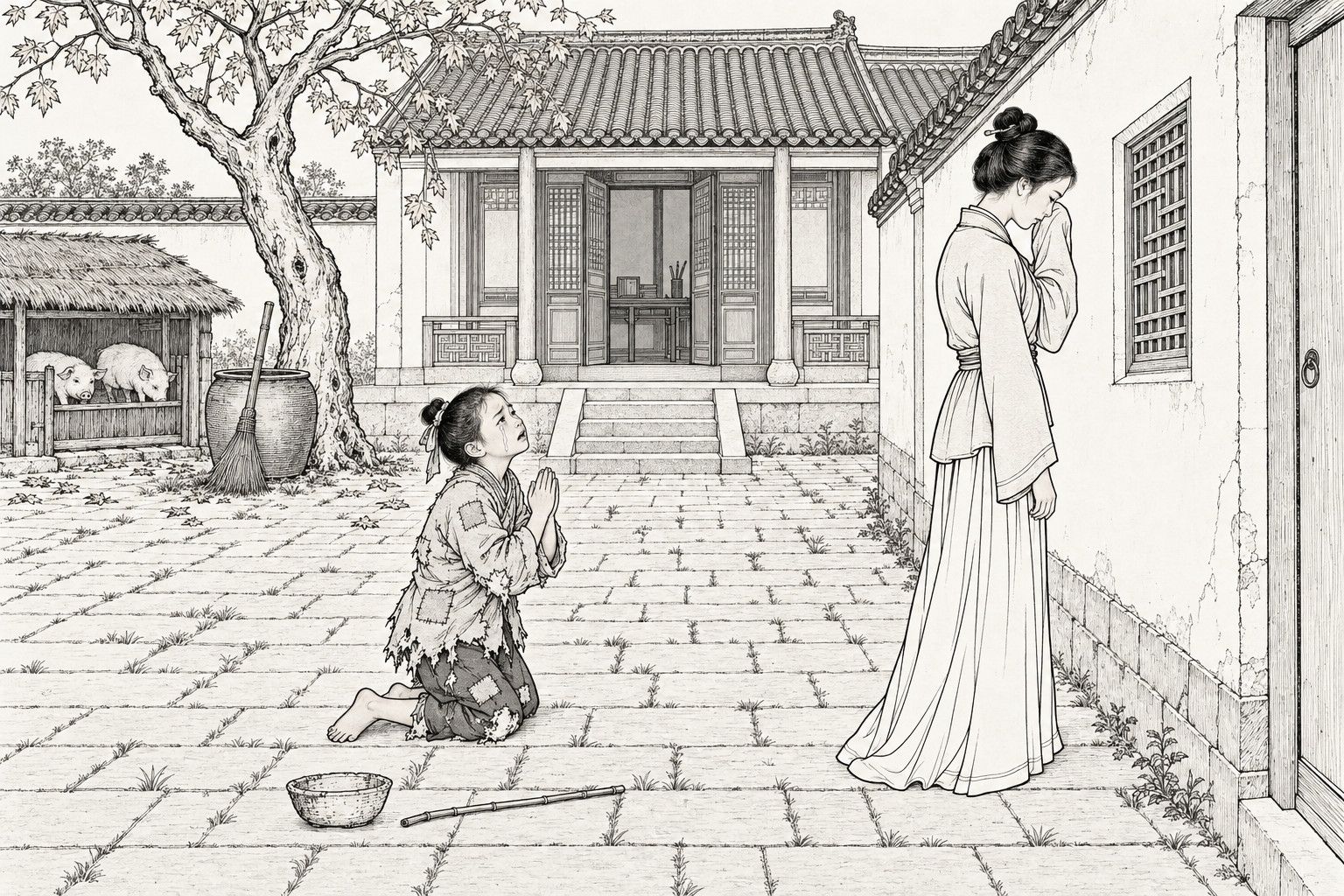
細柳娘,中都之士人女也。或以其腰嫖嬝可愛,戲呼之「細柳」云。柳少慧,解文字,喜讀相人書。而生平簡默,未嘗言人臧否;但有問名者,必求一親窺其人。閱人甚多,俱未可,而年十九矣。父母怒之曰:「天下迄無良匹,汝將以丫角老耶?」女曰:「我實欲以人勝天;顧久而不就,亦吾命也。今而後,請惟父母之命是聽。」時有高生者,世家名士,聞細柳之名,委禽焉。既醮,夫婦甚得。生前室遺孤,小字長福,時五歲,女撫養周至。女或歸寧,福輒號啼從之,呵遣所不能止。年餘,女產一子,名之長怙。生問名字之義,答言:「無他,但望其長依膝下耳。」女於女紅疏略,常不留意;而於畝之東南,稅之多寡,按籍而問,惟恐不詳。久之,謂生曰:「家中事請置勿顧,待妾自為之,不知可當家否?」生如言,半載而家無廢事,生亦賢之。一日,生赴鄰村飲酒,適有追逋賦者,打門而誶;遣奴慰之,弗去。乃趣僮召生歸。隸既去,生笑曰:「細柳,今始知慧女不若癡男耶?」女聞之,俯首而哭。生驚挽而勸之,女終不樂。生不忍以家政累之,仍欲自任,女又不肯。晨興夜寐,經紀彌勤。每先一年,即儲來歲之賦,以故終歲未嘗見催租者一至其門;又以此法計衣食,由此用度益紓。於是生乃大喜,嘗戲之曰:「細柳何細哉:眉細、腰細、凌波細,且喜心思更細。」女對曰:「高郎誠高矣:品高、志高、文字高,但願壽數尤高。」村中有貨美材者,女不惜重直致之;價不能足,又多方乞貸於戚里。生以其不急之物,固止之,卒弗聽。蓄之年餘,富室有喪者,以倍貲贖諸其門。生因利而謀諸女,女不可。問其故,不語;再問之,熒熒欲涕。心異之,然不忍重拂焉,乃罷。又踰歲,生年二十有五,女禁不令遠遊;歸稍晚,僮僕招請者,相屬於道。於是同人咸戲謗之。一日,生如友人飲,覺體不快而歸,至中途墮馬,遂卒。時方溽暑,幸衣衾皆所夙備。里中始共服細娘智。福年十歲,始學為文。父既歿,嬌惰不肯讀,輒亡去從牧兒遨。譙訶不改,繼以夏楚,而頑冥如故。母無奈之,因呼而諭之曰:「既不願讀,亦復何能相強?但貧家無冗人,可更若衣,便與僮僕共操作。不然,鞭撻勿悔!」於是衣以敗絮,使牧豕;歸則自掇陶器,與諸僕啗飯粥。數日,苦之,泣跪庭下,願仍讀。母返身向壁,置不聞。不得已,執鞭啜泣而出。殘秋向盡,桁無衣,足無履,冷雨沾濡,縮頭如丐。里人見而憐之,納繼室者,皆引細娘為戒,嘖有煩言。女亦稍稍聞之,而漠不為意。福不堪其苦,棄豕逃去,女亦任之,殊不追問。積數月,乞食無所,憔悴自歸;不敢遽入,哀求鄰媼往白母。女曰:「若能受百杖,可來見;不然,早復去。」福聞之,驟入,痛哭願受杖。母問:「今知改悔乎?」曰:「悔矣。」曰:「既知悔,無須撻楚,可安分牧豕,再犯不宥!」福大哭曰:「願受百杖,請復讀。」女不聽,鄰嫗慫恿之,始納焉。濯髮授衣,令與弟怙同師。勤身銳慮,大異往昔,三年遊泮。中丞楊公,見其文而器之,月給常廩,以助燈火。怙最鈍,讀數年不能記姓名。母令棄卷而農。怙遊閒憚於作苦。母怒曰:「四民各有本業,既不能讀,又不能耕,寧不溝瘠死耶?」立杖之。由是率奴輩耕作,一朝晏起,則詬罵從之;而衣服飲食,母輒以美者歸兄。怙雖不敢言,而心竊不能平。農工既畢,母出貲使學負販。怙淫賭,入手喪敗,詭托盜賊運數,以欺其母。母覺之,杖責瀕死。福長跪哀乞,願以身代,怒始解。自是一出門,母輒探察之。怙行稍斂,而非其心之所得已也。一日,請母,將從諸賈入洛;實借遠遊,以快所欲,而中心惕惕,惟恐不遂所請。母聞之,殊無疑慮,即出碎金三十兩,為之具裝;末又以鋌金一枚付之,曰:「此乃祖宦囊之遺,不可用去,聊以壓裝,備急可耳。且汝初學跋涉,亦不敢望重息,只此三十金得無虧負足矣。」臨行又囑之。怙諾而出,欣欣意自得。至洛,謝絕客侶,宿名娼李姬之家。凡十餘夕,散金漸盡。自以巨金在囊,初不意空匱在慮;及取而斫之,則偽金耳。大駭,失色。李媼見其狀,冷語侵客。怙心不自安,然囊空無所向往,猶翼姬念夙好,不即絕之。俄有二人握索入,驟縶項領。驚懼不知所為。哀問其故,則姬已竊偽金去首公庭矣。至官,不能置辭,梏掠幾死。收獄中,又無資斧,大為獄吏所虐,乞食於囚,苟延餘息。初,怙之行也,母謂福曰:「記取廿日後,當遣汝之洛。我事煩,恐忽忘之。」福不知所謂,黯然欲悲,不敢復請而退。過二十日而問之。歎曰:「汝弟今日之浮蕩,猶汝昔日之廢學也。我不冒惡名,汝何以有今日?人皆謂我忍,但淚浮枕簟,而人不知耳!」因泣下。福侍立敬聽,不敢研詰。泣已,乃曰:「汝弟蕩心不死,故授之偽金以挫折之,今度已在縲絏中矣。中丞待汝厚,汝往求焉,可以脫其死難,而生其愧悔也。」福立刻而發;比入洛,則弟被逮三日矣。即獄中而望之,怙奄然面目如鬼,見兄涕不可仰。福亦哭。時福為中丞所寵異,故遐邇皆知其名。邑宰知為怙兄,急釋之。怙至家,猶恐母怒,膝行而前。母顧曰:「汝願遂耶?」怙零涕不敢復作聲,福亦同跪,母始叱之起。由是痛自悔,家中諸務,經理維勤;即偶惰,母亦不呵問之。凡數月,並不與言商賈,意欲自請而不敢,以意告兄。母聞而喜,並力質貸而付之,半載而息倍焉。是年,福秋捷,又三年登第;弟貨殖累巨萬矣。邑有客洛者,窺見太夫人,年四旬,猶若三十許人,而衣妝樸素,類常家云。
细柳娘,中都之士人女也。或以其腰嫖嬝可爱,戏呼之「细柳」云。柳少慧,解文字,喜读相人书。而生平简默,未尝言人臧否;但有问名者,必求一亲窥其人。阅人甚多,俱未可,而年十九矣。父母怒之曰:「天下迄无良匹,汝将以丫角老耶?」女曰:「我实欲以人胜天;顾久而不就,亦吾命也。今而后,请惟父母之命是听。」时有高生者,世家名士,闻细柳之名,委禽焉。既醮,夫妇甚得。生前室遗孤,小字长福,时五岁,女抚养周至。女或归宁,福辄号啼从之,呵遣所不能止。年余,女产一子,名之长怙。生问名字之义,答言:「无他,但望其长依膝下耳。」女于女红疏略,常不留意;而于亩之东南,税之多寡,按籍而问,惟恐不详。久之,谓生曰:「家中事请置勿顾,待妾自为之,不知可当家否?」生如言,半载而家无废事,生亦贤之。一日,生赴邻村饮酒,适有追逋赋者,打门而谇;遣奴慰之,弗去。乃趣僮召生归。隶既去,生笑曰:「细柳,今始知慧女不若痴男耶?」女闻之,俯首而哭。生惊挽而劝之,女终不乐。生不忍以家政累之,仍欲自任,女又不肯。晨兴夜寐,经纪弥勤。每先一年,即储来岁之赋,以故终岁未尝见催租者一至其门;又以此法计衣食,由此用度益纾。于是生乃大喜,尝戏之曰:「细柳何细哉:眉细、腰细、凌波细,且喜心思更细。」女对曰:「高郎诚高矣:品高、志高、文字高,但愿寿数尤高。」村中有货美材者,女不惜重直致之;价不能足,又多方乞贷于戚里。生以其不急之物,固止之,卒弗听。蓄之年余,富室有丧者,以倍赀赎诸其门。生因利而谋诸女,女不可。问其故,不语;再问之,荧荧欲涕。心异之,然不忍重拂焉,乃罢。又逾岁,生年二十有五,女禁不令远游;归稍晚,僮仆招请者,相属于道。于是同人咸戏谤之。一日,生如友人饮,觉体不快而归,至中途堕马,遂卒。时方溽暑,幸衣衾皆所夙备。里中始共服细娘智。福年十岁,始学为文。父既殁,娇惰不肯读,辄亡去从牧儿遨。谯诃不改,继以夏楚,而顽冥如故。母无奈之,因呼而谕之曰:「既不愿读,亦复何能相强?但贫家无冗人,可更若衣,便与僮仆共操作。不然,鞭挞勿悔!」于是衣以败絮,使牧豕;归则自掇陶器,与诸仆啗饭粥。数日,苦之,泣跪庭下,愿仍读。母返身向壁,置不闻。不得已,执鞭啜泣而出。残秋向尽,桁无衣,足无履,冷雨沾濡,缩头如丐。里人见而怜之,纳继室者,皆引细娘为戒,啧有烦言。女亦稍稍闻之,而漠不为意。福不堪其苦,弃豕逃去,女亦任之,殊不追问。积数月,乞食无所,憔悴自归;不敢遽入,哀求邻媪往白母。女曰:「若能受百杖,可来见;不然,早复去。」福闻之,骤入,痛哭愿受杖。母问:「今知改悔乎?」曰:「悔矣。」曰:「既知悔,无须挞楚,可安分牧豕,再犯不宥!」福大哭曰:「愿受百杖,请复读。」女不听,邻妪怂恿之,始纳焉。濯发授衣,令与弟怙同师。勤身锐虑,大异往昔,三年游泮。中丞杨公,见其文而器之,月给常廪,以助灯火。怙最钝,读数年不能记姓名。母令弃卷而农。怙游闲惮于作苦。母怒曰:「四民各有本业,既不能读,又不能耕,宁不沟瘠死耶?」立杖之。由是率奴辈耕作,一朝晏起,则诟骂从之;而衣服饮食,母辄以美者归兄。怙虽不敢言,而心窃不能平。农工既毕,母出赀使学负贩。怙淫赌,入手丧败,诡托盗贼运数,以欺其母。母觉之,杖责濒死。福长跪哀乞,愿以身代,怒始解。自是一出门,母辄探察之。怙行稍敛,而非其心之所得已也。一日,请母,将从诸贾入洛;实借远游,以快所欲,而中心惕惕,惟恐不遂所请。母闻之,殊无疑虑,即出碎金三十两,为之具装;末又以铤金一枚付之,曰:「此乃祖宦囊之遗,不可用去,聊以压装,备急可耳。且汝初学跋涉,亦不敢望重息,只此三十金得无亏负足矣。」临行又嘱之。怙诺而出,欣欣意自得。至洛,谢绝客侣,宿名娼李姬之家。凡十余夕,散金渐尽。自以巨金在囊,初不意空匮在虑;及取而斫之,则伪金耳。大骇,失色。李媪见其状,冷语侵客。怙心不自安,然囊空无所向往,犹翼姬念夙好,不即绝之。俄有二人握索入,骤絷项领。惊惧不知所为。哀问其故,则姬已窃伪金去首公庭矣。至官,不能置辞,梏掠几死。收狱中,又无资斧,大为狱吏所虐,乞食于囚,苟延余息。初,怙之行也,母谓福曰:「记取廿日后,当遣汝之洛。我事烦,恐忽忘之。」福不知所谓,黯然欲悲,不敢复请而退。过二十日而问之。叹曰:「汝弟今日之浮荡,犹汝昔日之废学也。我不冒恶名,汝何以有今日?人皆谓我忍,但泪浮枕簟,而人不知耳!」因泣下。福侍立敬听,不敢研诘。泣已,乃曰:「汝弟荡心不死,故授之伪金以挫折之,今度已在缧絏中矣。中丞待汝厚,汝往求焉,可以脱其死难,而生其愧悔也。」福立刻而发;比入洛,则弟被逮三日矣。即狱中而望之,怙奄然面目如鬼,见兄涕不可仰。福亦哭。时福为中丞所宠异,故遐迩皆知其名。邑宰知为怙兄,急释之。怙至家,犹恐母怒,膝行而前。母顾曰:「汝愿遂耶?」怙零涕不敢复作声,福亦同跪,母始叱之起。由是痛自悔,家中诸务,经理维勤;即偶惰,母亦不呵问之。凡数月,并不与言商贾,意欲自请而不敢,以意告兄。母闻而喜,并力质贷而付之,半载而息倍焉。是年,福秋捷,又三年登第;弟货殖累巨万矣。邑有客洛者,窥见太夫人,年四旬,犹若三十许人,而衣妆朴素,类常家云。
Slender Willow was the daughter of a gentleman-scholar of Zhongdu. Because her waist was so lithe and lovely, people called her Slender Willow (Xiliu) in fun. As a girl she was clever. She could read and write, and she loved books on physiognomy. Yet all her life she was quiet and sparing of words, and never passed judgment on anyone. Only, whenever a family came asking for her hand, she insisted on seeing the man for herself. She looked over a great many and found none acceptable, and she reached nineteen. Her parents were angry. “Is there no good match anywhere in the world? Do you mean to grow old with your hair still in girl’s tufts?” “I truly wanted my own effort to win out over Heaven,” she said. “But I have tried a long while and found no one, and that too must be my fate. From now on I will do as you, my parents, decide.” At that time there was a scholar named Gao, a well-known man of an old family. He heard of Slender Willow and sent the betrothal goose. After the wedding, husband and wife got on very well. Gao’s late first wife had left a son, whose childhood name was Changfu. He was five, and Slender Willow brought him up with every care. Whenever she went home to visit her parents, Fu would howl and cry to go with her, and no scolding could stop him. A year or so later she bore a son and named him Changhu. Gao asked what the name meant. “Nothing in particular,” she said. “I only hope he will long stay at our knees.” She was careless about needlework and paid it little mind; but which way each field lay and how much tax it owed, she went through the registers asking about, afraid only of missing something. After a while she said to Gao, “Please put the household affairs aside and leave them to me. I wonder whether I can run the house?” Gao did as she said. Within half a year nothing in the house was neglected, and Gao too thought her capable. One day, when Gao had gone to a neighbouring village to drink, a man came chasing unpaid taxes, pounding on the gate and cursing. She sent a servant to calm him, but he would not leave, so she hurried a page off to call Gao home. When the runner had gone, Gao laughed. “Slender Willow, now do you see that a clever woman is no match for a foolish man?” Hearing this, she bowed her head and wept. Startled, Gao drew her to him and tried to comfort her, but she stayed unhappy. He could not bear to burden her with the household and wanted to take it back himself, but she would not hear of it. Up early and to bed late, she managed things more diligently than ever. A year ahead each time, she put by the next year’s taxes, so that from one year’s end to the next no tax collector ever came to their gate. She reckoned food and clothing the same way, and from then on their means grew easier and easier. Gao was delighted, and once teased her: “How slender Slender Willow is! Slender brows, slender waist, slender little feet — and, to my joy, a mind finer still.” “My husband Gao is high indeed,” she replied: “high in character, high in purpose, high in letters — I only hope he will be higher still in years.” Someone in the village had a fine coffin for sale. She paid a heavy price for it without a second thought, and when she could not raise the whole sum, she borrowed every way she could from relatives and neighbours. Gao thought it a thing they had no need of yet and tried hard to stop her, but she would not listen. They had kept it a year or so when a rich family suffered a death and came to the door offering twice the price. Gao, seeing the profit, talked it over with her, but she would not agree. He asked why; she said nothing. He asked again, and her eyes brimmed with tears. He thought it strange, but could not bear to cross her again, and let it drop. Another year passed, and Gao turned twenty-five. She forbade him to travel far; if he came home a little late, the servants she sent to fetch him followed one another down the road. His friends all made fun of him for it behind his back. One day Gao went to drink at a friend’s house, felt unwell, and started home. Halfway there he fell from his horse and died. It was the height of the muggy summer; fortunately the grave clothes and shroud had all been made ready long before. Only then did the whole village come to admire Slender Willow’s foresight. Fu was ten and had just begun to learn to write essays. After his father died he grew spoiled and lazy and would not study, and kept running off to roam with the herd boys. Scolding did not change him, nor did the rod that followed; he was as stubborn and dull as before. His mother could do nothing with him, so she called him and told him: “If you will not study, how can I force you? But a poor family has no room for idle hands. Change your clothes and work with the servants. Otherwise, when the whip comes, don’t be sorry!” So she dressed him in tattered padding and set him to herding pigs. When he came back he fetched his own earthenware bowl and ate rice gruel with the servants. After a few days he could not stand it. He knelt weeping in the courtyard and begged to go back to his books. His mother turned her face to the wall as if she had not heard. He had no choice but to take up the whip and go out, sobbing. Autumn was drawing to its end. There were no clothes on his rack and no shoes on his feet; the cold rain soaked him, and he went about hunched like a beggar. The villagers pitied him when they saw him. Men taking second wives all held up Slender Willow as a warning, and there was much angry talk. Some of it reached her, but she paid it no attention. Fu could not bear the hardship. He abandoned the pigs and ran away, and she let him go without asking after him at all. After several months, with nowhere left to beg, he came home haggard. He did not dare go straight in, but begged an old woman next door to go and speak to his mother. “If he can take a hundred strokes, he may come and see me,” she said. “If not, let him go away again, and soon.” Hearing this, Fu rushed in, weeping bitterly, and offered to take the beating. “Do you know now to mend your ways?” his mother asked. “I am sorry,” he said. “Since you are sorry, there is no need for the rod. Go and herd the pigs and keep to your place. Do it again and there will be no pardon!” Fu wailed, “I will take a hundred strokes. Please let me study again.” She would not listen; only when the old woman next door urged her did she take him back. She had his hair washed and gave him clothes, and set him to study with the same tutor as his brother Hu. He worked hard and applied his mind, utterly changed from before, and in three years he became a licentiate. Governor Yang saw his essays and thought highly of him, and gave him a regular monthly stipend to help pay for his lamp oil. Hu was the dullest of boys. After several years of study he could not so much as write his own name. His mother told him to give up books and farm. Hu liked idling and shrank from hard work. His mother said angrily, “Each of the four classes of people has its proper calling. If you can neither study nor plough, will you not die starving in a ditch?” She caned him on the spot. From then on he led the servants in the field work. If he slept late one morning, curses followed; and in clothes and food, his mother always gave the better share to his brother. Hu did not dare say anything, but in his heart he resented it. When the farm work was done, his mother gave him money to learn peddling. Hu whored and gambled and lost everything that came into his hands, then lied to his mother that he had been robbed or had bad luck. She found out and caned him almost to death. Fu knelt and pleaded, offering to take the punishment in his place, and only then did her anger ease. From then on, whenever Hu went out, his mother had him watched. His conduct improved a little, but not because he wished it. One day he asked his mother’s leave to go to Luoyang with some merchants. In truth he meant to use the long journey to indulge himself, and inwardly he was anxious, afraid she would refuse. His mother heard him out without the least suspicion. At once she brought out thirty taels of broken silver and fitted him out for the journey. Last of all she handed him an ingot, saying, “This is left over from your grandfather’s purse when he was an official. It is not to be spent. Just keep it at the bottom of your baggage, in case of need. Besides, you are new to the road, and I don’t look for great profit; if you lose none of these thirty taels, that is enough.” At parting she charged him again. Hu promised and went out, delighted and pleased with himself. In Luoyang he took leave of his travelling companions and lodged at the house of a famous courtesan, Li. In ten nights or so the broken silver was nearly gone. With the big ingot in his bag, it never crossed his mind to worry about running short; but when he took it out and cut into it, it was false. He was aghast and went pale. Seeing how things stood, old Mother Li began to make cutting remarks at him. Hu was uneasy, but with his purse empty he had nowhere to go, and he still hoped the girl would remember their fondness and not cast him off at once. Suddenly two men came in with a rope and tied it round his neck. Terrified, he did not know what to do. He begged to know why: the girl had stolen the false ingot and gone to denounce him at the court. Before the magistrate he had nothing to say for himself, and he was shackled and beaten nearly to death. He was locked in prison, and having no money, he was cruelly treated by the jailers; he lived on scraps begged from the other prisoners, barely clinging to life. When Hu had set out, his mother had said to Fu, “Remember: twenty days from now I must send you to Luoyang. I have so much to do, I am afraid I may forget.” Fu did not know what she meant. She looked so stricken that he did not dare ask again, and withdrew. When twenty days had passed he asked her. She sighed. “Your brother’s dissipation today is just like your neglect of your studies long ago. If I had not taken on an evil name, how would you be where you are today? Everyone calls me hard-hearted, but no one knows the tears that soak my pillow and mat.” And she wept. Fu stood by and listened respectfully, not daring to question her. When she had done weeping, she said, “Your brother’s wild heart is not dead, so I gave him a false ingot to break him. By now I reckon he is in chains. The Governor treats you generously. Go and ask his help: you can save your brother from death, and bring him to shame and repentance.” Fu set off at once. When he reached Luoyang, his brother had been in custody three days. He went to see him in the prison. Hu was half dead and looked like a ghost; seeing his brother, he wept and could not lift his face. Fu wept too. Fu was then high in the Governor’s favour, so his name was known far and near. When the magistrate learned he was Hu’s brother, he released Hu at once. Hu came home still afraid of his mother’s anger, and went to her on his knees. She looked at him. “Have you had your wish?” Hu wept and dared not make a sound. Fu knelt beside him, and only then did she sharply order them up. From then on Hu repented bitterly. He managed all the household affairs with diligence; even when he was now and then slack, his mother did not scold him. For several months she said nothing about trade. He wanted to ask but did not dare, and told his brother what he had in mind. His mother was glad to hear it. She pawned and borrowed every way she could and gave him the money, and in half a year he had doubled it. That year Fu passed the provincial examination in the autumn, and three years later the metropolitan examination; and his brother had piled up tens of thousands in trade. A man of my county who had been living in Luoyang caught sight of the old lady. She was forty, yet looked about thirty, and dressed as plainly as any ordinary housewife.