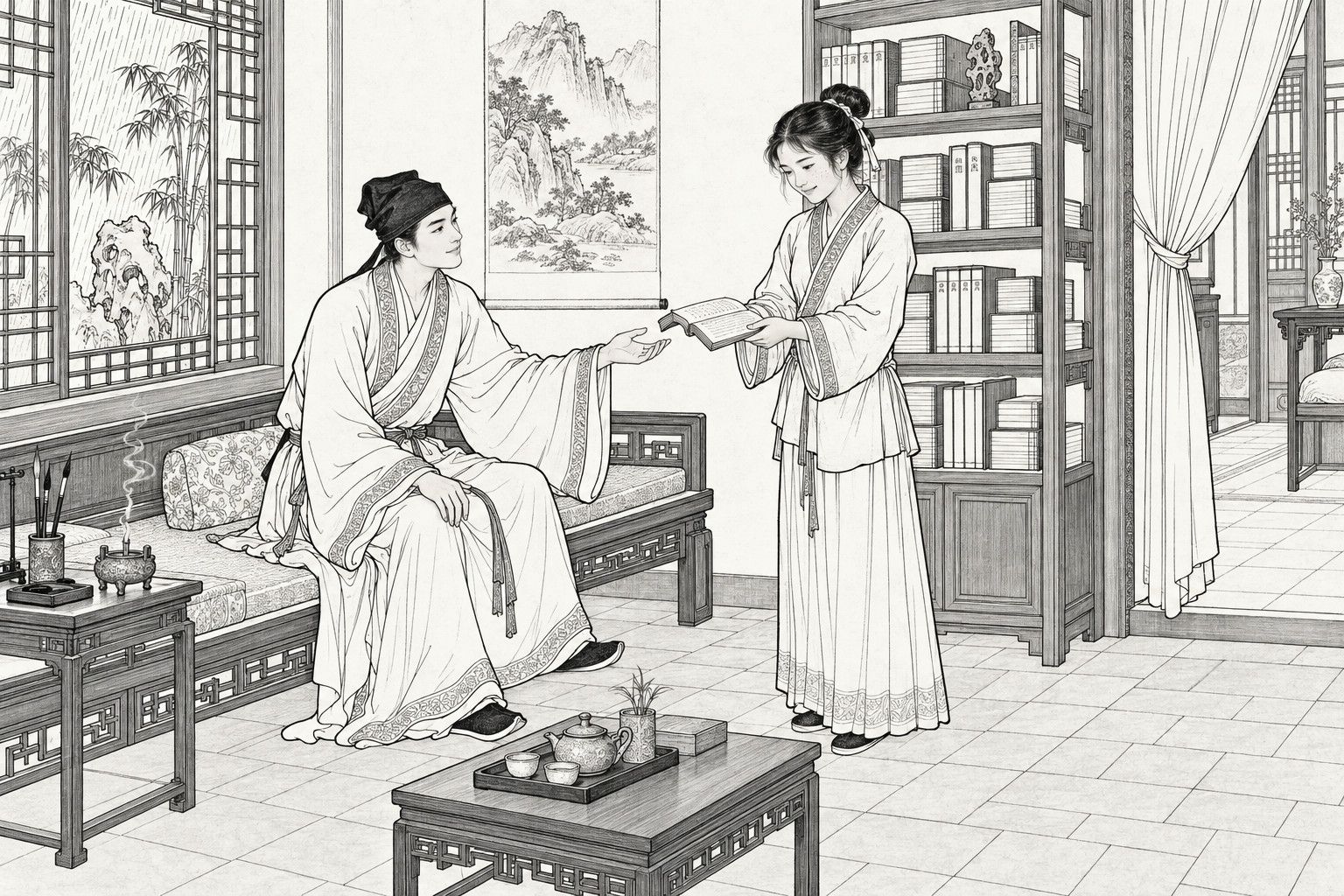
洛陽孫公子,名麒,娶蔣太守女,甚相得。二十夭殂,悲不自勝。離家,居山中別業。適陰雨,晝臥,室無人。忽見複室簾下,露婦人足,疑而問之。有女子褰簾入,年約十八九,衣服樸潔,而微黑多麻,類貧家女。意必村中僦屋者,呵曰:「所須宜白家人,何得輕入!」女微笑曰:「妾非村中人,祖籍山東,呂姓。父文學士。妾小字無病。從父客遷,早離顧復。慕公子世家名士,願為康成文婢。」孫笑曰:「卿意良佳。然僕輩雜居,實所不便,容旋里後,當輿聘之。」女次且曰:「自揣陋劣,何敢遂望敵體?聊備案前驅使,當不至倒捧冊卷。」孫曰:「納婢亦須吉日。」乃指架上,使取通書第四卷,──蓋試之也。女翻檢得之。先自涉覽,而後進之,笑曰:「今日河魁不曾在房。」孫意少動,留匿室中。女閒居無事,為之拂几整書,焚香拭鼎,滿室光潔,孫悅之。至夕,遣僕他宿。女俛眉承睫,殷勤臻至。命之寢,始持燭去。中夜睡醒,則床頭似有臥人;以手探之,知為女。捉而撼焉。女驚起立榻下。孫曰:「何不別寢,床頭豈汝臥處也?」女曰:「妾善懼。」孫憐之,俾施枕床內。忽聞氣息之來,清如蓮蕊,異之;呼與共枕,不覺心蕩;漸與同衾,大悅之。念避匿非策,又恐同歸招議。孫有母姨,近隔十餘門,謀令遁諸其家,而後再致之。女稱善,便言:「阿姨,妾熟識之,無容先達,請即去。」孫送之,踰垣而去。孫母姨,寡媼也。凌晨起戶,女掩入。媼詰之。答云:「若甥遣問阿姨。公子欲歸,路賒乏騎,留奴暫寄此耳。」媼信之,遂止焉。孫歸,矯謂姨家有婢,欲相贈,遣人舁之而還,坐臥皆以從。久益嬖之,納為妾。世家論昏,皆勿許,殆有終焉之志。女知之,苦勸令娶;乃娶於許,而終嬖愛無病。許甚賢,略不爭夕;無病事許益恭:以此嫡庶偕好。許舉一子阿堅,無病愛抱如己出。兒甫三歲,輒離乳媼,從無病宿;許喚之,不去。無何,許病卒。臨訣,囑孫曰:「無病最愛兒,即令子之可也;即正位焉亦可也。」既葬,孫將踐其言。告諸宗黨,僉謂不可;女亦固辭,遂止。邑有王天官女,新寡,來求婚。孫雅不欲娶,王再請之。媒道其美,宗族仰其勢,共慫恿之。孫惑焉,又娶之。色果豔,而驕已甚,衣服器用,多厭嫌,輒加毀棄。孫以愛敬故,不忍有所拂。入門數月,擅寵專房,而無病至前,笑啼皆罪。時怒遷夫婿,數相鬧鬥。孫患苦之,以故多獨宿。婦又怒。孫不能堪,託故之都,逃婦難也。婦以遠遊咎無病。無病鞠躬屏氣,承望顏色;而婦終不快。夜使直宿床下,兒奔與俱。每喚起給使,兒輒啼。婦厭罵之。無病急呼乳媼來抱之,不去;強之,益號。婦怒起,毒撻無算,始從乳媼去。兒以是病悸,不食。婦禁無病不令見之。兒終日啼,婦叱媼,使棄諸地。兒氣竭聲嘶,呼而求飲;婦戒勿與。日既暮,無病窺婦不在,潛飲兒。兒見之,棄水捉衿,號咷不止。婦聞之,意氣洶洶而出。兒聞聲輟涕,一躍遂絕。無病大哭。婦怒曰:「賤婢醜態!豈以兒死脅我耶!無論孫家襁褓物;即殺王府世子,王天官女亦能任之!」無病乃抽息忍涕,請為葬具。婦不許,立命棄之。婦去,竊撫兒,四體猶溫。隱語媼曰:「可速將去,少待於野,我當繼至。其死也,共棄之;活也,共撫之。」媼曰:「諾。」無病入室,攜簪珥出,追及之。共視兒,已蘇。二人喜,謀趨別業,往依姨。媼慮其纖步為累,無病乃先趨以俟之,疾若飄風,媼力奔始能及。約二更許,兒病危,不復可前。遂斜行入村,至田叟家,倚門待曉,扣扉借室,出簪珥易貲,巫醫並致,病卒不瘳。女掩泣曰:「媼好視兒,我往尋其父也。」媼方驚其謬妄,而女已杳矣。駭詫不已。是日,孫在都,方憩息床上,女悄然入。孫驚起曰:「纔眠已入夢耶!」女握手哽咽,頓足不能出聲。久之久之,方失聲而言曰:「妾歷千辛萬苦,與兒逃於楊──」句未終,縱聲大哭,倒地而滅。孫駭絕,猶疑為夢。喚從人共視之,衣履宛然。大異不解。即刻趣裝,星馳而歸。既聞兒死妾遁,撫膺大悲。語侵婦,婦反唇相稽。孫忿,出白刃;婢嫗遮救,不得近,遙擲之。刀脊中額,額破血流,披髮嗥叫而出,將以奔告其家。孫捉還,杖撻無數,衣皆若縷,傷痛不可轉側。孫命舁諸房中護養之,將待其瘥而後出之。婦兄弟聞之,怒,率多騎登門;孫亦集健僕械禦之。兩相叫罵,竟日始散。王未快意,訟之。孫捍衛入城,自詣質審,訴婦惡狀。宰不能屈,送廣文懲戒以悅王。廣文朱先生,世家子,剛正不阿。廉得情,怒曰:「堂上公以我為天下之齷齪教官,勒索傷天害理之錢,以吮人癰痔者耶!此等乞丐相,我所不能!」竟不受命,孫公然歸。王無奈之,乃示意朋好,為之調停,欲生謝過其家。孫不肯,十反不能決。婦創漸平,欲出之,又恐王氏不受,因循而安之。
妾亡子死,夙夜傷心,思得乳媼,一問其情。
因憶無病言「逃於楊」,近村有楊家疃,疑其在是;往問之,並無知者。或言五十里外有楊谷,遣騎詣訊,果得之。兒漸平復;相見各喜,載與俱歸。兒望見父,噭然大啼,孫亦淚下。婦聞兒尚存,盛氣奔出,將致誚罵。兒方啼,開目見婦,驚投父懷,若求藏匿。抱而視之,氣已絕矣。急呼之,移時始甦。孫恚曰:「不知如何酷虐,遂使吾兒至此!」乃立離婚書,送婦歸。王果不受,又舁還孫。孫不得已,父子別居一院,不與婦通。乳媼乃備述無病情狀,孫始悟其為鬼。感其義,葬其衣履,題碑曰「鬼妻呂無病之墓」。無何,婦產一男,交手於項而死之。孫益忿,復出婦;王又舁還之。孫乃具狀控諸上臺,皆以天官故,置不理。後天官卒,孫控不已,乃判令大歸。孫由此不復娶,納婢焉。婦既歸,悍名譟甚,居三四年,無問名者。婦頓悔,而已不可復挽。有孫家舊媼,適至其家。婦優待之,對之流涕;揣其情,似念故夫。媼歸告孫,孫笑置之。又年餘,婦母又卒,孤無所依,諸娣姒頗厭嫉之;婦益失所,日輒涕零。一貧士喪偶,兄議厚其奩妝而遣之,婦不肯。每陰託往來者致意孫,泣告以悔,孫不聽。一日,婦率一婢,竊驢跨之,竟奔孫。孫方自內出,迎跪階下,泣不可止。孫欲去之。婦牽衣復跪之。孫固辭曰:「如復相聚,常無間言則已耳;一朝有他,汝兄弟如虎狼,再求離逷,豈可復得!」婦曰:「妾竊奔而來,萬無還理。留則留之,否則死之!且妾自二十一歲從君,二十三歲被出,誠有十分惡,寧無一分情?」乃脫一腕釧,並兩足而束之,袖覆其上,曰:「此時香火之誓,君寧不憶之耶?」孫乃熒眥欲淚,使人挽扶入室;而猶疑王氏詐諼,欲得其兄弟一言為證據。婦曰:「妾私出,何顏復求兄弟?如不相信,妾藏有死具在此,請斷指以自明。」遂於腰間出利刃,就床邊伸左手一指斷之,血溢如涌。孫大駭,急為束裹。婦容色痛變,而更不呻吟。笑曰:「妾今日黃梁之夢已醒,特借斗室為出家計,何用相猜?」孫乃使子及妾另居一所,而己朝夕往來於兩間。又日求良藥醫指創,月餘尋愈。婦由此不茹葷酒,閉戶誦佛而已。居久,見家政廢弛,謂孫曰:「妾此來,本欲置他事於不問,今見如此用度,恐子孫有餓莩者矣。無已,再腆顏一經紀之。」乃集婢媼,按日責其績織。家人以其自投也,慢之,竊相誚訕,婦若不聞知。既而課工,惰者鞭撻不貸,眾始懼之。又垂簾課主計僕,綜理微密。孫乃大喜,使兒及妾皆朝見之。阿堅已九歲,婦加意溫卹,朝入塾,常留甘餌以待其歸;兒亦漸親愛之。一日,兒以石投雀,婦適過,中顱而仆,踰刻不語。孫大怒,撻兒。婦蘇,力止之。且喜曰:「妾昔虐兒,心中每不自釋,今幸消一罪案矣。」孫益嬖愛之,婦每拒,使就妾宿。居數年,屢產屢殤,曰:「此昔日殺兒之報也。」阿堅既娶,遂以外事委兒,內事委媳。一日曰:「妾某日當死。」孫不信。婦自理葬具,至日,更衣入棺而卒。顏色如生,異香滿室;既殮,香始漸滅。
洛阳孙公子,名麒,娶蒋太守女,甚相得。二十夭殂,悲不自胜。离家,居山中别业。适阴雨,昼卧,室无人。忽见复室帘下,露妇人足,疑而问之。有女子褰帘入,年约十八九,衣服朴洁,而微黑多麻,类贫家女。意必村中僦屋者,呵曰:「所须宜白家人,何得轻入!」女微笑曰:「妾非村中人,祖籍山东,吕姓。父文学士。妾小字无病。从父客迁,早离顾复。慕公子世家名士,愿为康成文婢。」孙笑曰:「卿意良佳。然仆辈杂居,实所不便,容旋里后,当舆聘之。」女次且曰:「自揣陋劣,何敢遂望敌体?聊备案前驱使,当不至倒捧册卷。」孙曰:「纳婢亦须吉日。」乃指架上,使取通书第四卷,──盖试之也。女翻检得之。先自涉览,而后进之,笑曰:「今日河魁不曾在房。」孙意少动,留匿室中。女闲居无事,为之拂几整书,焚香拭鼎,满室光洁,孙悦之。至夕,遣仆他宿。女俛眉承睫,殷勤臻至。命之寝,始持烛去。中夜睡醒,则床头似有卧人;以手探之,知为女。捉而撼焉。女惊起立榻下。孙曰:「何不别寝,床头岂汝卧处也?」女曰:「妾善惧。」孙怜之,俾施枕床内。忽闻气息之来,清如莲蕊,异之;呼与共枕,不觉心荡;渐与同衾,大悦之。念避匿非策,又恐同归招议。孙有母姨,近隔十余门,谋令遁诸其家,而后再致之。女称善,便言:「阿姨,妾熟识之,无容先达,请即去。」孙送之,逾垣而去。孙母姨,寡媪也。凌晨起户,女掩入。媪诘之。答云:「若甥遣问阿姨。公子欲归,路赊乏骑,留奴暂寄此耳。」媪信之,遂止焉。孙归,矫谓姨家有婢,欲相赠,遣人舁之而还,坐卧皆以从。久益嬖之,纳为妾。世家论昏,皆勿许,殆有终焉之志。女知之,苦劝令娶;乃娶于许,而终嬖爱无病。许甚贤,略不争夕;无病事许益恭:以此嫡庶偕好。许举一子阿坚,无病爱抱如己出。儿甫三岁,辄离乳媪,从无病宿;许唤之,不去。无何,许病卒。临诀,嘱孙曰:「无病最爱儿,即令子之可也;即正位焉亦可也。」既葬,孙将践其言。告诸宗党,佥谓不可;女亦固辞,遂止。邑有王天官女,新寡,来求婚。孙雅不欲娶,王再请之。媒道其美,宗族仰其势,共怂恿之。孙惑焉,又娶之。色果艳,而骄已甚,衣服器用,多厌嫌,辄加毁弃。孙以爱敬故,不忍有所拂。入门数月,擅宠专房,而无病至前,笑啼皆罪。时怒迁夫婿,数相闹斗。孙患苦之,以故多独宿。妇又怒。孙不能堪,托故之都,逃妇难也。妇以远游咎无病。无病鞠躬屏气,承望颜色;而妇终不快。夜使直宿床下,儿奔与俱。每唤起给使,儿辄啼。妇厌骂之。无病急呼乳媪来抱之,不去;强之,益号。妇怒起,毒挞无算,始从乳媪去。儿以是病悸,不食。妇禁无病不令见之。儿终日啼,妇叱媪,使弃诸地。儿气竭声嘶,呼而求饮;妇戒勿与。日既暮,无病窥妇不在,潜饮儿。儿见之,弃水捉衿,号咷不止。妇闻之,意气汹汹而出。儿闻声辍涕,一跃遂绝。无病大哭。妇怒曰:「贱婢丑态!岂以儿死胁我耶!无论孙家襁褓物;即杀王府世子,王天官女亦能任之!」无病乃抽息忍涕,请为葬具。妇不许,立命弃之。妇去,窃抚儿,四体犹温。隐语媪曰:「可速将去,少待于野,我当继至。其死也,共弃之;活也,共抚之。」媪曰:「诺。」无病入室,携簪珥出,追及之。共视儿,已苏。二人喜,谋趋别业,往依姨。媪虑其纤步为累,无病乃先趋以俟之,疾若飘风,媪力奔始能及。约二更许,儿病危,不复可前。遂斜行入村,至田叟家,倚门待晓,扣扉借室,出簪珥易赀,巫医并致,病卒不瘳。女掩泣曰:「媪好视儿,我往寻其父也。」媪方惊其谬妄,而女已杳矣。骇诧不已。是日,孙在都,方憩息床上,女悄然入。孙惊起曰:「才眠已入梦耶!」女握手哽咽,顿足不能出声。久之久之,方失声而言曰:「妾历千辛万苦,与儿逃于杨──」句未终,纵声大哭,倒地而灭。孙骇绝,犹疑为梦。唤从人共视之,衣履宛然。大异不解。即刻趣装,星驰而归。既闻儿死妾遁,抚膺大悲。语侵妇,妇反唇相稽。孙忿,出白刃;婢妪遮救,不得近,遥掷之。刀脊中额,额破血流,披发嗥叫而出,将以奔告其家。孙捉还,杖挞无数,衣皆若缕,伤痛不可转侧。孙命舁诸房中护养之,将待其瘥而后出之。妇兄弟闻之,怒,率多骑登门;孙亦集健仆械御之。两相叫骂,竟日始散。王未快意,讼之。孙捍卫入城,自诣质审,诉妇恶状。宰不能屈,送广文惩戒以悦王。广文朱先生,世家子,刚正不阿。廉得情,怒曰:「堂上公以我为天下之龌龊教官,勒索伤天害理之钱,以吮人痈痔者耶!此等乞丐相,我所不能!」竟不受命,孙公然归。王无奈之,乃示意朋好,为之调停,欲生谢过其家。孙不肯,十反不能决。妇创渐平,欲出之,又恐王氏不受,因循而安之。
妾亡子死,夙夜伤心,思得乳媪,一问其情。
因忆无病言「逃于杨」,近村有杨家疃,疑其在是;往问之,并无知者。或言五十里外有杨谷,遣骑诣讯,果得之。儿渐平复;相见各喜,载与俱归。儿望见父,噭然大啼,孙亦泪下。妇闻儿尚存,盛气奔出,将致诮骂。儿方啼,开目见妇,惊投父怀,若求藏匿。抱而视之,气已绝矣。急呼之,移时始甦。孙恚曰:「不知如何酷虐,遂使吾儿至此!」乃立离婚书,送妇归。王果不受,又舁还孙。孙不得已,父子别居一院,不与妇通。乳媪乃备述无病情状,孙始悟其为鬼。感其义,葬其衣履,题碑曰「鬼妻吕无病之墓」。无何,妇产一男,交手于项而死之。孙益忿,复出妇;王又舁还之。孙乃具状控诸上台,皆以天官故,置不理。后天官卒,孙控不已,乃判令大归。孙由此不复娶,纳婢焉。妇既归,悍名噪甚,居三四年,无问名者。妇顿悔,而已不可复挽。有孙家旧媪,适至其家。妇优待之,对之流涕;揣其情,似念故夫。媪归告孙,孙笑置之。又年余,妇母又卒,孤无所依,诸娣姒颇厌嫉之;妇益失所,日辄涕零。一贫士丧偶,兄议厚其奁妆而遣之,妇不肯。每阴托往来者致意孙,泣告以悔,孙不听。一日,妇率一婢,窃驴跨之,竟奔孙。孙方自内出,迎跪阶下,泣不可止。孙欲去之。妇牵衣复跪之。孙固辞曰:「如复相聚,常无间言则已耳;一朝有他,汝兄弟如虎狼,再求离逷,岂可复得!」妇曰:「妾窃奔而来,万无还理。留则留之,否则死之!且妾自二十一岁从君,二十三岁被出,诚有十分恶,宁无一分情?」乃脱一腕钏,并两足而束之,袖覆其上,曰:「此时香火之誓,君宁不忆之耶?」孙乃荧眦欲泪,使人挽扶入室;而犹疑王氏诈谖,欲得其兄弟一言为证据。妇曰:「妾私出,何颜复求兄弟?如不相信,妾藏有死具在此,请断指以自明。」遂于腰间出利刃,就床边伸左手一指断之,血溢如涌。孙大骇,急为束裹。妇容色痛变,而更不呻吟。笑曰:「妾今日黄梁之梦已醒,特借斗室为出家计,何用相猜?」孙乃使子及妾另居一所,而己朝夕往来于两间。又日求良药医指创,月余寻愈。妇由此不茹荤酒,闭户诵佛而已。居久,见家政废弛,谓孙曰:「妾此来,本欲置他事于不问,今见如此用度,恐子孙有饿莩者矣。无已,再腆颜一经纪之。」乃集婢媪,按日责其绩织。家人以其自投也,慢之,窃相诮讪,妇若不闻知。既而课工,惰者鞭挞不贷,众始惧之。又垂帘课主计仆,综理微密。孙乃大喜,使儿及妾皆朝见之。阿坚已九岁,妇加意温恤,朝入塾,常留甘饵以待其归;儿亦渐亲爱之。一日,儿以石投雀,妇适过,中颅而仆,逾刻不语。孙大怒,挞儿。妇苏,力止之。且喜曰:「妾昔虐儿,心中每不自释,今幸消一罪案矣。」孙益嬖爱之,妇每拒,使就妾宿。居数年,屡产屡殇,曰:「此昔日杀儿之报也。」阿坚既娶,遂以外事委儿,内事委媳。一日曰:「妾某日当死。」孙不信。妇自理葬具,至日,更衣入棺而卒。颜色如生,异香满室;既殓,香始渐灭。
Sun Qi, a young gentleman of Luoyang, married the daughter of Prefect Jiang, and they got on very well. She died at twenty, and his grief was more than he could bear. He left home and went to live at his villa in the hills. One day it was dark and raining, and he lay down in the daytime with no one else in the room. Suddenly he saw a woman’s feet showing beneath the curtain of the inner room. Puzzled, he called out. A girl lifted the curtain and came in. She was about eighteen or nineteen, plainly but neatly dressed, rather dark and much pockmarked, like a girl from a poor family. Sure she must belong to one of the families renting rooms in the village, he snapped, “If you need something, tell my servants. How dare you walk in like this!” The girl smiled. “I’m not from the village. My family comes from Shandong, and our name is Lü. My father was a man of letters. My childhood name is Wubing. I went with my father when he moved away to live as a stranger, and lost my parents’ care early. I have long admired you, sir, as a gentleman of an old family and a scholar of name, and I would like to be your lettered maid, like the maids of Zheng Kangcheng.” Sun laughed. “A kind thought, my dear. But my servants all live here with me, and it would be awkward. Wait until I go home, and I will send a chair and gifts for you.” The girl hesitated. “I know how plain and lowly I am. How could I hope to be your equal? Only let me wait on you at your desk. At least I would not hold the books upside down.” “Even taking a maid needs a lucky day,” said Sun. He pointed to the shelf and told her to fetch the fourth volume of the almanac. It was a test. She searched and found it. She looked through it herself before handing it to him, and said with a smile, “Today Hekui is not in the Chamber.” Sun’s heart stirred a little, and he kept her hidden in his room. Having nothing else to do, she dusted the desk and put the books in order, burned incense and wiped the tripod, till the whole room shone. Sun was pleased with her. That night he sent his servant to sleep elsewhere. She kept her eyes lowered and watched his every look, and waited on him with great care. Only when he told her to go to bed did she take the candle and leave. In the middle of the night he woke and felt that someone seemed to be lying at the head of the bed. He reached out his hand and knew it was the girl. He took hold of her and shook her. She started up and stood beside the bed. “Why don’t you sleep somewhere else?” said Sun. “Is the head of my bed a place for you to lie?” “I am easily frightened,” she said. Sun pitied her and let her put her pillow on the inner side of the bed. Suddenly he noticed her breath, fresh as a lotus bud, and wondered at it. He called her to share his pillow, and before he knew it his heart was stirred. By degrees they came under one quilt, and he was delighted with her. He thought that hiding her was no plan, but feared there would be talk if they went home together. Sun had an aunt, his mother’s sister, who lived only a dozen doors from his house. He planned to have the girl slip away to her house and fetch her from there afterwards. The girl thought it a good plan. “I know your aunt well,” she said. “There’s no need to send word ahead. Let me go now.” Sun saw her off, and she went over the wall. The aunt was a widow. When she opened her door at dawn, the girl slipped in. The old woman asked who she was. “Your nephew sent me to ask after you, aunt. The young master wants to come home, but the road is long and he has no horse, so he has left me here with you for a while.” The old woman believed her, and she stayed. When Sun came home, he pretended that his aunt had a maid she wished to give him, and sent men with a chair to bring her back. Sitting or lying, she was always at his side. The longer it went on, the more he doted on her, and he took her as his concubine. Old families offered matches, and he refused them all; he seemed set on keeping her to the end. When the girl learned of it, she urged him hard to marry. So he married a girl of the Xu family, but it was Wubing he loved best. Mrs. Xu was a good woman and never vied for his nights; Wubing served her all the more humbly, and so wife and concubine got on well. Mrs. Xu bore a son, Ajian, and Wubing loved to hold him as if he were her own. As soon as the boy was three he left the wet nurse and slept with Wubing; when Mrs. Xu called him, he would not go. Before long Mrs. Xu fell ill and died. At the parting she said to Sun, “Wubing loves the boy best. Let her be his mother. Or make her your wife; that would be well too.” After the burial Sun meant to do as she said. He told his clan, and they all said no; the girl herself firmly refused, so the matter was dropped. In the town there was a daughter of Minister Wang, newly widowed, who sought to marry him. Sun did not much want to marry, but the Wangs asked again. The go-between praised her beauty, the clan looked up to her family’s power, and together they urged him on. Sun was swayed, and married again. She was indeed beautiful, but very proud. She found fault with most of her clothes and household things, and would break them or throw them out. Out of love and respect, Sun could not bear to cross her. Within a few months of coming into the house she had his favour and his bed to herself, and when Wubing came near her, her smiles and her tears were both a crime. At times she turned her anger on her husband, and they quarrelled again and again. Sun was so sick of it that he often slept alone, and that angered her too. Unable to stand it, he found an excuse to go to the capital, to escape his wife. She blamed Wubing for his going away. Wubing bowed low and hardly dared breathe, watching her face to please her, but the wife was never content. At night she made Wubing keep watch beneath her bed, and the boy ran in to be with her. Whenever the wife called her up to wait on her, the boy cried. The wife was sick of it and cursed him. Wubing quickly called the wet nurse to take him; he would not go, and when she tried to force him, he howled the louder. The wife got up in a rage and beat him savagely, past counting, before he would go with the nurse. After this the boy fell ill with fright and would not eat. The wife forbade Wubing to see him. The boy cried all day; the wife scolded the nurse and made her put him down on the floor. His strength gone, his voice hoarse, he cried for water; the wife forbade anyone to give him any. When dusk fell, Wubing watched till the wife was away and secretly gave him a drink. When he saw her, he threw the water aside, clutched at her clothes and wailed on and on. The wife heard and came out in a fury. At the sound of her the boy stopped crying, gave one jerk, and was dead. Wubing wept aloud. “Slut, what a show!” said the wife angrily. “Do you think you can threaten me with the brat’s death? Never mind a Sun-family baby — if I killed the heir of a prince’s house, the daughter of Minister Wang could answer for it!” Wubing choked back her sobs and asked to get things for his burial. The wife refused and ordered him thrown out at once. When the wife had gone, Wubing stroked the boy in secret: his limbs were still warm. She whispered to the nurse, “Take him away quickly and wait for me out in the country. I’ll come after you. If he dies, we’ll leave him together; if he lives, we’ll raise him together.” “Yes,” said the nurse. Wubing went into her room, took her hairpins and earrings, and caught up with her. They looked at the boy together: he had come round. Overjoyed, the two planned to make for the villa and take refuge with the aunt. The nurse was afraid that Wubing’s small feet would hold them back, so Wubing went on ahead to wait for her, swift as a gust of wind; only by running her hardest could the nurse keep up. At about the second watch the boy took a turn for the worse, and they could go no farther. So they turned off into a village, to the house of an old farmer, and waited by the gate till dawn. Then they knocked and borrowed a room, sold the pins and earrings, and fetched both shaman and doctor; but the boy did not get better. Covering her face and weeping, the girl said, “Look after him well, nurse. I’m going to find his father.” The nurse was just wondering at such wild talk when the girl was gone. She was astonished beyond words. That day, in the capital, Sun was resting on his bed when the girl came in without a sound. Sun started up. “I’ve only just lain down, and I’m dreaming already!” She clasped his hands, choking, stamping her feet, unable to make a sound. For a long, long time she could not speak. At last she cried out, “I went through a thousand hardships — I fled with the boy to Yang—” Before she could finish she burst into loud sobs, fell to the ground, and vanished. Sun was terrified, and still thought it a dream. He called his servants to look: her clothes and shoes lay there plain to see. He was amazed and could make nothing of it. At once he packed and rode home day and night. When he heard that the boy was dead and the concubine had fled, he beat his breast in grief. He said harsh things to his wife, and she answered him back. In fury Sun drew a blade. The maids and old women got in his way to save her, and he could not get near, so he threw it at her from where he stood. The back of the blade struck her forehead; it split, and the blood ran. Her hair loose, she ran out howling, meaning to go and tell her family. Sun dragged her back and beat her with a stick past counting, till her clothes hung in shreds and she was in too much pain to turn over. He had her carried to her room and nursed, meaning to send her away once she was well. Her brothers heard of it and came to the door in a rage with many horsemen; Sun gathered his strong servants with weapons to hold them off. The two sides shouted abuse at each other all day before they broke up. Still not satisfied, the Wangs took him to court. Sun went into the city under guard, presented himself for trial, and told of his wife’s wickedness. The magistrate could not find him in the wrong, and sent him to the director of studies for punishment, to please the Wangs. The director of studies, Mr. Zhu, came of an old family and was upright and unbending. He looked into the case and found out the truth. “Does His Honour take me for the filthiest schoolmaster in the land,” he said angrily, “to squeeze out money against Heaven and reason and suck men’s boils and piles? I can’t play the beggar like that!” He would not take the order at all, and Sun went home openly. The Wangs could do nothing about it, so they hinted to friends to mediate, wanting Sun to come and apologize to their family. Sun would not, and ten rounds of talk settled nothing. As the wife’s wounds healed, Sun wanted to send her away, but he feared the Wangs would not take her back, and so he let things drift and kept her.
His concubine gone and his son dead,he grieved day and night;he longed to find the wet nurseand ask her what had happened.
Then he remembered Wubing saying “fled to Yang.” There was a village nearby called Yangjiatuan; thinking they might be there, he went to ask, but no one knew anything. Someone said there was a Yang Valley fifty li away. He sent a rider to inquire, and there they were. The boy had slowly recovered. They were glad to see each other, and the rider brought them home in a cart. When the boy saw his father, he burst out crying, and Sun shed tears too. Hearing that the boy was alive, the wife came storming out, meaning to rail at him. The boy was still crying; he opened his eyes, saw her, and threw himself in terror into his father’s arms, as if begging to be hidden. Sun held him and looked: he had stopped breathing. They called to him urgently, and after a while he came round. “I don’t know how cruelly she treated him, to bring my boy to this!” said Sun bitterly. He wrote out a bill of divorce at once and sent his wife home. As he had feared, the Wangs would not take her, and carried her back to Sun. Sun could do nothing; he and his son lived in a separate courtyard and had nothing to do with her. Only now did the nurse tell him everything about Wubing, and Sun understood at last that she had been a ghost. Moved by her devotion, he buried her clothes and shoes and inscribed the stone: Tomb of Lü Wubing, Ghost Wife. Before long the wife gave birth to a boy, put her hands around his neck, and killed him. Sun was angrier than ever and sent her away again; again the Wangs carried her back. So Sun brought suits before the higher courts, but because of the Minister they all set them aside. Later the Minister died. Sun pressed his suit without stopping, and at last it was ruled that she go home for good. After this Sun never married again, but took a maid as his concubine. Back with her family, the wife’s name as a shrew was on everyone’s lips, and in three or four years no one came to ask for her hand. She was suddenly sorry, but it was too late to undo. An old woman who used to serve the Suns happened to come to her house. The wife treated her very well and wept in front of her; from the look of it, she was thinking of her former husband. The old woman went home and told Sun, who laughed and let it be. A year or so later the wife’s mother died too, and she was left alone with no one to lean on; her brothers’ wives resented and disliked her. She had less of a place than ever, and wept every day. A poor scholar had lost his wife, and her brother proposed to send her to him with a generous dowry, but she refused. Again and again she secretly asked people going to and fro to carry word to Sun, weeping that she was sorry; Sun would not listen. One day, with one maid, she stole a donkey, rode it, and ran straight to Sun. Sun was just coming out from the inner rooms; she knelt at the foot of the steps to meet him, weeping without stopping. Sun wanted to send her off. She caught at his clothes and knelt again. Sun refused firmly. “If we live together again and there’s never a word between us, well and good. But one day there will be trouble, and your brothers are tigers and wolves. If I want to be rid of you then, how will I ever manage it?” “I ran away to come here,” she said. “There is no way I can go back. If you keep me, keep me; if not, I die. And I came to you at twenty-one and was put out at twenty-three. Even if I am ten parts wicked, is there not one part of love?” She took off a bracelet, put her two feet together and slipped it round them, and covered it with her sleeve. “The vows we made before the incense then — don’t you remember them?” Sun’s eyes glistened as if he would weep. He had her helped into the house; but he still suspected Mrs. Wang of some trick, and wanted a word from her brothers as proof. “I came away in secret,” she said. “How could I face my brothers to ask them anything? If you don’t believe me, I have brought something to die with. Let me cut off a finger to prove it.” She took a sharp knife from her waist, stretched out her left hand by the bed and cut off a finger; the blood gushed out. Sun was horrified and quickly bound it up. Her face was twisted with pain, but she did not make a sound. She smiled. “Today I have woken from my dream of yellow millet. I only want a small room to live in as a nun. Why suspect me?” So Sun had his son and the concubine live in another part of the house, and went between the two morning and evening. He also sought good medicine every day for her finger, and in a month or so it healed. From then on she ate no meat and drank no wine; she kept her door shut and chanted the Buddha’s name, and that was all. After a long time there, seeing that the household had gone to ruin, she said to Sun, “When I came here, I meant to leave everything else alone. But seeing money spent like this, I fear your descendants will starve. There’s nothing for it but to swallow my shame and manage things once more.” She gathered the maids and old women and set them their spinning and weaving day by day. Because she had come back of her own accord, the household looked down on her and mocked her behind her back; she acted as if she heard nothing. Then, when she checked the work, she whipped the idle without mercy, and they began to fear her. She also sat behind a curtain and went over the accounts with the stewards, managing everything down to the smallest detail. Sun was delighted, and had his son and the concubine pay their respects to her every morning. Ajian was nine by now. She took special care of him; when he went to school in the morning, she always kept sweets for him to come home to, and the boy grew fond of her too. One day the boy threw a stone at a sparrow; the wife happened to be passing, it struck her head, and she fell and lay without speaking for more than a quarter of an hour. Sun beat the boy in a rage. When she came round, she stopped him with all her strength, and said gladly, “I was cruel to him once, and it has always weighed on me. Now, by luck, one crime is wiped out.” Sun loved her all the more, but she often refused him and sent him to sleep with the concubine. Over several years she bore child after child, and each one died. “This is my punishment for the child I killed,” she said. When Ajian married, she handed the outside affairs to him and the household to his wife. One day she said, “I shall die on such-and-such a day.” Sun did not believe it. She saw to her own burial things, and on that day she changed her clothes, lay down in the coffin, and died. Her face looked alive, and a strange fragrance filled the room; only after she was laid out did it slowly fade.