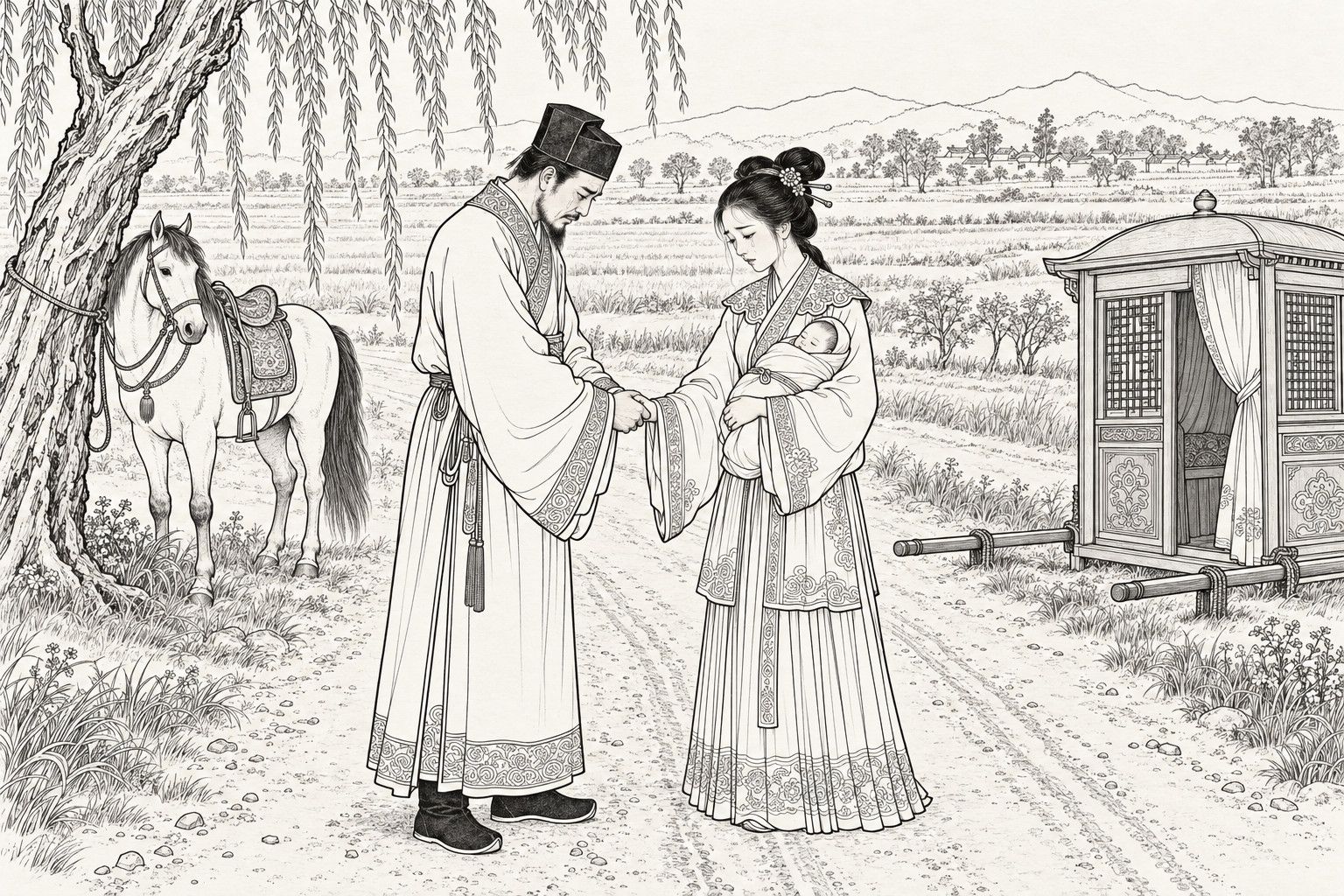
蒙陰王慕貞,世家子也。偶游江浙,見媼哭於途,詰之。言:「先夫止遺一子,今犯死刑,誰有能出之者?」王素慷慨,誌其姓名,出橐中金為之斡旋,竟釋其罪。其人出,聞王之救己也,茫然不解其故,訪詣旅邸,感泣謝問。王曰:「無他,憐汝母老耳。」其人大駭曰:「母故已久。」王亦異之。抵暮,媼來申謝,王咎其謬誣。媼曰:「實相告:我東山老狐也。二十年前曾與兒父有一夕之好,故不忍其鬼之餒也。」王悚然起敬,再欲詰之,已杳。先是,王妻賢而好佛,不茹葷酒;治潔室,懸觀音像,以無子,日日焚禱其中。而神又最靈,輒示夢,教人趨避,以故家中事皆取決焉。後有疾,綦篤,移榻其中;又別設錦裀於內室而扃其戶,若有所伺。王以為惑,而以其疾勢昏瞀,不忍傷之。臥病二年,惡囂,常屏人獨寢。潛聽之,似與人語;啟門視之,又寂然。病中他無所慮,有女十四歲,惟日催治裝遣嫁。既醮,呼王至榻前,執手曰:「今訣矣!初病時,菩薩告我,命當速死,念不了者,幼女未嫁,因賜少藥,俾延息以待。去歲,菩薩將回南海,留案前侍女小梅,為妾服役。今將死,薄命人又無所出。保兒,妾所憐愛,恐娶悍怒之婦,令其子母失所。小梅姿容秀美,又溫淑,即以為繼室可也。」蓋王有妾,生一子,名保兒。王以其言荒唐,曰:「卿素敬者神,今出此言,不已褻乎?」答云:「小梅事我年餘,相忘形骸,我已婉求之矣。」問:「小梅何處?」曰:「室中非耶?」方欲再詰,閉目已逝。王夜守靈幃,聞室中隱隱啜泣,大駭,疑為鬼。喚諸婢妾啟鑰視之,則二八麗者,縗服在室。眾以為神,共羅拜之。女斂涕扶掖。王凝注之,俛首而已。王曰:「如果亡室之言非妄,請即上堂,受兒女朝謁;如其不可,僕亦不敢妄想,以取罪過。」女腆然出,竟登北堂。王使婢為設坐南嚮,王先拜,女亦答拜;下而長幼卑賤,以次伏叩,女莊容坐受;惟妾至,則挽之。自夫人臥病,婢惰奴偷,家久替。眾參已,肅肅列侍。女曰:「我感夫人盛意,羈留人間,又以大事相委,汝輩宜各洗心,為主效力,從前愆尤,悉不計校;不然,莫謂室無人也!」共視座上,真如懸觀音圖像,時被微風吹動。聞言悚惕,鬨然並諾。女乃排撥喪務,一切井井,由是大小無敢懈者。女終日經紀內外,王將有作,亦稟白而行;然雖一夕數見,並不交一私語。既殯,王欲申前約,不敢徑告,囑妾微示意。女曰:「妾受夫人諄囑,義不容辭;但匹配大禮,不得草草。年伯黃先生,位尊德重,求使主秦晉之盟,則惟命是聽。」時沂水黃太僕,致仕閒居,於王為父執,往來最善。王即親詣,以實告。黃奇之,即與同來。女聞,即出展拜。黃一見,驚為天人,遜謝不敢當禮;既而助妝優厚,成禮乃去。女餽遺枕履,若奉舅姑,由此交益親。合巹後,王終以神故,褻中帶肅,時研詰菩薩起居。女笑曰:「君亦太愚,焉有正直之神,而下婚塵世者?」王力審所自。女曰:「不必研窮,既以為神,朝夕供養,自無殃咎。」女御下常寬,非笑不語;然婢賤戲狎時,遙見之,則默默無聲。女笑諭曰:「豈爾輩尚以我為神耶?我何神哉!實為夫人姨妹,少相交好;姊病見思,陰使南村王姥招我來。第以日近姊夫,有男女之嫌,故託為神道,閉內室中,其實何神。」眾猶不信;而日侍邊傍,見其舉動,不少異於常人,浮言漸息。然即頑奴鈍婢,王素撻楚所不能化者,女一言無不樂於奉命。皆云:「並不自知。實非畏之,但睹其貌,則心自柔,故不忍拂其意耳。」以此百廢具舉。數年中,田地連阡,倉廩萬石矣。又數年,妾產一女。女生一子;子生,左臂有朱點,因字小紅。彌月,女使王盛筵招黃。黃賀儀豐渥,但辭以耄,不能遠涉;女遣兩媼,強邀之,黃始至。抱兒出,袒其左臂,以示命名之意。又再三問其吉凶。黃笑曰:「此喜紅也,可增一字,名喜紅。」女大悅,更出展叩。是日,鼓樂充庭,貴戚如市。黃留三日始去。忽門外有輿馬來,逆女歸寧。向十餘年,並無瓜葛,共議之,而女若不聞。理妝竟,抱子於懷,要王相送,王從之。至二三十里許,寂無行人,女停輿,呼王下騎,屏人與語,曰:「王郎王郎,會短離長,謂可悲否?」王驚問故。女曰:「君謂妾何人也?」答曰:「不知。」女曰:「江南拯一死罪,有之乎?」曰:「有。」曰:「哭於路者吾母也,感義而思所報,乃因夫人好佛,附為神道,實將以妾報君也。今幸生此襁褓物,此願已慰。妾視君晦運將來,此兒在家,恐不能育,故借歸寧,解兒厄難。君記取家有死口時,當於晨雞初唱,詣西河柳堤上,見有挑葵花燈來者,遮道苦求,可免災難。」王曰:「諾。」因訊歸期。女云:「不可預定。要當牢記吾言,後會亦不遠也。」臨別,執手愴然交涕。俄登輿,疾若風。王望之不見,始返。經六七年,絕無音問。忽四鄉瘟疫流行,死者甚眾,一婢病三日死。王念曩囑,頗以關心。是日與客飲,大醉而睡。既醒,聞雞鳴,急起至堤頭,見燈光閃爍,適已過去。急追之,止隔百步許,愈追愈遠,漸不可見,懊恨而返。數日暴病,尋卒。王族多無賴,共憑陵其孤寡,田禾樹木,公然伐取,家日陵替。踰歲,保兒又殤,一家更無所主。族人益橫,割裂田產,廄中牛馬俱空;又欲瓜分第宅。以妾居故,遂將數人來,強奪鬻之。妾戀幼女,母子環泣,慘動鄰里。方危難間,俄聞門外有肩輿入,共覘,則女引小郎自車中出。四顧人紛如市,問:「此何人?」妾哭訴其由。女顏色慘變,便喚從來僕役,關門下鑰。眾欲抗拒,而手足若痿。女令一一收縛,繫諸廊柱,日與薄粥三甌。即遣老僕奔告黃公,然後入室哀泣。泣已,謂妾曰:「此天數也。已期前月來,適以母病耽延,遂至於今。不謂轉盼間已成邱墟!」問舊時婢媼,則皆被族人掠去,又益欷歔。越日,婢僕聞女至,皆自遁歸,相見無不流涕。所縶族人,共譟兒非慕貞體胤,女亦不置辨。既而黃公至,女引兒出迎。黃握兒臂,便捋左袂,見朱記宛然,因袒示眾人,以證其確。乃細審失物,登簿記名,親詣邑令。令拘無賴輩,各笞四十,械禁嚴追;不數日,田地馬牛,悉歸故主。黃將歸,女引兒泣拜曰:「妾非世間人,叔父所知也。今以此子委叔父矣。」黃曰:「老夫一息尚在,無不為區處。」黃去,女盤查就緒,託兒於妾,乃具饌為夫祭掃,半日不返。視之,則杯饌猶陳,而人杳矣。
蒙阴王慕贞,世家子也。偶游江浙,见媪哭于途,诘之。言:「先夫止遗一子,今犯死刑,谁有能出之者?」王素慷慨,志其姓名,出橐中金为之斡旋,竟释其罪。其人出,闻王之救己也,茫然不解其故,访诣旅邸,感泣谢问。王曰:「无他,怜汝母老耳。」其人大骇曰:「母故已久。」王亦异之。抵暮,媪来申谢,王咎其谬诬。媪曰:「实相告:我东山老狐也。二十年前曾与儿父有一夕之好,故不忍其鬼之馁也。」王悚然起敬,再欲诘之,已杳。先是,王妻贤而好佛,不茹荤酒;治洁室,悬观音像,以无子,日日焚祷其中。而神又最灵,辄示梦,教人趋避,以故家中事皆取决焉。后有疾,綦笃,移榻其中;又别设锦裀于内室而扃其户,若有所伺。王以为惑,而以其疾势昏瞀,不忍伤之。卧病二年,恶嚣,常屏人独寝。潜听之,似与人语;启门视之,又寂然。病中他无所虑,有女十四岁,惟日催治装遣嫁。既醮,呼王至榻前,执手曰:「今诀矣!初病时,菩萨告我,命当速死,念不了者,幼女未嫁,因赐少药,俾延息以待。去岁,菩萨将回南海,留案前侍女小梅,为妾服役。今将死,薄命人又无所出。保儿,妾所怜爱,恐娶悍怒之妇,令其子母失所。小梅姿容秀美,又温淑,即以为继室可也。」盖王有妾,生一子,名保儿。王以其言荒唐,曰:「卿素敬者神,今出此言,不已亵乎?」答云:「小梅事我年余,相忘形骸,我已婉求之矣。」问:「小梅何处?」曰:「室中非耶?」方欲再诘,闭目已逝。王夜守灵帏,闻室中隐隐啜泣,大骇,疑为鬼。唤诸婢妾启钥视之,则二八丽者,缞服在室。众以为神,共罗拜之。女敛涕扶掖。王凝注之,俛首而已。王曰:「如果亡室之言非妄,请即上堂,受儿女朝谒;如其不可,仆亦不敢妄想,以取罪过。」女腆然出,竟登北堂。王使婢为设坐南向,王先拜,女亦答拜;下而长幼卑贱,以次伏叩,女庄容坐受;惟妾至,则挽之。自夫人卧病,婢惰奴偷,家久替。众参已,肃肃列侍。女曰:「我感夫人盛意,羁留人间,又以大事相委,汝辈宜各洗心,为主效力,从前愆尤,悉不计校;不然,莫谓室无人也!」共视座上,真如悬观音图像,时被微风吹动。闻言悚惕,哄然并诺。女乃排拨丧务,一切井井,由是大小无敢懈者。女终日经纪内外,王将有作,亦禀白而行;然虽一夕数见,并不交一私语。既殡,王欲申前约,不敢径告,嘱妾微示意。女曰:「妾受夫人谆嘱,义不容辞;但匹配大礼,不得草草。年伯黄先生,位尊德重,求使主秦晋之盟,则惟命是听。」时沂水黄太仆,致仕闲居,于王为父执,往来最善。王即亲诣,以实告。黄奇之,即与同来。女闻,即出展拜。黄一见,惊为天人,逊谢不敢当礼;既而助妆优厚,成礼乃去。女餽遗枕履,若奉舅姑,由此交益亲。合卺后,王终以神故,亵中带肃,时研诘菩萨起居。女笑曰:「君亦太愚,焉有正直之神,而下婚尘世者?」王力审所自。女曰:「不必研穷,既以为神,朝夕供养,自无殃咎。」女御下常宽,非笑不语;然婢贱戏狎时,遥见之,则默默无声。女笑谕曰:「岂尔辈尚以我为神耶?我何神哉!实为夫人姨妹,少相交好;姊病见思,阴使南村王姥招我来。第以日近姊夫,有男女之嫌,故托为神道,闭内室中,其实何神。」众犹不信;而日侍边傍,见其举动,不少异于常人,浮言渐息。然即顽奴钝婢,王素挞楚所不能化者,女一言无不乐于奉命。皆云:「并不自知。实非畏之,但睹其貌,则心自柔,故不忍拂其意耳。」以此百废具举。数年中,田地连阡,仓廪万石矣。又数年,妾产一女。女生一子;子生,左臂有朱点,因字小红。弥月,女使王盛筵招黄。黄贺仪丰渥,但辞以耄,不能远涉;女遣两媪,强邀之,黄始至。抱儿出,袒其左臂,以示命名之意。又再三问其吉凶。黄笑曰:「此喜红也,可增一字,名喜红。」女大悦,更出展叩。是日,鼓乐充庭,贵戚如市。黄留三日始去。忽门外有舆马来,逆女归宁。向十余年,并无瓜葛,共议之,而女若不闻。理妆竟,抱子于怀,要王相送,王从之。至二三十里许,寂无行人,女停舆,呼王下骑,屏人与语,曰:「王郎王郎,会短离长,谓可悲否?」王惊问故。女曰:「君谓妾何人也?」答曰:「不知。」女曰:「江南拯一死罪,有之乎?」曰:「有。」曰:「哭于路者吾母也,感义而思所报,乃因夫人好佛,附为神道,实将以妾报君也。今幸生此襁褓物,此愿已慰。妾视君晦运将来,此儿在家,恐不能育,故借归宁,解儿厄难。君记取家有死口时,当于晨鸡初唱,诣西河柳堤上,见有挑葵花灯来者,遮道苦求,可免灾难。」王曰:「诺。」因讯归期。女云:「不可预定。要当牢记吾言,后会亦不远也。」临别,执手怆然交涕。俄登舆,疾若风。王望之不见,始返。经六七年,绝无音问。忽四乡瘟疫流行,死者甚众,一婢病三日死。王念曩嘱,颇以关心。是日与客饮,大醉而睡。既醒,闻鸡鸣,急起至堤头,见灯光闪烁,适已过去。急追之,止隔百步许,愈追愈远,渐不可见,懊恨而返。数日暴病,寻卒。王族多无赖,共凭陵其孤寡,田禾树木,公然伐取,家日陵替。逾岁,保儿又殇,一家更无所主。族人益横,割裂田产,厩中牛马俱空;又欲瓜分第宅。以妾居故,遂将数人来,强夺鬻之。妾恋幼女,母子环泣,惨动邻里。方危难间,俄闻门外有肩舆入,共觇,则女引小郎自车中出。四顾人纷如市,问:「此何人?」妾哭诉其由。女颜色惨变,便唤从来仆役,关门下钥。众欲抗拒,而手足若痿。女令一一收缚,系诸廊柱,日与薄粥三瓯。即遣老仆奔告黄公,然后入室哀泣。泣已,谓妾曰:「此天数也。已期前月来,适以母病耽延,遂至于今。不谓转盼间已成邱墟!」问旧时婢媪,则皆被族人掠去,又益欷歔。越日,婢仆闻女至,皆自遁归,相见无不流涕。所絷族人,共噪儿非慕贞体胤,女亦不置辨。既而黄公至,女引儿出迎。黄握儿臂,便捋左袂,见朱记宛然,因袒示众人,以证其确。乃细审失物,登簿记名,亲诣邑令。令拘无赖辈,各笞四十,械禁严追;不数日,田地马牛,悉归故主。黄将归,女引儿泣拜曰:「妾非世间人,叔父所知也。今以此子委叔父矣。」黄曰:「老夫一息尚在,无不为区处。」黄去,女盘查就绪,托儿于妾,乃具馔为夫祭扫,半日不返。视之,则杯馔犹陈,而人杳矣。
Wang Muzhen of Mengyin came of an old and distinguished family. Once, travelling in Jiangsu and Zhejiang, he saw an old woman weeping by the road and asked what was wrong. “My late husband left only one son,” she said, “and now he is condemned to death. Is there anyone who can get him out?” Wang had always been generous. He took down the son’s name, spent money from his purse to work on the case, and in the end got him acquitted. When the man came out and heard that Wang had saved him, he could not think why. He sought Wang out at his inn and, weeping with gratitude, thanked him and asked the reason. “No reason,” said Wang. “I only pitied your old mother.” The man was astounded. “My mother died long ago.” Wang, too, thought it strange. Toward evening the old woman came to thank him again, and Wang reproached her for lying to him. “I will tell you the truth,” she said. “I am an old fox of the Eastern Hills. Twenty years ago I spent one night with the boy’s father, so I could not bear to let his ghost go hungry.” Wang rose to his feet in awe. He wanted to ask more, but she was gone. Before this, Wang’s wife, a good woman devoted to the Buddha, ate no meat and drank no wine. She had set aside a clean room and hung a picture of Guanyin in it, and because she had no son, she burned incense and prayed there every day. The goddess was most responsive: she often came in dreams to tell them what to seek and what to shun, so that every matter in the house was settled by her. Later the wife fell ill, very gravely, and had her bed moved into that room. She also had a brocade cushion laid in an inner room and the door locked, as if she were waiting for someone. Wang thought her deluded, but her illness had left her confused, and he could not bear to cross her. She lay ill for two years. She hated noise, and often sent everyone away and slept alone. Listening in secret, they heard her seem to talk with someone; but when they opened the door to look, all was silent. In her illness she cared for nothing else. She had a daughter of fourteen, and every day she urged them only to get the trousseau ready and marry the girl off. When the girl had been married, she called Wang to her bedside and took his hand. “Now we part. When I first fell ill, the Bodhisattva told me I was fated to die soon. What I could not let go of was that my young daughter was not yet married, so she gave me a little medicine to keep me breathing till then. Last year, when the Bodhisattva was about to go back to the Southern Sea, she left me Xiaomei, the maid who attends before her altar, to wait on me. Now I am dying, and, ill-fated as I am, I have borne you no son. Bao’er is dear to me, and I am afraid you will marry some shrew who will leave him and his mother with nowhere to turn. Xiaomei is lovely, and gentle too. You may take her as your second wife.” For Wang had a concubine who had borne him a son named Bao’er. Wang thought this absurd. “It is the gods you have always revered. Isn’t it irreverent to say such a thing now?” “Xiaomei has served me for more than a year,” she answered. “We have put aside all ceremony, and I have already asked her, gently.” “Where is Xiaomei?” “Isn’t she in the room?” He was about to ask more, but her eyes had closed; she was gone. That night, as Wang kept watch by the mourning curtains, he heard faint sobbing in the room. Greatly alarmed, he thought it was a ghost. He called the maids and the concubine to unlock the door and look. Inside was a beauty of about sixteen, dressed in mourning hemp. They all took her for a goddess and knelt around her. She held back her tears and helped them up. Wang stared at her; she only bowed her head. “If what my late wife said was not nonsense,” said Wang, “please come up to the hall and receive the children’s greetings. If that cannot be, I would not dare to presume and bring sin on myself.” Shyly she came out, and went right up into the north hall. Wang had a maid set her a seat facing south. Wang bowed first, and she returned his bow. Then the whole household, old and young, high and low, prostrated themselves in turn, and she received them seated, with a grave face; only when the concubine came did she raise her up. Ever since the lady had taken to her bed, the maids had grown lazy and the menservants light-fingered, and the house had long been going downhill. When all had paid their respects, they stood in silent rows. “I was moved by the lady’s great kindness,” she said, “so I have stayed on in the world of men, and she has entrusted me with important affairs. Each of you must wash your heart clean and serve your master with all your strength, and I will not count your past faults against you. Otherwise, do not think there is no one in charge of this house!” They all looked at her on the seat: she was exactly like the hanging picture of Guanyin, stirring now and then in a light breeze. Hearing her, they trembled and promised with one voice. She then took the funeral in hand, and everything was in perfect order; from then on no one, great or small, dared to slack. All day she managed affairs inside the house and out, and when Wang meant to do anything, he consulted her first. But though they might see each other several times in an evening, they never exchanged a private word. When the coffin had been laid to rest, Wang wanted to hold her to the earlier agreement, but did not dare say so outright; he asked the concubine to hint at it. “I took the lady’s earnest charge,” she said, “and duty will not let me refuse. But marriage is a great rite and cannot be done in haste. Uncle Huang is high in rank and great in virtue. If he can be asked to preside over the match, I will do whatever he says.” At that time Huang of Yishui, formerly of the Court of the Imperial Stud, had retired and was living at home. He was an old friend of Wang’s father, and the two houses were on the closest terms. Wang went to him in person and told him the truth. Huang thought it remarkable and came back with him at once. When she heard, she came straight out and bowed to him. At the sight of her Huang was amazed, as if at a being from Heaven, and modestly declined to accept her bow. Then he gave generously toward her trousseau, and left only when the wedding was done. She sent him pillows and shoes, as a bride does her husband’s parents, and from then on the families grew closer still. After they had drunk the wedding cup, Wang still thought of her as divine, and there was reverence mixed into his intimacy. He often pressed her about how the Bodhisattva lived. She laughed. “You are too foolish. What upright god would come down to marry in the dusty world?” Wang pressed hard to know where she came from. “No need to dig to the bottom of it,” she said. “Since you take me for a goddess, make offerings morning and night, and no harm will come to you.” She was always lenient with those under her and never spoke without a smile; yet when the maids and servants were larking about and caught sight of her in the distance, they fell silent. She smiled and told them, “Do you still take me for a goddess? What goddess am I! I am really the lady’s cousin on her mother’s side; we were close as girls. When my cousin fell ill she missed me, and secretly sent old Mother Wang of South Village to fetch me. Only, I would be near my cousin’s husband every day, and people would talk about a man and a woman, so I passed myself off as a goddess and shut myself in the inner room. In truth, what goddess was there?” Still they did not believe her. But serving at her side every day, and seeing that she behaved no differently from anyone else, they let the idle talk die down. Yet even stubborn menservants and dull maids, whom Wang’s beatings had never reformed, would gladly obey at a single word from her. “We don’t know why ourselves,” they all said. “It isn’t that we fear her. It’s only that when we see her face our hearts soften, and we can’t bear to go against her.” So everything that had fallen into neglect was taken up again. Within a few years his fields ran on, one after another, and his granaries held ten thousand piculs. Some years later the concubine bore a daughter. Xiaomei bore a son. When he was born he had a red dot on his left arm, so they named him Xiaohong, Little Red. When he was a month old, Xiaomei had Wang give a great feast and invite Huang. Huang sent rich gifts but excused himself as too old to travel so far. Xiaomei sent two old women to press him, and only then did he come. She carried the baby out and bared his left arm to show why he had been so named, and asked again and again whether it boded good or ill. Huang laughed. “This is a red of joy. Add one character and call him Xihong, Happy Red.” She was delighted, and came out again to bow to him. That day drums and music filled the courtyard, and noble kinsmen thronged like a market. Huang stayed three days before he left. Suddenly a carriage and horses came to the gate to fetch Xiaomei home on a visit to her family. In more than ten years she had never had any family ties at all. Everyone talked it over, but she seemed not to hear. When she had finished dressing, she took the boy in her arms and asked Wang to see her on her way, and he did. After twenty or thirty li, where the road was empty of travellers, she stopped the carriage, called Wang down from his horse, sent the attendants off, and said, “Wang, my love, my Wang, our meetings are short and our partings long. Is that not sad?” Startled, Wang asked what she meant. “Who do you think I am?” she said. “I don’t know,” he answered. “Did you once save a man condemned to death, south of the Yangzi?” “I did.” “The woman weeping by the road was my mother. She was moved by your goodness and wanted to repay you, and because the lady was devoted to the Buddha, she passed me off as a goddess. In truth she meant to repay you with me. Now I have been lucky enough to bear this little one in swaddling clothes, and her wish is fulfilled. I see dark days coming for you. If the child stays in the house, I fear he will not live to grow up, so I am using this visit home to save him from harm. Remember this: when there is a death in the house, at the first crow of the cock, go to the willow embankment by the west river. When you see someone coming with a sunflower lantern, block the way and beg hard, and you may escape the calamity.” “I will,” said Wang, and asked when she would come back. “That cannot be fixed beforehand. Only keep my words firmly in mind; our next meeting is not far off.” At parting they held hands and wept in sorrow. Then she got into the carriage and was off like the wind. Wang watched till she was out of sight, and only then turned back. Six or seven years passed without a word from her. Then a plague swept the countryside on every side, and a great many died. One of the maids fell sick and died in three days. Wang remembered her old instructions and was much concerned. That day he drank with guests, got very drunk and went to sleep. When he woke he heard the cock crowing, got up in haste and went to the embankment. He saw the gleam of a lantern, just going past. He hurried after it. It was only about a hundred paces off, but the harder he chased the farther it went, until it vanished, and he went home sick with regret. A few days later he was struck by a sudden illness, and soon died. Many of Wang’s clan were scoundrels. They ganged up on the widow and orphans, openly cutting and carrying off their crops and trees, and the household sank lower every day. The next year Bao’er died too, and there was no one at all left to head the family. The clansmen grew still more lawless. They carved up the land, emptied the stables of oxen and horses, and meant to divide up the house itself. Because the concubine was living there, they brought several men to seize her by force and sell her. The concubine clung to her little daughter; mother and child held each other and wept, and the neighbours were moved by their misery. In the midst of this crisis a sedan chair was heard coming in at the gate. They all looked: it was Xiaomei, leading her little boy out of the carriage. Looking round at the crowd milling about like a market, she asked, “Who are all these people?” Weeping, the concubine told her. Xiaomei’s face changed terribly. She called the servants who had come with her and had them shut and lock the gate. The men tried to resist, but their hands and feet seemed paralysed. She had them bound one by one and tied to the pillars of the veranda, and gave them three bowls of thin gruel a day. She at once sent an old servant hurrying to tell Lord Huang, then went inside and wept bitterly. When she had done weeping, she said to the concubine, “This is Heaven’s reckoning. I meant to come last month, but my mother fell ill and I was kept till now. I never thought that in the blink of an eye it would all be in ruins!” She asked after the old maids and serving women, and learned that the clansmen had carried them all off, and she sighed and sobbed all the more. The next day the maids and servants heard she had come, and all ran away and came back on their own; not one of them could see her without weeping. The clansmen tied to the pillars clamoured together that the boy was not Wang Muzhen’s own flesh and blood, and she did not trouble to argue. Then Lord Huang arrived, and she led the boy out to meet him. Huang took the boy’s arm and pushed back his left sleeve: there was the red mark, plain as ever. He bared it for everyone to see, as proof. Then he went carefully through what had been taken, wrote it all in a register with the names, and went in person to the county magistrate. The magistrate arrested the scoundrels, gave each of them forty strokes, and kept them in fetters and in jail while he pressed them hard; within days the land, the horses and the oxen had all gone back to their rightful owner. When Huang was about to leave, Xiaomei led the boy to him, bowed down weeping and said, “I am not of this world, as you know, Uncle. Now I entrust this child to you.” “As long as this old man has a breath left in him,” said Huang, “I will see to everything for him.” After Huang had gone, she put the accounts in order and entrusted the boy to the concubine. Then she prepared food and went to sweep her husband’s grave and make offerings to him. Half a day passed and she had not come back. They went to look: the cups and dishes were still laid out, but she was gone.