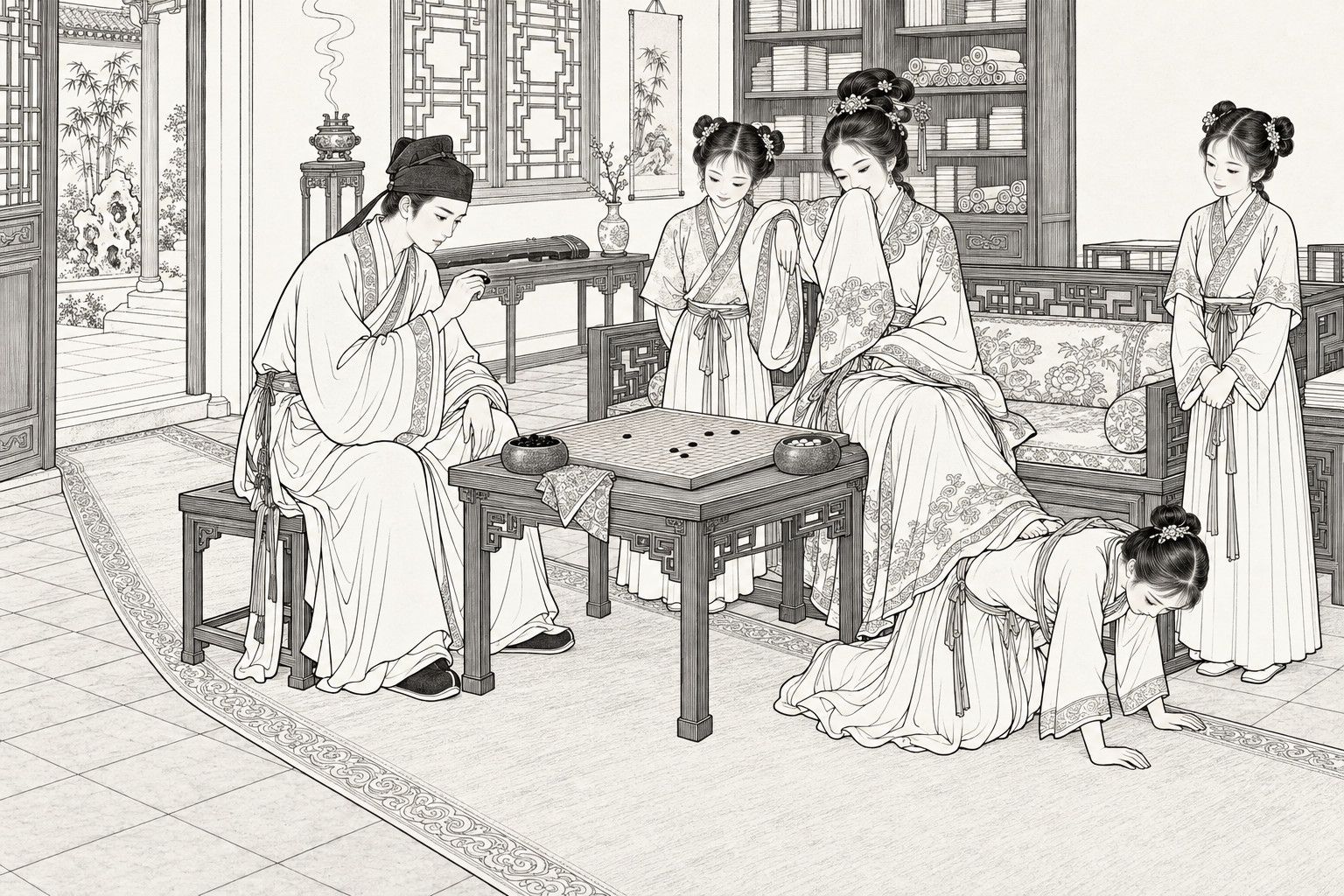
安大業,盧龍人。生而能言,母飲以犬血,始止。既長,韶秀,顧影無儔;慧而能讀。世家爭婚之。母夢曰:「兒當尚主。」信之。至十五六,迄無驗,亦漸自悔。一日,安獨坐,忽聞異香。俄一美婢奔入,曰:「公主至。」即以長氈貼地,自門外直至榻前。方駭疑間,一女郎扶婢肩入;服色容光,映照四堵。婢即以繡墊設榻上,扶女郎坐。安倉皇不知所為,鞠躬便問:「何處神仙,勞降玉趾?」女郎微笑,以袍袖掩口。婢曰:「此聖后府中雲蘿公主也。聖后屬意郎君,欲以公主下嫁,故使自來相宅。」安驚喜,不知置詞;女亦俯首:相對寂然。安故好棋,楸枰嘗置坐側。一婢以紅巾拂塵,移諸案上,曰:「主日耽此,不知與粉侯孰勝?」安移坐近案,主笑從之。甫三十餘著,婢竟亂之,曰:「駙馬負矣!」斂子入盒,曰:「駙馬當是俗間高手,主僅能讓六子。」乃以六黑子實局中,主亦從之。主坐次,輒使婢伏坐下,以背受足;左足踏地,則更一婢右伏。又兩小鬟夾侍之;每值安凝思時,輒曲一肘伏肩上。局闌未結,小鬟笑云:「駙馬負一子。」進曰:「主惰,宜且退。」女乃傾身與婢耳語。婢出,少頃而還,以千金置榻上,告生曰:「適主言居宅湫隘,煩以此少致修飾,落成相會也。」一婢曰:「此月犯天刑,不宜建造;月後吉。」女起;生遮止,閉門。婢出一物,狀類皮排,就地鼓之;雲氣突出,俄頃四合,冥不見物,索之已杳。母知之,疑以為妖。而生神馳夢想,不能復捨。急於落成,無暇禁忌;刻日敦迫,廊舍一新。先是,有灤州生袁大用,僑寓鄰坊,投刺於門;生素寡交,託他出,又窺其亡而報之。後月餘,門外適相值,二十許少年也。宮絹單衣,絲帶烏履,意甚都雅。略與頃談,頗甚溫謹。悅之,揖而入。請與對弈,互有贏虧。已而設酒留連,談笑大懽。明日,邀生至其寓所,珍肴雜進,相待殷渥。有小童十二三許,拍板清歌,又跳擲作劇。生大醉,不能行,便令負之。生以其纖弱,恐不勝。袁強之。僮綽有餘力,荷送而歸。生奇之。次日,犒以金,再辭乃受。由此交情款密,三數日輒一過從。袁為人簡默,而慷慨好施。市有負債鬻女者,解囊代贖,無吝色。生以此益重之。過數日,詣生作別,贈象箸、楠珠等十餘事,白金五百,用助興作。生反金受物,報以束帛。後月餘,樂亭有仕宦而歸者,橐貲充牣。盜夜入,執主人,燒鐵鉗灼,劫掠一空。家人識袁,行牒追捕。鄰院屠氏,與生家積不相能,因其土木大興,陰懷疑忌。適有小僕竊象箸,賣諸其家,知袁所贈,因報大尹。尹以兵繞舍,值生主僕他出,執母而去。母衰邁受驚,僅存氣息,二三日不復飲食。尹釋之。生聞母耗,急奔而歸,則母病已篤,越宿遂卒。收殮甫畢,為捕役執去。尹見其年少溫文,竊疑誣枉,故恐喝之。生實述其交往之由。尹問:「何以暴富?」生曰:「母有藏鏹,因欲親迎,故治昏室耳。」尹信之,具牒解郡。鄰人知其無事,以重金賂監者,使殺諸途。路經深山,被曳近削壁,將推墮之。計逼情危,時方急難,忽一虎自叢莽中出,囓二役皆死,啣生去。至一處,重樓疊閣,虎入,置之。見雲蘿扶婢出,淒然慰弔:「妾欲留君,但母喪未卜窀穸。可懷牒去,到郡自投,保無恙也。」因取生胸前帶,連結十餘扣,囑云:「見官時,拈此結而解之,可以弭禍。」生如其教,詣郡自投。太守喜其誠信,又稽牒知其冤,銷名令歸。至中途,遇袁,下騎執手,備言情況。袁憤然作色,默不一語。生曰:「以君風采,何自污也?」袁曰:「某所殺皆不義之人,所取皆非義之財。不然,即遺於路者,不拾也。君教我固自佳,然如君家鄰,豈可留在人間耶!」言已,超乘而去。生歸,殯母已,柴門謝客。忽一夜,盜入鄰家,父子十餘口,盡行殺戮,止留一婢。席卷貲物,與僮分攜之。臨去,執燈謂婢:汝認之:殺人者我也,與人無涉。」並不啟關,飛簷越壁而去。明日,告官。疑生知情,又捉生去。邑宰詞色甚厲。生上堂握帶,且辨且解,宰不能詰,又釋之。既歸,益自韜晦,讀書不出,一跛嫗執炊而已。服既闋,日掃階庭,以待好音。一日,異香滿院。登閣視之,內外陳設煥然矣。悄揭畫簾,則公主凝妝坐。急拜之。女挽手曰:「君不信數,遂使土木為災;又以苫塊之戚,遲我三年琴瑟:是急之而反以得緩,天下事大抵然也。」生將出貲治具。女曰:「勿復須。」婢探櫝,肴羹熱如新出於鼎,酒亦芳冽。酌移時,日已投暮,足下所踏婢,漸都亡去。女四肢嬌惰,足股屈伸,似無所著。生狎抱之。女曰:「君暫釋手。今有兩道,請君擇之。」生攬項問故。曰:「若為棋酒之交,可得三十年聚首;若作床第之歡,可六年諧合耳。君焉取?」生曰:「六年後再商之。」女乃默然,遂相燕好。女曰:「妾固知君不免俗道,此亦數也。」因使生蓄婢媼,別居南院,炊爨紡織,以作生計。北院中並無煙火,惟棋枰、酒具而已。戶常闔,生推之則自開,他人不得入也。然南院人作事勤惰,女輒知之,每使生往譴責,無不具服。女無繁言,無響笑,與有所談,但俯首微哂。每駢肩坐,喜斜倚人。生舉而加諸膝,輕如抱嬰。生曰:「卿輕若此,可作掌上舞。」曰:「此何難!但婢子之為,所不屑耳。飛燕原九姊侍兒,屢以輕佻獲罪,怒謫塵間,又不守女子之貞;今已幽之。」閣上以錦布滿,冬未嘗寒,夏未嘗熱。女嚴冬皆著輕縠;生為製鮮衣,強使著之。踰時解去,曰:「塵濁之物,幾於壓骨成勞!」一日,抱諸膝上,忽覺沉倍曩昔,異之。笑指腹曰:「此中有俗種矣。」過數日,顰黛不食,曰:「近病惡阻,頗思煙火之味。」生乃為具甘旨。從此飲食遂不異於常人。一日曰:「妾質單弱,不任生產。婢子樊英頗健,可使代之。」乃脫衷服衣英,閉諸室。少頃,聞兒啼。啟扉視之,男也。喜曰:「此兒福相,大器也!」因名大器。繃納生懷,俾付乳媼,養諸南院。女自免身,腰細如初,不食煙火矣。忽辭生,欲暫歸寧。問返期,答以「三日」。鼓皮排如前狀,遂不見。至期不來;積年餘,音信全渺,亦已絕望。生鍵戶下幃,遂領鄉薦。終不肯娶;每獨宿北院,沐其餘芳。一夜,輾轉在榻,忽見燈火射窗,門亦自闢,群婢擁公主入。生喜,起問爽約之罪。女曰:「妾未愆期,天上二日半耳。」生得意自詡,告以秋捷,意主必喜。女愀然曰:「烏用是儻來者為!無足榮辱,止折人壽數耳。三日不見,入俗幛又深一層矣。」生由是不復進取。過數月,又欲歸寧。生殊悽戀。女曰:「此去定早還,無煩穿望。且人生合離,皆有定數,撙節之則長,恣縱之則短也。」既去,月餘即返。從此一年半歲輒一行,往往數月始還,生習為常,亦不之怪。又生一子。女舉之曰:「豺狼也!」立命棄之。生不忍而止,名曰可棄。甫周歲,急為卜婚。諸媒接踵,問其甲子,皆謂不合。曰:「吾欲為狼子治一深圈,竟不可得,當今傾敗六七年,亦數也。」囑生曰:「記取四年後,侯氏生女,左脅有小贅疣,乃此兒婦。當婚之,勿較其門地也。」即令書而誌之。後又歸寧,竟不復返。生每以所囑告親友。果有侯氏女,生有疣贅,侯賤而行惡,眾咸不齒,生竟媒定焉。大器十七歲及第,娶雲氏,夫妻皆孝友。父鐘愛之。可棄漸長,不喜讀,輒偷與無賴博賭,恆盜物償戲債。父怒,撻之,卒不改。相戒提防,不使有所得。遂夜出,小為穿窬。為主所覺,縛送邑宰。宰審其姓氏,以名刺送之歸。父兄共縶之,楚掠慘棘,幾於絕氣。兄代哀免,始釋之。父忿恚得疾,食銳減。乃為二子立析產書,樓閣沃田,盡歸大器。可棄怨怒,夜持刀入室,將殺兄,悞中嫂。先是,主有遺袴,絕輕耎,雲拾作寢衣。可棄斫之,火星四射,大懼,奔出。父知,病益劇,數月尋卒。可棄聞父死,始歸。兄善視之,而可棄益肆。年餘,所分田產略盡,赴郡訟兄。官審知其人,斥逐之。兄弟之好遂絕。又踰年,可棄二十有三,侯女十五矣。兄憶母言,欲急為完婚。召至家,除佳宅與居;迎婦入門,以父遺良田,悉登籍交之,曰:「數頃薄產,為若蒙死守之,今悉相付。吾弟無行,寸草與之,皆棄也。此後成敗,在於新婦:能令改行,無憂凍餓;不然,兄亦不能填無底壑也。」侯雖小家女,然固慧麗,可棄雅畏愛之,所言無敢違。每出,限以晷刻,過期,則詬厲不與飲食,可棄以此少斂。年餘,生一子。婦曰:「我以後無求於人矣。膏腴數頃,母子何患不溫飽?無夫焉,亦可也。」會可棄盜粟出賭,婦知之,彎弓於門以拒之。大懼,避去。窺婦入,逡巡亦入。婦操刀起。可棄反奔,婦逐斫之,斷幅傷臀,血沾襪履。忿極,往訴兄,兄不禮焉,冤慚而去。過宿復至,跪嫂哀泣,求先容於婦,婦決絕不納。可棄怒,將往殺婦,兄不語。可棄忿起,操戈直出。嫂愕然,欲止之。兄目禁之。俟其去,乃曰:「彼固作此態,實不敢歸也。」使人覘之,已入家門。兄始色動,將奔赴之,而可棄已坌息入。蓋可棄入家,婦方弄兒,望見之,擲兒床上,覓得廚刀;可棄懼,曳戈反走,婦逐出門外始返。兄已得其情,故詰之。可棄不言,惟向隅泣,目盡腫。兄憐之,親率之去,婦乃納之。俟兄出,罰使長跪,要以重誓,而後以瓦盆賜之食。自此改行為善。婦持籌握算,日致豐盈,可棄仰成而已。後年七旬,子孫滿前,婦猶時捋白鬚,使膝行焉。
安大业,卢龙人。生而能言,母饮以犬血,始止。既长,韶秀,顾影无俦;慧而能读。世家争婚之。母梦曰:「儿当尚主。」信之。至十五六,迄无验,亦渐自悔。一日,安独坐,忽闻异香。俄一美婢奔入,曰:「公主至。」即以长毡贴地,自门外直至榻前。方骇疑间,一女郎扶婢肩入;服色容光,映照四堵。婢即以绣垫设榻上,扶女郎坐。安仓皇不知所为,鞠躬便问:「何处神仙,劳降玉趾?」女郎微笑,以袍袖掩口。婢曰:「此圣后府中云萝公主也。圣后属意郎君,欲以公主下嫁,故使自来相宅。」安惊喜,不知置词;女亦俯首:相对寂然。安故好棋,楸枰尝置坐侧。一婢以红巾拂尘,移诸案上,曰:「主日耽此,不知与粉侯孰胜?」安移坐近案,主笑从之。甫三十余着,婢竟乱之,曰:「驸马负矣!」敛子入盒,曰:「驸马当是俗间高手,主仅能让六子。」乃以六黑子实局中,主亦从之。主坐次,辄使婢伏坐下,以背受足;左足踏地,则更一婢右伏。又两小鬟夹侍之;每值安凝思时,辄曲一肘伏肩上。局阑未结,小鬟笑云:「驸马负一子。」进曰:「主惰,宜且退。」女乃倾身与婢耳语。婢出,少顷而还,以千金置榻上,告生曰:「适主言居宅湫隘,烦以此少致修饰,落成相会也。」一婢曰:「此月犯天刑,不宜建造;月后吉。」女起;生遮止,闭门。婢出一物,状类皮排,就地鼓之;云气突出,俄顷四合,冥不见物,索之已杳。母知之,疑以为妖。而生神驰梦想,不能复舍。急于落成,无暇禁忌;刻日敦迫,廊舍一新。先是,有滦州生袁大用,侨寓邻坊,投刺于门;生素寡交,托他出,又窥其亡而报之。后月余,门外适相值,二十许少年也。宫绢单衣,丝带乌履,意甚都雅。略与顷谈,颇甚温谨。悦之,揖而入。请与对弈,互有赢亏。已而设酒留连,谈笑大懽。明日,邀生至其寓所,珍肴杂进,相待殷渥。有小童十二三许,拍板清歌,又跳掷作剧。生大醉,不能行,便令负之。生以其纤弱,恐不胜。袁强之。僮绰有余力,荷送而归。生奇之。次日,犒以金,再辞乃受。由此交情款密,三数日辄一过从。袁为人简默,而慷慨好施。市有负债鬻女者,解囊代赎,无吝色。生以此益重之。过数日,诣生作别,赠象箸、楠珠等十余事,白金五百,用助兴作。生反金受物,报以束帛。后月余,乐亭有仕宦而归者,橐赀充牣。盗夜入,执主人,烧铁钳灼,劫掠一空。家人识袁,行牒追捕。邻院屠氏,与生家积不相能,因其土木大兴,阴怀疑忌。适有小仆窃象箸,卖诸其家,知袁所赠,因报大尹。尹以兵绕舍,值生主仆他出,执母而去。母衰迈受惊,仅存气息,二三日不复饮食。尹释之。生闻母耗,急奔而归,则母病已笃,越宿遂卒。收殓甫毕,为捕役执去。尹见其年少温文,窃疑诬枉,故恐喝之。生实述其交往之由。尹问:「何以暴富?」生曰:「母有藏镪,因欲亲迎,故治昏室耳。」尹信之,具牒解郡。邻人知其无事,以重金赂监者,使杀诸途。路经深山,被曳近削壁,将推堕之。计逼情危,时方急难,忽一虎自丛莽中出,囓二役皆死,啣生去。至一处,重楼叠阁,虎入,置之。见云萝扶婢出,凄然慰吊:「妾欲留君,但母丧未卜窀穸。可怀牒去,到郡自投,保无恙也。」因取生胸前带,连结十余扣,嘱云:「见官时,拈此结而解之,可以弭祸。」生如其教,诣郡自投。太守喜其诚信,又稽牒知其冤,销名令归。至中途,遇袁,下骑执手,备言情况。袁愤然作色,默不一语。生曰:「以君风采,何自污也?」袁曰:「某所杀皆不义之人,所取皆非义之财。不然,即遗于路者,不拾也。君教我固自佳,然如君家邻,岂可留在人间耶!」言已,超乘而去。生归,殡母已,柴门谢客。忽一夜,盗入邻家,父子十余口,尽行杀戮,止留一婢。席卷赀物,与僮分携之。临去,执灯谓婢:汝认之:杀人者我也,与人无涉。」并不启关,飞檐越壁而去。明日,告官。疑生知情,又捉生去。邑宰词色甚厉。生上堂握带,且辨且解,宰不能诘,又释之。既归,益自韬晦,读书不出,一跛妪执炊而已。服既阕,日扫阶庭,以待好音。一日,异香满院。登阁视之,内外陈设焕然矣。悄揭画帘,则公主凝妆坐。急拜之。女挽手曰:「君不信数,遂使土木为灾;又以苫块之戚,迟我三年琴瑟:是急之而反以得缓,天下事大抵然也。」生将出赀治具。女曰:「勿复须。」婢探椟,肴羹热如新出于鼎,酒亦芳冽。酌移时,日已投暮,足下所踏婢,渐都亡去。女四肢娇惰,足股屈伸,似无所着。生狎抱之。女曰:「君暂释手。今有两道,请君择之。」生揽项问故。曰:「若为棋酒之交,可得三十年聚首;若作床第之欢,可六年谐合耳。君焉取?」生曰:「六年后再商之。」女乃默然,遂相燕好。女曰:「妾固知君不免俗道,此亦数也。」因使生蓄婢媪,别居南院,炊爨纺织,以作生计。北院中并无烟火,惟棋枰、酒具而已。户常阖,生推之则自开,他人不得入也。然南院人作事勤惰,女辄知之,每使生往谴责,无不具服。女无繁言,无响笑,与有所谈,但俯首微哂。每骈肩坐,喜斜倚人。生举而加诸膝,轻如抱婴。生曰:「卿轻若此,可作掌上舞。」曰:「此何难!但婢子之为,所不屑耳。飞燕原九姊侍儿,屡以轻佻获罪,怒谪尘间,又不守女子之贞;今已幽之。」阁上以锦布满,冬未尝寒,夏未尝热。女严冬皆着轻縠;生为制鲜衣,强使着之。逾时解去,曰:「尘浊之物,几于压骨成劳!」一日,抱诸膝上,忽觉沉倍曩昔,异之。笑指腹曰:「此中有俗种矣。」过数日,颦黛不食,曰:「近病恶阻,颇思烟火之味。」生乃为具甘旨。从此饮食遂不异于常人。一日曰:「妾质单弱,不任生产。婢子樊英颇健,可使代之。」乃脱衷服衣英,闭诸室。少顷,闻儿啼。启扉视之,男也。喜曰:「此儿福相,大器也!」因名大器。绷纳生怀,俾付乳媪,养诸南院。女自免身,腰细如初,不食烟火矣。忽辞生,欲暂归宁。问返期,答以「三日」。鼓皮排如前状,遂不见。至期不来;积年余,音信全渺,亦已绝望。生键户下帏,遂领乡荐。终不肯娶;每独宿北院,沐其余芳。一夜,辗转在榻,忽见灯火射窗,门亦自辟,群婢拥公主入。生喜,起问爽约之罪。女曰:「妾未愆期,天上二日半耳。」生得意自诩,告以秋捷,意主必喜。女愀然曰:「乌用是傥来者为!无足荣辱,止折人寿数耳。三日不见,入俗幛又深一层矣。」生由是不复进取。过数月,又欲归宁。生殊凄恋。女曰:「此去定早还,无烦穿望。且人生合离,皆有定数,撙节之则长,恣纵之则短也。」既去,月余即返。从此一年半岁辄一行,往往数月始还,生习为常,亦不之怪。又生一子。女举之曰:「豺狼也!」立命弃之。生不忍而止,名曰可弃。甫周岁,急为卜婚。诸媒接踵,问其甲子,皆谓不合。曰:「吾欲为狼子治一深圈,竟不可得,当今倾败六七年,亦数也。」嘱生曰:「记取四年后,侯氏生女,左胁有小赘疣,乃此儿妇。当婚之,勿较其门地也。」即令书而志之。后又归宁,竟不复返。生每以所嘱告亲友。果有侯氏女,生有疣赘,侯贱而行恶,众咸不齿,生竟媒定焉。大器十七岁及第,娶云氏,夫妻皆孝友。父钟爱之。可弃渐长,不喜读,辄偷与无赖博赌,恒盗物偿戏债。父怒,挞之,卒不改。相戒提防,不使有所得。遂夜出,小为穿窬。为主所觉,缚送邑宰。宰审其姓氏,以名刺送之归。父兄共絷之,楚掠惨棘,几于绝气。兄代哀免,始释之。父忿恚得疾,食锐减。乃为二子立析产书,楼阁沃田,尽归大器。可弃怨怒,夜持刀入室,将杀兄,悮中嫂。先是,主有遗袴,绝轻耎,云拾作寝衣。可弃斫之,火星四射,大惧,奔出。父知,病益剧,数月寻卒。可弃闻父死,始归。兄善视之,而可弃益肆。年余,所分田产略尽,赴郡讼兄。官审知其人,斥逐之。兄弟之好遂绝。又逾年,可弃二十有三,侯女十五矣。兄忆母言,欲急为完婚。召至家,除佳宅与居;迎妇入门,以父遗良田,悉登籍交之,曰:「数顷薄产,为若蒙死守之,今悉相付。吾弟无行,寸草与之,皆弃也。此后成败,在于新妇:能令改行,无忧冻饿;不然,兄亦不能填无底壑也。」侯虽小家女,然固慧丽,可弃雅畏爱之,所言无敢违。每出,限以晷刻,过期,则诟厉不与饮食,可弃以此少敛。年余,生一子。妇曰:「我以后无求于人矣。膏腴数顷,母子何患不温饱?无夫焉,亦可也。」会可弃盗粟出赌,妇知之,弯弓于门以拒之。大惧,避去。窥妇入,逡巡亦入。妇操刀起。可弃反奔,妇逐斫之,断幅伤臀,血沾袜履。忿极,往诉兄,兄不礼焉,冤惭而去。过宿复至,跪嫂哀泣,求先容于妇,妇决绝不纳。可弃怒,将往杀妇,兄不语。可弃忿起,操戈直出。嫂愕然,欲止之。兄目禁之。俟其去,乃曰:「彼固作此态,实不敢归也。」使人觇之,已入家门。兄始色动,将奔赴之,而可弃已坌息入。盖可弃入家,妇方弄儿,望见之,掷儿床上,觅得厨刀;可弃惧,曳戈反走,妇逐出门外始返。兄已得其情,故诘之。可弃不言,惟向隅泣,目尽肿。兄怜之,亲率之去,妇乃纳之。俟兄出,罚使长跪,要以重誓,而后以瓦盆赐之食。自此改行为善。妇持筹握算,日致丰盈,可弃仰成而已。后年七旬,子孙满前,妇犹时捋白须,使膝行焉。
An Daye was a man of Lulong. He could talk as soon as he was born; only when his mother gave him dog’s blood to drink did he stop. When he grew up he was handsome and refined, with no match but his own reflection, and he was clever and good at his books. Great families vied to marry their daughters to him. His mother had a dream, and said, “Our son is to marry a princess.” She believed it. But he reached fifteen, then sixteen, and nothing came of it, and little by little regret set in. One day, as An sat alone, he suddenly smelled a strange fragrance. Soon a pretty maid ran in. “The princess is here,” she said. At once a long felt carpet was laid along the ground, from outside the gate right up to his couch. While he was still startled and wondering, a young lady came in, leaning on a maid’s shoulder; her clothes and her radiance lit up all four walls. The maid put an embroidered cushion on the couch and helped her sit. An was flustered and did not know what to do. He bowed and asked, “What immortal are you, to trouble your jade feet to come down here?” The lady smiled and hid her mouth behind her sleeve. “This is Princess Yunluo, of the Holy Empress’s palace,” said the maid. “The Holy Empress has her eye on you, young sir, and means to give you the princess in marriage, so she has sent her to look over your house herself.” An was astonished and delighted, and could not find a word to say. The girl, too, kept her head bowed. They sat facing each other in silence. An had always loved weiqi, and kept a board of catalpa wood beside his seat. A maid dusted it with a red kerchief and moved it onto the table. “The princess is absorbed in this every day,” she said. “I wonder which is better, she or the Powdered Marquis?” An moved his seat up to the table, and the princess, smiling, did the same. They had played barely thirty moves when the maid swept the stones into disorder. “The consort has lost!” she said. She gathered the stones into their boxes. “The consort must be a master among mortals. The princess can give him only six stones.” So she set six black stones on the board for him, and the princess went along with it. As the princess sat, she always had a maid crouch beneath her seat to take her feet on her back; when she put her left foot down, another maid crouched on the right. Two little maids stood in attendance on either side, and whenever An was deep in thought over a move, she would bend an elbow and lean on one of their shoulders. The game was nearly over but not yet counted when a little maid laughed. “The consort has lost by one stone.” She stepped forward. “The princess is tired. She should withdraw for now.” The girl leaned over and whispered to a maid. The maid went out, came back shortly, and put a thousand taels on the couch. “The princess said just now that your house is cramped and low,” she told him. “Please use this to do it up a little. When it is finished, she will meet you.” Another maid said, “This month falls under the Heavenly Punishment. It is not right for building. After this month it will be lucky.” The girl rose. An barred her way and shut the door. A maid brought out a thing shaped like a leather bellows and pumped it on the ground. Cloud billowed out of it, and in a moment closed in on every side, so dark that nothing could be seen. When he searched for them, they were gone. His mother heard of it and suspected they were evil spirits. But An’s mind ran after the princess waking and dreaming; he could not let her go. In his haste to finish the house he had no time for taboos. He set a date and pressed the work, and the halls and rooms were all made new. Before this, a scholar from Luanzhou named Yuan Dayong, lodging in a neighbouring quarter, had left his card at the gate. An had never cared for company; he sent word that he was out, then watched until Yuan was away and went to return the call. A month or so later they happened to meet outside the gate. Yuan was a young man of about twenty, in an unlined gown of palace silk, with a silk sash and black shoes, and a most elegant air. They talked a little, and he was gentle and courteous. An liked him, and bowed him in. He invited him to a game of weiqi, and each won some and lost some. Then An set out wine and kept him on, and they talked and laughed with great pleasure. The next day Yuan invited An to his lodging and served him dish after dish of delicacies, treating him most warmly. A page boy of twelve or thirteen sang in a clear voice, beating time with clappers, then leaped and tumbled to amuse them. An got very drunk and could not walk, so Yuan told the boy to carry him. An thought him too slight, and feared he could not manage. Yuan insisted. The boy had strength to spare; he took An on his back and carried him home. An thought it remarkable. The next day he sent the boy a reward of money; the boy refused twice before he took it. From then on the two were close friends, and called on each other every few days. Yuan was a man of few words, but generous and fond of giving. When a man in the market was selling his daughter to pay a debt, Yuan opened his purse and bought her back, without a trace of grudging. An thought all the more of him for it. Some days later Yuan came to take his leave. He gave An a dozen or so things, ivory chopsticks, nanmu-wood beads and the like, and five hundred taels of silver to help with the building. An returned the silver, kept the things, and gave him a bolt of silk in return. A month or so later, in Laoting, an official came home from his post with his bags stuffed full. Robbers broke in at night, seized the master, burned him with red-hot tongs, and carried off everything. The household recognized Yuan, and warrants went out for his arrest. The Tu family next door to An had long been at odds with his household, and when they saw his great building works they grew secretly suspicious and spiteful. It happened that a young servant of An’s stole the ivory chopsticks and sold them to the Tus. Learning they were Yuan’s gift, the Tus reported it to the magistrate. The magistrate surrounded the house with soldiers. An and his servant happened to be out, so they took his mother away. She was old and frail, and the fright left her barely breathing; for two or three days she would not eat or drink. The magistrate let her go. When An heard the news he rushed home, but his mother was already gravely ill, and she died the next night. He had barely laid her in her coffin when the constables seized him. The magistrate, seeing how young and gentle he was, privately suspected a false charge, and tried to frighten him. An told him truthfully how he had come to know Yuan. “How did you get rich so suddenly?” the magistrate asked. “My mother had money put away,” said An. “I am about to bring home a bride, so I was making ready the bridal rooms.” The magistrate believed him, and sent him under escort to the prefecture with a report. The neighbours knew he would get off, so they paid the guards a large bribe to kill him on the road. Their way led through deep mountains. The guards dragged him to a sheer cliff and were about to push him over. At this desperate moment, with no way out, a tiger sprang from the thickets, bit both guards to death, and carried An off in its jaws. It came to a place of towers and halls rising one above another, went in, and set him down. Yunluo came out, leaning on a maid, and sadly consoled him on his loss. “I would keep you here,” she said, “but your mother’s grave is not yet chosen. Take the papers with you and give yourself up at the prefecture. I promise no harm will come to you.” She took the sash at his breast and tied a dozen or more knots in it. “When you stand before the official,” she told him, “pick at these knots and untie them, and the trouble will pass.” An did as she said, and gave himself up at the prefecture. The prefect was pleased with his honesty, and, finding from the papers that he had been wronged, struck his name from the case and sent him home. Halfway home he met Yuan. He got down from his horse, took his hand, and told him all that had happened. Yuan’s face darkened with anger, but he said not a word. “A man of your bearing,” said An, “why do you sully yourself?” “Everyone I have killed was a wicked man,” said Yuan, “and everything I have taken was ill-gotten. If not, I would not pick up so much as a thing dropped on the road. Your advice is good in itself. But people like your neighbours — how can they be left in the world?” With that he leaped onto his horse and was gone. An went home, held his mother’s funeral, and shut his brushwood gate against callers. One night a robber broke into the house next door and slaughtered the whole family, father, sons and all, more than ten people, sparing only one maid. He swept up everything of value, and he and his boy carried it off between them. As he was leaving, he held up a lamp and said to the maid, “Take a good look. I am the one who did the killing. It has nothing to do with anyone else.” He did not even open the gate, but flew over eaves and walls and was gone. The next day it was reported. The officials suspected An knew something, and arrested him again. The county magistrate was harsh in word and look. An went up into the hall holding his sash, and as he argued he untied the knots; the magistrate could find nothing to put to him, and released him again. Back home, he hid himself away more than ever, reading and never going out, with only a lame old woman to cook for him. When his mourning was over, he swept the steps and courtyard every day, waiting for good news. One day a strange fragrance filled the courtyard. He went up to the upper rooms to look, and found them furnished in splendour inside and out. Quietly he lifted the painted curtain: there sat the princess in full array. He hastened to bow to her. She took his hand. “You did not believe in fate,” she said, “and so your building brought disaster on you. Then your grief on the straw mat and clod pillow put off our music of zither and lute for three years. Hurry a thing and it comes all the slower. Most things in the world are like that.” An was going to spend money on a feast. “There is no need,” she said. A maid reached into a box, and the dishes and broth were as hot as if just out of the pot, and the wine was fragrant and clear. They drank for a while. As the sun went down, the maids she had been resting her feet on all slipped away one by one. The princess grew languid in every limb; she bent and stretched her legs as if they had nothing to rest on. An took her in his arms. “Let go for a moment,” she said. “There are two roads before you. Choose one.” He held her round the neck and asked what she meant. “If we are companions over chess and wine, we may have thirty years together. If we take the pleasures of the bed, we will have six years of harmony, no more. Which will you take?” “Let us talk it over again in six years,” said An. She said nothing, and they made love. “I knew you could not escape the common way,” she said. “This too is fate.” So she had An take on maids and old women to live apart in the south courtyard, cooking, spinning and weaving to make a living. In the north courtyard no cooking fire was ever lit; there was only the weiqi board and the wine things. Its door was always shut. When An pushed it, it opened of itself; no one else could get in. Yet whether the people in the south courtyard worked hard or idled, the princess always knew, and she would send An to rebuke them; not one failed to own up. She spoke little and never laughed aloud. When he talked to her, she only bowed her head and smiled faintly. When they sat shoulder to shoulder, she liked to lean against him. An would lift her onto his knee; she was as light as a baby in his arms. “You are so light, my dear,” he said, “you could dance on the palm of a hand.” “What is hard about that? Only it is a thing for maids, and beneath me. Feiyan was my ninth sister’s handmaid. She was punished again and again for her flighty ways, until in anger she was banished to the dusty world below, where she did not keep a woman’s chastity either. She is shut away now.” The upper rooms were hung all over with brocade; they were never cold in winter, never hot in summer. Even in the depths of winter the princess wore only light gauze. An had new clothes made for her and pressed her to put them on. After a while she took them off. “Things of the dusty, muddy world,” she said. “They weigh on my bones till I nearly fall ill.” One day, holding her on his knee, he suddenly found her twice as heavy as before, and wondered at it. She smiled and pointed to her belly. “There is a mortal seed in here.” A few days later she knit her brows and would not eat. “I have morning sickness,” she said, “and I rather long for the taste of food cooked over a fire.” So An got delicacies for her, and from then on she ate and drank like anyone else. One day she said, “My constitution is frail. I am not equal to giving birth. My maid Fan Ying is sturdy; she can do it in my place.” She took off her underclothes, dressed Ying in them, and shut her in a room. In a moment they heard a baby cry. They opened the door: it was a boy. The princess was delighted. “This child has a lucky face. He will be a great vessel!” So he was named Daqi, Great Vessel. She swaddled him and put him in An’s arms, and had him handed to a wet nurse and raised in the south courtyard. Once she was delivered, her waist was as slender as before, and she no longer ate food cooked over fire. Then suddenly she took leave of An: she wanted to go home for a while to visit her mother. He asked when she would be back. “In three days,” she said. She pumped the leather bellows as before, and vanished. The day came and she did not. A year and more passed with no word at all, and he gave up hope. An locked his door, let down the curtain over his books, and went on to pass the provincial examination. He would never marry. He always slept alone in the north courtyard, bathed in the scent she had left. One night, as he tossed and turned on his bed, lamplight suddenly shone in at the window, the door opened of itself, and a crowd of maids came in around the princess. An was overjoyed. He got up and charged her with breaking her word. “I have not missed the day,” she said. “It is only two and a half days in Heaven.” Pleased with himself, An boasted of his success in the autumn examination, sure that the princess would be glad. Her face fell. “What use is a thing that comes by chance like that? It brings no true honour or disgrace; it only cuts short your years. I have not seen you for three days, and you have sunk one layer deeper into the veils of the world.” After that An sought no further advancement. A few months later she wanted to visit home again. An was very sad to let her go. “This time I will surely be back soon,” she said. “You need not wear your eyes out watching for me. Besides, our meetings and partings in life all have their fixed measure. Spend them sparingly and they last long; squander them and they are short.” She went, and came back in a month or so. From then on she went every year or half year, often not returning for several months. An grew used to it and thought nothing of it. She bore another son. She held him up. “A jackal, a wolf!” she said, and ordered at once that he be cast away. An could not bear it and stopped them. He named the boy Keqi, Fit to Be Thrown Away. When the child was barely a year old, she hastened to find him a match. Matchmakers came one after another, but when the birth dates were compared, none was found to suit. “I wanted to build a deep pen for this wolf cub,” she said, “and it cannot be had. He must go to ruin for six or seven years. That too is fate.” She told An, “Remember this. Four years from now, a family named Hou will have a daughter with a small wart on her left side. She is this boy’s wife. Marry him to her, and never mind her family’s standing.” She had him write it down to remember it. Later she went home again, and this time never came back. An often told relatives and friends what she had charged him with. Sure enough, a daughter was born to the Hou family with a wart. The Hous were lowly people of bad conduct whom everyone looked down on, but An went ahead and had the match arranged. Daqi passed the examinations at seventeen and married a girl of the Yun family. Husband and wife were both dutiful and loving, and their father doted on them. As Keqi grew up he had no liking for books. He would sneak off to gamble with ruffians, and was always stealing things to pay his gambling debts. His father beat him in fury, but he never mended. The household warned each other to watch him and let nothing fall into his hands. So he went out at night and took to petty burglary. A householder caught him, tied him up, and took him to the county magistrate. When the magistrate found out his family name, he sent him home with his own visiting card. His father and brother tied him up together and flogged him so cruelly that he nearly stopped breathing. Only when his brother begged them to spare him did they let him go. His father fell ill from rage and vexation, and ate far less. He drew up a deed dividing the property between his two sons; the buildings and fertile fields all went to Daqi. Keqi, bitter and furious, came into the room one night with a knife to kill his brother, and struck his sister-in-law by mistake. Now the princess had left behind a pair of trousers, extremely light and soft, and Daqi’s wife, Mrs. Yun, had taken them to sleep in. When Keqi’s blade struck them, sparks flew every way. In terror he ran out. When his father learned of it, his illness grew worse, and a few months later he died. Only on hearing of his father’s death did Keqi come home. His brother treated him well, but Keqi grew wilder than ever. In a year or so he had run through nearly all his share of the land, and he went to the prefecture to sue his brother. The official, knowing what sort of man he was, threw him out. That was the end of brotherly feeling between them. Another year passed. Keqi was twenty-three, and the Hou girl fifteen. His brother remembered their mother’s words and wanted the marriage done quickly. He called Keqi home and cleared a fine house for him to live in. When the bride came in at the gate, he entered in the register all the good fields their father had left and handed them over to her. “These few qing of poor land,” he said, “I have guarded with my life for you, and now I hand them all over. My brother has no conduct. Give him so much as a blade of grass and he will throw it away. From now on, whether he makes good or comes to ruin rests with you, his bride. If you can make him mend his ways, you need never fear cold or hunger. If not, even I, his brother, cannot fill a bottomless pit.” Though the Hou girl came of a humble family, she was clever and pretty, and Keqi both feared and loved her; he dared not cross a word she said. Whenever he went out she set him a time to be back. If he was late, she cursed him fiercely and gave him nothing to eat or drink. This reined Keqi in a little. After a year or so she bore a son. “From now on I need nothing from anyone,” she said. “With a few qing of rich land, why should mother and son fear going cold or hungry? I can do without a husband too.” Then Keqi stole some grain to go gambling. When his wife found out, she stood at the gate with her bow drawn to keep him out. He was terrified and slunk off. He watched until she went in, then crept in after her. She took up a knife and rose. Keqi turned and ran; she chased him and slashed, cutting through his gown and into his buttock, so that blood soaked his socks and shoes. Beside himself with rage, he went to complain to his brother. His brother showed him no courtesy, and he left aggrieved and ashamed. The next day he came again, knelt to his sister-in-law and wept, begging her to speak for him to his wife first. But his wife flatly refused to take him back. Keqi, in a rage, said he would go and kill his wife. His brother said nothing. Keqi sprang up furious, seized a halberd, and went straight out. His sister-in-law was alarmed and wanted to stop him, but his brother checked her with a look. When Keqi had gone, he said, “He’s only putting on a show. He doesn’t really dare go home.” He sent someone to spy; Keqi had already gone in at his own gate. Only then did the brother’s face change. He was about to rush over when Keqi came in, panting. What had happened was this. When Keqi went in, his wife was playing with the baby. Seeing him, she tossed the baby onto the bed and found a kitchen knife. Keqi was frightened; he turned and fled, trailing his halberd, and she chased him out of the gate before she turned back. His brother already knew the whole story, but asked him anyway. Keqi said nothing; he only wept facing the corner until his eyes were swollen shut. His brother pitied him and took him back himself, and then his wife let him in. Once the brother had left, she made him kneel a long time as punishment and swear a solemn oath, and only then did she give him food in an earthenware bowl. From then on he mended his ways and lived a good life. His wife kept the accounts and managed everything, and they grew richer by the day; Keqi simply lived on what she made. Later, when he was seventy, with sons and grandsons all around him, his wife would still now and then take hold of his white beard and make him go about on his knees.
異史氏曰:「悍妻妒婦,遭之者如疽附於骨,死而後已,豈不毒哉!然砒、附,天下之至毒也,苟得其用,瞑眩大瘳,非參、苓所能及矣。而非仙人洞見臟腑,又烏敢以毒藥貽子孫哉!」
异史氏曰:「悍妻妒妇,遭之者如疽附于骨,死而后已,岂不毒哉!然砒、附,天下之至毒也,苟得其用,瞑眩大瘳,非参、苓所能及矣。而非仙人洞见脏腑,又乌敢以毒药贻子孙哉!」
The Historian of the Strange says: A shrewish wife, a jealous woman: to the man who meets one she is like an ulcer clinging to the bone, not gone till he dies. Is that not poison? Yet arsenic and aconite are the deadliest poisons under heaven, and if they are put to the right use, the patient reels and is wholly cured, as ginseng and poria could never do. But who but an immortal, seeing straight into a man’s vitals, would dare leave poison as a legacy to children and grandchildren?