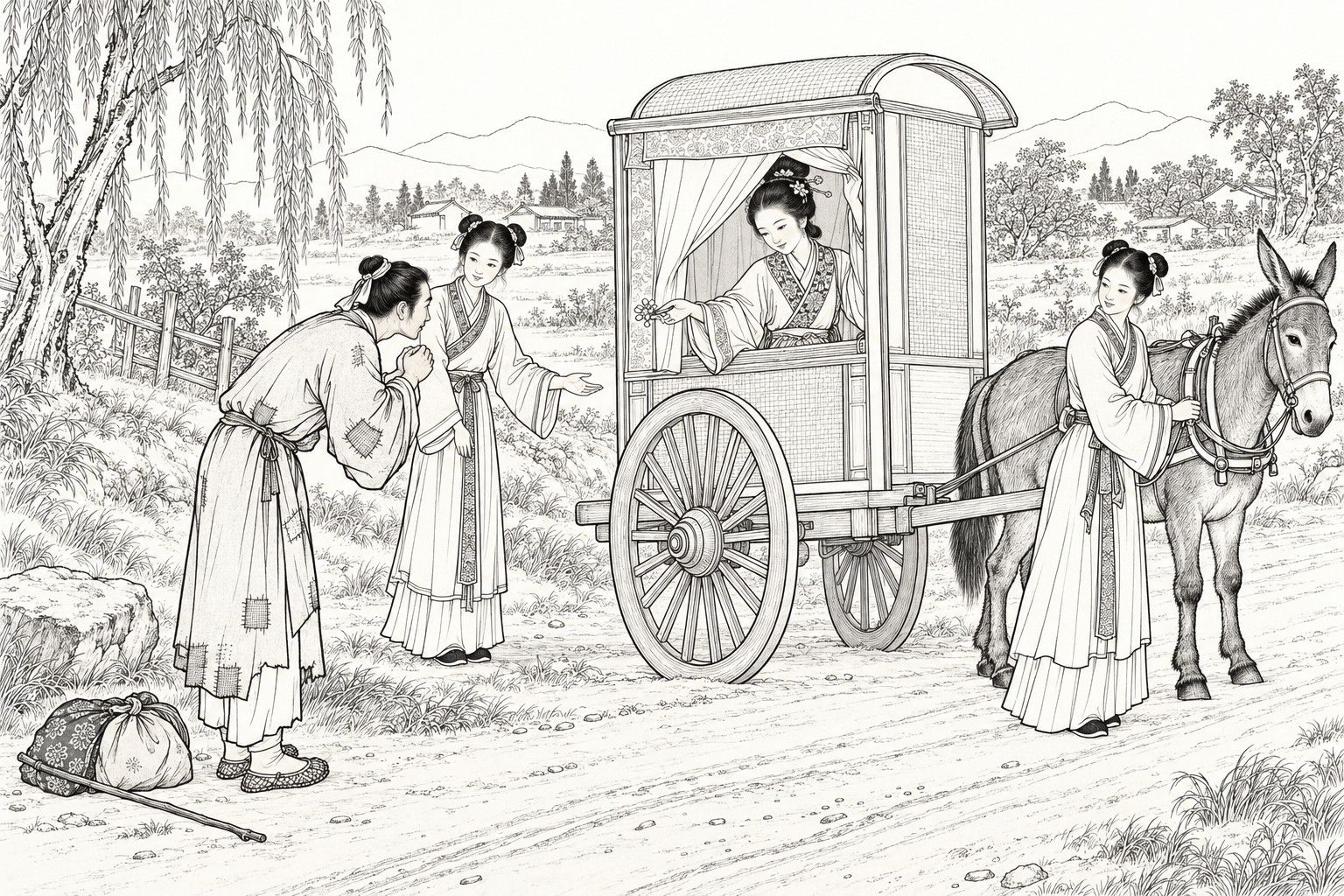
米生者,閩人,傳者忘其名字、郡邑。偶入郡,醉過市廛,聞高門中簫鼓如雷。問之居人,云是開壽筵者,然門庭亦殊清寂。聽之,笙歌繁響。醉中雅愛樂之,並不問其何家,即街頭市祝儀,投晚生刺焉。或見其衣冠樸陋,便問:「君係此翁何親?」答言:「無之。」或言:「此流寓者,僑居於此,不審何官,甚貴倨也。既非親屬,將何求?」生聞而悔之,而刺已入矣。無何,兩少年出逆客,華裳眩目,丰采都雅,揖生入。見一叟南向坐,東西列數筵,客六七人,皆似貴冑;見生至,盡起為禮,叟亦杖而起。生久立,待與周旋,而叟殊不離席。兩少年致詞曰:「家君衰邁,起拜良艱,予兄弟代謝高賢之見枉也。」生遜謝而罷。遂增一筵於上,與叟接席。未幾,女樂作於下。座後設琉璃屏,以幛內眷。鼓吹大作,座客不復可以傾談。筵將終,兩少年起,各以巨杯勸客,杯可容三斗,生有難色;然見客受,亦受。頃刻四顧,主客盡釂;生不得已,亦強盡之。少年復斟。生覺憊甚,起而告退。少年強挽其裾。生大醉逿地,但覺有人以冷水灑面,恍然若寤。起視,賓客盡散,惟一少年捉臂送之,遂別而歸。後再過其門,則已遷去矣。自郡歸,偶適市,一人自肆中出,招之飲。視之,不識;姑從之入,則座上先有里人鮑莊在焉。問其人,乃諸姓,市中磨鏡者也。問:「何相識?」曰:「前日上壽者,君識之否?」生言:「不識。」諸言:「予出入其門最稔。翁,傅姓,但不知何省何官。先生上壽時,我方在墀下,故識之也。」日暮,飲散。鮑莊夜死於途。鮑父不識諸,執名訟生。檢得鮑莊體有重傷,生以謀殺論死,備歷械梏;以諸未獲,罪無申證,頌繫之。年餘,直指巡方,廉知其冤,出之。家中田產蕩盡,而衣巾革褫,冀其可以辨復,於是攜囊入郡。日將暮,步履頗殆,休於路側。遙見小車來,二青衣夾隨之。既過,忽命停輿。車中不知何言。俄一青衣問生:「君非米姓乎?」生驚起諾之。問:「何貧窶若此?」生告以故。又問:「安之?」又告之。青衣去,向車中語;俄復返,請生至車前。車中以纖手搴簾,微睨之,絕代佳人也。謂生曰:「君不幸得無妄之禍,聞之太息。今日學使署中,非白手可以出入者,途中無可解贈,……」乃於髻上摘珠花一朵,授生曰:「此物可鬻百金,請緘藏之。」生下拜,欲問官閥,車行甚疾,其去已遠,不解何人。執花懸想,上綴明珠,非凡物也。珍藏而行。至郡,投狀,上下勒索甚苦;出花展視,不忍置去,遂歸。歸而無家,依於兄嫂。幸兄賢,為之經紀,貧不廢讀。過歲,赴郡應童子試,誤入深山。會清明節,游人甚眾。有數女騎來,內一女郎,即曩年車中人也。見生停驂,問其所往。生具以對。女驚曰:「君衣頂尚未復耶?」生慘然於衣下出珠花,曰:「不忍棄此,故猶童子也。」女郎暈紅上頰。既,囑坐待路隅,款段而去。久之,一婢馳馬來,以裹物授生,曰:「娘子言:今日學使之門如市,贈白金二百,為進取之資。」生辭曰:「娘子惠我多矣!自分掇芹非難,重金所不敢受。但告以姓名,繪一小像,焚香供之,足矣。」婢不顧,委地下而去。生由此用度頗充,然終不屑夤緣。後入邑庠第一。以金授兄;兄善居積,三年,舊業盡復。適閩中巡撫為生祖門人,優卹甚厚,兄弟稱巨家矣。然生素清鯁,雖屬大僚通家,而未嘗有所干謁。一日,有客裘馬至門,都無識者。出視,則傅公子也。揖而入,各道間闊。治具相款。客辭以冗,然亦不竟言去。已而肴酒既陳,公子起而請閒,相將入內,拜伏於地。生驚問:「何事?」愴然曰:「家君適罹大禍,欲有求於撫臺,非兄不可。」生辭曰:「渠雖世誼,而以私干人,生平所不為也。」公子伏地哀泣。生厲色曰:「小生與公子,一飲之知交耳,何遂以喪節強人!」公子大慚,起而別去。越日,方獨坐,有青衣人入,視之,即山中贈金者。生方驚起,青衣曰:「君忘珠花否?」生曰:「唯唯,不敢忘!」曰:「昨公子,即娘子胞兄也。」生聞之,竊喜,偽曰:「此難相信。若得娘子親見一言,則油鼎可蹈耳;不然,不敢奉命。」青衣出,馳馬而去。更盡復返,扣扉入曰:「娘子來矣!」言未已,女郎慘然入,向壁而哭,不作一語。生拜曰:「小生非卿,無以有今日。但有驅策,敢不惟命!」女曰:「受人求者常驕人,求人者常畏人。中夜奔波,生平何解此苦,祇以畏人故耳,亦復何言!」生慰之曰:「小生所以不遽諾者,恐過此一見為難耳。使卿夙夜蒙露,吾知罪矣!」因挽其祛。隱抑搔之。女怒曰:「子誠敝人也!不念疇昔之義,而欲乘人之厄。予過矣!予過矣!」忿然而出,登車欲去。生追出謝過,長跪而要遮之。青衣亦為緩頰。女意稍解,就車中謂生曰:「實告君:妾非人,乃神女也。家君為南岳都理司,偶失禮於地官,將達帝聽;非本地都人官印信,不可解也。君如不忘舊義,以黃紙一幅,為妾求之。」言已,車發遂去。生歸,悚懼不已。乃假驅祟,言於巡撫。巡撫謂其事近巫蠱,不許。生以厚金賂其心腹,諾之,而未得其便也。既歸,青衣候門,生具告之,默然遂去,意似怨其不忠。生追送之曰:「歸語娘子:如事不諧,我以身命殉之!」既歸,終夜輾轉,不知計之所出。適院署有寵姬購珠,乃以珠花獻之。姬大悅,竊印為生嵌之。懷歸,青衣適至。笑曰:「幸不辱命。然數年來貧賤乞食所不忍鬻者,今還為主人棄之矣!」因告以情;且曰:「黃金拋置,我都不惜;寄語娘子:珠花須要償也!」踰數日,傅公子登堂申謝,納黃金百兩。生作色曰:「所以然者,為令妹之惠我無私耳;不然,即萬金豈足以易名節哉!」再強之,聲色益厲。公子慚而去,曰:「此事殊未了!」翼日,青衣奉女郎命,進明珠百顆,曰:「此足以償珠花否耶?」生曰:「重花者,非貴珠也。設當日贈我萬鎰之寶,直須賣作富家翁耳,什襲而甘貧賤,何為乎?娘子神人,小生何敢他望,幸得報洪恩於萬一,死無憾矣!」青衣置珠案間,生朝拜而後卻之。越數日,公子又至。生命治肴酒。公子使從人入廚下,自行烹調,相對縱飲,懽若一家。有客餽苦糯,公子飲而美之,引盡百琖,面頰微赬。乃謂生曰:「君貞介士,愚兄弟不能早知君,有愧裙釵多矣。家君感大德,無以相報,欲以妹子附為婚姻,恐以幽明見嫌也。」生喜懼非常,不知所對。公子辭而出,曰:「明夜七月初九,新月鉤辰,天孫有少女下嫁,吉期也,可備青廬。」次夕,果送女郎至,一切無異常人。三日後,女自兄嫂以及婢僕,大小皆有餽賞。又最賢,事嫂如姑。數年不育,勸納副室,生不肯。適兄賈於江淮,為買少姬而歸。姬,顧姓,小字博士,貌亦清婉,夫婦皆喜。見髻上插珠花,甚似當年故物;摘視,果然。異而詰之。答云:「昔有巡撫愛妾死,其婢盜出鬻於市,先人廉其直,買而歸。妾愛之。先人無子,生妾一人,故所求無不得。後父死家落,妾寄養於顧媼之家;顧,妾姨行,見珠,屢欲售去,妾投井覓死,故至今猶存也。」夫婦歎曰:「十年之物,復歸故主,豈非數哉!」女另出珠花一朵,曰:「此物久無偶矣!」因並賜之,親為簪於髻上。姬退,問女郎家世甚悉,家人皆諱言之。陰語生曰:「妾視娘子,非人間人也;其眉目間有神氣。昨簪花時,得近視,其美麗出於肌裏,非若凡人以黑白位置中見長耳。」生笑之。姬曰:「君勿言,妾將試之:如其神,但有所須,無人處焚香以求,彼當自知。」女郎繡襪精工,博士愛之,而未敢言,乃即閨中焚香祝之。女早起,忽檢篋中,出襪,遣婢贈博士。生見之而笑。女問故,以實告。女曰:「黠哉婢乎!」因其慧,益憐愛之:然博士益恭,昧爽時,必熏沐以朝。後博士一舉兩男,兩人分字之。生年八十,女貌猶如處子。生抱病,女鳩匠為材,令寬大倍於尋常。既死,女不哭;男女他適,則女已入材中死矣。因並葬之。至今傳為「大材冢」云。
米生者,闽人,传者忘其名字、郡邑。偶入郡,醉过市廛,闻高门中箫鼓如雷。问之居人,云是开寿筵者,然门庭亦殊清寂。听之,笙歌繁响。醉中雅爱乐之,并不问其何家,即街头市祝仪,投晚生刺焉。或见其衣冠朴陋,便问:「君系此翁何亲?」答言:「无之。」或言:「此流寓者,侨居于此,不审何官,甚贵倨也。既非亲属,将何求?」生闻而悔之,而刺已入矣。无何,两少年出逆客,华裳眩目,丰采都雅,揖生入。见一叟南向坐,东西列数筵,客六七人,皆似贵胄;见生至,尽起为礼,叟亦杖而起。生久立,待与周旋,而叟殊不离席。两少年致词曰:「家君衰迈,起拜良艰,予兄弟代谢高贤之见枉也。」生逊谢而罢。遂增一筵于上,与叟接席。未几,女乐作于下。座后设琉璃屏,以幛内眷。鼓吹大作,座客不复可以倾谈。筵将终,两少年起,各以巨杯劝客,杯可容三斗,生有难色;然见客受,亦受。顷刻四顾,主客尽釂;生不得已,亦强尽之。少年复斟。生觉惫甚,起而告退。少年强挽其裾。生大醉逿地,但觉有人以冷水洒面,恍然若寤。起视,宾客尽散,惟一少年捉臂送之,遂别而归。后再过其门,则已迁去矣。自郡归,偶适市,一人自肆中出,招之饮。视之,不识;姑从之入,则座上先有里人鲍庄在焉。问其人,乃诸姓,市中磨镜者也。问:「何相识?」曰:「前日上寿者,君识之否?」生言:「不识。」诸言:「予出入其门最稔。翁,傅姓,但不知何省何官。先生上寿时,我方在墀下,故识之也。」日暮,饮散。鲍庄夜死于途。鲍父不识诸,执名讼生。检得鲍庄体有重伤,生以谋杀论死,备历械梏;以诸未获,罪无申证,颂系之。年余,直指巡方,廉知其冤,出之。家中田产荡尽,而衣巾革褫,冀其可以辨复,于是携囊入郡。日将暮,步履颇殆,休于路侧。遥见小车来,二青衣夹随之。既过,忽命停舆。车中不知何言。俄一青衣问生:「君非米姓乎?」生惊起诺之。问:「何贫窭若此?」生告以故。又问:「安之?」又告之。青衣去,向车中语;俄复返,请生至车前。车中以纤手搴帘,微睨之,绝代佳人也。谓生曰:「君不幸得无妄之祸,闻之太息。今日学使署中,非白手可以出入者,途中无可解赠,……」乃于髻上摘珠花一朵,授生曰:「此物可鬻百金,请缄藏之。」生下拜,欲问官阀,车行甚疾,其去已远,不解何人。执花悬想,上缀明珠,非凡物也。珍藏而行。至郡,投状,上下勒索甚苦;出花展视,不忍置去,遂归。归而无家,依于兄嫂。幸兄贤,为之经纪,贫不废读。过岁,赴郡应童子试,误入深山。会清明节,游人甚众。有数女骑来,内一女郎,即曩年车中人也。见生停骖,问其所往。生具以对。女惊曰:「君衣顶尚未复耶?」生惨然于衣下出珠花,曰:「不忍弃此,故犹童子也。」女郎晕红上颊。既,嘱坐待路隅,款段而去。久之,一婢驰马来,以裹物授生,曰:「娘子言:今日学使之门如市,赠白金二百,为进取之资。」生辞曰:「娘子惠我多矣!自分掇芹非难,重金所不敢受。但告以姓名,绘一小像,焚香供之,足矣。」婢不顾,委地下而去。生由此用度颇充,然终不屑夤缘。后入邑庠第一。以金授兄;兄善居积,三年,旧业尽复。适闽中巡抚为生祖门人,优恤甚厚,兄弟称巨家矣。然生素清鲠,虽属大僚通家,而未尝有所干谒。一日,有客裘马至门,都无识者。出视,则傅公子也。揖而入,各道间阔。治具相款。客辞以冗,然亦不竟言去。已而肴酒既陈,公子起而请闲,相将入内,拜伏于地。生惊问:「何事?」怆然曰:「家君适罹大祸,欲有求于抚台,非兄不可。」生辞曰:「渠虽世谊,而以私干人,生平所不为也。」公子伏地哀泣。生厉色曰:「小生与公子,一饮之知交耳,何遂以丧节强人!」公子大惭,起而别去。越日,方独坐,有青衣人入,视之,即山中赠金者。生方惊起,青衣曰:「君忘珠花否?」生曰:「唯唯,不敢忘!」曰:「昨公子,即娘子胞兄也。」生闻之,窃喜,伪曰:「此难相信。若得娘子亲见一言,则油鼎可蹈耳;不然,不敢奉命。」青衣出,驰马而去。更尽复返,扣扉入曰:「娘子来矣!」言未已,女郎惨然入,向壁而哭,不作一语。生拜曰:「小生非卿,无以有今日。但有驱策,敢不惟命!」女曰:「受人求者常骄人,求人者常畏人。中夜奔波,生平何解此苦,祇以畏人故耳,亦复何言!」生慰之曰:「小生所以不遽诺者,恐过此一见为难耳。使卿夙夜蒙露,吾知罪矣!」因挽其祛。隐抑搔之。女怒曰:「子诚敝人也!不念畴昔之义,而欲乘人之厄。予过矣!予过矣!」忿然而出,登车欲去。生追出谢过,长跪而要遮之。青衣亦为缓颊。女意稍解,就车中谓生曰:「实告君:妾非人,乃神女也。家君为南岳都理司,偶失礼于地官,将达帝听;非本地都人官印信,不可解也。君如不忘旧义,以黄纸一幅,为妾求之。」言已,车发遂去。生归,悚惧不已。乃假驱祟,言于巡抚。巡抚谓其事近巫蛊,不许。生以厚金赂其心腹,诺之,而未得其便也。既归,青衣候门,生具告之,默然遂去,意似怨其不忠。生追送之曰:「归语娘子:如事不谐,我以身命殉之!」既归,终夜辗转,不知计之所出。适院署有宠姬购珠,乃以珠花献之。姬大悦,窃印为生嵌之。怀归,青衣适至。笑曰:「幸不辱命。然数年来贫贱乞食所不忍鬻者,今还为主人弃之矣!」因告以情;且曰:「黄金抛置,我都不惜;寄语娘子:珠花须要偿也!」逾数日,傅公子登堂申谢,纳黄金百两。生作色曰:「所以然者,为令妹之惠我无私耳;不然,即万金岂足以易名节哉!」再强之,声色益厉。公子惭而去,曰:「此事殊未了!」翼日,青衣奉女郎命,进明珠百颗,曰:「此足以偿珠花否耶?」生曰:「重花者,非贵珠也。设当日赠我万镒之宝,直须卖作富家翁耳,什袭而甘贫贱,何为乎?娘子神人,小生何敢他望,幸得报洪恩于万一,死无憾矣!」青衣置珠案间,生朝拜而后却之。越数日,公子又至。生命治肴酒。公子使从人入厨下,自行烹调,相对纵饮,懽若一家。有客餽苦糯,公子饮而美之,引尽百琖,面颊微赪。乃谓生曰:「君贞介士,愚兄弟不能早知君,有愧裙钗多矣。家君感大德,无以相报,欲以妹子附为婚姻,恐以幽明见嫌也。」生喜惧非常,不知所对。公子辞而出,曰:「明夜七月初九,新月钩辰,天孙有少女下嫁,吉期也,可备青庐。」次夕,果送女郎至,一切无异常人。三日后,女自兄嫂以及婢仆,大小皆有餽赏。又最贤,事嫂如姑。数年不育,劝纳副室,生不肯。适兄贾于江淮,为买少姬而归。姬,顾姓,小字博士,貌亦清婉,夫妇皆喜。见髻上插珠花,甚似当年故物;摘视,果然。异而诘之。答云:「昔有巡抚爱妾死,其婢盗出鬻于市,先人廉其直,买而归。妾爱之。先人无子,生妾一人,故所求无不得。后父死家落,妾寄养于顾媪之家;顾,妾姨行,见珠,屡欲售去,妾投井觅死,故至今犹存也。」夫妇叹曰:「十年之物,复归故主,岂非数哉!」女另出珠花一朵,曰:「此物久无偶矣!」因并赐之,亲为簪于髻上。姬退,问女郎家世甚悉,家人皆讳言之。阴语生曰:「妾视娘子,非人间人也;其眉目间有神气。昨簪花时,得近视,其美丽出于肌里,非若凡人以黑白位置中见长耳。」生笑之。姬曰:「君勿言,妾将试之:如其神,但有所须,无人处焚香以求,彼当自知。」女郎绣袜精工,博士爱之,而未敢言,乃即闺中焚香祝之。女早起,忽检箧中,出袜,遣婢赠博士。生见之而笑。女问故,以实告。女曰:「黠哉婢乎!」因其慧,益怜爱之:然博士益恭,昧爽时,必熏沐以朝。后博士一举两男,两人分字之。生年八十,女貌犹如处子。生抱病,女鸠匠为材,令宽大倍于寻常。既死,女不哭;男女他适,则女已入材中死矣。因并葬之。至今传为「大材冢」云。
There was a scholar named Mi, a man of Fujian. Whoever passed the story on has forgotten his given name, and his prefecture and county too. Once he went to the prefectural city, and as he was passing drunk through the market he heard pipes and drums thundering behind a lofty gate. He asked the people who lived nearby, and they said someone was holding a birthday feast. Yet the gateway and courtyard were strangely quiet. He listened: pipes and singing, a rich swell of sound. He was drunk and had always loved music, so he did not even ask whose house it was. He bought a birthday gift right there in the street and sent in his visiting card, signed ‘your junior’. Someone saw how plain and shabby his clothes and cap were and asked, “What relation are you to the old gentleman?” “None,” he answered. Another said, “He’s a stranger, only lodging here for a while. No one knows what office he holds, but he’s very grand and haughty. If you’re no relation, what are you after?” Mi heard this and was sorry, but his card had already gone in. Before long two young men came out to receive the guest. Their clothes were dazzling, and they were handsome and refined. They bowed Mi in. He saw an old man seated facing south, with several tables set out along the east and west sides, and six or seven guests who all looked like sons of noble houses. When they saw Mi come in they all rose to greet him, and the old man rose too, leaning on his staff. Mi stood a long while, waiting to go through the courtesies with him, but the old man never left his seat. The two young men spoke for him: “Our father is old and feeble, and finds it very hard to rise and bow. We brothers thank you in his place, worthy sir, for honouring us with your visit.” Mi modestly returned their thanks, and that was all. Then another table was added at the top, next to the old man’s. Soon girl musicians began to play below. Behind the seats stood a glass screen to shield the women of the household. The drums and pipes rose to such a din that the guests could no longer talk. When the feast was nearly over, the two young men rose and each pressed a huge cup on the guests. Each cup would hold three pecks. Mi looked dismayed, but when he saw the others accept, he accepted too. In a moment he looked around: host and guests had all drained their cups. Mi had no choice but to force his down as well. The young men poured again. Mi felt utterly spent, and rose to take his leave. The young men caught at his robe to keep him. Mi, dead drunk, fell sprawling. All he knew was that someone was sprinkling cold water on his face, and he came to as if waking. He got up and looked. The guests had all gone, and only one of the young men was holding his arm to see him out. So he said goodbye and went home. Later he passed that gate again, and they had moved away. After he came home from the city, he happened to go to the market one day, and a man came out of a shop and invited him in for a drink. Mi looked at him and did not know him. Still, he went in with him, and found Bao Zhuang, a man from his own village, already seated there. Mi asked who his host was. It was a man named Zhu, who polished mirrors in the market. “How do you know me?” Mi asked. “The man whose birthday you went to the other day — do you know him?” “No,” said Mi. “I’m in and out of that house more than anyone,” said Zhu. “The old man’s name is Fu, but I don’t know what province he’s from or what office he holds. When you went up with your birthday wishes, sir, I was just below the steps. That’s how I know you.” At dusk the drinking broke up. That night Bao Zhuang died on the road. Bao’s father did not know Zhu, so he named Mi in his suit. The inquest found grave wounds on Bao Zhuang’s body. Mi was sentenced to death for murder and suffered every kind of shackle and fetter. Zhu had not been caught, so there was no witness to prove the crime, and Mi was kept in custody, out of irons. After more than a year the imperial inspector came through on his tour, found out that Mi had been wronged, and let him go. His family’s land and property were all gone, and he had been stripped of his scholar’s robe and cap. He hoped to clear his name and have them restored, so he took up his bag and set off for the prefectural city. As the day was ending, worn out with walking, he rested at the roadside. In the distance he saw a small carriage coming, with a maid walking on either side. When it had passed, an order suddenly came to stop. Something was said inside, but he could not tell what. Presently one of the maids asked him, “Is your name not Mi, sir?” Mi started up and said it was. “Why are you so poor and wretched?” she asked. He told her the reason. “And where are you going?” He told her that too. The maid went back and spoke towards the carriage. She soon returned and asked Mi to come up to it. From inside, a slender hand lifted the curtain. She glanced at him sidelong: she was a beauty such as an age sees only once. She said to him, “You have had the misfortune to meet with a disaster you did nothing to deserve. When I heard of it I sighed. These days no one goes in and out of the education commissioner’s office empty-handed. I have nothing with me on the road that I can give you…” Then she took a pearl flower from her hair and handed it to him. “This will fetch a hundred taels. Please keep it safe.” Mi bowed to the ground and was about to ask about her family and rank, but the carriage moved off fast and was already far away. He had no idea who she was. He held the flower and wondered. It was set with bright pearls, no ordinary thing. He put it carefully away and went on. In the city he handed in his petition, but high and low they squeezed him hard for money. He took out the flower and looked it over, but could not bear to part with it, and so went home. At home he had no household of his own, and lived with his brother and sister-in-law. Luckily his brother was a good man and managed his affairs for him, so for all his poverty he did not give up his studies. A year later he set out for the prefectural city to sit the boys’ examination, and strayed deep into the mountains. It was the Qingming festival, and many people were out walking. Several women came riding by, and among them was a young lady. She was the one from the carriage of years before. Seeing Mi, she reined in her horse and asked where he was going. Mi told her everything. “Haven’t you got your robe and cap back yet?” she said in surprise. Mi, looking wretched, brought out the pearl flower from under his clothes. “I couldn’t bear to part with this, so I’m still a ‘boy’.” A flush rose to her cheeks. Then she told him to sit and wait by the roadside, and rode slowly off. After a long while a maid came galloping up and handed him a bundle. “My lady says the education commissioner’s gate is like a marketplace these days. She gives you two hundred taels of silver to pay your way forward.” Mi declined. “Your lady has done more than enough for me! I reckon getting back into the school won’t be hard, and I dare not take so much money. Only tell me her name, and I will paint a little portrait and burn incense before it. That will be enough.” The maid paid him no heed, dropped the bundle on the ground and left. From then on Mi had money to spare, but he never stooped to buying favour. Later he entered the county school at the head of the list. He gave the silver to his brother, who was good at managing and saving, and in three years the family’s old property was all recovered. It happened, too, that the governor of Fujian had been a student of Mi’s grandfather. He showed them great kindness, and the brothers came to be counted a wealthy family. But Mi had always been upright and stiff-necked. Though his family had old ties with so high an official, he never once went to him asking favours. One day a visitor in furs, on a fine horse, came to the gate, and no one knew him. Mi came out to look. It was the young master of the Fu family. Mi bowed him in, and they talked over the long time since they had met. Mi had food and wine laid out for him. The guest excused himself as busy, but did not actually say he would go. When the dishes and wine had been set out, the young master rose and asked to speak in private. They went together into an inner room, and there he threw himself down on the floor. “What is this?” asked Mi in alarm. In anguish the young man said, “My father has just met with great disaster. He needs a favour from the governor, and no one but you, brother, can get it.” Mi refused. “He may be an old friend of my family, but I have never in my life asked favours of men for private ends.” The young master lay on the floor and wept piteously. Mi’s face hardened. “You and I are acquaintances of one drinking party, nothing more. How can you push me to throw away my integrity?” The young master was deeply ashamed. He rose, took his leave and went. The next day, as Mi sat alone, a maid came in. He saw it was the one who had given him the silver in the mountains. Mi was just rising in surprise when she said, “Have you forgotten the pearl flower?” “No, no — I would never dare forget it!” “The young gentleman yesterday is my lady’s own brother.” Mi was secretly glad to hear it, but he pretended otherwise: “That is hard to believe. If your lady will see me herself and say a word, I would walk into a cauldron of boiling oil. Otherwise I cannot do as you ask.” The maid went out and galloped away. At the end of the watch she was back. She knocked and came in saying, “My lady is here!” Before she had finished, the young lady came in, stricken, turned her face to the wall and wept without a word. Mi bowed and said, “But for you I would not be where I am today. Whatever you bid me do, how could I not obey?” She said, “Those who are begged are always proud with others; those who beg are always afraid of others. Rushing about in the middle of the night — when in my life have I known such misery? It is only because I am the one who must fear. What more is there to say?” Mi comforted her. “The only reason I didn’t agree at once was that I was afraid it would be hard to see you again after this. To make you go out under the night dew — I know I am to blame!” With that he caught her by the cuff of her sleeve, and under it furtively pressed and tickled her. “You really are a low creature!” she cried in anger. “You forget the kindness of the past, and want to take advantage of someone in trouble. I was wrong about you! I was wrong!” She stormed out and got into her carriage to leave. Mi ran after her begging pardon, and knelt in her path to stop her. The maid too put in a word for him. Her anger eased a little, and from the carriage she said to him, “I will tell you the truth. I am not human; I am a goddess. My father is the Chief Administrator of the Southern Peak. He happened to give offence to the Officer of Earth, and the matter is going to be brought to the ears of the Emperor on High. Nothing can undo it but the seal of the human official who governs this region. If you have not forgotten our old friendship, take a sheet of yellow paper and get it for me.” With that the carriage set off and was gone. Mi went home in a state of dread. He spoke to the governor, pretending it was to drive away a haunting. The governor said it smacked of witchcraft and would not allow it. Mi bribed one of the governor’s trusted men handsomely. The man agreed, but had not yet found his chance. When Mi got home the maid was waiting at the gate. He told her everything. She went off without a word, seeming to resent that he had not been true. Mi ran after her and said, “Go back and tell your lady: if this fails, I will pay for it with my life!” Back inside, he tossed and turned all night, and could think of no plan. It so happened that a favourite concubine in the governor’s residence was buying pearls, so he presented the pearl flower to her. She was delighted. She secretly took the seal and stamped the paper for him. He came home with it inside his robe just as the maid arrived. He said with a smile, “Happily I have not failed in my errand. But all these years, poor and begging for my bread, I couldn’t bear to sell that flower. Now I have thrown it away after all, for its owner’s sake!” Then he told her how it had come about, and added, “I wouldn’t mind throwing away gold at all. But tell your lady: the pearl flower must be paid back!” A few days later young master Fu came to the hall to thank him and offered him a hundred taels of gold. Mi’s face changed. “I did it because your sister was kind to me without any thought for herself. Otherwise, could even ten thousand in gold buy a man’s good name?” When Fu pressed it on him again, his voice and looks grew harsher still. The young master left abashed, saying, “This matter is far from settled!” The next day the maid came at her lady’s command with a hundred bright pearls. “Is this enough to pay for the pearl flower?” Mi said, “I treasured the flower, but not because pearls are precious. Had she given me a treasure worth ten thousand ingots that day, I’d simply have sold it and made myself a rich old man. Why would I have wrapped it in layer on layer and put up with being poor? Your lady is divine — how could I dare hope for anything else? If I have repaid one ten-thousandth of her great kindness, I can die without regret!” The maid set the pearls on the table. Mi bowed to them reverently, and then sent them back. A few days later the young master came again. Mi ordered food and wine. The young master sent his own servants into the kitchen to do the cooking, and the two of them sat face to face and drank freely, as merry as one family. A guest had sent Mi a gift of bitter glutinous-rice wine. The young master tasted it, liked it, and drank off a hundred cups, till his cheeks were faintly flushed. Then he said to Mi, “You are a man of firm principle. My brother and I were too dull to know you sooner, and we have much to be ashamed of beside our sister. My father is grateful for your great kindness and has no way to repay it. He would like to give you my sister in marriage, but fears you may object that we are of the unseen world and you of the living.” Mi was overjoyed and frightened beyond measure, and did not know what to answer. The young master took his leave and went out, saying, “Tomorrow night is the ninth of the seventh month. The new moon hooks the Chen star, and the Heavenly Grandchild has a young daughter to marry below. It is a lucky day. You may set up the bridal tent.” The next evening they did indeed bring the young lady, and everything was just as with ordinary people. Three days later she gave presents to everyone, great and small, from Mi’s brother and sister-in-law down to the maids and menservants. She was most virtuous besides, and served her sister-in-law as she would a mother-in-law. For several years she bore no child. She urged Mi to take a concubine, but he would not. Then his brother, trading in the region of the Yangzi and the Huai, bought a young concubine for him and brought her home. Her surname was Gu and her pet name was Boshi. She too was fine and gentle in looks, and husband and wife were both pleased. They noticed a pearl flower in her hair that looked very like the one of years ago. They took it out to look, and it was. Amazed, they questioned her. She answered, “Once a governor’s favourite concubine died, and her maid stole this and sold it in the market. My late father got it cheap and bought it home. I loved it. My father had no son — I was his only child — so I got whatever I asked for. Later he died and the family came down in the world, and I was sent to live with old Mrs. Gu. She’s an aunt of mine on my mother’s side. When she saw the pearls she kept wanting to sell them, but I tried to throw myself down a well. That’s why it is still here today.” Husband and wife sighed: “A thing ten years gone comes back to its old owner — what is that, if not fate!” Mi’s wife brought out another pearl flower. “This one has long been without its mate!” she said. She gave Boshi both, and pinned them into her hair with her own hands. After Boshi had withdrawn, she asked many questions about her mistress’s family, but everyone in the house avoided the subject. She said to Mi in private, “The way I see it, my lady is not of this human world. There is something divine about her brows and eyes. Yesterday when she pinned the flowers on me I could look at her close, and her beauty comes from inside the skin. It’s not like ordinary women, whose looks are just a matter of where the black and white fall.” Mi laughed at her. “Don’t say anything,” said Boshi. “I’ll test her. If she is divine, then whenever I want something I need only burn incense and pray where no one can see, and she ought to know of herself.” Mi’s wife had embroidered stockings of beautiful work. Boshi loved them but dared not say so. She burned incense in her own room and prayed for them. Mi’s wife got up early, suddenly searched her chest, took out the stockings and sent a maid to give them to Boshi. Seeing this, Mi laughed. His wife asked why, and he told her the truth. “What a sly little minx!” she said. Because the girl was clever, she grew all the fonder of her. But Boshi only became more respectful, and every day at first light she would bathe, perfume herself and come to pay her respects. Later Boshi bore two sons at one birth, and the two women each raised one. When Mi was eighty, his wife still looked like a young girl. Mi fell ill, and she gathered carpenters to make a coffin twice the usual size. When he died she did not weep. But when the men and women of the household stepped away, she had already got into the coffin and died. So the two were buried together, and to this day, they say, people call it the Tomb of the Big Coffin.