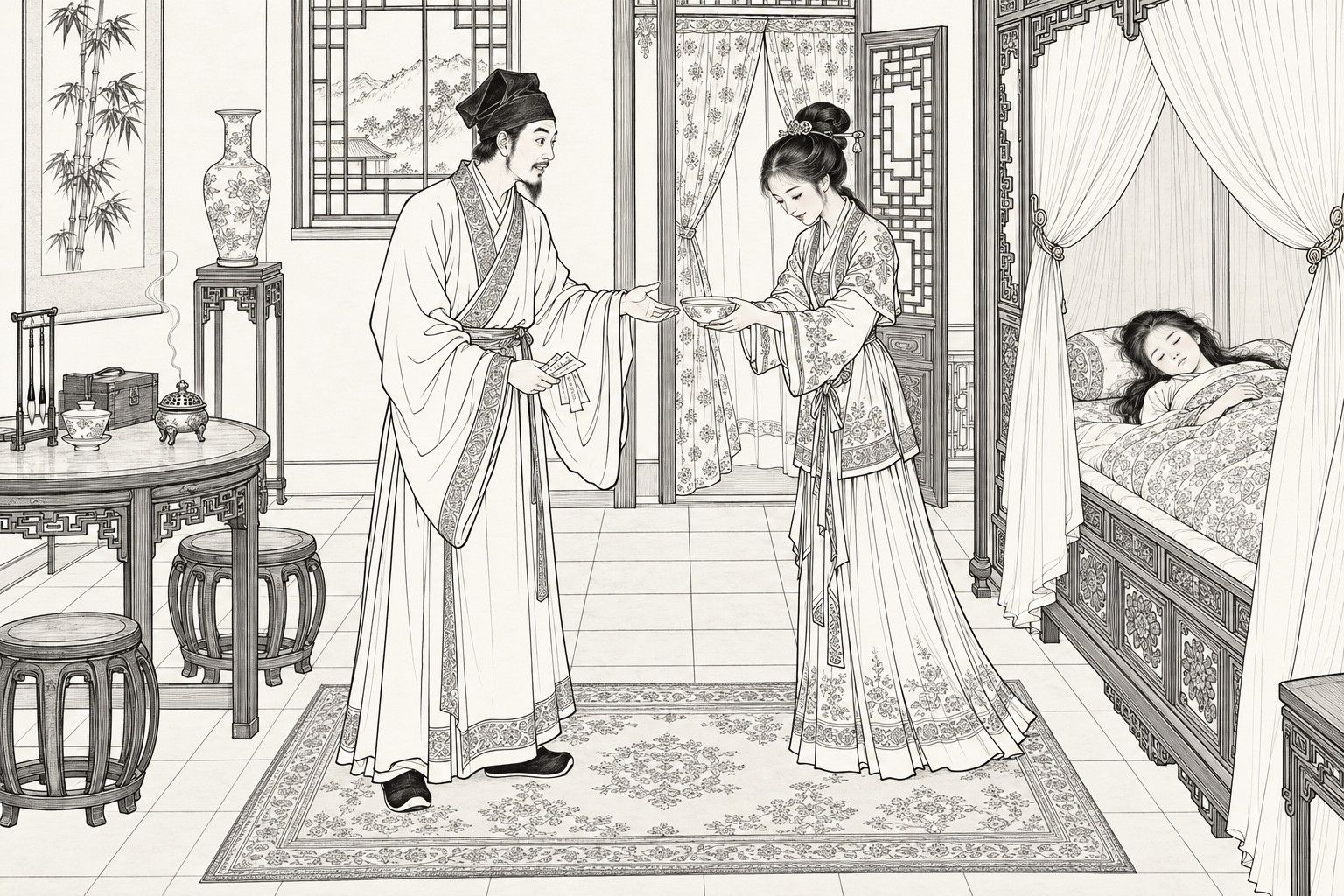
石太璞,泰山人,好厭禳之術。有道士遇之,賞其慧,納為弟子。啟牙籤,出二卷,上卷驅狐,下卷驅鬼,乃以下卷授之,曰:「虔奉此書,衣食佳麗皆有之。」問其姓名,曰:「吾汴城北村玄帝觀王赤城也。」留數日,盡傳其訣。石由此精於符籙,委贄者踵接於門。一日,有叟來,自稱翁姓,炫陳幣帛,謂其女鬼病已殆,必求親詣。石聞病危,辭不受贄,姑與俱往。十餘里入山村,至其家,廊舍華好。入室,見少女臥縠幛中,婢以鉤挂帳。望之年十四五許,支綴於床,形容已槁。近臨之,忽開目云:「良醫至矣。」舉家皆喜,謂其不語已數日矣。石乃出,因詰病狀。叟言:「白晝見少年來,與共寢處,捉之已杳,少間復至,意其為鬼。」石曰:「其鬼也,驅之匪難;恐其是狐,則非余所敢知矣。」叟云:「必非必非。」石授以符,是夕宿於其家。夜分,有少年入,衣冠整肅。石疑是主人眷屬,起而問之。曰:「我鬼也。翁家盡狐。偶悅其女紅亭,姑止焉。鬼為狐祟,陰騭無傷,君何必離人之緣而護之也?女之姊長亭,光豔尤絕。敬留全璧,以待高賢。彼如許字,方可為之施治;爾時我當自去。」石諾之。是夜,少年不復至,女頓醒。天明,叟喜,以告石,請石入視。石焚舊符,乃坐診之。見繡幕有女郎,麗若天人,心知其長亭也。診已,索水灑幛。女郎急以椀水付之,蹀躞之間,意動神流。石生此際,心殊不在鬼矣。出辭叟,託製藥去,數日不返。鬼益肆,除長亭外,子婦婢女,俱被淫惑。又以僕馬招石,石託疾不赴。明日,叟自至。石故作病股狀,扶杖而出。叟拜已,問故。曰:「此鰥之難也!曩夜婢子登榻,傾跌,墮湯夫人泡兩足耳。」叟問:「何久不續?」石曰:「恨不得清門如翁者。」叟默而出。石走送曰:「病瘥當自至,無煩玉趾也。」又數日,叟復來;石跛而見之。叟慰問三數語,便曰:「頃與荊人言,君如驅鬼去,使舉家安枕,小女長亭,年十七矣,願遣奉事君子。」石喜,頓首於地。乃謂叟:「雅意若此,病軀何敢復愛。」立刻出門,並騎而去。入視祟者既畢,石恐背約,請與媼盟。媼遽出曰:「先生何見疑也?」即以長亭所插金簪,授石為信。石朝拜之。已,乃遍集家人,悉為祓除。惟長亭深匿無跡;遂寫一佩符,使人持贈之。是夜寂然,鬼影盡滅,惟紅亭呻吟未已,投以法水,所患若失。石欲起辭,叟挽止殷懇。至晚,肴核羅列,勸酬殊切。漏二下,主人乃辭客去。石方就枕,聞叩扉甚急;起視,則長亭掩入,辭氣倉皇,言:「吾家欲以白刃相仇,可急遁!」言已,逕返身去。石戰懼無色,越垣急竄。遙見火光,疾奔而往,則里人夜獵者也。喜。待獵畢,乃與俱歸。心懷怨憤,無路可伸,思欲之汴城尋赤城,而家有老父,病廢已久,日夜籌思,莫決進止。忽一日,雙輿至門,則翁媼送長亭至,謂石曰:「曩夜之歸,胡再不謀?」石見長亭,怨恨都消,故亦隱而不發。媼促兩人庭拜訖。石將設筵,辭曰:「我非閒人,不能坐享甘旨。我家老子昏髦,倘有不悉,郎肯為長亭一念老身,為幸多矣。」登車遂去。蓋殺婿之謀,媼不之聞;及追之不得而返,媼始知之。頗不能平,與叟日相詬誶;長亭亦飲泣不食。媼強送女來,非翁意也。長亭入門,詰之,始知其故。過兩三月,翁家取女歸寧。石料其不返,禁止之。女自此時一涕零。年餘,生一子,名慧兒,買乳媼哺之。然兒善啼,夜必歸母。一日,翁家又以輿來,言媼思女甚。長亭益悲,石不忍復留之。欲抱子去,石不可,長亭乃自歸。別時,以一月為期,既而半載無耗。遣人往探之,則向所僦宅久空。又二年餘,望想都絕;而兒啼終夜,寸心如割。既而石父又病卒,倍益哀傷;因而病憊,苫次彌留,不能受賓朋之弔。方昏憒間,忽聞婦人哭入。視之,則縗絰者長亭也。石大悲,一慟遂絕。婢驚呼,女始啜泣,撫之良久,始漸甦。自疑已死,謂相聚於冥中。」女曰:「非也。妾不孝,不能得嚴父心,尼歸三載,誠所負心。適家人由海東經此,得翁凶問。妾遵嚴命而絕兒女之情,不敢循亂命而失翁媳之禮。妾來時,母知而父不知也。」言間,兒投懷中。言已,始撫之,泣曰:「我有父,兒無母矣!」兒亦噭啕,一室掩泣。女起,經理家政,柩前牲盛潔備,石乃大慰。而病久,急切不能起。女乃請石外兄款洽弔客。喪既閉,石始杖而能起,相與營謀齋葬。葬已,女欲辭歸,以受背父之譴。夫挽兒號,隱忍而止。未幾,有人來告母病,乃謂石曰:「妾為君父來,君不為妾母放令去耶?」石許之。女使乳媼抱兒他適,涕洟出門而去。去後,數年不返。石父子漸亦忘之。一日,昧爽啟扉,則長亭飄入。石方駭問,女戚然坐榻上,嘆曰:「生長閨閣,視一里為遙;今一日夜而奔千里,殆矣!」細詰之,女欲言復止。請之不已,哭曰:「今為君言,恐妾之所悲,而君之所快也。邇年徙居晉界,僦居趙搢紳之第。主客交最善,以紅亭妻其公子。公子數逋蕩,家庭頗不相安。妹歸告父;父留之,半年不令還。公子忿恨,不知何處聘一惡人來,遣神綰鎖,縛老父去。一門大駭,頃刻四散矣。」石聞之,笑不自禁。女怒曰:「彼雖不仁,妾之父也。妾與君琴瑟數年,止有相好而無相尤。今日人亡家敗,百口流離,即不為父傷,寧不為妾弔乎!聞之忭舞,更無片語相慰藉,何不義也!」拂袖而出。石追謝之,亦已渺矣。悵然自悔,拚已決絕。過二三日,媼與女俱來,石喜慰問。母女俱伏。驚而詢之,母女俱哭。女曰:「妾負氣而去,今不能自堅,又欲求人,復何顏矣!」石曰:「岳固非人;母之惠,卿之情,所不忘也。然聞禍而樂,亦猶人情,卿何不能暫忍?」女曰:「頃於途中遇母,始知縶吾父者,蓋君師也。」石曰:「果爾,亦大易。然翁不歸,則卿之父子離散;恐翁歸,則卿之夫泣兒悲也。」媼矢以自明,女亦誓以相報。石乃即刻治任如汴,詢至玄帝觀,則赤城歸未久。入而參之。便問:「何來?」石視廚下一老狐,孔前股而繫之。笑曰:「弟子之來,為此老魅。」赤城詰之,曰:「是吾岳也。」因以實告。道士謂其狡詐,不肯輕釋。固請,乃許之。石因備述其詐,狐聞之,塞身入灶,似有慚狀。道士笑曰:「彼羞惡之心,未盡亡也。」石起,牽之而出,以刀斷索抽之。狐痛極,齒齦齦然。石不遽抽,而頓挫之,笑問曰:「翁痛之,勿抽可耶?」狐睛睒閃,似有慍色。既釋,搖尾出觀而去。石辭歸。三日前,已有人報叟信,媼先去,留女待石。石至,女逆而伏。石挽之曰:「卿如不忘琴瑟之情,不在感激也。」女曰:「今復遷還故居矣,村舍鄰邇,音問可以不梗。妾欲歸省,三日可旋,君信之否?」曰:「兒生而無母,未便殤折。我日日鰥居,習已成慣。今不似趙公子,而反德報之,所以為卿者盡矣。如其不還,在卿為負義,道里雖近,當亦不復過問,何不信之與有?」女次日去,二日即返。問:「何速?」曰:「父以君在汴曾相戲弄,未能忘懷,言之絮絮;妾不欲復聞,故早來也。」自此閨中之往來無間,而翁婿間尚不通弔慶云。
石太璞,泰山人,好厌禳之术。有道士遇之,赏其慧,纳为弟子。启牙签,出二卷,上卷驱狐,下卷驱鬼,乃以下卷授之,曰:「虔奉此书,衣食佳丽皆有之。」问其姓名,曰:「吾汴城北村玄帝观王赤城也。」留数日,尽传其诀。石由此精于符箓,委贽者踵接于门。一日,有叟来,自称翁姓,炫陈币帛,谓其女鬼病已殆,必求亲诣。石闻病危,辞不受贽,姑与俱往。十余里入山村,至其家,廊舍华好。入室,见少女卧縠幛中,婢以钩挂帐。望之年十四五许,支缀于床,形容已槁。近临之,忽开目云:「良医至矣。」举家皆喜,谓其不语已数日矣。石乃出,因诘病状。叟言:「白昼见少年来,与共寝处,捉之已杳,少间复至,意其为鬼。」石曰:「其鬼也,驱之匪难;恐其是狐,则非余所敢知矣。」叟云:「必非必非。」石授以符,是夕宿于其家。夜分,有少年入,衣冠整肃。石疑是主人眷属,起而问之。曰:「我鬼也。翁家尽狐。偶悦其女红亭,姑止焉。鬼为狐祟,阴骘无伤,君何必离人之缘而护之也?女之姊长亭,光艳尤绝。敬留全璧,以待高贤。彼如许字,方可为之施治;尔时我当自去。」石诺之。是夜,少年不复至,女顿醒。天明,叟喜,以告石,请石入视。石焚旧符,乃坐诊之。见绣幕有女郎,丽若天人,心知其长亭也。诊已,索水洒幛。女郎急以椀水付之,蹀躞之间,意动神流。石生此际,心殊不在鬼矣。出辞叟,托制药去,数日不返。鬼益肆,除长亭外,子妇婢女,俱被淫惑。又以仆马招石,石托疾不赴。明日,叟自至。石故作病股状,扶杖而出。叟拜已,问故。曰:「此鳏之难也!曩夜婢子登榻,倾跌,堕汤夫人泡两足耳。」叟问:「何久不续?」石曰:「恨不得清门如翁者。」叟默而出。石走送曰:「病瘥当自至,无烦玉趾也。」又数日,叟复来;石跛而见之。叟慰问三数语,便曰:「顷与荆人言,君如驱鬼去,使举家安枕,小女长亭,年十七矣,愿遣奉事君子。」石喜,顿首于地。乃谓叟:「雅意若此,病躯何敢复爱。」立刻出门,并骑而去。入视祟者既毕,石恐背约,请与媪盟。媪遽出曰:「先生何见疑也?」即以长亭所插金簪,授石为信。石朝拜之。已,乃遍集家人,悉为祓除。惟长亭深匿无迹;遂写一佩符,使人持赠之。是夜寂然,鬼影尽灭,惟红亭呻吟未已,投以法水,所患若失。石欲起辞,叟挽止殷恳。至晚,肴核罗列,劝酬殊切。漏二下,主人乃辞客去。石方就枕,闻叩扉甚急;起视,则长亭掩入,辞气仓皇,言:「吾家欲以白刃相仇,可急遁!」言已,径返身去。石战惧无色,越垣急窜。遥见火光,疾奔而往,则里人夜猎者也。喜。待猎毕,乃与俱归。心怀怨愤,无路可伸,思欲之汴城寻赤城,而家有老父,病废已久,日夜筹思,莫决进止。忽一日,双舆至门,则翁媪送长亭至,谓石曰:「曩夜之归,胡再不谋?」石见长亭,怨恨都消,故亦隐而不发。媪促两人庭拜讫。石将设筵,辞曰:「我非闲人,不能坐享甘旨。我家老子昏髦,倘有不悉,郎肯为长亭一念老身,为幸多矣。」登车遂去。盖杀婿之谋,媪不之闻;及追之不得而返,媪始知之。颇不能平,与叟日相诟谇;长亭亦饮泣不食。媪强送女来,非翁意也。长亭入门,诘之,始知其故。过两三月,翁家取女归宁。石料其不返,禁止之。女自此时一涕零。年余,生一子,名慧儿,买乳媪哺之。然儿善啼,夜必归母。一日,翁家又以舆来,言媪思女甚。长亭益悲,石不忍复留之。欲抱子去,石不可,长亭乃自归。别时,以一月为期,既而半载无耗。遣人往探之,则向所僦宅久空。又二年余,望想都绝;而儿啼终夜,寸心如割。既而石父又病卒,倍益哀伤;因而病惫,苫次弥留,不能受宾朋之吊。方昏愦间,忽闻妇人哭入。视之,则缞绖者长亭也。石大悲,一恸遂绝。婢惊呼,女始啜泣,抚之良久,始渐甦。自疑已死,谓相聚于冥中。」女曰:「非也。妾不孝,不能得严父心,尼归三载,诚所负心。适家人由海东经此,得翁凶问。妾遵严命而绝儿女之情,不敢循乱命而失翁媳之礼。妾来时,母知而父不知也。」言间,儿投怀中。言已,始抚之,泣曰:「我有父,儿无母矣!」儿亦噭啕,一室掩泣。女起,经理家政,柩前牲盛洁备,石乃大慰。而病久,急切不能起。女乃请石外兄款洽吊客。丧既闭,石始杖而能起,相与营谋斋葬。葬已,女欲辞归,以受背父之谴。夫挽儿号,隐忍而止。未几,有人来告母病,乃谓石曰:「妾为君父来,君不为妾母放令去耶?」石许之。女使乳媪抱儿他适,涕洟出门而去。去后,数年不返。石父子渐亦忘之。一日,昧爽启扉,则长亭飘入。石方骇问,女戚然坐榻上,叹曰:「生长闺阁,视一里为遥;今一日夜而奔千里,殆矣!」细诘之,女欲言复止。请之不已,哭曰:「今为君言,恐妾之所悲,而君之所快也。迩年徙居晋界,僦居赵搢绅之第。主客交最善,以红亭妻其公子。公子数逋荡,家庭颇不相安。妹归告父;父留之,半年不令还。公子忿恨,不知何处聘一恶人来,遣神绾锁,缚老父去。一门大骇,顷刻四散矣。」石闻之,笑不自禁。女怒曰:「彼虽不仁,妾之父也。妾与君琴瑟数年,止有相好而无相尤。今日人亡家败,百口流离,即不为父伤,宁不为妾吊乎!闻之忭舞,更无片语相慰藉,何不义也!」拂袖而出。石追谢之,亦已渺矣。怅然自悔,拼已决绝。过二三日,媪与女俱来,石喜慰问。母女俱伏。惊而询之,母女俱哭。女曰:「妾负气而去,今不能自坚,又欲求人,复何颜矣!」石曰:「岳固非人;母之惠,卿之情,所不忘也。然闻祸而乐,亦犹人情,卿何不能暂忍?」女曰:「顷于途中遇母,始知絷吾父者,盖君师也。」石曰:「果尔,亦大易。然翁不归,则卿之父子离散;恐翁归,则卿之夫泣儿悲也。」媪矢以自明,女亦誓以相报。石乃即刻治任如汴,询至玄帝观,则赤城归未久。入而参之。便问:「何来?」石视厨下一老狐,孔前股而系之。笑曰:「弟子之来,为此老魅。」赤城诘之,曰:「是吾岳也。」因以实告。道士谓其狡诈,不肯轻释。固请,乃许之。石因备述其诈,狐闻之,塞身入灶,似有惭状。道士笑曰:「彼羞恶之心,未尽亡也。」石起,牵之而出,以刀断索抽之。狐痛极,齿龈龈然。石不遽抽,而顿挫之,笑问曰:「翁痛之,勿抽可耶?」狐睛睒闪,似有愠色。既释,摇尾出观而去。石辞归。三日前,已有人报叟信,媪先去,留女待石。石至,女逆而伏。石挽之曰:「卿如不忘琴瑟之情,不在感激也。」女曰:「今复迁还故居矣,村舍邻迩,音问可以不梗。妾欲归省,三日可旋,君信之否?」曰:「儿生而无母,未便殇折。我日日鳏居,习已成惯。今不似赵公子,而反德报之,所以为卿者尽矣。如其不还,在卿为负义,道里虽近,当亦不复过问,何不信之与有?」女次日去,二日即返。问:「何速?」曰:「父以君在汴曾相戏弄,未能忘怀,言之絮絮;妾不欲复闻,故早来也。」自此闺中之往来无间,而翁婿间尚不通吊庆云。
Shi Taipu, a man of Mount Tai, was fond of the arts of charms and exorcism. A Daoist met him, admired his quick wits, and took him as a disciple. The Daoist undid the ivory tag of a book case and took out two volumes. The first was for driving out foxes, the second for driving out ghosts. He gave Shi the second, saying, “Serve this book devoutly, and food, clothes and a beautiful woman will all be yours.” Asked his name, he said, “I am Wang Chicheng, of the Temple of the Dark Emperor in the village north of Bian.” He stayed several days and passed on all his secrets. From then on Shi was a master of talismans and charms, and the people bringing gifts to his door trod on one another’s heels. One day an old man came who said his surname was Weng. He laid out a dazzling display of money and silk and said his daughter was sick with a ghost and close to death; he begged Shi to come in person. Hearing that she was in danger, Shi declined the gifts and went along with him for the time being. After ten li or more they came into a mountain village and reached the house. Its galleries and rooms were splendid. In the bedroom a girl lay behind gauze curtains; a maid hooked the curtain back. She looked fourteen or fifteen. She lay limp on the bed, wasted away. When Shi came near, she suddenly opened her eyes and said, “A good doctor has come.” The whole household rejoiced: she had not spoken for days, they said. Shi went out and asked about the illness. “In broad daylight a young man is seen coming to lie with her,” said the old man. “When we try to catch him he is gone, and a moment later he is back. We think he is a ghost.” “If it is a ghost,” said Shi, “driving it out is not hard. If it should be a fox, that is beyond what I dare undertake.” “It isn’t, it isn’t,” said the old man. Shi gave him a talisman and stayed the night. At midnight a young man came in, his clothes and cap in good order. Taking him for one of the family, Shi got up to ask who he was. “I am a ghost,” he said. “The Wengs are all foxes. I happened to take a fancy to their daughter Hongting, so I am staying here a while. A ghost haunting foxes does your hidden merit no harm. Why must you break up a love affair to protect them? The girl’s elder sister, Changting, is even more dazzling. I have respectfully kept her whole, a flawless jade, for some worthy gentleman. If they promise her to you, then treat them, and not before; at that time I will leave of my own accord.” Shi agreed. That night the young man did not come, and the girl came to herself at once. At dawn the old man was delighted. He told Shi and asked him to come in and see her. Shi burned the old talisman and sat down to examine her. Behind an embroidered curtain he saw a young woman as lovely as a goddess, and knew in his heart she was Changting. When he had finished, he asked for water to sprinkle on the curtains. The young woman hurried over with a bowl of water; as she moved to and fro on her small steps, his heart stirred and his spirit went out to her. At that moment Shi’s mind was not on ghosts at all. He went out and took leave of the old man, saying he had to go and make up medicines, and stayed away for days. The ghost grew bolder. Apart from Changting, the sons’ wives and the maids all fell to his lust. They sent a servant with a horse to fetch Shi; Shi pleaded illness and did not go. The next day the old man came himself. Shi pretended to have a bad leg and came out on a stick. The old man bowed and asked what had happened. “These are the troubles of a man without a wife!” said Shi. “The other night my maid climbed on the bed and slipped, and Lady Hot-Water fell and scalded both my feet.” “Why have you gone so long without remarrying?” the old man asked. “It’s only that I can’t find a family as respectable as yours, sir,” said Shi. The old man went out without a word. Shi saw him off. “When I am better I will come of my own accord. Don’t trouble your honoured feet.” Some days later the old man came again, and Shi limped out to meet him. After a few words of sympathy the old man said, “I have just been talking with my wife. If you drive the ghost away and let the whole household sleep in peace, our daughter Changting, who is seventeen, will be sent to serve you.” Shi was delighted and knocked his head on the ground. “Since you mean so kindly,” he said, “how could I go on sparing this sick body?” He set out at once, and they rode off side by side. When he had gone in and seen all the afflicted, Shi, afraid they would break their word, asked to swear it with the old woman. She came straight out. “Why do you doubt us, sir?” she said, and gave him the gold pin from Changting’s hair as a pledge. Shi bowed low to her. Then he gathered the whole household and purified them all. Only Changting stayed hidden deep inside and never showed herself, so he wrote a talisman for her to wear and had it taken to her. That night all was still; the ghost had vanished without a trace. Only Hongting still moaned; he gave her charmed water, and her trouble left her as if it had never been. Shi wanted to take his leave, but the old man earnestly pressed him to stay. In the evening dishes and fruits were spread out, and he was plied with wine most warmly. At the second watch the host at last bade his guest good night and left. Shi had just lain down when there was an urgent knocking at the door. He got up to look: it was Changting, who slipped in and closed the door. In a frightened voice she said, “My family means to take a knife to you. Run, quickly!” With that she turned and was gone. Shi shook with fear, the colour gone from his face. He climbed over the wall and fled. Far off he saw firelight and ran toward it: it was villagers out hunting by night. He was glad. He waited until the hunt was over and went home with them. He was bitter and angry, but had no way to get redress. He thought of going to Bian to find Chicheng, but he had an old father at home who had long been an invalid. He turned it over day and night and could not decide whether to go or stay. Then one day two sedan chairs came to his gate: the Wengs’ old woman was bringing Changting. She said to Shi, “Why did you go home that night without another word with us?” When Shi saw Changting all his resentment melted away, so he too kept it hidden and said nothing. The old woman hurried the two of them through their wedding bows in the courtyard. Shi was going to lay on a feast, but she declined. “I am not a woman of leisure. I cannot sit and enjoy fine food. My old man is muddled and senile. If he has failed you in anything, I would count it a great kindness if you would think of me, for Changting’s sake.” She got into her carriage and left. The truth was that the old woman had known nothing of the plot to kill her son-in-law; only when the others came back from chasing him empty-handed did she learn of it. She was very upset and quarrelled with the old man every day, and Changting wept quietly and would not eat. The old woman had insisted on bringing her daughter; it was not the old man’s wish. Shi learned all this only after Changting had come into his house and he questioned her. Two or three months later the Wengs came to take their daughter home for a visit. Shi guessed she would not come back and forbade it. From then on she would often weep. A year or so later she bore a son, named Hui’er. They hired a wet nurse to feed him, but the boy cried a great deal and at night always had to go back to his mother. One day the Wengs sent a sedan chair again, saying the old woman was longing for her daughter. Changting grew sadder than ever, and Shi could not bear to keep her any longer. She wanted to take the child; Shi would not allow it, so Changting went home alone. At parting she said she would be back in a month. Half a year passed without a word. He sent someone to look, and found that the house they had rented had long stood empty. Two years and more went by, and he gave up all hope. Yet the child cried all night, and it cut him to the heart. Then Shi’s father fell ill and died, which doubled his grief. He fell ill himself and wasted away, and lay near death on the mourning mat, unable to receive the condolences of guests and friends. As he lay in a stupor, he suddenly heard a woman come in weeping. He looked: it was Changting, in mourning hemp. Shi was so overcome that with one great howl he fainted away. The maid cried out in alarm. Only then did Changting break into sobs. She stroked him for a long time, and slowly he came round. He thought he must be dead, and that they were together again in the world below. “No,” she said. “I was a bad daughter: I could not win my father over, and he kept me from coming back for three years. I have truly wronged you. Just now some of my family passed this way from east of the sea and brought word of your father’s death. I obeyed my father’s stern orders and gave up the love of wife and mother, but I dared not obey a wrong order so far as to fail in my duty as a daughter-in-law. When I came, my mother knew and my father did not.” As she spoke, the boy threw himself into her arms. Only when she had finished did she stroke him. “I have a father,” she wept, “and my child has no mother!” The boy wailed too, and the whole room hid their faces and wept. She got up and took charge of the household. The offerings of meat and grain before the coffin were clean and complete, and Shi was much comforted. But he had been ill a long time and could not get up so quickly, so she asked his cousin to receive the mourners. When the mourning visits were over, Shi was at last able to get up on a stick, and together they arranged the rites and the burial. After the burial she wanted to go home and take her punishment for disobeying her father. But her husband held her back and the boy wailed, and she swallowed her feelings and stayed. Before long someone came to say her mother was ill. She said to Shi, “I came for your father. Will you not let me go for my mother?” Shi agreed. She had the wet nurse carry the boy off somewhere else, and went out of the gate in tears. After she left, years passed and she did not come back. Shi and his son gradually forgot her. One day, at first light, Shi opened his door and Changting swept in. Before Shi could ask in alarm what was wrong, she sat down sadly on the couch and sighed. “I was raised in the women’s rooms and thought a single li a long way. Now I have run a thousand in a day and a night. I am worn out!” He asked her what had happened; she began to speak and stopped. He kept on asking, and she wept. “If I tell you now, I am afraid what grieves me will delight you. These last years we moved to Shanxi and rented the mansion of a gentleman named Zhao. Landlord and tenants were the best of friends, and Hongting was married to his son. But the son kept running off on his pleasures, and there was no peace in the family. My sister came home and told our father, and Father kept her with us and would not let her go back for half a year. The son was furious. He hired some villain from somewhere, who sent spirits with chains to bind my old father and carry him off. The whole family took fright and scattered in a moment.” Shi could not help laughing. She was angry. “Cruel he may be, but he is my father. For years you and I have been in tune as zither and lute, with nothing but love and never a reproach. Now our people are lost and our house is ruined, a hundred of us scattered and homeless. Even if you don’t grieve for my father, will you not feel for me? You hear of it and dance for joy, without one word of comfort. How heartless!” She shook out her sleeves and left. Shi ran after her to apologise, but she was already gone. He was dejected and sorry, and resigned himself to its being over for good. Two or three days later the old woman came with her daughter. Shi was glad and greeted them warmly, but mother and daughter both fell to the ground before him. Startled, he asked why, and both of them wept. “I went off in a temper,” said Changting, “and now I cannot hold firm and want to beg your help. How can I show my face?” “Your father is no human being, certainly,” said Shi. “But your mother’s kindness and your love I have never forgotten. Still, to be glad when you hear of a disaster is only human. Couldn’t you bear with me a little?” “Just now I met my mother on the road,” she said, “and learned that the man who has my father in bonds is your own master.” “If so, it is very easy,” said Shi. “But if the old man does not come back, you are parted from your father; and I fear that if he does come back, your husband will weep and your son grieve.” The old woman swore an oath to prove her good faith, and Changting too swore to repay him. Shi packed at once and set out for Bian. He asked his way to the Temple of the Dark Emperor and found that Chicheng had only lately come home. He went in to pay his respects. “Why have you come?” Chicheng asked at once. Shi saw an old fox in the kitchen, tied by a cord through a hole pierced in its foreleg. He laughed. “Your disciple has come for this old devil.” Chicheng asked what he meant. “He is my father-in-law,” said Shi, and told him the whole truth. The Daoist said the fox was cunning and treacherous and would not lightly let it go. Shi pressed him, and at last he agreed. Shi then told at length how the fox had tricked him. Hearing this, the fox squeezed itself into the stove, as if ashamed. The Daoist laughed. “He has not lost his sense of shame entirely.” Shi got up and led the fox out. He cut the cord with a knife and began to pull it out. The fox, in great pain, gnashed its teeth. Shi did not pull it out at once but jerked it by fits and starts, and asked, laughing, “Does it hurt, sir? Shall I leave it in?” The fox’s eyes flashed, and it looked angry. Once free, it wagged its tail, went out of the temple and was gone. Shi took his leave and went home. Three days earlier someone had brought news of the old man; the old woman had gone home first and left her daughter to wait for Shi. When Shi arrived, Changting came out to meet him and fell to her knees. Shi raised her. “If you have not forgotten what we are to each other, zither and lute, there is no need for gratitude.” “We have moved back to our old home now,” she said. “The village is close by, so word can pass between us freely. I would like to go home to see my parents. I can be back in three days. Do you trust me?” “The boy was born and had no mother, and he has not died of it,” said Shi. “I have lived day after day without a wife and have grown used to it. Now, unlike young Master Zhao, I have repaid wrong with kindness; I have done all I can for you. If you do not come back, the breach of faith is yours, and though the way is short I will not ask after you again. So what is there for me not to trust?” She left the next day and was back two days later. “Why so soon?” he asked. “Father cannot forget how you made sport of him in Bian. He goes on and on about it. I did not want to hear any more, so I came back early.” From then on the women of the two houses came and went freely; but between father-in-law and son-in-law there was still no exchange of condolences or congratulations, or so it is said.