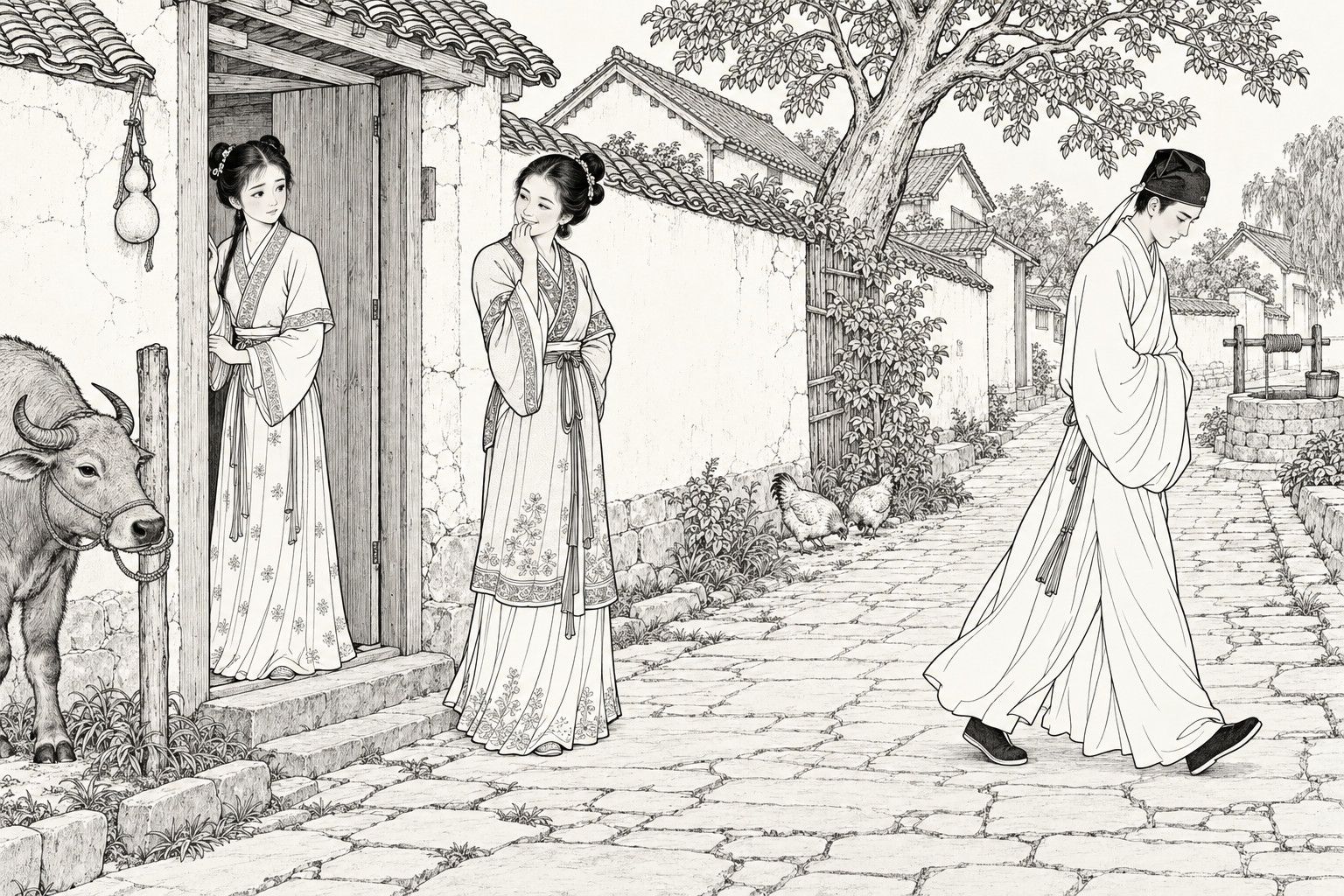
東昌卞氏,業牛醫者,有女小字臙脂,才姿惠麗。父寶愛之,欲占鳳於清門,而世族鄙其寒賤,不屑締盟,所以及笄未字。對戶龔姓之妻王氏,佻脫善謔,女閨中談友也。一日,送至門,見一少年過,白服裙帽,丰采甚都。女意似動,秋波縈轉之。少年俯其首,趨而去。去既遠,女猶凝眺。王窺其意,戲之曰:「以娘子才貌,得配若人,庶可無恨。」女暈紅上頰,脈脈不作一語。王問:「識得此郎否?」答云:「不識。」王曰:「此南巷鄂秀才秋隼,故孝廉之子。妾向與同里,故識之,世間男子,無其溫婉。今衣素,以妻服未闋也。娘子如有意,當寄語使委冰焉。」女無語,王笑而去。數日無耗,心疑王氏未暇即往,又疑宦裔不肯俯拾。邑邑徘徊,縈念頗苦;漸廢飲食,寢疾惙頓。王氏適來省視,研詰病因。答言:「自亦不知。但爾日別後,即覺忽忽不快,延命假息,朝暮人也。」王小語曰:「我家男子,負販未歸,尚無人致聲鄂郎。芳體違和,非為此否?」女赬顏良久。王戲之曰:「果為此者,病已至是,尚何顧忌?先令夜來一聚,彼豈不肯可?」女嘆息曰:「事至此,已不能羞。,但渠不嫌寒賤,即遣媒來,病當愈;若私約,則斷斷不可!」王頷之,遂去。王幼時與鄰生宿介通,既嫁,宿偵夫他出,輒尋舊好。是夜宿適來,因述女言為笑,戲囑致意鄂生。宿久知女美,聞之竊喜,幸其機可乘也。將與婦謀,又恐其妒,乃假無心之詞,問女家閨闥甚悉。次夜,踰垣入,直達女所,以指叩窗。內問:「誰何?」答以:「鄂生。」女曰:「妾所以念君者,為百年,不為一夕。郎果愛妾,但宜速倩冰人;若言私合,不敢從命。」宿姑諾之,苦求一握纖腕為信。女不忍過拒,力疾啟扉。宿遽入,即抱求歡。女無力撐拒,仆地上,氣息不續。宿急曳之。女曰:「何來惡少,必非鄂郎;果是鄂郎,其人溫馴,知妾病由,當相憐恤,何遂狂暴若此!若復爾爾,便當鳴呼,品行虧損,兩無所益!」宿恐假跡敗露,不敢復強,但請後會。女以親迎為期。宿以為遠,又請之。女厭糾纏,約待病愈。宿求信物,女不許。宿捉足解繡履而去。女呼之返,曰:「身已許君,復何吝惜?但恐『畫虎成狗』,致貽污謗。今褻物已入君手,料不可反。君如負心,但有一死!」宿既出,又投宿王所。既臥,心不忘履,陰揣衣袂,竟已烏有。急起篝燈,振衣冥索。詰之,不應。疑婦藏匿,婦故笑以疑之。宿不能隱,實以情告。言已,遍燭門外,竟不可得。懊恨歸寢,竊幸深夜無人,遺落當猶在途也。早起尋之,亦復杳然。先是,巷中有毛大者,游手無籍。嘗挑王氏不得,知宿與洽,思掩執以脅之。是夜,過其門,推之未扃,潛入。方至窗下,踏一物,耎若絮帛,拾視,則巾裹女舄。伏聽之,聞宿自述甚悉,喜極,抽身而出。踰數夕,越牆入女家,門戶不悉,誤詣翁舍。翁窺窗,見男子,察其音蹟,知為女來者。心忿怒,操刀直出。毛大駭,反走。方欲攀垣,而卞追已近,急無所逃,反身奪刃;媼起大呼,毛不得脫,因而殺之。女稍痊,聞喧始起。共燭之,翁腦裂不復能言,俄頃已絕。於牆下得繡履,媼視之,臙脂物也。逼女,女哭而實告之;但不忍貽累王氏,言鄂生之自至而已。天明,訟於邑。邑宰拘鄂。鄂為人謹訥,年十九歲,見客羞澀如童子。被執,駭絕。上堂不知置詞,惟有戰慄。宰益信其情真,橫加梏械。生不堪痛楚,以是誣服。即解郡,敲扑如邑。生冤氣填塞,每欲與女面相質;及相遭,女輒詬詈,遂結舌不能自伸,由是論死。往來覆訊,經數官無異詞。後委濟南府復案。時吳公南岱守濟南,一見鄂生,疑不類殺人者,陰使人從容私問之,俾盡得其詞。公以是益知鄂生冤。籌思數日,始鞫之。先問臙脂:「訂約後,有知者否?」答:「無之。」「遇鄂生時,別有人否?」亦答:「無之。」乃喚生上,溫語慰之。生自言:「曾過其門,但見舊鄰婦王氏與一少女出,某即趨避,過此並無一言。」吳公叱女曰:「適言側無他人,何以有鄰婦也?」欲刑之。女懼曰:「雖有王氏,與彼實無關涉。」公罷質,命拘王氏。數日已至,又禁不與女通,立刻出審,便問王:「殺人者誰?」王對:「不知。」公詐之曰:「臙脂供言,殺卞某汝悉知之,胡得隱匿?」婦呼曰:「冤哉!淫婢自思男子,我雖有媒合之言,特戲之耳。彼自引奸夫入院,我何知焉!」公細詰之,始述其前後相戲之詞。公呼女上,怒曰:「汝言彼不知情,今何以自供撮合哉?」女流涕曰:「自己不肖,致父慘死,訟結不知何年,又累他人,誠不忍耳。」公問王氏:「既戲後,曾語何人?」王供:「無之。」公怒曰:「夫妻在床,應無不言者,何得云無?」王供:「丈夫久客未歸。」公曰:「雖然,凡戲人者,皆笑人之愚,以炫己之慧,更不向一人言,將誰欺?」命梏十指。婦不得已,實供:「曾與宿言。」公於是釋鄂拘宿。宿至,自供:「不知。」公曰:「宿妓者必無良士!」嚴械之。宿自供:「賺女是真。自失履後,未敢復往,殺人實不知情。」公怒曰:「踰牆者何所不至!」又械之。宿不任凌藉,遂以自承。招成報上,無不稱吳公之神。鐵案如山,宿遂延頸以待秋決矣。然宿雖放縱無行,故東國名士。聞學使施公愚山賢能稱最,且又憐才恤士之德,因以一詞控其冤枉,語言愴惻。公乃討其招供,反覆凝思之。拍案曰:「此生冤也!」遂請於院、司,移案再鞫。問宿生:「鞋遺何所?」供曰:「忘之。但叩婦門時,猶在袖中。」轉詰王氏:「宿介之外,姦夫有幾?」供言:「無有。」公曰:「淫亂之人,豈得專私一個?」供言:「身與宿介,稚齒交合,故未能謝絕;後非無見挑者,身實未敢相從。」因使指其人以實之。供云:「同里毛大,屢挑而屢拒之矣。」公曰:「何忽貞白如此?」命搒之。婦頓首出血,力辨無有,乃釋之。又詰:「汝夫遠出,寧無有託故而來者?」曰:「有之,某甲、某乙,皆以借貸餽贈,曾一二次入小人家。」蓋甲、乙皆巷中游蕩子,有心於婦而未發者也。公悉籍其名,並拘之。既集,公赴城隍廟,使盡伏案前。便謂:「曩夢神人相告,殺人者不出汝等四五人中。今對神明,不得有妄言。如肯自首,尚可原宥;虛者,廉得無赦!」同聲言無殺人之事。公以三木置地,將並加之;括髮裸身,齊鳴冤苦。公命釋之,謂曰:「既不自招,當使鬼神指之。」使人以氈褥悉障殿窗,令無少隙;袒諸囚背,驅入暗中,始授盆水,一一命自盥訖;繫諸壁下,戒令「面壁勿動。殺人者,當有神書其背」。少間,喚出驗視,指毛曰:「此真殺人賊也!」蓋公先使人以灰塗壁,又以煙煤濯其手:殺人者恐神來書,故匿背於壁而有灰色;臨出,以手護背,而有煙色也。公固疑是毛,至此益信。施以毒刑,盡吐其實。判曰:「宿介:蹈盆成括殺身之道,成登徒子好色之名。祗緣兩小無猜,遂野鶩如家雞之戀;為因一言有漏,致得隴興望蜀之心。將仲子而踰園牆,便如鳥墮;冒劉郎而至洞口,竟賺門開。感帨驚尨,鼠有皮胡若此?攀花折樹,士無行其謂何!幸而聽病燕之嬌啼,猶為玉惜;憐弱柳之憔悴,未似鶯狂。而釋么鳳於羅中,尚有文人之意;乃劫香盟於襪底,寧非無賴之尤!蝴蜨過牆,隔窗有耳;蓮花卸瓣,墮地無蹤。假中之假以生,冤外之冤誰信?天降禍起,酷械至於垂亡;自作孽盈,斷頭幾於不續。彼踰牆鑽隙,固有玷夫儒冠;而僵李代桃,誠難消其冤氣。是宜稍寬笞扑,折其已受之慘;姑降青衣,開其自新之路。若毛大者:刁猾無籍,市井凶徒。被鄰女之投梭,淫心不死;伺狂童之入巷,賊智忽生。開戶迎風,喜得履張生之蹟;求漿值酒,妄思偷韓掾之香。何意魄奪自天,魂攝於鬼。浪乘槎木,直入廣寒之宮;逕泛漁舟,錯認桃源之路。遂使情火息焰,慾海生波。刀橫直前,投鼠無他顧之意;寇窮安往,急兔起反噬之心。越壁入人家,止期張有冠而李借;奪兵遺繡履,遂教魚脫網而鴻離。風流道乃生此惡魔,溫柔鄉何有此鬼蜮哉!即斷首領,以快人心。臙脂:身猶未字,歲已及笄。以月殿之仙人,自應有郎似玉;原霓裳之舊隊,何愁貯屋無金?而乃感關雎而念好逑,竟繞春婆之夢;怨摽梅而思吉士,遂離倩女之魂。為因一線纏縈,致使群魔交至。爭婦女之顏色,恐失『臙脂』;惹鷙鳥之紛飛,並托『秋隼』。蓮鉤摘去,難保一瓣之香;鐵限敲來,幾破連城之玉。嵌紅豆於骰子,相思骨竟作厲階;喪喬木於斧斤,可憎才真成禍水!葳蕤自守,幸白璧之無瑕;縲絏苦爭,喜錦衾之可覆。嘉其入門之拒,猶潔白之情人;遂其擲果之心,亦風流之雅事。仰彼邑令,作爾冰人。」案既結,遐邇傳誦焉。自吳公鞫後,女始知鄂生冤。堂下相遇,腆然含涕,似有痛惜之詞,而未可言也。生感其眷戀之情,愛慕殊切;而又念其出身微,且日登公堂,為千人所窺指,恐娶之為人姍笑,日夜縈迴,無以自主。判牒既下,意始安帖。邑宰為之委禽,送鼓吹焉。
东昌卞氏,业牛医者,有女小字臙脂,才姿惠丽。父宝爱之,欲占凤于清门,而世族鄙其寒贱,不屑缔盟,所以及笄未字。对户龚姓之妻王氏,佻脱善谑,女闺中谈友也。一日,送至门,见一少年过,白服裙帽,丰采甚都。女意似动,秋波萦转之。少年俯其首,趋而去。去既远,女犹凝眺。王窥其意,戏之曰:「以娘子才貌,得配若人,庶可无恨。」女晕红上颊,脉脉不作一语。王问:「识得此郎否?」答云:「不识。」王曰:「此南巷鄂秀才秋隼,故孝廉之子。妾向与同里,故识之,世间男子,无其温婉。今衣素,以妻服未阕也。娘子如有意,当寄语使委冰焉。」女无语,王笑而去。数日无耗,心疑王氏未暇即往,又疑宦裔不肯俯拾。邑邑徘徊,萦念颇苦;渐废饮食,寝疾惙顿。王氏适来省视,研诘病因。答言:「自亦不知。但尔日别后,即觉忽忽不快,延命假息,朝暮人也。」王小语曰:「我家男子,负贩未归,尚无人致声鄂郎。芳体违和,非为此否?」女赪颜良久。王戏之曰:「果为此者,病已至是,尚何顾忌?先令夜来一聚,彼岂不肯可?」女叹息曰:「事至此,已不能羞。,但渠不嫌寒贱,即遣媒来,病当愈;若私约,则断断不可!」王颔之,遂去。王幼时与邻生宿介通,既嫁,宿侦夫他出,辄寻旧好。是夜宿适来,因述女言为笑,戏嘱致意鄂生。宿久知女美,闻之窃喜,幸其机可乘也。将与妇谋,又恐其妒,乃假无心之词,问女家闺闼甚悉。次夜,逾垣入,直达女所,以指叩窗。内问:「谁何?」答以:「鄂生。」女曰:「妾所以念君者,为百年,不为一夕。郎果爱妾,但宜速倩冰人;若言私合,不敢从命。」宿姑诺之,苦求一握纤腕为信。女不忍过拒,力疾启扉。宿遽入,即抱求欢。女无力撑拒,仆地上,气息不续。宿急曳之。女曰:「何来恶少,必非鄂郎;果是鄂郎,其人温驯,知妾病由,当相怜恤,何遂狂暴若此!若复尔尔,便当鸣呼,品行亏损,两无所益!」宿恐假迹败露,不敢复强,但请后会。女以亲迎为期。宿以为远,又请之。女厌纠缠,约待病愈。宿求信物,女不许。宿捉足解绣履而去。女呼之返,曰:「身已许君,复何吝惜?但恐『画虎成狗』,致贻污谤。今亵物已入君手,料不可反。君如负心,但有一死!」宿既出,又投宿王所。既卧,心不忘履,阴揣衣袂,竟已乌有。急起篝灯,振衣冥索。诘之,不应。疑妇藏匿,妇故笑以疑之。宿不能隐,实以情告。言已,遍烛门外,竟不可得。懊恨归寝,窃幸深夜无人,遗落当犹在途也。早起寻之,亦复杳然。先是,巷中有毛大者,游手无籍。尝挑王氏不得,知宿与洽,思掩执以胁之。是夜,过其门,推之未扃,潜入。方至窗下,踏一物,耎若絮帛,拾视,则巾裹女舄。伏听之,闻宿自述甚悉,喜极,抽身而出。逾数夕,越墙入女家,门户不悉,误诣翁舍。翁窥窗,见男子,察其音迹,知为女来者。心忿怒,操刀直出。毛大骇,反走。方欲攀垣,而卞追已近,急无所逃,反身夺刃;媪起大呼,毛不得脱,因而杀之。女稍痊,闻喧始起。共烛之,翁脑裂不复能言,俄顷已绝。于墙下得绣履,媪视之,臙脂物也。逼女,女哭而实告之;但不忍贻累王氏,言鄂生之自至而已。天明,讼於邑。邑宰拘鄂。鄂为人谨讷,年十九岁,见客羞涩如童子。被执,骇绝。上堂不知置词,惟有战栗。宰益信其情真,横加梏械。生不堪痛楚,以是诬服。即解郡,敲扑如邑。生冤气填塞,每欲与女面相质;及相遭,女辄诟詈,遂结舌不能自伸,由是论死。往来覆讯,经数官无异词。后委济南府复案。时吴公南岱守济南,一见鄂生,疑不类杀人者,阴使人从容私问之,俾尽得其词。公以是益知鄂生冤。筹思数日,始鞫之。先问臙脂:「订约后,有知者否?」答:「无之。」「遇鄂生时,别有人否?」亦答:「无之。」乃唤生上,温语慰之。生自言:「曾过其门,但见旧邻妇王氏与一少女出,某即趋避,过此并无一言。」吴公叱女曰:「适言侧无他人,何以有邻妇也?」欲刑之。女惧曰:「虽有王氏,与彼实无关涉。」公罢质,命拘王氏。数日已至,又禁不与女通,立刻出审,便问王:「杀人者谁?」王对:「不知。」公诈之曰:「臙脂供言,杀卞某汝悉知之,胡得隐匿?」妇呼曰:「冤哉!淫婢自思男子,我虽有媒合之言,特戏之耳。彼自引奸夫入院,我何知焉!」公细诘之,始述其前后相戏之词。公呼女上,怒曰:「汝言彼不知情,今何以自供撮合哉?」女流涕曰:「自己不肖,致父惨死,讼结不知何年,又累他人,诚不忍耳。」公问王氏:「既戏后,曾语何人?」王供:「无之。」公怒曰:「夫妻在床,应无不言者,何得云无?」王供:「丈夫久客未归。」公曰:「虽然,凡戏人者,皆笑人之愚,以炫己之慧,更不向一人言,将谁欺?」命梏十指。妇不得已,实供:「曾与宿言。」公于是释鄂拘宿。宿至,自供:「不知。」公曰:「宿妓者必无良士!」严械之。宿自供:「赚女是真。自失履后,未敢复往,杀人实不知情。」公怒曰:「逾墙者何所不至!」又械之。宿不任凌借,遂以自承。招成报上,无不称吴公之神。铁案如山,宿遂延颈以待秋决矣。然宿虽放纵无行,故东国名士。闻学使施公愚山贤能称最,且又怜才恤士之德,因以一词控其冤枉,语言怆恻。公乃讨其招供,反复凝思之。拍案曰:「此生冤也!」遂请于院、司,移案再鞫。问宿生:「鞋遗何所?」供曰:「忘之。但叩妇门时,犹在袖中。」转诘王氏:「宿介之外,奸夫有几?」供言:「无有。」公曰:「淫乱之人,岂得专私一个?」供言:「身与宿介,稚齿交合,故未能谢绝;后非无见挑者,身实未敢相从。」因使指其人以实之。供云:「同里毛大,屡挑而屡拒之矣。」公曰:「何忽贞白如此?」命搒之。妇顿首出血,力辨无有,乃释之。又诘:「汝夫远出,宁无有托故而来者?」曰:「有之,某甲、某乙,皆以借贷餽赠,曾一二次入小人家。」盖甲、乙皆巷中游荡子,有心于妇而未发者也。公悉籍其名,并拘之。既集,公赴城隍庙,使尽伏案前。便谓:「曩梦神人相告,杀人者不出汝等四五人中。今对神明,不得有妄言。如肯自首,尚可原宥;虚者,廉得无赦!」同声言无杀人之事。公以三木置地,将并加之;括发裸身,齐鸣冤苦。公命释之,谓曰:「既不自招,当使鬼神指之。」使人以毡褥悉障殿窗,令无少隙;袒诸囚背,驱入暗中,始授盆水,一一命自盥讫;系诸壁下,戒令「面壁勿动。杀人者,当有神书其背」。少间,唤出验视,指毛曰:「此真杀人贼也!」盖公先使人以灰涂壁,又以烟煤濯其手:杀人者恐神来书,故匿背于壁而有灰色;临出,以手护背,而有烟色也。公固疑是毛,至此益信。施以毒刑,尽吐其实。判曰:「宿介:蹈盆成括杀身之道,成登徒子好色之名。祗缘两小无猜,遂野鹜如家鸡之恋;为因一言有漏,致得陇兴望蜀之心。将仲子而逾园墙,便如鸟堕;冒刘郎而至洞口,竟赚门开。感帨惊尨,鼠有皮胡若此?攀花折树,士无行其谓何!幸而听病燕之娇啼,犹为玉惜;怜弱柳之憔悴,未似莺狂。而释幺凤于罗中,尚有文人之意;乃劫香盟于袜底,宁非无赖之尤!蝴蜨过墙,隔窗有耳;莲花卸瓣,堕地无踪。假中之假以生,冤外之冤谁信?天降祸起,酷械至于垂亡;自作孽盈,断头几于不续。彼逾墙钻隙,固有玷夫儒冠;而僵李代桃,诚难消其冤气。是宜稍宽笞扑,折其已受之惨;姑降青衣,开其自新之路。若毛大者:刁猾无籍,市井凶徒。被邻女之投梭,淫心不死;伺狂童之入巷,贼智忽生。开户迎风,喜得履张生之迹;求浆值酒,妄思偷韩掾之香。何意魄夺自天,魂摄于鬼。浪乘槎木,直入广寒之宫;径泛渔舟,错认桃源之路。遂使情火息焰,欲海生波。刀横直前,投鼠无他顾之意;寇穷安往,急兔起反噬之心。越壁入人家,止期张有冠而李借;夺兵遗绣履,遂教鱼脱网而鸿离。风流道乃生此恶魔,温柔乡何有此鬼蜮哉!即断首领,以快人心。臙脂:身犹未字,岁已及笄。以月殿之仙人,自应有郎似玉;原霓裳之旧队,何愁贮屋无金?而乃感关雎而念好逑,竟绕春婆之梦;怨摽梅而思吉士,遂离倩女之魂。为因一线缠萦,致使群魔交至。争妇女之颜色,恐失『臙脂』;惹鸷鸟之纷飞,并托『秋隼』。莲钩摘去,难保一瓣之香;铁限敲来,几破连城之玉。嵌红豆于骰子,相思骨竟作厉阶;丧乔木于斧斤,可憎才真成祸水!葳蕤自守,幸白璧之无瑕;缧絏苦争,喜锦衾之可覆。嘉其入门之拒,犹洁白之情人;遂其掷果之心,亦风流之雅事。仰彼邑令,作尔冰人。」案既结,遐迩传诵焉。自吴公鞫后,女始知鄂生冤。堂下相遇,腆然含涕,似有痛惜之词,而未可言也。生感其眷恋之情,爱慕殊切;而又念其出身微,且日登公堂,为千人所窥指,恐娶之为人姗笑,日夜萦回,无以自主。判牒既下,意始安帖。邑宰为之委禽,送鼓吹焉。
A man named Bian of Dongchang made his living as a cattle doctor. He had a daughter whose childhood name was Yanzhi, clever and lovely. Her father doted on her and hoped to match her with a family of scholars; but the old families looked down on his poverty and humble trade and would not deign to make a match, so though she had come of age she was still not betrothed. Across the road lived the wife of a man named Gong, Mrs. Wang, a flighty woman fond of joking, who was the girl’s friend and confidante. One day, as the girl saw her to the gate, a young man passed by, dressed in white with a skirt and cap, and very handsome. The girl seemed taken with him, and her eyes followed him, lingering. The young man lowered his head and hurried away. When he was far off, the girl was still gazing after him. Mrs. Wang saw what she was feeling, and teased her. “With your talents and your looks, young lady, if you could be matched with a man like that, you’d have nothing to regret.” A blush rose to the girl’s cheeks; she gazed silently and said not a word. “Do you know who he is?” asked Mrs. Wang. “No,” she answered. “That’s E Qiusun, the licentiate from the south lane, son of the late provincial graduate. I used to live in the same neighbourhood, so I know him. There’s no gentler man in the world. He’s in white now because his mourning for his wife isn’t over. If you’re interested, young lady, I’ll send him word and have him send a go-between.” The girl said nothing, and Mrs. Wang went off laughing. Several days passed without news. The girl suspected Mrs. Wang had not had time to go yet, and then suspected that a son of an official family would not stoop to pick her up. She brooded and lingered, and her longing tormented her; little by little she stopped eating and drinking, and took to her bed, sick and weak. Mrs. Wang happened to come to see her, and pressed her for the cause of her illness. “I don’t know myself,” she said. “But ever since we parted that day I’ve felt low and listless. I’m only just clinging to life; I may not last from morning to night.” Mrs. Wang whispered, “My husband is away peddling and hasn’t come back, so there’s been no one to send word to young E. You’re poorly — isn’t this the reason?” The girl blushed scarlet for a long time. Mrs. Wang teased her: “If that’s what it is, and you’re this ill already, why worry about propriety? First have him come one night and meet you. Why would he refuse?” The girl sighed. “Things have come to this — I’m past being shy. If only he doesn’t scorn my poverty and humble birth and sends a go-between at once, I’ll get well. But a secret meeting — never!” Mrs. Wang nodded and left. When she was young, Mrs. Wang had had an affair with a neighbour’s son, a scholar named Su Jie. After she married, whenever Su found out that her husband had gone away, he came to renew their old pleasures. That night Su happened to come, and she told him what the girl had said, for a laugh, and teasingly asked him to pass the message on to E. Su had long known the girl was beautiful. Hearing this, he was secretly glad, and delighted to have an opening. He thought of plotting it with the woman, but was afraid she would be jealous; so, as if without purpose, he asked about the girl’s house and rooms in great detail. The next night he climbed over the wall, went straight to the girl’s room and tapped on the window with his finger. “Who’s there?” she asked from inside. “E,” he answered. “If I long for you,” said the girl, “it is for a hundred years, not for one night. If you really love me, you should find a go-between quickly. But if you speak of a secret union, I dare not do as you ask.” Su pretended to agree, and begged hard just to hold her slender wrist as a pledge. The girl could not bear to refuse him too harshly, and dragging herself from her sickbed, she opened the door. Su rushed in and at once seized her, demanding her love. The girl had no strength to fight him off, fell to the ground and could not get her breath. Su hastily pulled her up. “What young thug is this?” she said. “You can’t be E. If you were E — he is gentle and mild; he would know why I am ill and take pity on me. How could he be so violent? If you do that again, I’ll scream, and we’ll both be ruined, and neither of us will gain anything!” Afraid his disguise would be found out, Su did not dare force her further, and only asked for another meeting. The girl said it would be on the day he came for her as his bride. Su thought that too far off, and asked again. Tired of his pestering, she agreed to wait till she was well. Su asked for a keepsake; she refused. Su seized her foot, pulled off her embroidered shoe and went off. She called him back. “I have promised myself to you; why should I grudge you anything? But I fear we will ‘try to paint a tiger and end with a dog,’ and bring shame and slander on me. Now that something so intimate is in your hands, I don’t suppose you’ll give it back. If you go back on me, there is nothing left for me but death!” When Su left, he went to spend the night at Mrs. Wang’s. Once he was in bed, he had not forgotten the shoe; he felt secretly in his sleeve — it was gone. He jumped up, lit a lamp, shook out his clothes and searched everywhere. She asked what he was doing; he did not answer. He suspected she had hidden it, and she laughed on purpose to make him suspect it more. Su could not keep it from her, and told her the truth. Then he searched with a lamp all round outside the door, but could not find it. He went back to bed vexed, but secretly comforted himself that so late at night no one would be about, and that it must still be lying on the path. He got up early to look, but it was gone without a trace. Now, in the lane lived one Mao Da, an idler with no proper trade. He had once made advances to Mrs. Wang and got nowhere, and knowing that Su was her lover, he meant to catch them in the act and blackmail her. That night he passed her gate, pushed it, found it unbolted, and slipped in. Just as he reached the window, he trod on something soft as wadding or silk. He picked it up and looked: it was a woman’s shoe wrapped in a kerchief. Crouching to listen, he heard Su telling the whole story. Overjoyed, he slipped away. A few nights later he climbed the wall into the girl’s house; but not knowing the doors and rooms, he went by mistake to the old man’s quarters. The old man peeped out of the window and saw a man; from his voice and his movements he knew he had come for his daughter. In fury he seized a knife and went straight out. Mao was frightened and turned to run. He was about to climb the wall when Bian came up close behind; with no way to escape, Mao turned back and wrenched the knife from him. The old woman got up and screamed. Mao could not get away, and so he killed him. The girl, who was a little better, heard the uproar and only then got up. They brought a light: the old man’s skull was split, he could not speak, and in a moment he was dead. Under the wall they found the embroidered shoe. The old woman looked at it: it was Yanzhi’s. She pressed the girl, who wept and told the truth; but unwilling to drag Mrs. Wang into it, she said only that E had come to her of his own accord. At dawn they took the case to the county. The magistrate had E arrested. E was a cautious, tongue-tied young man of nineteen, as shy with visitors as a little boy. When he was seized he was frightened out of his wits. Brought into court, he did not know what to say, and could only tremble. This made the magistrate all the surer of his guilt, and he put him to torture. Unable to bear the pain, the young man confessed falsely. He was sent on to the prefecture, where he was beaten as in the county. Choking with the injustice of it, he always wanted to face the girl and have it out; but whenever they met, she cursed and reviled him, and he was so tongue-tied that he could not defend himself. So he was sentenced to death. The case went back and forth through retrial after retrial; several officials heard it, and none came to a different verdict. Later it was sent to Jinan Prefecture for review. At that time Lord Wu Nandai was prefect of Jinan. As soon as he saw E, he doubted he was the kind of man who kills, and secretly sent someone to question him privately and at leisure, so as to get his whole story. From this the lord was all the more sure that E had been wronged. After thinking it over for several days, he began the trial. First he asked Yanzhi, “After you made your pact, did anyone know of it?” “No one,” she answered. “When you met E, was anyone else there?” Again she answered, “No one.” Then he called the young man up and spoke to him gently to comfort him. “I did pass her gate once,” the young man said, “but I only saw my old neighbour Mrs. Wang come out with a young girl. I hurried away at once. Beyond that, I never said a word.” Lord Wu shouted at the girl, “You just said there was no one else nearby. Where does this neighbour woman come from?” He was about to have her put to torture. The girl was frightened. “Mrs. Wang was there, but she really had nothing to do with it.” The lord stopped the hearing and ordered Mrs. Wang arrested. In a few days she was brought in. He kept her from any contact with the girl and brought her out for trial at once, and asked her straight away, “Who was the murderer?” “I don’t know,” she answered. The lord tricked her: “Yanzhi has testified that you know all about the killing of Bian. How can you hide it?” The woman cried out, “It’s not fair! The slut was mooning after a man on her own. I may have talked of matchmaking, but it was only a joke. She brought her lover into the yard herself; how should I know?” The lord questioned her closely, and at last she told him all the teasing that had passed between them. The lord called the girl up and said angrily, “You said she knew nothing about it. Now why has she confessed to bringing you together?” The girl wept. “It is my own wickedness that has caused my father’s cruel death. No one knows what year this case will end, and to drag someone else in as well — I truly could not bear it.” The lord asked Mrs. Wang, “After you teased her, whom did you tell?” “No one,” she testified. The lord said angrily, “Husband and wife in bed tell each other everything. How can you say no one?” “My husband has been away a long time and not come back,” she testified. “Even so,” said the lord, “anyone who teases another laughs at their foolishness to show off their own wit. If you never told a single person, whom were you fooling?” He ordered her ten fingers put in the press. The woman had no choice but to tell the truth: “I told Su.” So the lord released E and had Su arrested. When Su came, he testified, “I know nothing about it.” “A man who sleeps with whores can be no gentleman!” said the lord, and had him severely tortured. Su testified, “It’s true I tricked the girl. But after I lost the shoe I never dared go back. About the killing I really know nothing.” The lord said angrily, “A man who climbs walls will stop at nothing!” and tortured him again. Su could not stand the abuse, and confessed. The confession was drawn up and reported to the higher authorities, and everyone praised Lord Wu’s godlike insight. The case was as firm as iron and as solid as a mountain, and Su stretched out his neck to wait for the autumn executions. But though Su was dissolute and of bad character, he was a well-known scholar of the eastern province. He heard that the education commissioner, Lord Shi Yushan, was the most able and virtuous of officials, and moreover one who pitied talent and cared for scholars. So he sent him a petition protesting his innocence, in words of great anguish. The lord sent for his confession and pondered it over and over. Then he struck the table. “This scholar is innocent!” He asked the governor and the provincial judge to transfer the case to him for retrial. He asked Su, “Where did you lose the shoe?” “I don’t remember,” Su testified. “But when I knocked at the woman’s door it was still in my sleeve.” The lord turned to question Mrs. Wang. “Besides Su Jie, how many lovers have you had?” “None,” she testified. “A loose woman,” said the lord, “keeping to just one man?” She testified, “Su Jie and I were lovers when we were children, so I couldn’t break it off. Later there were others who made advances, but I truly didn’t dare go along with them.” So he made her name them to prove it. She testified, “Mao Da from our lane made advances again and again, and I refused him every time.” “And how did you suddenly become so chaste?” said the lord, and ordered her flogged. The woman knocked her head on the ground till it bled, and swore there had been nothing; so he let her go. He asked again, “With your husband far away, was there never anyone who came on some pretext?” “There were. So-and-so and So-and-so both came into my house once or twice, to borrow money or bring presents.” These two were both idlers from the lane who had designs on her but had not yet made a move. The lord took down all their names and had them all arrested. When they were all gathered, the lord went to the temple of the City God and made them all kneel before the altar. Then he told them, “I had a dream in which a god told me that the murderer is one of you four or five. Now that you are before the god, you may not lie. If you will confess, there may still be mercy; if you lie, when I find you out there will be no pardon!” With one voice they said they had killed no one. The lord had the three instruments of torture set on the ground, ready to put on them all. Their hair was bound up and their bodies stripped, and they all cried out at the injustice. The lord ordered them released, and said, “Since you will not confess, I shall have the spirits point out the man.” He had felt and blankets hung over all the windows of the temple hall, so that not a crack of light came through. He had the prisoners’ backs bared and drove them into the darkness; then he gave them a basin of water and had each of them wash his hands in turn. He tied them up by the wall and ordered them, “Face the wall and do not move. On the murderer’s back a god will write.” After a while he called them out to inspect them, and pointing at Mao, he said, “This is the real murderer!” For the lord had had the wall smeared with lime beforehand, and had soot put in the water they washed their hands in. The murderer, afraid the god would come and write on him, had hidden his back against the wall, and so it had lime on it; and as he came out, he had covered his back with his hands, and so it had soot on it. The lord had suspected Mao all along, and now he was sure. He put him to cruel torture, and Mao told the whole truth. His verdict read: “Su Jie: You trod the road of Pencheng Kuo, whose little talent got him killed, and earned a name for lust like Master Dengtu’s. Only because two children played together without a care, the wild duck was loved like the hen at home; because one word slipped out, having won Long, you set your heart on Shu. Like Zhongzi in the song you climbed the garden wall and dropped in like a bird; posing as Liu Chen at the fairies’ cave, you tricked the door open. ‘Do not stir my sash, do not set the dog barking’ — the rat at least has its skin; how could a man behave like this? Climbing for flowers and breaking branches — what is to be said of a scholar without conduct! Luckily you heeded the sick swallow’s tender cries and still spared the jade; you pitied the frail willow’s wan looks, and were not as wild as the oriole. That you let the little phoenix out of the net shows something still of the man of letters; but to rob her of a fragrant pledge from beneath her stocking — is that not the very height of villainy! The butterfly crossed the wall, but beyond the window there were ears; the lotus shed a petal, and it fell to the ground and left no trace. So from the false was born a falser still; and who would believe a wrong beyond the wrong? Disaster fell from heaven, and cruel torture brought you to the brink of death; the sin was of your own making, and your head was all but parted from your body. Your climbing of walls and creeping through gaps has indeed disgraced the scholar’s cap; but the plum that withered in the peach’s place — such a wrong is hard to dispel. It is fitting to lighten your flogging somewhat, counting against it the sufferings you have already borne, and for now to degrade you to the blue gown, opening a way for you to make yourself new. As for Mao Da: a slippery villain with no trade, a ruffian of the marketplace. Though the neighbour woman threw her shuttle at him, his lust would not die; watching the wild youth come down the lane, a thief’s cunning suddenly woke in him. Finding the door open to the breeze, he was glad to tread in Zhang’s footsteps; asking for broth and finding wine, he madly thought to steal Clerk Han’s perfume. Who would have thought that Heaven would snatch his wits and ghosts seize his soul? Rashly riding the raft, he meant to sail straight into the Palace of Vast Cold; steering his fishing boat, he mistook the road to the Peach Blossom Spring. So the fire of passion was snuffed out, and waves rose on the sea of lust. Bian came straight on with his knife, bent on striking the rat with no care for the vase; the cornered bandit had nowhere to go, and the desperate hare turned to bite. He climbed into another man’s house hoping only that Zhang’s hat would sit on Li’s head; snatching the blade and dropping the embroidered shoe, he let the fish slip the net while the wild goose was caught. That the road of romance should breed such a demon! How could the land of tenderness hold such a creature of darkness? Let his head be struck off at once, to gladden the hearts of all. Yanzhi: still unbetrothed, she had reached the age of the hairpin. An immortal of the moon palace, she should surely have a husband fair as jade; one of the old troupe of the Rainbow Skirt, why should she fear having no golden house? Yet stirred by ‘The Ospreys’ she longed for a fine mate, and wandered into the Spring Dame’s dream; grieving like the song of the falling plums, she yearned for a good man, till her soul left her body like Qiannü’s. Because of one tangled thread, a host of demons came at her together. Fighting over a woman’s colouring, they feared to lose the ‘Rouge’; stirring up a flurry of birds of prey, they both passed themselves off as the ‘Autumn Falcon’. The lotus hook was plucked away, and it was hard to keep the fragrance of one petal; the iron threshold was battered, and the jade worth many cities nearly shattered. Red beans set in dice — the bones of longing became the stair to disaster; her father, the tall tree, fell to the axe — the hateful darling truly became a flood of ruin. Yet Yet she kept herself locked away and guarded, and happily the white jade has no flaw; in fetters she fought hard, and happily the brocade quilt can still cover all. We commend her refusal at the door: she is still a pure-hearted lover. We grant the wish of her thrown fruit: this too is a graceful romance. Let the county magistrate act as your go-between.” When the case was closed, the verdict was recited far and wide. Only after Lord Wu’s trial did the girl learn that E had been wronged. When they met below the court, she was abashed and in tears, as if she had words of grief and regret that she could not say. The young man was moved by her devotion and loved her deeply; but he also thought of her low birth, and how every day she had gone up into court and been stared at and pointed at by thousands, and he feared that if he married her people would laugh at him. Day and night he turned it over and could not make up his mind. Only when the judgment came down did his heart settle. The county magistrate sent the betrothal gifts on his behalf, and sent a band of drums and pipes for the wedding.