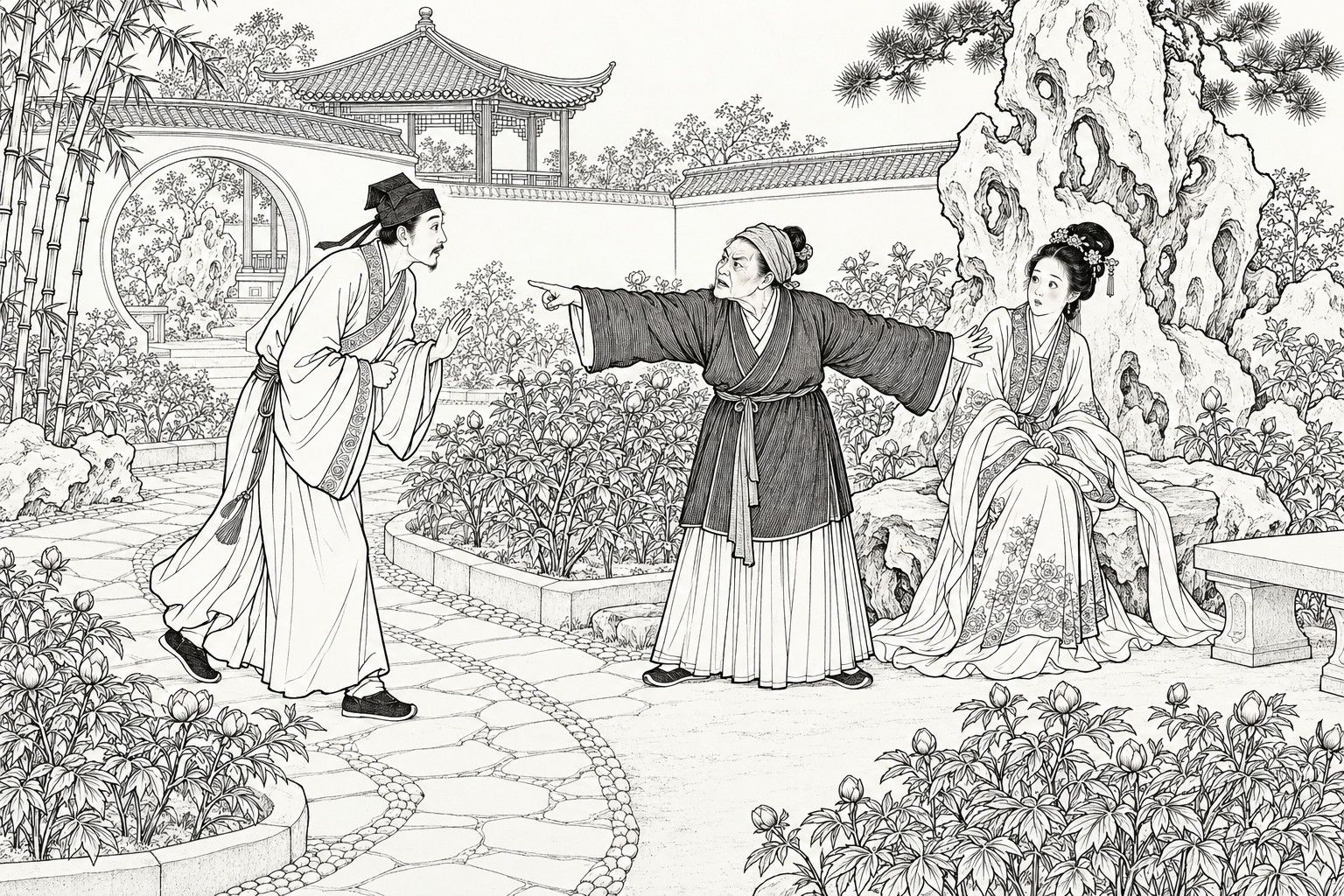
常大用,洛人。癖好牡丹。聞曹州牡丹甲齊、魯,心向往之。適以他事如曹,因假搢紳之園居焉。而時方二月,牡丹未華,惟徘徊園中,目注勾萌,以望其拆。作懷牡丹詩百絕。未幾,花漸含苞,而資斧將匱;尋典春衣,流連忘返。一日,凌晨趨花所,則一女郎及老嫗在焉。疑是貴家宅眷,亦遂遄返。暮而往,又見之,從容避去。微窺之,宮妝豔絕。眩迷之中,忽轉一想:此必仙人,世上豈有此女子乎!急返身而搜之,驟過假山,適與媼遇。女郎方坐石上,相顧失驚。嫗以身幛女,叱曰:「狂生何為!」生長跪曰:「娘子必是神仙!」嫗咄之曰:「如此妄言,自當縶送令尹!」生大懼,女郎微笑曰:「去之!」過山而去。生返,不能徒步。意女郎歸告父兄,必有詬辱之來。偃臥空齋,自悔孟浪。竊幸女郎無怒容,或當不復置念。悔懼交集,終夜而病。日已向辰,喜無問罪之師,心漸寧帖。而回憶聲容,轉懼為想。如是三日,憔悴欲死。秉燭夜分,僕已熟眠。嫗入,持甌而進曰:「吾家葛巾娘子,手合鴆湯,其速飲!」生聞而駭,既而曰:「僕與娘子,夙無怨嫌,何至賜死?既為娘子手調,與其相思而病,不如仰藥而死!」遂引而盡之。嫗笑,接甌而去。生覺藥氣香冷,似非毒者。俄覺肺鬲寬舒,頭顱清爽,酣然睡去。既醒,紅日滿窗。試起,病若失,心益信其為仙。無可夤緣,但於無人時,彷彿其立處、坐處,虔拜而默禱之。一日,行去,忽於深樹內,覿面遇女郎,幸無他人,大喜,投地。女郎近曳之,忽聞異香竟體,即以手握玉腕而起,指膚軟膩,使人骨節欲酥。正欲有言,老嫗忽至。女令隱身石後,南指曰:「夜以花梯度牆,四面紅窗者,即妾居也。」匆匆遂去。生悵然,魂魄飛散,莫能知其所往。至夜,移梯登南垣,則垣下已有梯在,喜而下,果有紅窗。室中聞敲棋聲,佇立不敢復前,姑踰垣歸。少間,再過之,子聲猶繁;漸近窺之,則女郎與一素衣美人相對著,老嫗亦在坐,一婢侍焉。又返。凡三往復,三漏已催。生伏梯上,聞嫗出云:「梯也,誰置此?」呼婢共移去之。生登垣,欲下無階,恨悒而返。次夕,復往,梯先設矣。幸寂無人,入,則女郎兀坐,若有思者。見生驚起,斜立含羞。生揖曰:「自謂福薄,恐於天人無分,亦有今夕耶!」遂狎抱之。纖腰盈掬,吹氣如蘭,撐拒曰:「何遽爾!」生曰:「好事多磨,遲為鬼妒。」言未及已,遙聞人語。女急曰:「玉版妹子來矣!君可姑伏床下。」生從之。無何,一女子入,笑曰:「敗軍之將,尚可復言戰否?業已烹茗,敢邀為長夜之歡。」女郎辭以困惰。玉版固請之,女郎堅坐不行。玉版曰:「如此戀戀,豈藏有男子在室耶?」強拉之,出門而去。生膝行而出。恨絕,遂搜枕簟。冀一得其遺物。而室內并無香匳,祇床頭有水精如意,上結紫巾,芳潔可愛。懷之,越垣歸。自理衿袖,體香猶凝,傾慕益切。然因伏床之恐,遂有懷刑之懼,籌思不敢復往,但珍藏如意,以冀其尋。隔夕,女郎果至,笑曰:「妾向以君為君子也,而不知寇盜也,」生曰:「良有之。所以偶不君子者,第望其如意耳。」乃攬體入懷,代解裙結。玉肌乍露,熱香四流,偎抱之間,覺鼻息汗熏,無氣不馥。因曰:「僕固意卿為仙人,今益知不妄。幸蒙垂盼,緣在三生。但恐杜蘭香之下嫁,終成離恨耳。」女笑曰:「君慮亦過。妾不過離魂之倩女,偶為情動耳。此事宜要慎祕,恐是非之口,捏造黑白,君不能生翼,妾不能乘風,則禍離更慘於好別矣。」生然之,而終疑為仙,固詰姓氏。女曰:「既以妾為仙,仙人何必以姓名傳。」問:「嫗何人?」曰:「此桑姥。妾少時受其露覆,故不與婢輩同。」遂起,欲去,曰:「妾處耳目多,不可久羈,蹈隙當復來。」臨別,索如意,曰:「此非妾物,乃玉版所遺。」問:「玉版為誰?」曰:「妾叔妹也。」付鉤乃去。去後,衾枕皆染異香。由此三兩夜輒一至。生惑之,不復思歸。而囊橐既空,欲貨馬,女知之,曰:「君以妾故,瀉囊質衣,情所不忍。又去代步,千餘里將何以歸?妾有私蓄,聊可助裝。」生辭曰:「感卿情好,撫臆誓肌,不足論報;而又貪鄙,以耗卿財,何以為人矣!」女固強之,曰:「姑假君。」遂捉生臂,至一桑樹下,指一石,曰:「轉之!」生從之。又拔頭上簪,刺土數十下,又曰:「爬之。」生又從之。則甕口已見。女探入,出白鏹近五十兩許;生把臂止之,不聽,又出十餘鋌,生強反其半而後掩之。一夕,謂生曰:「近日微有浮言,勢不可長,此不可不預謀也。」生驚曰:「且為奈何!小生素迂謹,今為卿故,如寡婦之失守,不復能自主矣。一惟卿命,刀鋸斧鉞,亦所不遑顧耳!」女謀偕亡,命生先歸,約會於洛。生治任旋里,擬先歸而後逆之;比至,則女郎車適已至門。登堂朝家人,四鄰驚賀,而並不知其竊而逃也。生竊自危;女殊坦然,謂生曰:「無論千里外非邏察所及,即或知之,妾世家女,卓王孫當無如長卿何也。」生弟大器,年十七,女顧之曰:「是有慧根,前程尤勝於君。」完婚有期,妻忽夭殞。女曰:「妾妹玉版,君固嘗窺見之,貌頗不惡,年亦相若,作夫婦可稱嘉耦。」生聞之而笑,戲請作伐,女曰:「必欲致之,即亦非難。」喜問:「何術?」曰:「妹與妾最相善。兩馬駕輕車,費一嫗之往返耳。」生懼前情俱發,不敢從其謀;女固言:「不害。」即命車,遣桑媼去。數日,至曹。將近里門,媼下車,使御者止而候於途,乘夜入里。良久,偕女子來,登車遂發。昏暮即宿車中,五更復行。女郎計其時日,使大器盛服而逆之。五十里許,乃相遇,御輪而歸;鼓吹花燭,起拜成禮。由此兄弟皆得美婦,而家又日以富。一日,有大寇數十騎,突入第。生知有變,舉家登樓。寇入,圍樓。生俯問:「有仇否?」答言:「無仇。但有兩事相求:一則聞兩夫人世間所無,請賜一見;一則五十八人,各乞金五百。」聚薪樓下,為縱火計以脅之。生允其索金之請;寇不滿志,欲焚樓,家人大恐。女欲與玉版下樓,止之不聽。炫妝而下,階未盡者三級,謂寇曰:「我姊妹皆仙媛,暫時一履塵世,何畏寇盜!欲賜汝萬金,恐汝不敢受也。」寇眾一齊仰拜,喏聲「不敢」。姊妹欲退,一寇曰:「此詐也!」女聞之,反身佇立,曰:「意欲何作,便早圖之!尚未晚也。」諸寇相顧,默無一言。姊妹從容上樓而去。寇仰望無跡,鬨然始散。後二年,姊妹各舉一子,始漸自言:「魏姓,母封曹國夫人。」生疑曹無魏姓世家,又且大姓失女,何得一置不問?未敢窮詰,而心竊怪之。遂託故復詣曹,入境諮訪,世族并無魏姓。於是仍假館舊主人。忽見壁上有贈曹國夫人詩,頗涉駭異,因詰主人。主人笑,即請往觀曹夫人,至則牡丹一本,高與簷等。問所由名,則以此花為曹第一,故同人戲封之。問其「何種」?曰:「葛巾紫也。」心益駭,遂疑女為花妖。既歸,不敢質言,但述贈夫人詩以覘之。女蹙然變色,遽出,呼玉版抱兒至,謂生曰:「三年前,感君見思,遂呈身相報;今見猜疑,何可復聚!」因與玉版皆舉兒遙擲之,兒墮地並沒。生方驚顧,則二女俱渺矣。悔恨不已。後數日,墮兒處生牡丹二株,一夜徑尺,當年而花,一紫一白,朵大如盤,較尋常之葛巾、玉版,瓣尤繁碎。數年,茂蔭成叢;移分他所,更變異種,莫能識其名。自此牡丹之盛,洛下無雙焉。
常大用,洛人。癖好牡丹。闻曹州牡丹甲齐、鲁,心向往之。适以他事如曹,因假搢绅之园居焉。而时方二月,牡丹未华,惟徘徊园中,目注勾萌,以望其拆。作怀牡丹诗百绝。未几,花渐含苞,而资斧将匮;寻典春衣,流连忘返。一日,凌晨趋花所,则一女郎及老妪在焉。疑是贵家宅眷,亦遂遄返。暮而往,又见之,从容避去。微窥之,宫妆艳绝。眩迷之中,忽转一想:此必仙人,世上岂有此女子乎!急返身而搜之,骤过假山,适与媪遇。女郎方坐石上,相顾失惊。妪以身幛女,叱曰:「狂生何为!」生长跪曰:「娘子必是神仙!」妪咄之曰:「如此妄言,自当絷送令尹!」生大惧,女郎微笑曰:「去之!」过山而去。生返,不能徒步。意女郎归告父兄,必有诟辱之来。偃卧空斋,自悔孟浪。窃幸女郎无怒容,或当不复置念。悔惧交集,终夜而病。日已向辰,喜无问罪之师,心渐宁帖。而回忆声容,转惧为想。如是三日,憔悴欲死。秉烛夜分,仆已熟眠。妪入,持瓯而进曰:「吾家葛巾娘子,手合鸩汤,其速饮!」生闻而骇,既而曰:「仆与娘子,夙无怨嫌,何至赐死?既为娘子手调,与其相思而病,不如仰药而死!」遂引而尽之。妪笑,接瓯而去。生觉药气香冷,似非毒者。俄觉肺鬲宽舒,头颅清爽,酣然睡去。既醒,红日满窗。试起,病若失,心益信其为仙。无可夤缘,但于无人时,仿佛其立处、坐处,虔拜而默祷之。一日,行去,忽于深树内,觌面遇女郎,幸无他人,大喜,投地。女郎近曳之,忽闻异香竟体,即以手握玉腕而起,指肤软腻,使人骨节欲酥。正欲有言,老妪忽至。女令隐身石后,南指曰:「夜以花梯度墙,四面红窗者,即妾居也。」匆匆遂去。生怅然,魂魄飞散,莫能知其所往。至夜,移梯登南垣,则垣下已有梯在,喜而下,果有红窗。室中闻敲棋声,伫立不敢复前,姑逾垣归。少间,再过之,子声犹繁;渐近窥之,则女郎与一素衣美人相对着,老妪亦在坐,一婢侍焉。又返。凡三往复,三漏已催。生伏梯上,闻妪出云:「梯也,谁置此?」呼婢共移去之。生登垣,欲下无阶,恨悒而返。次夕,复往,梯先设矣。幸寂无人,入,则女郎兀坐,若有思者。见生惊起,斜立含羞。生揖曰:「自谓福薄,恐于天人无分,亦有今夕耶!」遂狎抱之。纤腰盈掬,吹气如兰,撑拒曰:「何遽尔!」生曰:「好事多磨,迟为鬼妒。」言未及已,遥闻人语。女急曰:「玉版妹子来矣!君可姑伏床下。」生从之。无何,一女子入,笑曰:「败军之将,尚可复言战否?业已烹茗,敢邀为长夜之欢。」女郎辞以困惰。玉版固请之,女郎坚坐不行。玉版曰:「如此恋恋,岂藏有男子在室耶?」强拉之,出门而去。生膝行而出。恨绝,遂搜枕簟。冀一得其遗物。而室内并无香匳,祇床头有水精如意,上结紫巾,芳洁可爱。怀之,越垣归。自理衿袖,体香犹凝,倾慕益切。然因伏床之恐,遂有怀刑之惧,筹思不敢复往,但珍藏如意,以冀其寻。隔夕,女郎果至,笑曰:「妾向以君为君子也,而不知寇盗也,」生曰:「良有之。所以偶不君子者,第望其如意耳。」乃揽体入怀,代解裙结。玉肌乍露,热香四流,偎抱之间,觉鼻息汗熏,无气不馥。因曰:「仆固意卿为仙人,今益知不妄。幸蒙垂盼,缘在三生。但恐杜兰香之下嫁,终成离恨耳。」女笑曰:「君虑亦过。妾不过离魂之倩女,偶为情动耳。此事宜要慎秘,恐是非之口,捏造黑白,君不能生翼,妾不能乘风,则祸离更惨于好别矣。」生然之,而终疑为仙,固诘姓氏。女曰:「既以妾为仙,仙人何必以姓名传。」问:「妪何人?」曰:「此桑姥。妾少时受其露覆,故不与婢辈同。」遂起,欲去,曰:「妾处耳目多,不可久羁,蹈隙当复来。」临别,索如意,曰:「此非妾物,乃玉版所遗。」问:「玉版为谁?」曰:「妾叔妹也。」付钩乃去。去后,衾枕皆染异香。由此三两夜辄一至。生惑之,不复思归。而囊橐既空,欲货马,女知之,曰:「君以妾故,泻囊质衣,情所不忍。又去代步,千余里将何以归?妾有私蓄,聊可助装。」生辞曰:「感卿情好,抚臆誓肌,不足论报;而又贪鄙,以耗卿财,何以为人矣!」女固强之,曰:「姑假君。」遂捉生臂,至一桑树下,指一石,曰:「转之!」生从之。又拔头上簪,刺土数十下,又曰:「爬之。」生又从之。则瓮口已见。女探入,出白镪近五十两许;生把臂止之,不听,又出十余铤,生强反其半而后掩之。一夕,谓生曰:「近日微有浮言,势不可长,此不可不预谋也。」生惊曰:「且为奈何!小生素迂谨,今为卿故,如寡妇之失守,不复能自主矣。一惟卿命,刀锯斧钺,亦所不遑顾耳!」女谋偕亡,命生先归,约会于洛。生治任旋里,拟先归而后逆之;比至,则女郎车适已至门。登堂朝家人,四邻惊贺,而并不知其窃而逃也。生窃自危;女殊坦然,谓生曰:「无论千里外非逻察所及,即或知之,妾世家女,卓王孙当无如长卿何也。」生弟大器,年十七,女顾之曰:「是有慧根,前程尤胜于君。」完婚有期,妻忽夭殒。女曰:「妾妹玉版,君固尝窥见之,貌颇不恶,年亦相若,作夫妇可称嘉耦。」生闻之而笑,戏请作伐,女曰:「必欲致之,即亦非难。」喜问:「何术?」曰:「妹与妾最相善。两马驾轻车,费一妪之往返耳。」生惧前情俱发,不敢从其谋;女固言:「不害。」即命车,遣桑媪去。数日,至曹。将近里门,媪下车,使御者止而候于途,乘夜入里。良久,偕女子来,登车遂发。昏暮即宿车中,五更复行。女郎计其时日,使大器盛服而逆之。五十里许,乃相遇,御轮而归;鼓吹花烛,起拜成礼。由此兄弟皆得美妇,而家又日以富。一日,有大寇数十骑,突入第。生知有变,举家登楼。寇入,围楼。生俯问:「有仇否?」答言:「无仇。但有两事相求:一则闻两夫人世间所无,请赐一见;一则五十八人,各乞金五百。」聚薪楼下,为纵火计以胁之。生允其索金之请;寇不满志,欲焚楼,家人大恐。女欲与玉版下楼,止之不听。炫妆而下,阶未尽者三级,谓寇曰:「我姊妹皆仙媛,暂时一履尘世,何畏寇盗!欲赐汝万金,恐汝不敢受也。」寇众一齐仰拜,喏声「不敢」。姊妹欲退,一寇曰:「此诈也!」女闻之,反身伫立,曰:「意欲何作,便早图之!尚未晚也。」诸寇相顾,默无一言。姊妹从容上楼而去。寇仰望无迹,哄然始散。后二年,姊妹各举一子,始渐自言:「魏姓,母封曹国夫人。」生疑曹无魏姓世家,又且大姓失女,何得一置不问?未敢穷诘,而心窃怪之。遂托故复诣曹,入境咨访,世族并无魏姓。于是仍假馆旧主人。忽见壁上有赠曹国夫人诗,颇涉骇异,因诘主人。主人笑,即请往观曹夫人,至则牡丹一本,高与檐等。问所由名,则以此花为曹第一,故同人戏封之。问其「何种」?曰:「葛巾紫也。」心益骇,遂疑女为花妖。既归,不敢质言,但述赠夫人诗以觇之。女蹙然变色,遽出,呼玉版抱儿至,谓生曰:「三年前,感君见思,遂呈身相报;今见猜疑,何可复聚!」因与玉版皆举儿遥掷之,儿堕地并没。生方惊顾,则二女俱渺矣。悔恨不已。后数日,堕儿处生牡丹二株,一夜径尺,当年而花,一紫一白,朵大如盘,较寻常之葛巾、玉版,瓣尤繁碎。数年,茂荫成丛;移分他所,更变异种,莫能识其名。自此牡丹之盛,洛下无双焉。
Chang Dayong was a man of Luoyang, and peonies were his obsession. He heard that the peonies of Caozhou were the finest in all Shandong, and his heart went out to them. It happened that other business took him to Caozhou, so he borrowed lodgings in the garden of a gentleman of rank there. But it was only the second month, and the peonies had not yet bloomed. He could only wander about the garden, his eyes fixed on the buds and shoots, watching for them to open. He wrote a hundred quatrains, Longing for the Peonies. Before long the flowers began to bud, but his money was running out; soon he pawned his spring clothes, lingering on and forgetting to go home. One day, at first light, he hurried to the flowers and found a young lady there with an old woman. Supposing she was one of the women of some noble house, he turned straight back. When he went in the evening he saw her again; she withdrew unhurriedly. He stole a glance: she was dressed like a lady of the palace and dazzlingly beautiful. In his daze a new thought suddenly struck him: she must be an immortal — how could the world hold a woman like this? He quickly turned back to look for her, and as he hurried round the rockery he ran right into the old woman. The young lady was sitting on a rock; they looked at each other in alarm. The old woman shielded the girl with her body and snapped, “Mad scholar, what are you doing?” Chang fell to his knees. “The lady must be a goddess!” The old woman spat at him. “Talking such wild nonsense — you ought to be tied up and handed to the magistrate!” Chang was terrified. The young lady smiled faintly. “Come away!” And they went off round the rockery. Chang went back, so weak in the legs he could hardly walk. He thought the young lady would go home and tell her father and brothers, and insults and abuse would surely follow. He lay down in his empty study, regretting his rashness. He took secret comfort that she had not looked angry; perhaps she would think no more of it. Torn between regret and fear, he was ill by morning. The sun climbed toward mid-morning, and when no one came to call him to account he was glad, and his heart gradually grew calm. But as he recalled her voice and face, his fear turned to longing. Three days of this, and he was so wasted he was nearly dead. He sat up by candlelight past midnight, his servant already sound asleep, when the old woman came in holding a bowl. “Our lady Gejin has mixed you a cup of poison with her own hands,” she said. “Drink it quickly!” Chang was startled. Then he said, “There has never been any grudge or ill will between the lady and me. Why should she send me death? But since the lady mixed it with her own hands, rather than fall ill of longing, I would sooner drink it and die!” And he drained it. The old woman laughed, took the bowl and left. Chang found the medicine smelled fragrant and cool, and did not seem to be poison. Soon he felt his chest ease and his head clear, and he fell into a deep sleep. When he woke the red sun filled the window. He tried getting up: the illness was gone as if it had never been. He was more convinced than ever that she was an immortal. He had no way to reach her. He could only, when no one was about, picture where she had stood and where she had sat, and bow there devoutly and pray in silence. One day, as he was walking, he came face to face with her deep among the trees. Luckily there was no one else there. Overjoyed, he threw himself on the ground. She came close to pull him up, and suddenly he caught a strange fragrance from her whole body. He took her jade-white wrist and rose; the skin of her fingers was so soft and smooth it seemed to melt his bones. He was just about to speak when the old woman suddenly appeared. The girl had him hide behind a rock, and pointed south. “At night, climb the wall by the flower ladder. The room with red windows on all four sides is where I live.” And she hurried away. Chang was left forlorn, his soul scattered, with no idea where she had gone. That night he moved a ladder and climbed the south wall, and found a ladder already standing at its foot. Delighted, he went down, and there indeed were the red windows. He heard the click of chess pieces from inside, and stood still, not daring to go nearer; for the time being he climbed back over the wall and went home. After a while he went over again, and the pieces were still clicking busily. He crept near and peeped in: the young lady and a beauty dressed in white sat facing each other over the board, the old woman sitting with them and a maid waiting on them. He went back again. Three times he went back and forth, and already the third watch was being called. As Chang lay flat on the ladder, he heard the old woman come out. “A ladder? Who put this here?” She called the maid and the two of them took it away. Chang climbed the wall but had no way down, and went back sick with disappointment. The next evening he went again, and the ladder was set there already. Luckily all was quiet and there was no one about. He went in: the young lady sat alone, motionless, as if lost in thought. Seeing him she started up and stood half turned away, shy. Chang bowed. “I thought my luck was too thin, that a heavenly being was not for me. Yet tonight has come after all!” And he took her in his arms. Her slender waist would barely fill his hands, and her breath was sweet as orchids. She pushed him away. “Why so fast?” “Good things meet with many obstacles,” said Chang. “Wait, and the ghosts grow jealous.” Before he had finished they heard voices in the distance. “Little Sister Yuban is coming!” she said urgently. “Hide under the bed for now.” Chang did so. Before long a girl came in and laughed. “Does the defeated general dare talk of battle again? I’ve already brewed the tea; may I invite you to make a long night of it?” The young lady excused herself, saying she was tired and lazy. Yuban pressed her; she would not budge. “So reluctant!” said Yuban. “Have you got a man hidden in your room?” She dragged her off by force, out of the door. Chang crawled out on his knees, utterly frustrated. He searched the pillow and mat, hoping to find something of hers left behind. But there was no scent box in the room, only a crystal ruyi at the head of the bed, with a purple kerchief tied to it, fragrant, clean and lovely. He put it inside his robe and went home over the wall. When he smoothed his collar and sleeves, the scent of her body still clung to them, and his longing grew keener than ever. But after hiding under the bed he was afraid of being punished, and after much thought he did not dare go back. He only treasured the ruyi, hoping she would come looking for it. Two evenings later she did come. She laughed. “I took you for a gentleman. I did not know you were a thief.” “That is true,” said Chang. “If for once I was no gentleman, it was only in the hope of my ruyi — of having things as I wished.” He drew her into his arms and untied her skirt for her. Her jade-white flesh was suddenly bare, and a warm fragrance flowed all around; as he held her close, her breath and her sweat were scented, and there was no breath of her that was not perfumed. So he said, “I always thought you were an immortal, and now I know I was not wrong. That you have looked on me with favour is a bond fated over three lives. But I fear that, as when Du Lanxiang came down to marry, it will end in parting and sorrow.” She laughed. “You worry too much. I am only a girl like Qiannü whose soul left her body, moved for a moment by love. This must be kept very secret. I fear wagging tongues will twist black and white, and then — you cannot grow wings, and I cannot ride the wind — a forced parting would be more bitter than a happy farewell.” Chang agreed, but he still suspected she was an immortal, and pressed her for her name. “Since you take me for an immortal,” she said, “why should an immortal leave a name behind?” “Who is the old woman?” he asked. “That is Granny Sang. When I was little I was sheltered under her dew, so she is not like the maids.” Then she rose to go. “There are too many eyes and ears where I live. I can’t stay long. When there’s a chance I’ll come again.” As she left, she asked for the ruyi. “This is not mine. Yuban left it.” “Who is Yuban?” he asked. “My cousin.” He handed it over and she went. After she had gone the quilt and pillow were steeped in a strange fragrance. From then on she came every two or three nights. Chang was so bewitched that he thought no more of going home. But his purse was empty, and he meant to sell his horse. She learned of it and said, “It hurts me that for my sake you have emptied your purse and pawned your clothes. And if you get rid of your horse, how will you get home, more than a thousand li? I have some savings of my own, which may help a little for the journey.” Chang declined. “I am grateful for your love. I could lay my hand on my heart and swear by my own body, and it would not repay you. If I were greedy and mean enough to spend your money too, what kind of man would I be?” She insisted. “Just borrow it, then.” She took him by the arm to a mulberry tree, pointed at a stone and said, “Turn that!” He did. Then she pulled the pin from her hair and stabbed the earth dozens of times. “Dig,” she said. He did that too, and the mouth of a jar appeared. She reached in and brought out nearly fifty taels of silver. Chang caught her arm to stop her, but she would not listen and brought out more than ten ingots besides. Chang insisted on putting half back, and then they covered the jar over. One evening she said to him, “Lately there has been a little gossip. This cannot go on. We must plan ahead.” Chang was alarmed. “What shall we do? I have always been a cautious pedant, but now for your sake I am like a widow who has lost her virtue — I am no longer my own master. I will do whatever you say. Knife, saw, axe or battle-axe, I haven’t time to care!” She planned for them to run away together. She told him to go home first, and they would meet at Luoyang. Chang packed and returned home, meaning to arrive first and then come back to meet her. But when he got there, her carriage had just reached his gate. She went into the hall and greeted the family. The neighbours all came round in surprise to congratulate them, never knowing she had run away from home. Chang secretly feared for himself; she was perfectly calm. “Leaving aside that we are a thousand li beyond the reach of any patrol,” she said to him, “even if they did find out — I am the daughter of an old family, and Zhuo Wangsun could do nothing about Changqing.” Chang’s younger brother Daqi was seventeen. She looked at him and said, “This one has roots of wisdom. His future will be even better than yours.” His wedding day had been fixed when his bride suddenly died. “My sister Yuban,” she said, “you once caught a glimpse of her. She is not bad-looking, and she is about his age. They would make a fine couple.” Chang laughed at this and jokingly asked her to be the go-between. “If you really want her, it isn’t hard,” she said. Delighted, he asked, “How?” “My sister and I are the closest of friends. Two horses and a light carriage, and one old woman’s trip there and back — that’s all it will cost.” Chang feared the whole affair would come to light and dared not go along with her plan, but she insisted, “No harm will come of it.” She ordered the carriage at once and sent Granny Sang. After some days the old woman reached Caozhou. Near the village gate she got down, had the driver stop and wait by the road, and went into the village under cover of night. After a long while she came back with a girl; they got into the carriage and set off. At dusk they slept in the carriage, and at the fifth watch they went on again. The young lady counted the days and had Daqi dress in his finest to go and meet them. About fifty li along the road they met, and he drove the carriage home himself. With drums and pipes and flowered candles, they rose and bowed and the rites were done. And so both brothers had beautiful wives, and the family grew richer by the day. One day a great band of robbers, several dozen horsemen, burst into the house. Chang knew something was wrong, and the whole household went up into the tower. The robbers came in and surrounded it. Chang leaned out and asked, “Do you have some grudge against us?” “No grudge,” they answered. “But we have two requests. One: we hear your two ladies are like nothing else in the world, and we beg a look at them. Two: there are fifty-eight of us, and we each want five hundred in silver.” They piled firewood at the foot of the tower, threatening to set it alight. Chang agreed to give them the money; the robbers were not satisfied and were about to burn the tower. The household was terrified. The young lady wanted to go down with Yuban. They tried to stop her, but she would not listen. Dressed in all their finery the two went down, and three steps short of the bottom she said to the robbers, “We sisters are both immortals, come down to the dusty world for a little while. Why should we fear robbers? I would like to give you ten thousand in gold, but I’m afraid you would not dare take it.” The robbers all bowed down together, looking up at them, and chorused, “We wouldn’t dare.” The sisters were about to withdraw when one robber said, “It’s a trick!” She heard it, turned round and stood still. “Whatever you mean to do, do it now! It is not too late.” The robbers looked at one another without a word. The sisters went back upstairs unhurriedly. The robbers stared up until they were out of sight, then broke up in a clamour and scattered. Two years later the sisters each bore a son. Only then did they begin to say a little about themselves: “Our family name is Wei. Our mother was given the title Lady of Cao.” Chang doubted there was any great family named Wei in Caozhou. Besides, if a great family lost a daughter, how could it let the matter drop without a word? He did not dare question them closely, but privately he thought it strange. So, making some excuse, he went to Caozhou again. Once there he made inquiries: among the old families there was none named Wei. So he lodged with his former host again. Suddenly he saw on the wall a poem presented to the Lady of Cao. Rather startled, he asked his host about it. The host laughed and invited him to go and see the Lady of Cao at once. It turned out to be a peony as tall as the eaves. When he asked how it came by the name, he was told that it was the finest flower in Caozhou, so their circle had given it the title in jest. He asked what kind it was. “Gejin Purple,” said the host. Chang was more alarmed than ever, and began to suspect his wife was a flower spirit. When he got home he dared not ask her outright; he only recited the poem to the Lady of Cao to see how she would take it. She frowned and her face changed. She went straight out and called Yuban to bring the children. Then she said to Chang, “Three years ago I was moved by your longing for me, and gave myself to you in return. Now that I am suspected, how can we stay together?” She and Yuban both lifted the children and flung them far away. The children fell to the ground and vanished. As Chang stared in shock, the two women vanished too. He was sick with regret. A few days later two peonies sprang up where the children had fallen. In a single night they measured a foot across and flowered that same year, one purple and one white, with blooms as big as plates, their petals more numerous and finer than those of the ordinary Gejin and Yuban. In a few years they had grown into a thick, shady clump. When they were divided and moved to other places, they turned into new varieties no one could name. From then on, the splendour of their peonies had no equal in Luoyang.