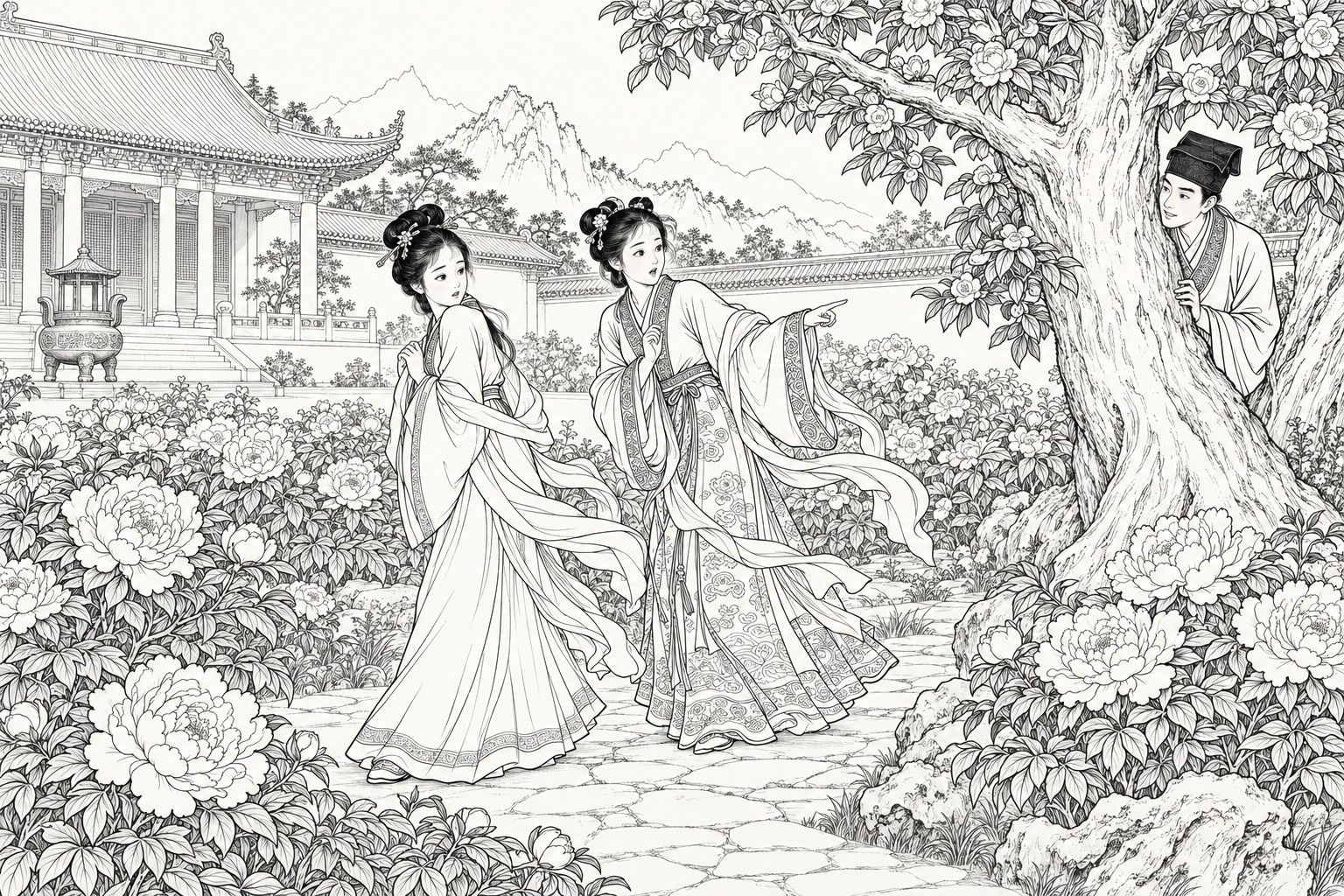
勞山下清宮,耐冬高二丈,大數十圍,牡丹高丈餘,花時璀璨似錦。膠州黃生,舍讀其中。一日,自窗中見女郎,素衣掩映花間。心疑觀中焉得此。趨出,已遁去。自此屢見之。遂隱身叢樹中,以伺其至。未幾,女郎又偕一紅裳者來,遙望之,豔麗雙絕。行漸近,紅裳者卻退,曰:「此處有生人!」生暴起。二女驚奔,袖裙飄拂,香風洋溢,追過短牆,寂然已杳。愛慕彌切,因題句樹下云:
「無限相思苦,含情對短窗。恐歸沙吒利,何處覓無雙?」
歸齋冥想。女郎忽入,驚喜承迎。女笑曰:「君洶洶似強寇,使人恐怖;不知君乃騷雅士,無妨相見。」生略叩生平。曰:「妾小字香玉,隸籍平康巷。被道士閉置山中,實非所願。」生問:「道士何名?當為卿一滌此垢。」女曰:「不必,彼亦未敢相逼。借此與風流士長作幽會,亦佳。」問:「紅衣者誰?」曰:「此名絳雪,乃妾義姊。」遂相狎。及醒,曙色已紅。女急起,曰:「貪歡忘曉矣。」著衣易履,且曰:「妾酧君作,勿笑:
『良夜更易盡,朝暾已上窗。願如梁上燕,棲處自成雙。』」
生握腕曰:「卿秀外惠中,令人愛而忘死。顧一日之去,如千里之別。卿乘間當來,勿待夜也。」女諾之。由此夙夜必偕。每使邀絳雪來,輒不至,生以為恨。女曰:「絳姊性殊落落,不似妾情癡也。當從容勸駕,不必過急。」一夕,女慘然入,曰:「君隴不能守,尚望蜀耶?今長別矣。」問:「何之?」以袖拭淚,曰:「此有定數,難為君言。昔日佳作,今成讖語矣。『佳人已屬沙吒利,義士今無古押衙』,可為妾詠。」詰之,不言,但有嗚咽。竟夜不眠,早旦而去。生怪之。次日,有即墨藍氏,入宮游矚,見白牡丹,悅之,掘移逕去。生始悟香玉乃花妖也,悵惋不已。過數日,聞藍氏移花至家,日就萎悴。恨極,作哭花詩五十首,日日臨穴涕洟。一日,憑弔方返,遙見紅衣人,揮涕穴側。從容近就,女亦不避。生因把袂,相向汍瀾。已而挽請入室,女亦從之。歎曰:「童稚姊妹,一朝斷絕!聞君哀傷,彌增妾慟。淚墮九泉,或當感誠再作;然死者神氣已散,倉卒何能與吾兩人共談笑也。」生曰:「小生薄命,妨害情人,當亦無福可消雙美。曩頻煩香玉道達微忱,胡再不臨?」女曰:「妾以年少書生,什九薄倖;不知君固至情人也。然妾與君交,以情不以淫。若晝夜狎暱,則妾所不能矣。」言已,告別。生曰:「香玉長離,使人寢食俱廢。賴卿少留,慰此懷思,何決絕如此!」女乃止,過宿而去。數日不復至。冷雨幽窗,苦懷香玉,輾轉床頭,淚凝枕席。攬衣更起,挑燈復踵前韻曰:
「山院黃昏雨,垂簾坐小窗。相思人不見,中夜淚雙雙。」
詩成自吟。忽窗外有人曰:「作者不可無和。」聽之,絳雪也。啟戶內之。女視詩,即續其後曰:
「連袂人何處?孤燈照晚窗。空山人一個,對影自成雙。」
生讀之淚下,因怨相見之疏。女曰:「妾不能如香玉之熱,但可少慰君寂寞耳。」生欲與狎。曰:「相見之歡,何必在此。」於是至無聊時,女輒一至。至則宴飲唱酧,有時不寢遂去,生亦聽之。謂曰:「香玉吾愛妻,絳雪吾良友也。」每欲相問:「卿是院中第幾株?乞早見示,僕將抱植家中,免似香玉被惡人奪去,貽恨百年。」女曰:「故土難移,告君亦無益也。妻尚不能終從,況友乎!」生不聽,捉臂而出,每至牡丹下,輒問:「此是卿否?」女不言,掩口笑之。旋生以臘歸過歲。至二月間,忽夢絳雪至,愀然曰:「妾有大難!君急往,尚得相見;遲無及矣。」醒而異之,急命僕馬,星馳至山。則道士將建屋,有一耐冬,礙其營造,工師將縱斤矣。生急止之。入夜,絳雪來謝。生笑曰:「向不實告,宜遭此厄!今已知卿;如卿不至,當以艾炷相炙。」女曰:「妾固知君如此,曩故不敢相告也。」坐移時,生曰:「今對良友,益思豔妻。久不哭香玉,卿能從我哭乎?」二人乃往,臨穴灑涕。更餘,絳雪收淚勸止。又數夕,生方寂坐,絳雪笑入曰:「報君喜信:花神感君至情,俾香玉復降宮中。」生問:「何時?」答曰:「不知,約不遠耳。」天明下榻,生囑曰:「僕為卿來,勿長使人孤寂。」女笑諾。兩夜不至。生往抱樹,搖動撫摩,頻喚無聲。乃返,對燈團艾,將往灼樹。女遽入,奪艾棄之,曰:「君惡作劇,使人創痏,當與君絕矣!」生笑擁之。坐未定,香玉盈盈而入。生望見,泣下流離,急起把握。香玉以一手握絳雪,相對悲哽。及坐,生把之覺虛,如手自握,驚問之。香玉泫然曰:「昔,妾花之神,故凝;今,妾花之鬼,故散也。今雖相聚,勿以為真,但作夢寐觀可耳。」絳雪曰:「妹來大好!我被汝家男子糾纏死矣。」遂去。香玉款笑如前;但偎傍之間,彷彿一身就影。生悒悒不樂。香玉亦俯仰自恨。乃曰:「君以白蘞屑,少雜硫黃,日酹妾一杯水,明年此日報君恩。」別去。明日,往觀故處,則牡丹萌生矣。生乃日加培植,又作雕欄以護之。香玉來,感激倍至。生謀移植其家,女不可,曰:「妾弱質,不堪復戕。且物生各有定處,妾來原不擬生君家,違之反促年壽。但相憐愛,合好自有日耳。」生恨絳雪不至。香玉曰:「必欲強之使來,妾能致之。」乃與生挑燈至樹下,取草一莖,布掌作度,以度樹本,自下而上,至四尺六寸,按其處,使生以兩爪齊搔之。俄見絳雪從背後出,笑罵曰:「婢子來,助桀為虐耶!」牽挽並入。香玉曰:「姊勿怪!暫煩陪侍郎君,一年後不相擾矣。」從此遂以為常。生視花芽,日益肥茂,春盡,盈二尺許。歸後,以金遺道士,囑令朝夕培養之。次年四月至宮,則花一朵,含苞未放;方流連間,花搖搖欲拆;少時已開,花大如盤,儼然有小美人坐蕊中,裁三四指許;轉瞬飄然欲下,則香玉也。笑曰:「妾忍風雨以待君,君來何遲也!」遂入室。絳雪亦至,笑曰:「日日代人作婦,今幸退而為友。」遂相談讌。至中夜,絳雪乃去。二人同寢,款洽一如從前。後生妻卒,遂入山,不復歸。是時,牡丹已大如臂。生每指之曰:「我他日寄魂於此,當生卿之左。」二女笑曰:「君勿忘之。」後十餘年,忽病。其子至,對之而哀。生笑曰:「此我生期,非死期也,何哀為!」謂道士曰:「他日牡丹下有赤芽怒生,一放五葉者,即我也。」遂不復言。子輿之歸家。即卒。次年,果有肥芽突出,葉如其數。道士以為異,益灌溉之。三年,高數尺,大拱把,但不花。老道士死,其弟子不知愛惜,斫去之。白牡丹亦憔悴死;無何,耐冬亦死。
劳山下清宫,耐冬高二丈,大数十围,牡丹高丈余,花时璀璨似锦。胶州黄生,舍读其中。一日,自窗中见女郎,素衣掩映花间。心疑观中焉得此。趋出,已遁去。自此屡见之。遂隐身丛树中,以伺其至。未几,女郎又偕一红裳者来,遥望之,艳丽双绝。行渐近,红裳者却退,曰:「此处有生人!」生暴起。二女惊奔,袖裙飘拂,香风洋溢,追过短墙,寂然已杳。爱慕弥切,因题句树下云:
「无限相思苦,含情对短窗。恐归沙咤利,何处觅无双?」
归斋冥想。女郎忽入,惊喜承迎。女笑曰:「君汹汹似强寇,使人恐怖;不知君乃骚雅士,无妨相见。」生略叩生平。曰:「妾小字香玉,隶籍平康巷。被道士闭置山中,实非所愿。」生问:「道士何名?当为卿一涤此垢。」女曰:「不必,彼亦未敢相逼。借此与风流士长作幽会,亦佳。」问:「红衣者谁?」曰:「此名绛雪,乃妾义姊。」遂相狎。及醒,曙色已红。女急起,曰:「贪欢忘晓矣。」着衣易履,且曰:「妾酧君作,勿笑:
『良夜更易尽,朝暾已上窗。愿如梁上燕,栖处自成双。』」
生握腕曰:「卿秀外惠中,令人爱而忘死。顾一日之去,如千里之别。卿乘间当来,勿待夜也。」女诺之。由此夙夜必偕。每使邀绛雪来,辄不至,生以为恨。女曰:「绛姊性殊落落,不似妾情痴也。当从容劝驾,不必过急。」一夕,女惨然入,曰:「君陇不能守,尚望蜀耶?今长别矣。」问:「何之?」以袖拭泪,曰:「此有定数,难为君言。昔日佳作,今成谶语矣。『佳人已属沙咤利,义士今无古押衙』,可为妾咏。」诘之,不言,但有呜咽。竟夜不眠,早旦而去。生怪之。次日,有即墨蓝氏,入宫游瞩,见白牡丹,悦之,掘移径去。生始悟香玉乃花妖也,怅惋不已。过数日,闻蓝氏移花至家,日就萎悴。恨极,作哭花诗五十首,日日临穴涕洟。一日,凭吊方返,遥见红衣人,挥涕穴侧。从容近就,女亦不避。生因把袂,相向汍澜。已而挽请入室,女亦从之。叹曰:「童稚姊妹,一朝断绝!闻君哀伤,弥增妾恸。泪堕九泉,或当感诚再作;然死者神气已散,仓卒何能与吾两人共谈笑也。」生曰:「小生薄命,妨害情人,当亦无福可消双美。曩频烦香玉道达微忱,胡再不临?」女曰:「妾以年少书生,什九薄幸;不知君固至情人也。然妾与君交,以情不以淫。若昼夜狎暱,则妾所不能矣。」言已,告别。生曰:「香玉长离,使人寝食俱废。赖卿少留,慰此怀思,何决绝如此!」女乃止,过宿而去。数日不复至。冷雨幽窗,苦怀香玉,辗转床头,泪凝枕席。揽衣更起,挑灯复踵前韵曰:
「山院黄昏雨,垂帘坐小窗。相思人不见,中夜泪双双。」
诗成自吟。忽窗外有人曰:「作者不可无和。」听之,绛雪也。启户内之。女视诗,即续其后曰:
「连袂人何处?孤灯照晚窗。空山人一个,对影自成双。」
生读之泪下,因怨相见之疏。女曰:「妾不能如香玉之热,但可少慰君寂寞耳。」生欲与狎。曰:「相见之欢,何必在此。」于是至无聊时,女辄一至。至则宴饮唱酧,有时不寝遂去,生亦听之。谓曰:「香玉吾爱妻,绛雪吾良友也。」每欲相问:「卿是院中第几株?乞早见示,仆将抱植家中,免似香玉被恶人夺去,贻恨百年。」女曰:「故土难移,告君亦无益也。妻尚不能终从,况友乎!」生不听,捉臂而出,每至牡丹下,辄问:「此是卿否?」女不言,掩口笑之。旋生以腊归过岁。至二月间,忽梦绛雪至,愀然曰:「妾有大难!君急往,尚得相见;迟无及矣。」醒而异之,急命仆马,星驰至山。则道士将建屋,有一耐冬,碍其营造,工师将纵斤矣。生急止之。入夜,绛雪来谢。生笑曰:「向不实告,宜遭此厄!今已知卿;如卿不至,当以艾炷相炙。」女曰:「妾固知君如此,曩故不敢相告也。」坐移时,生曰:「今对良友,益思艳妻。久不哭香玉,卿能从我哭乎?」二人乃往,临穴洒涕。更余,绛雪收泪劝止。又数夕,生方寂坐,绛雪笑入曰:「报君喜信:花神感君至情,俾香玉复降宫中。」生问:「何时?」答曰:「不知,约不远耳。」天明下榻,生嘱曰:「仆为卿来,勿长使人孤寂。」女笑诺。两夜不至。生往抱树,摇动抚摩,频唤无声。乃返,对灯团艾,将往灼树。女遽入,夺艾弃之,曰:「君恶作剧,使人创痏,当与君绝矣!」生笑拥之。坐未定,香玉盈盈而入。生望见,泣下流离,急起把握。香玉以一手握绛雪,相对悲哽。及坐,生把之觉虚,如手自握,惊问之。香玉泫然曰:「昔,妾花之神,故凝;今,妾花之鬼,故散也。今虽相聚,勿以为真,但作梦寐观可耳。」绛雪曰:「妹来大好!我被汝家男子纠缠死矣。」遂去。香玉款笑如前;但偎傍之间,仿佛一身就影。生悒悒不乐。香玉亦俯仰自恨。乃曰:「君以白蔹屑,少杂硫黄,日酹妾一杯水,明年此日报君恩。」别去。明日,往观故处,则牡丹萌生矣。生乃日加培植,又作雕栏以护之。香玉来,感激倍至。生谋移植其家,女不可,曰:「妾弱质,不堪复戕。且物生各有定处,妾来原不拟生君家,违之反促年寿。但相怜爱,合好自有日耳。」生恨绛雪不至。香玉曰:「必欲强之使来,妾能致之。」乃与生挑灯至树下,取草一茎,布掌作度,以度树本,自下而上,至四尺六寸,按其处,使生以两爪齐搔之。俄见绛雪从背后出,笑骂曰:「婢子来,助桀为虐耶!」牵挽并入。香玉曰:「姊勿怪!暂烦陪侍郎君,一年后不相扰矣。」从此遂以为常。生视花芽,日益肥茂,春尽,盈二尺许。归后,以金遗道士,嘱令朝夕培养之。次年四月至宫,则花一朵,含苞未放;方流连间,花摇摇欲拆;少时已开,花大如盘,俨然有小美人坐蕊中,裁三四指许;转瞬飘然欲下,则香玉也。笑曰:「妾忍风雨以待君,君来何迟也!」遂入室。绛雪亦至,笑曰:「日日代人作妇,今幸退而为友。」遂相谈䜩。至中夜,绛雪乃去。二人同寝,款洽一如从前。后生妻卒,遂入山,不复归。是时,牡丹已大如臂。生每指之曰:「我他日寄魂于此,当生卿之左。」二女笑曰:「君勿忘之。」后十余年,忽病。其子至,对之而哀。生笑曰:「此我生期,非死期也,何哀为!」谓道士曰:「他日牡丹下有赤芽怒生,一放五叶者,即我也。」遂不复言。子舆之归家。即卒。次年,果有肥芽突出,叶如其数。道士以为异,益灌溉之。三年,高数尺,大拱把,但不花。老道士死,其弟子不知爱惜,斫去之。白牡丹亦憔悴死;无何,耐冬亦死。
At the Lower Palace of Purity on Mount Lao there was a camellia twenty feet tall and dozens of spans round, and a peony more than ten feet tall; in flower they glittered like brocade. A scholar named Huang, of Jiaozhou, lodged there to study. One day, from his window, he saw a young woman in white half hidden among the flowers. He wondered how such a person came to be in a Daoist temple. He hurried out, but she had already fled. After that he saw her many times. So he hid among the trees to wait for her. Before long the young woman came again, with another dressed in red. Watching them from a distance, he saw that both were dazzlingly lovely. As they came nearer, the one in red drew back. “There’s a stranger here!” Huang sprang up. The two girls ran off in alarm, sleeves and skirts fluttering, a fragrant breeze spilling all around. He chased them past a low wall, and all was silent; they were gone. His longing grew sharper than ever, and he wrote some lines on a tree:
“Endless the pain of longing;full of feeling I face the low window.I fear she will go to Shazhali —where then shall I seek my Wushuang?”
He went back to his study and sat lost in thought. Suddenly the young woman came in. Surprised and delighted, he rose to greet her. She smiled. “You came at us so fiercely, like a bandit, that you frightened us. I didn’t know you were a man of letters. There is no harm in meeting you.” Huang asked a little about her life. “My girlhood name is Xiangyu,” she said. “My name is on the rolls of Pingkang Lane, the pleasure quarter. A Daoist has shut me away in these mountains. It was never my wish.” “What is the Daoist’s name?” Huang asked. “I will wash this disgrace away for you.” “There is no need,” she said. “He has never dared to force me. And this way I can keep secret trysts with a man of taste for a long time — that is good too.” “Who is the one in red?” he asked. “Her name is Jiangxue. She is my sworn elder sister.” Then they made love. When they woke, the dawn was already red. She got up in haste. “I enjoyed myself so much I forgot the morning.” As she put on her clothes and changed her shoes, she said, “I have written an answer to your poem. Don’t laugh at it:
‘On a lovely night the watches run out too fast;already the morning sun climbs the window.I wish we were like the swallows on the beamthat nest together, two by two.’”
Huang took her by the wrist. “You are lovely without and wise within. You make a man love you and forget death. A single day apart from you is like a parting of a thousand li. Come whenever you find a chance; don’t wait for night.” She promised. From then on they were together morning and night. Each time he had her ask Jiangxue to come, Jiangxue never came, and Huang was sorry for it. “Sister Jiang is very aloof by nature,” said Xiangyu. “She is not as lovesick as I am. I will coax her round in good time; don’t be in too great a hurry.” One evening Xiangyu came in looking stricken. “You cannot keep even the one you have, and you are still hoping for the other? Now we must part forever.” “Where are you going?” he asked. She wiped her tears with her sleeve. “It is fated. It is hard to explain to you. Your fine poem of the other day has become a prophecy. ‘The beauty already belongs to Shazhali; the knight of honour is gone, there is no Officer Gu today’ — you may chant that for me.” He pressed her, but she would not say, and only sobbed. She did not sleep all night, and left at first light. Huang thought it strange. The next day a man named Lan from Jimo came into the temple to look around. He saw the white peony and took a fancy to it, dug it up and carried it straight off. Only then did Huang understand that Xiangyu was a flower spirit, and he grieved and sighed without end. A few days later he heard that Lan had moved the flower to his house and it was wilting day by day. In bitter grief he wrote fifty poems lamenting the flower, and every day he went to the hole where it had been and wept. One day, as he was coming back from mourning there, he saw the one in red in the distance, wiping away tears beside the hole. He went up to her slowly, and she did not run away. He took her sleeve, and they wept face to face. Then he took her hand and asked her into his room, and she went with him. She sighed. “We were sisters from childhood, and in one morning it is cut off! Hearing you grieve only deepens my sorrow. If our tears fall to the Nine Springs, perhaps their sincerity will move her to live again. But the spirit of the dead is already scattered; how could she come back so soon to talk and laugh with the two of us?” “I am an unlucky man,” said Huang. “I bring harm to the one I love, and I suppose I have no fortune to enjoy two beauties. I asked Xiangyu again and again to tell you how I felt. Why did you never come?” “I thought young scholars were faithless, nine in ten of them,” she said. “I did not know you were a man of true feeling. But my friendship with you is a matter of affection, not lust. To be intimate day and night — that I cannot do.” With that she said goodbye. “Now that Xiangyu has gone forever,” said Huang, “I can neither sleep nor eat. I was counting on you to stay a little and comfort my longing. Why be so final?” So she stayed, and left after the night was over. For several days she did not come again. Cold rain at the dark window; he missed Xiangyu bitterly, tossing and turning on his bed, his tears soaking the pillow and mat. He threw on his clothes and got up again, trimmed the lamp and wrote to the same rhymes as before:
“Evening rain in the mountain court;I sit at the small window, the curtain down.The one I long for is not to be seen;at midnight my tears fall two by two.”
He finished it and recited it to himself. Suddenly someone outside the window said, “A poem should not go without an answer.” He listened: it was Jiangxue. He opened the door and let her in. She looked at the poem and at once wrote after it:
“Where is the one who walked with me, sleeve by sleeve? A lone lamp lights the window at night.In the empty hills, one person alonemakes a pair with his own shadow.”
Huang wept as he read it, and reproached her for coming so seldom. “I cannot be as warm as Xiangyu,” she said, “but I can comfort your loneliness a little.” Huang wanted to make love to her. “The joy of being together need not lie in that,” she said. After that, whenever he was most at a loss, she would come. When she came they drank together and traded poems, and sometimes she left without going to bed; Huang let her do as she pleased. He told her, “Xiangyu is my beloved wife; Jiangxue is my good friend.” He kept asking her, “Which plant in the courtyard are you? Tell me soon. I will carry you home and plant you there, so that you are not snatched away by some villain like Xiangyu, leaving me a hundred years of regret.” “It is hard to move from your native soil,” she said. “Telling you would do no good. Even your wife could not stay with you to the end — still less a friend!” Huang would not listen. He took her by the arm and led her out, and at every peony he asked, “Is this you?” She said nothing, only covered her mouth and laughed at him. Soon afterwards Huang went home in the twelfth month for the New Year. In the second month he suddenly dreamed that Jiangxue came to him, looking grave. “I am in great danger! Come at once and you may still see me; any later and it will be too late.” He woke wondering at it, quickly called for his servant and horse, and rode through the night to the mountain. The Daoists were about to put up a building, and a camellia was in the way; the carpenter was just about to swing his axe. Huang quickly stopped him. That night Jiangxue came to thank him. Huang laughed. “You wouldn’t tell me the truth before, so you deserved this trouble! Now I know which you are. If you don’t come, I’ll burn you with moxa.” “I knew you would do something like this,” she said. “That is why I didn’t dare tell you before.” After they had sat a while, Huang said, “Now that I am facing my good friend, I miss my lovely wife all the more. It is long since I wept for Xiangyu. Will you weep with me?” So the two of them went and wept at the hole. After a watch or more, Jiangxue dried her tears and urged him to stop. A few evenings later, as Huang sat alone, Jiangxue came in laughing. “I bring you good news. The Flower God was so moved by the depth of your love that Xiangyu is to come down to the temple again.” “When?” Huang asked. “I don’t know, but it won’t be long.” At daybreak she got up from the couch, and Huang told her, “I came here for your sake. Don’t leave me lonely for long.” She laughed and promised. For two nights she did not come. Huang went and put his arms round the tree, shaking it and stroking it, calling her again and again, but there was no answer. So he went back, rolled moxa by the lamp and was about to go and burn the tree. She burst in, snatched the moxa and threw it away. “You and your nasty tricks! You would scar me. I am done with you!” Huang laughed and took her in his arms. Before they had settled down, Xiangyu came gracefully in. When Huang saw her his tears streamed down, and he rose quickly to take hold of her. Xiangyu took Jiangxue’s hand in one of hers, and the two looked at each other, choked with grief. When they sat down, Huang held her and felt nothing there, as if he were clasping his own hand. Startled, he asked her why. Xiangyu wept. “Before, I was the spirit of a flower, so I was solid. Now I am the ghost of a flower, so I am thin as air. We are together now, but don’t take it for real. Think of it as a dream, that is all.” “It is a very good thing you have come, little sister!” said Jiangxue. “Your man has pestered me half to death.” And she left. Xiangyu laughed and was tender as before, but when she nestled against him it was like a body leaning on a shadow. Huang was unhappy, and Xiangyu too kept blaming herself. Then she said, “Take powdered white ampelopsis root, mix in a little sulphur, and pour me a cup of water every day. A year from today I will repay your kindness.” She said goodbye and left. The next day he went to look at the old place: a peony shoot had come up. Huang tended it every day, and made a carved railing to protect it. When Xiangyu came, she was more grateful than ever. Huang planned to move it to his home, but she would not have it. “I am frail. I could not bear to be hurt again. Besides, every living thing has its place. I did not come intending to live in your house; going against that would only shorten my life. As long as we love each other, our day of union will come.” Huang was sorry that Jiangxue did not come. “If you really want to force her to come,” said Xiangyu, “I can bring her.” She went with Huang to the tree, carrying a lamp, and took a stalk of grass. Using the span of her hand as a measure, she measured the trunk from the bottom up to four feet six inches, pressed the spot, and told Huang to scratch it with the nails of both hands at once. Soon Jiangxue came out from behind the tree, laughing and scolding. “You little wretch, have you come to help the tyrant at his cruelty?” Xiangyu took her by the hand and drew her in with them. “Don’t be angry, sister! Just keep my husband company for a while. After a year we won’t trouble you any more.” From then on this became the custom. Huang watched the shoot grow plumper and more luxuriant every day; by the end of spring it was over two feet tall. When he went home he gave money to the Daoist and asked him to tend it morning and evening. In the fourth month of the following year he came to the temple. There was one flower, still in bud, not yet open. As he lingered beside it, the flower swayed as if about to burst; in a moment it had opened, a flower as big as a plate, and there, sitting in its heart, was a tiny beauty only three or four fingers tall. In the blink of an eye she floated down — it was Xiangyu. “I bore the wind and rain waiting for you,” she said with a smile. “Why are you so late?” And they went in. Jiangxue came too, laughing. “Day after day I have stood in as someone’s wife. Now, luckily, I can retire and be a friend.” So they talked and feasted, and at midnight Jiangxue left. The two of them slept together, as loving as before. Later Huang’s wife died, and he went into the mountains and did not go home again. By then the peony was as thick as an arm. Huang often pointed to it and said, “One day I will lodge my soul here, and grow on your left.” The two girls laughed. “Don’t forget, then.” More than ten years later he suddenly fell ill. His son came and grieved over him. Huang laughed. “This is my day of birth, not my day of death. Why grieve?” He told the Daoist, “One day a red shoot will thrust up beneath the peony and put out five leaves at once. That will be me.” Then he said nothing more. His son carried him home, and he died. The next year a plump shoot did burst up, with just that number of leaves. The Daoist thought it strange and watered it all the more. In three years it was several feet tall and as thick as two hands could circle, but it never flowered. When the old Daoist died, his disciple did not know to cherish it and cut it down. The white peony too withered and died, and before long the camellia died as well.