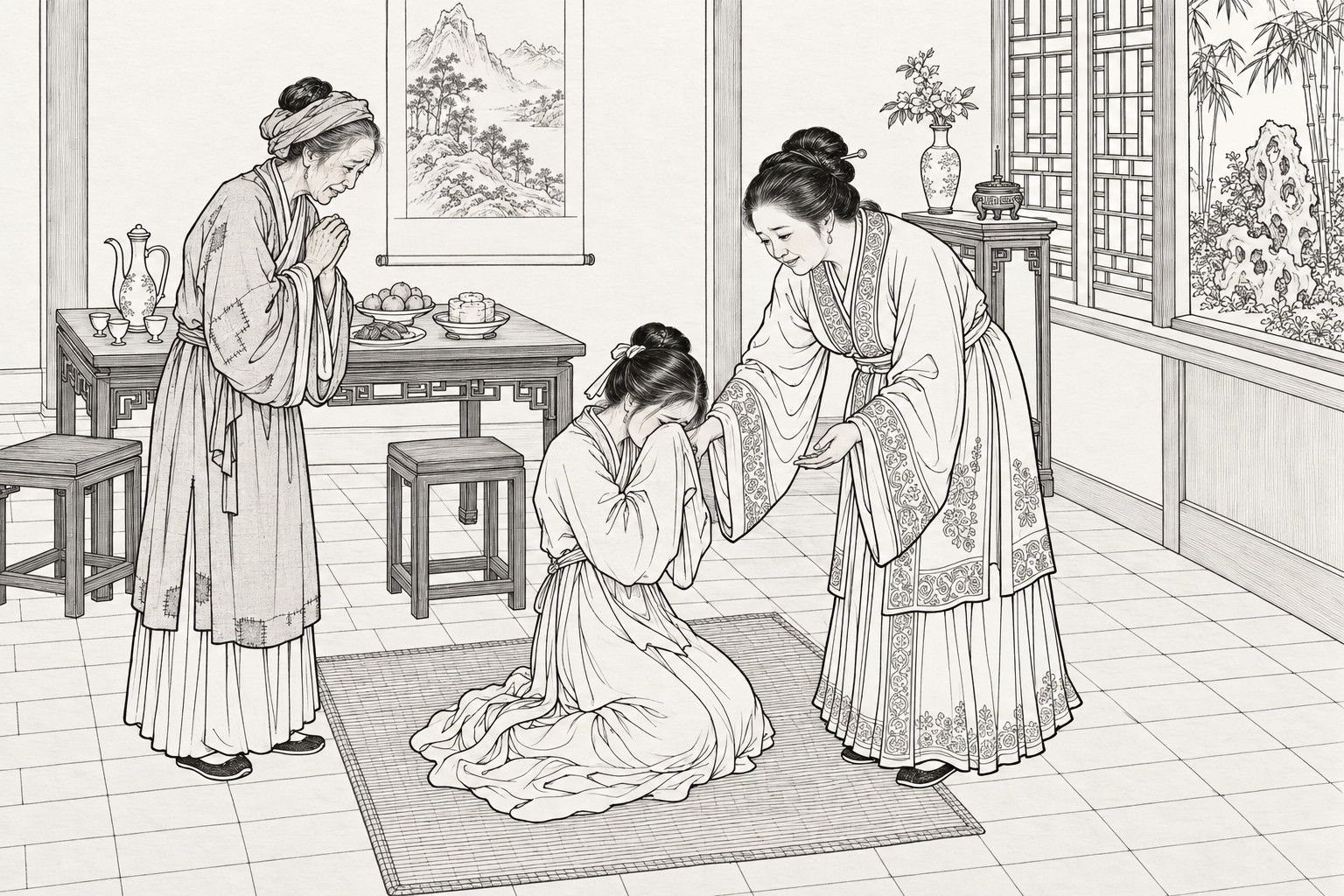
虞小思,東昌人。居積為業。妻夏,歸寧返,見門外一嫗,偕少女哭甚哀。夏詰之,嫗揮淚相告。乃知其夫王心齋,亦宦裔也。家中落,無衣食業,浼中保貸富室黃氏金,作賈。中途遭寇,喪貲,幸不死。至家,黃索償,計子母不下三十金,實無可準抵。黃窺其女紉針美,將謀作妾。使中保質告之:如肯可,折債外,仍以廿金壓券。王謀諸妻。妻泣曰:「我雖貧,固簪纓之冑。彼以執鞭發蹟,何敢遂媵吾女!況紉針固自有婿,汝烏得擅作主!」先是,同邑傅孝廉之子,與王投契,生男阿卯,與褓中論婚。後孝廉官於閩,年餘而卒。妻子不能歸,音耗俱絕。以故紉針十五,尚未字也。妻言及此,遂無詞,但謀所以為計。妻曰:「不得已,其試謀諸兩弟。」──蓋妻范氏,其祖曾任京職,兩孫田產尚多也。次日,妻攜女歸告兩弟,兩弟任其涕淚,並無一詞肯為設處。范乃號啼而歸。適逢夏詰,且訴且哭。夏憐之。視其女,綽約可愛,益為哀楚。因邀入其家,款以酒食。慰之曰:「母子勿戚,妾當竭力。」范未遑謝,女已哭伏在地,益加惋惜。籌思曰:「雖有薄蓄,然三十金亦復大難。當典質相付。」母子拜謝。夏以三日為約。別後,百計為之營謀,亦未敢告諸其夫。三日,未滿其數;又使人假諸其母。范母女已至,因以實告。又訂次日。抵暮,假金至,合裹並置床頭。至夜,有盜穴壁,以火入。夏覺,睨之,見一人臂跨短刀,狀貌凶惡。大懼,不敢作聲,偽為睡者。盜近箱,意將發扃。回顧夏枕邊有裹物,探身攫去,就燈解視;乃入腰橐,不復胠篋而去。夏乃起呼。家中惟一小婢,隔牆呼鄰,鄰人集而盜已遠。夏乃對燈啜泣。見婢睡熟,乃引帶自經於櫺間。天曙婢覺,呼人解救,四肢冰冷。虞聞奔至,詰婢始得其由,驚涕營葬。時方夏,尸不僵,亦不腐。過七日,乃殮之。既葬。紉針潛出,哭於其墓。暴雨忽集,霹靂大作,發墓,紉針震死。虞聞,奔驗,則棺木已啟,妻呻嘶其中,抱出之。見女尸,不知為誰。夏審視,始辨之。方相駭怪。未幾,范至,見女已死,哭曰:「固疑其在此,今果然矣!聞夫人自縊,日夜不絕聲。今夜語我,欲哭於殯宮,我未之應也。」夏感其義,遂與夫言,即以所葬材穴葬之。范拜謝。虞負妻歸,范亦歸告其夫。聞村北一人被雷擊死於途,身有字云:「偷夏氏金賊。」俄聞鄰婦哭聲,乃知雷擊者即其夫馬大也。村人白於官,拘婦械鞫,則范氏以夏之措金贖女,對人感泣,馬大賭博無賴,聞之而盜心遂生也。官押婦搜贓,則止存二十數;又檢馬尸得四數。官判賣婦償補責還虞。夏益喜,全金悉仍付范,俾償債主。葬女三日,夜大雷電以風,墳復發,女亦頓活。不歸其家,往扣夏氏之門,蓋認其墓,疑其復生也。夏驚起,隔扉問之。女曰:「夫人果生耶!我紉針耳。」夏駭為鬼,呼鄰媼詰之,知其復活,喜內入室。女自言:「願從夫人服役,不復歸矣。」夏曰:「得無謂我損金為買婢耶?汝葬後,債已代償,可勿見猜。」女益感泣,願以母事。夏不允。女曰:「兒能操作,亦不坐食。」天明,告范。范喜,急至。亦從女意,即以屬夏。范去,夏強送女歸。女啼思夏。王心齋自負女來,委諸門內而去。夏見,驚問,始知其故,遂亦安之。女見虞至,急下拜,呼以父。虞固無子女,又見女依依憐人,頗以為懽。女紡績縫紉,勤勞臻至。夏偶病劇,女晝夜給役。見夏不食,亦不食,面上時有啼痕。向人曰:「母有萬一,我誓不復生!」夏少瘳,始解顏為歡。夏聞流涕,曰:「我四十無子,但得生一女如紉針亦足矣。」夏從不育;逾年忽生一男,人以為行善之報。居二年,女益長。虞與王謀,不能堅守舊盟。王曰:「女在君家,婚姻惟君所命。」女十七,惠美無雙。此言出,問名者趾錯於門,夫妻為揀。富室黃某亦遣媒來。虞惡其為富不仁,力卻之。為擇於馮氏。馮,邑名士,子慧而能文。將告於王;王出負販未歸,遂逕諾之。黃以不得於虞,亦託作賈,跡王所在,設饌相邀,更復助以資本,漸漬習洽。因自言其子慧以自媒。王感其情,又仰其富,遂與訂盟。既歸,詣虞,則虞昨日已受馮氏婿書。聞王所言,不悅,呼女出,告以情。女佛然曰:「債主,吾仇也!以我事仇,但有一死!」王無顏,託人告黃以馮氏之盟。黃怒曰:「女姓王,不姓虞。我約在先,彼約在後,何得背盟!」遂控於邑宰,宰意以先約判歸黃。馮曰:「王某以女付虞,固言婚嫁不復預聞,且某有定婚書,彼不過杯酒之談耳。」宰不能斷,將惟女願從之。黃又以金賂官,求其左袒,以此月餘不決。一日,有孝廉北上,公車過東昌,使人問王心齋。適問於虞,虞轉詰之,蓋孝廉姓傅,即阿卯也。入閩籍,十八已鄉薦矣。以前約未婚。其母囑令便道訪王,問女曾否另字也。虞大喜,邀傅至家,歷述所遭。然婿遠來數千里,患無憑據。傅啟篋出王當日允婚書。虞招王至,驗之果真,乃共喜。是日當官覆審,傅投刺謁宰,其案始銷。涓吉約期乃去。會試後,市幣帛而還,居其舊第,行親迎禮。進士報已到閩,又報至東,傅又捷南宮。復入都觀政而返。女不樂南渡,傅亦以廬墓在,遂獨往扶父柩,載母俱歸。又數年,虞卒,子纔七八歲,女撫之過於其弟。使讀書,得入邑庠,家稱素封,皆傅力也。
虞小思,东昌人。居积为业。妻夏,归宁返,见门外一妪,偕少女哭甚哀。夏诘之,妪挥泪相告。乃知其夫王心斋,亦宦裔也。家中落,无衣食业,浼中保贷富室黄氏金,作贾。中途遭寇,丧赀,幸不死。至家,黄索偿,计子母不下三十金,实无可准抵。黄窥其女纫针美,将谋作妾。使中保质告之:如肯可,折债外,仍以廿金压券。王谋诸妻。妻泣曰:「我虽贫,固簪缨之胄。彼以执鞭发迹,何敢遂媵吾女!况纫针固自有婿,汝乌得擅作主!」先是,同邑傅孝廉之子,与王投契,生男阿卯,与褓中论婚。后孝廉官于闽,年余而卒。妻子不能归,音耗俱绝。以故纫针十五,尚未字也。妻言及此,遂无词,但谋所以为计。妻曰:「不得已,其试谋诸两弟。」──盖妻范氏,其祖曾任京职,两孙田产尚多也。次日,妻携女归告两弟,两弟任其涕泪,并无一词肯为设处。范乃号啼而归。适逢夏诘,且诉且哭。夏怜之。视其女,绰约可爱,益为哀楚。因邀入其家,款以酒食。慰之曰:「母子勿戚,妾当竭力。」范未遑谢,女已哭伏在地,益加惋惜。筹思曰:「虽有薄蓄,然三十金亦复大难。当典质相付。」母子拜谢。夏以三日为约。别后,百计为之营谋,亦未敢告诸其夫。三日,未满其数;又使人假诸其母。范母女已至,因以实告。又订次日。抵暮,假金至,合裹并置床头。至夜,有盗穴壁,以火入。夏觉,睨之,见一人臂跨短刀,状貌凶恶。大惧,不敢作声,伪为睡者。盗近箱,意将发扃。回顾夏枕边有裹物,探身攫去,就灯解视;乃入腰橐,不复胠箧而去。夏乃起呼。家中惟一小婢,隔墙呼邻,邻人集而盗已远。夏乃对灯啜泣。见婢睡熟,乃引带自经于櫺间。天曙婢觉,呼人解救,四肢冰冷。虞闻奔至,诘婢始得其由,惊涕营葬。时方夏,尸不僵,亦不腐。过七日,乃殓之。既葬。纫针潜出,哭于其墓。暴雨忽集,霹雳大作,发墓,纫针震死。虞闻,奔验,则棺木已启,妻呻嘶其中,抱出之。见女尸,不知为谁。夏审视,始辨之。方相骇怪。未几,范至,见女已死,哭曰:「固疑其在此,今果然矣!闻夫人自缢,日夜不绝声。今夜语我,欲哭于殡宫,我未之应也。」夏感其义,遂与夫言,即以所葬材穴葬之。范拜谢。虞负妻归,范亦归告其夫。闻村北一人被雷击死于途,身有字云:「偷夏氏金贼。」俄闻邻妇哭声,乃知雷击者即其夫马大也。村人白于官,拘妇械鞫,则范氏以夏之措金赎女,对人感泣,马大赌博无赖,闻之而盗心遂生也。官押妇搜赃,则止存二十数;又检马尸得四数。官判卖妇偿补责还虞。夏益喜,全金悉仍付范,俾偿债主。葬女三日,夜大雷电以风,坟复发,女亦顿活。不归其家,往扣夏氏之门,盖认其墓,疑其复生也。夏惊起,隔扉问之。女曰:「夫人果生耶!我纫针耳。」夏骇为鬼,呼邻媪诘之,知其复活,喜内入室。女自言:「愿从夫人服役,不复归矣。」夏曰:「得无谓我损金为买婢耶?汝葬后,债已代偿,可勿见猜。」女益感泣,愿以母事。夏不允。女曰:「儿能操作,亦不坐食。」天明,告范。范喜,急至。亦从女意,即以属夏。范去,夏强送女归。女啼思夏。王心斋自负女来,委诸门内而去。夏见,惊问,始知其故,遂亦安之。女见虞至,急下拜,呼以父。虞固无子女,又见女依依怜人,颇以为懽。女纺绩缝纫,勤劳臻至。夏偶病剧,女昼夜给役。见夏不食,亦不食,面上时有啼痕。向人曰:「母有万一,我誓不复生!」夏少瘳,始解颜为欢。夏闻流涕,曰:「我四十无子,但得生一女如纫针亦足矣。」夏从不育;逾年忽生一男,人以为行善之报。居二年,女益长。虞与王谋,不能坚守旧盟。王曰:「女在君家,婚姻惟君所命。」女十七,惠美无双。此言出,问名者趾错于门,夫妻为拣。富室黄某亦遣媒来。虞恶其为富不仁,力却之。为择于冯氏。冯,邑名士,子慧而能文。将告于王;王出负贩未归,遂径诺之。黄以不得于虞,亦托作贾,迹王所在,设馔相邀,更复助以资本,渐渍习洽。因自言其子慧以自媒。王感其情,又仰其富,遂与订盟。既归,诣虞,则虞昨日已受冯氏婿书。闻王所言,不悦,呼女出,告以情。女佛然曰:「债主,吾仇也!以我事仇,但有一死!」王无颜,托人告黄以冯氏之盟。黄怒曰:「女姓王,不姓虞。我约在先,彼约在后,何得背盟!」遂控於邑宰,宰意以先约判归黄。冯曰:「王某以女付虞,固言婚嫁不复预闻,且某有定婚书,彼不过杯酒之谈耳。」宰不能断,将惟女愿从之。黄又以金赂官,求其左袒,以此月余不决。一日,有孝廉北上,公车过东昌,使人问王心斋。适问于虞,虞转诘之,盖孝廉姓傅,即阿卯也。入闽籍,十八已乡荐矣。以前约未婚。其母嘱令便道访王,问女曾否另字也。虞大喜,邀傅至家,历述所遭。然婿远来数千里,患无凭据。傅启箧出王当日允婚书。虞招王至,验之果真,乃共喜。是日当官覆审,傅投刺谒宰,其案始销。涓吉约期乃去。会试后,市币帛而还,居其旧第,行亲迎礼。进士报已到闽,又报至东,傅又捷南宫。复入都观政而返。女不乐南渡,傅亦以庐墓在,遂独往扶父柩,载母俱归。又数年,虞卒,子才七八岁,女抚之过于其弟。使读书,得入邑庠,家称素封,皆傅力也。
Yu Xiaosi was a man of Dongchang who made his living by buying up goods and holding them for sale. His wife, Mrs. Xia, was coming home from a visit to her parents when she saw an old woman outside the gate, weeping bitterly with a young girl. Mrs. Xia asked what was wrong, and the old woman, wiping away her tears, told her. Her husband was Wang Xinzhai, who also came of an official family. The family had come down in the world and had no way to keep itself in food and clothes, so through a guarantor he had borrowed money from a rich man named Huang to go into trade. On the road he was set upon by bandits and lost the money, though he was lucky to escape with his life. When he got home, Huang demanded repayment. Principal and interest came to no less than thirty taels, and Wang truly had nothing to pay it with. Huang had caught sight of Wang’s daughter Renzhen and seen that she was beautiful, and he schemed to make her his concubine. He sent the guarantor to put it to them plainly: if they agreed, he would not only cancel the debt but add twenty taels to seal the bond. Wang talked it over with his wife. She wept. “Poor as we are, we come of a family of caps and tassels. That man got his start holding a carter’s whip. How dare he take my daughter as a secondary wife! Besides, Renzhen already has a husband promised. What right have you to decide on your own?” Years before, a son of the Fu family, a provincial graduate of the same county, had become fast friends with Wang. When he had a son, A-Mao, he and Wang matched the two babies while they were still in swaddling clothes. Later the provincial graduate took office in Fujian and died a year or so after. His wife and son could not come home, and all news of them was cut off. That was why Renzhen was fifteen and still not given to anyone. When his wife brought this up, Wang had nothing to say; they could only try to think what to do. “There is nothing for it,” said his wife. “Let me try my two brothers.” For she was a Fan; her grandfather had held office in the capital, and his two grandsons still had a good deal of land. The next day she took her daughter to her brothers and told them. They let her weep and wail, and not one word did they offer toward finding a way out. Mrs. Fan went home crying aloud. Just then Mrs. Xia asked her what was wrong, and she told her story through her tears. Mrs. Xia pitied her. And looking at the daughter, so graceful and lovely, she was sadder still. She invited them into the house and gave them wine and food. “Don’t grieve, the two of you,” she said to comfort them. “I will do all I can.” Before Mrs. Fan could thank her, the girl had thrown herself weeping on the ground, and Mrs. Xia was more moved than ever. She thought it over. “I have a little put by, but thirty taels is a great deal. I will pawn things and give it to you.” Mother and daughter bowed their thanks. Mrs. Xia promised it in three days. After they parted she tried every way she could think of to raise the money, but she did not dare tell her husband. By the third day she still did not have the full sum, so she sent to borrow from her own mother. Mrs. Fan and her daughter had already arrived; Mrs. Xia told them the truth and set the next day instead. Toward evening the borrowed money came. She wrapped it all in one bundle and put it at the head of her bed. In the night a thief dug through the wall and came in with a light. Mrs. Xia woke and looked out of the corner of her eye. It was a man with a short knife strapped to his arm, fierce of face. She was terrified. She dared not make a sound, and pretended to be asleep. The thief went to the chest, meaning to force the lock. Then he looked round and saw the bundle beside her pillow. He leaned over, snatched it, and undid it by the lamp. He put it in the pouch at his waist and left without bothering with the chest. Only then did Mrs. Xia get up and cry out. There was no one in the house but a little maid, who called over the wall to the neighbours; by the time they gathered, the thief was long gone. Mrs. Xia sat weeping by the lamp. When she saw that the maid was fast asleep, she took her sash and hanged herself from the window lattice. At dawn the maid woke and called for help to cut her down, but her limbs were ice cold. Yu heard and came running. Only by questioning the maid did he learn why. Shocked and weeping, he saw to the burial. It was summer, yet the body did not stiffen, nor did it rot. After seven days she was laid in her coffin, and then buried. Renzhen slipped out and wept at her grave. A storm gathered of a sudden, thunder crashed, the grave burst open, and Renzhen was struck dead. Yu heard and ran to look. The coffin had opened, and his wife was moaning inside. He lifted her out. He saw the girl’s body and did not know who she was; Mrs. Xia looked closely and knew her. They were still staring at each other in amazement when Mrs. Fan arrived. Seeing her daughter dead, she wept: “I thought she’d be here, and so she is! Ever since she heard you had hanged yourself, ma’am, she has cried day and night without stopping. Tonight she told me she wanted to go and weep at your grave, and I said no.” Mrs. Xia was moved by the girl’s devotion. She spoke to her husband, and they buried Renzhen in the very coffin and grave that had been Mrs. Xia’s. Mrs. Fan bowed her thanks. Yu carried his wife home on his back, and Mrs. Fan went home to tell her husband. Then they heard that north of the village a man had been struck dead by lightning on the road, and there were words on his body: “Thief who stole Mrs. Xia’s money.” Soon came the sound of a neighbour woman wailing, and they learned that the man struck was her husband, Ma Da. The villagers reported it to the magistrate, who had the woman arrested, put in irons and questioned. It came out that Mrs. Fan had gone about telling people, with grateful tears, how Mrs. Xia was raising money to redeem her daughter; Ma Da, a gambler and good-for-nothing, heard of it, and that was when he thought of stealing it. The magistrate sent the woman under guard to search for the loot, but only twenty-odd taels were left; some four more were found on Ma’s body. The magistrate ordered the woman sold to make up the rest and the money returned to Yu. Mrs. Xia was gladder than ever, and gave the whole sum to Mrs. Fan to pay off the creditor. Three days after the girl was buried there was a great storm in the night, thunder and lightning and wind. The grave burst open again, and the girl came back to life at once. She did not go home but went and knocked at Mrs. Xia’s door, for she knew whose grave it had been and supposed that Mrs. Xia had come back to life. Mrs. Xia started up and asked through the door who it was. “So you really are alive, ma’am!” said the girl. “It’s me, Renzhen.” Mrs. Xia was frightened, taking her for a ghost. She called the old woman next door to question her, and when she learned the girl had come back to life, she gladly let her in. The girl said, “I want to stay and serve you, ma’am. I won’t go home again.” “You don’t think I gave that money to buy you for a maid?” said Mrs. Xia. “After you were buried, the debt was paid for you. You need not suspect that.” The girl wept all the more and begged to serve her as a mother. Mrs. Xia would not agree. “I can work,” said the girl. “I won’t sit and eat for nothing.” At daybreak they told Mrs. Fan. She was overjoyed and hurried over. She too went along with her daughter’s wish and gave her into Mrs. Xia’s care. When Mrs. Fan had gone, Mrs. Xia made the girl go home. The girl cried for Mrs. Xia. Wang Xinzhai carried her over on his own back, set her down inside the gate, and left. Mrs. Xia was startled to see her, asked, and learned how it was, and after that she let her stay. When the girl saw Yu come in, she quickly knelt and called him Father. Yu had no children, and seeing how fondly the girl clung to them, he was delighted. She spun and wove and sewed, and worked tirelessly. Once Mrs. Xia fell gravely ill, and the girl waited on her day and night. When Mrs. Xia would not eat, she would not eat either, and her face was often stained with tears. She told people, “If anything happens to Mother, I swear I won’t go on living!” Only when Mrs. Xia was a little better did she smile again. Mrs. Xia heard of this and wept. “I am forty and childless,” she said. “If only I could bear a daughter like Renzhen, it would be enough.” Mrs. Xia had never borne a child; a year later she suddenly gave birth to a son. People said it was the reward for her good deeds. Two years passed, and the girl grew up. Yu talked it over with Wang: they could not hold to the old betrothal forever. “The girl is in your house,” said Wang. “Her marriage is yours to decide.” At seventeen she was clever and beautiful beyond compare. Once this was known, those asking for her hand crowded the doorway, and Yu and his wife chose among them. The rich man Huang sent a go-between too. Yu loathed him as a man grown rich by being heartless, and turned him down flat. He chose the Feng family instead. Feng was a gentleman of note in the county, and his son was bright and wrote well. Yu meant to tell Wang, but Wang was away peddling and had not come back, so Yu went ahead and agreed. Huang, having failed with Yu, also made out that he was going into trade, tracked Wang down, invited him to dinner, and even gave him capital, and little by little the two became close. Then Huang spoke of how bright his own son was, making the match himself. Wang was grateful for his kindness and dazzled by his wealth, and he agreed to the betrothal. When he got home and went to see Yu, he found that Yu had accepted the Feng family’s betrothal letter the day before. Yu was displeased to hear what Wang said. He called the girl out and told her. She flared up. “The creditor is my enemy! If you give me to my enemy, I will die first!” Wang, ashamed, had someone tell Huang of the Feng betrothal. Huang was furious. “The girl’s name is Wang, not Yu. My agreement came first, theirs after. How can he go back on his word!” He brought a suit before the county magistrate, who was inclined to award her to Huang on the earlier agreement. Feng said, “Wang gave his daughter over to Yu and said plainly he would have no more say in her marriage. And I have a betrothal letter; his was nothing but talk over a cup of wine.” The magistrate could not decide, and was going to leave it to the girl to choose. Then Huang bribed him to take his side, and so for more than a month the case went undecided. One day a provincial graduate travelling north to the examinations in the capital passed through Dongchang and sent someone to ask for Wang Xinzhai. As it happened, the man asked Yu, and Yu questioned him in turn. The graduate’s name was Fu: it was A-Mao. He had been registered in Fujian and had passed the provincial examination at eighteen. Because of the old betrothal he had not married, and his mother had told him to call on Wang on his way and ask whether the girl had been promised to anyone else. Yu was overjoyed. He invited Fu to his house and told him all that had happened. But the son-in-law had come thousands of li, and they worried there was no proof. Fu opened his case and brought out the letter in which Wang had agreed to the match all those years ago. Yu sent for Wang; he looked at it and it was genuine, and they all rejoiced. That was the very day set for the case to be heard again. Fu sent in his card and called on the magistrate, and the case was dropped. A lucky day was chosen and the date fixed, and then he left. After the metropolitan examination he bought silks for the wedding gifts and came back, lived in his family’s old house, and went through the rite of fetching the bride. The news of his success as a jinshi had already gone to Fujian; then it came to Dongchang too: Fu had passed the metropolitan examination. He went back to the capital to serve his probation in the ministries, and then returned. The girl did not want to move south, and Fu too had his family’s house and graves here, so he went alone to bring home his father’s coffin and his mother with it. Some years later Yu died, when his son was only seven or eight. The girl looked after the boy better than if he had been her own brother. She had him study, and he got into the county school. The family came to be counted among the wealthy, and all of it was Fu’s doing.