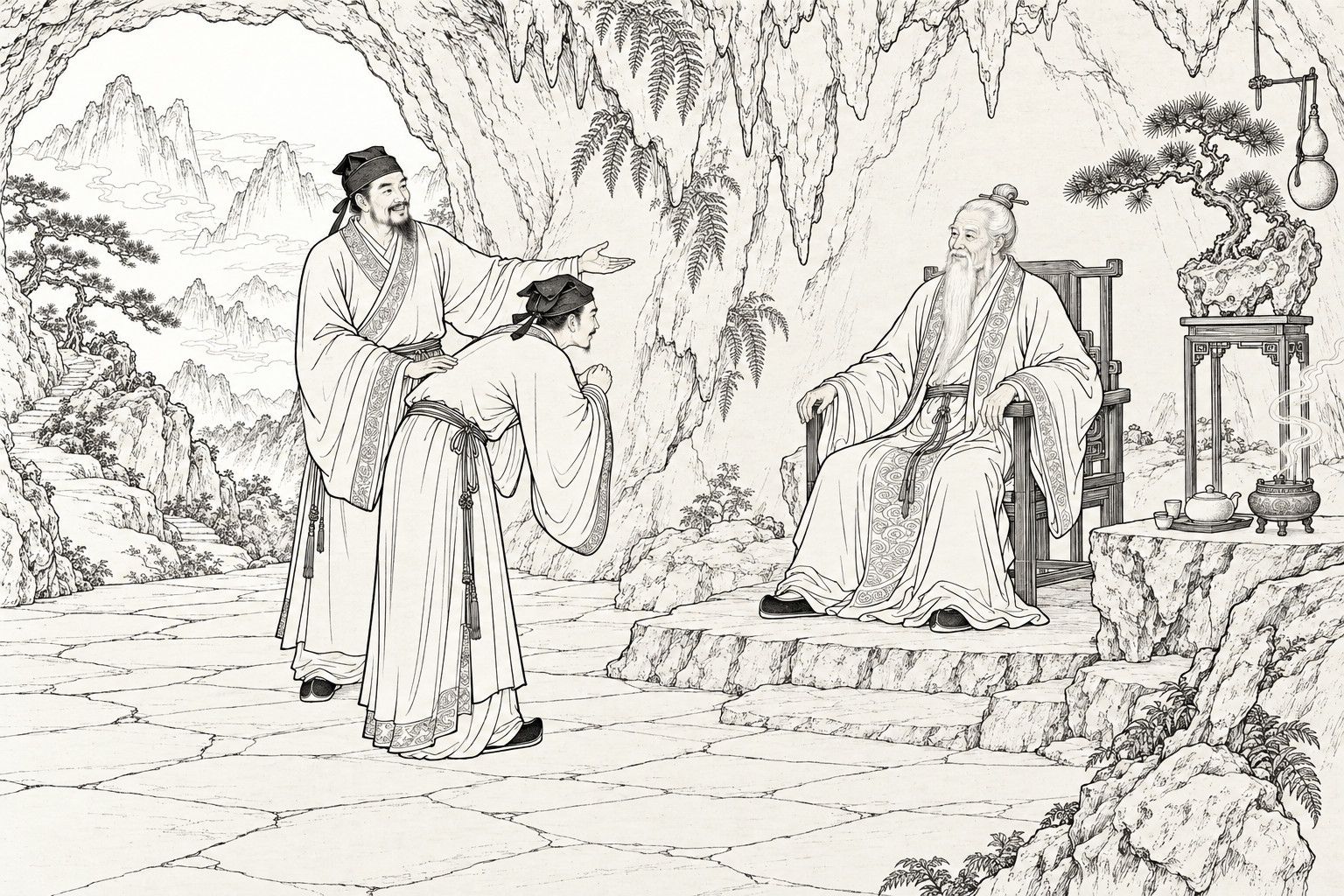
賈奉雉,平涼人。才名冠一時,而試輒不售。一日,途中遇一秀才,自言郎姓,風格灑然,談言微中。因邀俱歸,出課藝就正。郎讀罷,不甚稱許,曰:「足下文,小試取第一則有餘,闈場取榜尾則不足。」賈曰:「奈何?」郎曰:「天下事,仰而跂之則難,俯而就之甚易,此何須鄙人言哉!」遂指一二人、一二篇以為標準,大率賈所鄙棄而不屑道者。聞之,笑曰:「學者立言,貴乎不朽,即味列八珍,當使天下不以為泰耳。如此獵取功名,雖登臺閣,猶為賤也。」郎曰:「不然。文章雖美,賤則弗傳。君欲抱卷以終也則已;不然,簾內諸官,皆以此等物事進身,恐不能因閱君文,另換一副眼睛肺腸也。」賈終嘿然。郎起而笑曰:「少年盛氣哉!」遂別而去。是秋入闈復落,邑邑不得志,頗思郎言,遂取前所指示者強讀之。未至終篇,昏昏欲睡,心惶惑無以自主。又三年,闈場將近,郎忽至,相見甚懽。因出所擬七題,使賈作文。越日,索文而閱,不以為可,又令復作;作已,又訾之。賈戲於落卷中,集其冗泛濫,不可告人之句,連綴成文,俟其來而示之。郎喜曰:「得之矣!」因使熟記,堅囑勿忘。賈笑曰:「實相告:此言不由中,轉瞬即去,便受夏楚,不能復憶之也。」郎坐案頭,強令自誦一過;因使袒背,以筆寫符而去,曰:「只此已足,可以束閣群書矣。」驗其符,濯之不下,深入肌理。至場中,七題無一遺者。回思諸作,茫不記憶,惟戲綴之文,歷歷在心。然把筆終以為羞;欲少竄易,而顛倒苦思,竟不能復更一字。日已西墜,直錄而出。郎候之已久,問:「何暮也?」賈以實告,即求拭符;視之,已漫滅矣。再憶場中文,遂如隔世。大奇之。因問:「何不自謀?」笑曰:「某惟不作此等想,故能不讀此等文也。」遂約明日過諸其寓。賈諾之。郎既去,賈取文稿自閱之,大非本懷,怏怏不自得,不復訪郎,嗒喪而歸。未幾,榜發,竟中經魁。閱舊稿,一讀一汗。讀竟,重衣盡溼。自言曰:「此文一出,何以見天下士矣!」方慚怍間,郎忽至曰:「求中即中矣,何其悶也?」曰:「僕適自念,以金盆玉椀貯狗矢,真無顏出見同人。行將遁跡山丘,與世長絕矣。」郎曰:「此亦大高,但恐不能耳。果能之,僕引見一人,長生可得,並千載之名,亦不足戀,況儻來之富貴乎!」賈悅,留與共宿,曰:「容某思之。」天明,謂郎曰:「予志決矣!」不告妻子,飄然遂去。漸入深山,至一洞府,其中別有天地。有叟坐堂上,郎使參之,呼以師。叟曰:「來何早也?」郎白:「此人道念已堅,望加收齒。」叟曰:「汝既來,須將此身並置度外,始得。」賈唯唯聽命。郎送至一院,安其寢處,又投以餌,始去。房亦精潔;但戶無扉,窗無櫺,內惟一几一榻。賈解履登榻,月明穿射矣。覺微飢,取餌啖之,甘而易飽。竊意郎當復來,坐久寂然,杳無聲響。但覺清香滿室,臟腑空明,脈絡皆可指數。忽聞有聲甚厲,似貓抓癢,自牖睨之,則虎蹲檐下。乍見,甚驚;因憶師言,即復收神凝坐。虎似知其有人,尋入近榻,氣咻咻,遍嗅足股。少頃,聞庭中嗥動,如雞受縛,虎即趨出。又坐少時,一美人入,蘭麝撲人,悄然登榻,附耳小言曰:「我來矣。」一言之間,口脂散馥。賈瞑然不少動。又低聲曰:「睡乎?」聲音頗類其妻,心微動。又念曰:「此皆師相試之幻術也。」瞑如故。美人笑曰:「鼠子動矣!」初,夫妻與婢同室,押褻惟恐婢聞,私約一謎曰:「鼠子動,則相歡好。」忽聞是語,不覺大動,開目凝視,真其妻也。問:「何能來?」答云:「郎生恐君岑寂思歸,遣一嫗導我來。」言次,因賈出門不相告語,偎傍之際,頗有怨懟。賈慰藉良久,始得嬉笑為歡。既畢,夜已向晨,聞叟譙訶聲,漸近庭院。妻急起,無地自匿,遂越短牆而去。俄頃,郎從叟入。叟對賈杖郎,便令逐客。郎亦引賈自短牆出,曰:「僕望君奢,不免躁進;不圖情緣未斷,累受扑責。從此暫去,相見行有日也。」指示歸途,拱手遂別。賈俯視故村,故在目中。意妻弱步,必滯途間。疾趨里餘,已至家門,但見房垣零落,舊景全非,村中老幼,竟無一相識者,心始駭異。忽念劉、阮返自天台,情景真似。不敢入門,於對戶憩坐。良久,有老翁曳杖出。賈揖之,問:「賈某家何所?」翁指其第曰:「此即是也。得無欲聞奇事耶?僕悉知之。相傳此公聞捷即遁;遁時,其子纔七八歲。後至十四五歲,母忽大睡不醒。子在時,寒暑為之易衣;迨歿,兩孫窮踧,房舍拆毀,惟以木架苫覆蔽之。月前,夫人忽醒,屈指百餘年矣。遠近聞其異,皆來訪視,近日稍稀矣。」賈豁然頓悟,曰:「翁不知賈奉雉即某是也。」翁大駭,走報其家。時長孫已死;次孫祥,至五十餘矣。以賈年少,疑有詐偽。少間,夫人出,始識之。雙涕霪霪,呼與俱去。苦無屋宇,暫入孫舍。大小男婦,奔入盈側,皆其曾、玄,率陋劣少文。長孫婦吳氏,沽酒具藜藿;又使少子杲及婦,與己共室,除舍舍祖翁姑。賈入舍,煙埃兒溺,雜氣熏人。居數日,懊惋殊不可耐。兩孫家分供餐飲,調飪尤乖。里中以賈新歸,日日招飲;而夫人恆不得一飽。吳氏故士人女,頗嫻閨訓,承順不衰。祥家給奉漸疏,或嘑爾與之。賈怒,攜夫人去,設帳東里。每謂夫人曰:「吾甚悔此一返,而已無及矣。不得已,復理舊業,若心無愧恥,富貴不難致也。」居年餘,吳氏猶時餽餉,而祥父子絕跡矣。是歲,試入邑庠。邑令重其文,厚贈之,由此家稍裕。祥稍稍來近就之。賈喚入,計曩所耗費,出金償之,斥絕令去。遂買新第,移吳氏共居之。吳二子,長者留守舊業;次杲頗慧,使與門人輩共筆硯。賈自山中歸,心思益明澈。無何,連捷登進士第。又數年,以侍御出巡兩浙,聲名赫奕,歌舞樓臺,一時稱盛。賈為人骾峭,不避權貴,朝中大僚,思中傷之。賈屢疏恬退,未蒙俞旨,未幾而禍作矣。先是,祥六子皆無賴,賈雖擯斥不齒,然皆竊餘勢以作威福,橫占田宅,鄉人共患之。有某乙娶新婦,祥次子篡取為妾。乙故狙詐,鄉人斂金助訟,以此聞於都。於是當道者交章攻賈。賈殊無以自剖,被收經年。祥及次子皆瘐死。賈奉旨充遼陽軍。時杲入泮已久,為人頗仁厚,有賢聲。夫人生一子,年十六,遂以囑杲,夫妻攜一僕一媼而去。賈曰:「十餘年富貴,曾不如一夢之久。今始知榮華之場,皆地獄境界,悔比劉晨、阮肇,多造一重孽案耳。」數日,抵海岸,遙見巨舟來,鼓樂殷作,虞候皆如天神。既近,舟中一人出,笑請侍御過舟少憩。賈見驚喜,踴身而過,押隸不敢禁。夫人急欲相從,而相去已遠,遂憤投海中。漂泊數步,見一人垂練於水,引救而去。隸命篙師盪舟,且追且號,但聞鼓聲如雷,與轟濤相間,瞬間遂杳。僕識其人,蓋郎生也。
賈奉雉是平涼人。他的才名在當時無人能比,可每次參加科舉考試都不中。一天,他在路上遇到一個秀才,自稱姓郎,舉止灑脫,說話委婉,卻能說到要害。賈奉雉便邀請他一起回家,拿出平日練習的文章,請他指正。郎生讀完,並沒有怎麼稱讚,說:「你的文章,參加小考,拿第一名綽綽有餘;參加鄉試,卻連榜上的最後一名也拿不到。」賈奉雉問:「那該怎麼辦?」郎生說:「天下的事情,踮起腳往高處夠很難,彎下身去遷就卻很容易,這還用我來說嗎!」接著,他指出一兩個人、一兩篇文章,讓賈奉雉拿來當作標準。這些人大多是賈奉雉所鄙視的,文章也是他所不屑提起的。賈奉雉聽了,笑著說:「讀書人著書立說,可貴的是能流傳不朽。就算吃的是八珍美味,也應讓天下人覺得並不過分。用這種辦法去求取功名,即使做了高官,仍然是卑賤的。」郎生說:「不是這樣。文章雖好,作者身份低微,就傳不下去。你要是打算抱著自己的文章過一輩子,那也就罷了;否則,那些簾子後面的考官,都是靠這類東西出人頭地的,恐怕不會因為讀了你的文章,就另外換上一副眼光和心腸。」賈奉雉始終沉默不語。郎生站起來,笑著說:「年輕人的傲氣真盛啊!」隨即告辭離去。這年秋天,賈奉雉參加鄉試,又落了榜,悶悶不樂,很不得志。他常常想起郎生的話,便拿出先前郎生指給他的文章,勉強自己讀下去。還沒讀完一篇,就昏昏欲睡,心裡煩亂迷惑,無法控制自己。又過了三年,鄉試將近,郎生忽然來了,兩人見面都很高興。郎生拿出自己擬好的七道題,讓賈奉雉作文。第二天,他要來文章讀了,覺得不行,又讓賈奉雉重寫;寫完後,仍然加以指責。賈奉雉便開了個玩笑,從落第的試卷裡蒐集那些冗長空泛、氾濫無度、羞於拿給人看的句子,拼湊成文章,等郎生來時給他看。郎生高興地說:「這就對了!」於是讓他牢牢記住,再三叮囑不要忘掉。賈奉雉笑著說:「實話告訴你,這些話都不是出自我的本心,轉眼就忘了,即使拿教鞭打我,我也記不起來。」郎生坐在書案上,硬讓他自己背了一遍,又讓他露出後背,用筆畫了一道符,才離開,說:「有這個就夠了,你可以把所有的書都捆起來放到高處了。」賈奉雉檢視那道符,怎麼洗也洗不掉,已經深入皮肉。到了考場,七道考題全是郎生擬的那幾道,一道也不差。他回想自己先前寫的那些文章,竟一點也記不起來,只有那幾篇戲弄郎生時拼湊的文章,清清楚楚地留在心裡。可是拿起筆,終究覺得羞恥。他想稍微改動一下,反覆琢磨,苦苦思索,竟連一個字也改不了。太陽已經西沉,他只好照原樣抄下來,出了考場。郎生已經等了很久,問:「怎麼這麼晚?」賈奉雉如實告訴他,隨即請他擦掉那道符。檢視時,符已經模糊消失了。再想起考場上寫的文章,竟像是上輩子的事,記不清了。他覺得十分奇怪,便問:「你為什麼不替自己謀取功名呢?」郎生笑著說:「我正是因為不存這種念頭,才能不讀這類文章。」於是約好讓賈奉雉第二天去他的住處,賈奉雉答應了。郎生走後,賈奉雉拿出文稿自己讀,覺得完全違背了本心,悶悶不樂,很不滿意,也不再去拜訪郎生,垂頭喪氣地回了家。不久,榜單公佈,他竟中了經魁。他再讀舊稿,讀一點就出一身汗,讀完以後,幾層衣服全溼透了。他自言自語道:「這種文章一公佈,我還有什麼臉見天下的讀書人!」正在慚愧羞恥的時候,郎生忽然來了,說:「想考中就考中了,怎麼還這樣苦悶?」賈奉雉說:「我剛才想,用金盆玉碗裝狗屎,實在沒臉出去見同道。我打算隱居山野,永遠斷絕與世人的往來。」郎生說:「這也是很高尚的想法,只怕你做不到。你如果真能做到,我就引你去見一個人,可以求得長生。到了那時,連流傳千年的名聲都不值得留戀,更何況偶然得到的富貴呢!」賈奉雉很高興,留郎生一起過夜,說:「容我想一想。」天亮以後,他對郎生說:「我已經拿定主意了!」他沒有告訴妻子和兒子,就灑脫地離家而去。兩人漸漸進入深山,來到一處洞府,裡面另有一番天地。一位老翁坐在堂上,郎生讓賈奉雉上前拜見,稱他為師父。老翁說:「怎麼來得這麼早?」郎生稟告說:「這個人求道的心已經很堅定,希望您收他為弟子。」老翁說:「你既然來了,就必須連自己的身體也置之度外,才行。」賈奉雉連聲答應,表示聽從吩咐。郎生送他到一座院子,安排好睡覺的地方,又給了他一些食物,才離開。房間也很乾淨,只是門口沒有門扇,窗上沒有窗欞,裡面只有一張几案和一張床榻。賈奉雉脫下鞋,登上床榻,明亮的月光直照進來。他覺得有點餓,拿起食物吃了,味道甘甜,很容易就吃飽了。他心想郎生應該還會來,坐了很久,卻始終寂靜無聲。只覺得滿屋清香,臟腑清透,身上的脈絡都能一一數出來。忽然聽見一陣十分刺耳的聲音,像貓抓癢。他從窗口偷看,只見一隻老虎蹲在屋簷下。剛看見時,他十分害怕,隨後想起師父的話,便又收住心神,凝神靜坐。老虎像是知道里面有人,不久就走進來,靠近床榻,呼哧呼哧地喘著氣,嗅遍了他的腳和大腿。過了一會兒,聽見院裡有叫聲和撲騰聲,像雞被捆住了一樣,老虎立即跑了出去。他又坐了一會兒,一個美人走了進來,蘭花和麝香的氣息撲面而來。她悄悄登上床榻,湊到他耳邊低聲說:「我來了。」一句話之間,嘴上的脂粉散發出香氣。賈奉雉閉著眼,一點也不動。她又輕聲問:「睡了嗎?」聲音很像他的妻子,他心裡微微一動,隨即又想:「這都是師父考驗我的幻術。」仍然閉著眼睛。美人笑著說:「小老鼠動了!」原先,夫妻倆和婢女住在同一間屋裡,說親暱的話時,總怕被婢女聽見,便私下約定了一句暗語:「小老鼠動了,就一起歡好。」賈奉雉忽然聽到這句話,不由得心潮大動,睜開眼仔細看,果然是自己的妻子。他問:「你怎麼能到這裡來?」妻子回答:「郎生怕你寂寞,想要回家,就派了一個老婦人帶我來。」說話間,她依偎在賈奉雉身邊,對他出門時不告訴自己,頗有些埋怨。賈奉雉安慰了她很久,她才轉為嬉笑,兩人便親熱起來。事後,天已經快亮了,聽見老翁責罵的聲音漸漸靠近院子。妻子急忙起身,沒有地方藏身,便翻過矮牆走了。不一會兒,郎生跟著老翁進來。老翁當著賈奉雉的面,用棍子責打郎生,隨後命他把客人趕走。郎生便領著賈奉雉從矮牆翻出去,說:「我對你的期望太高,不免急於求成。沒想到你塵世間的情緣還沒斷,使我連帶受了責打。你暫且離開,我們很快還會有相見的日子。」他指明回家的路,拱手告別。賈奉雉往下看,原來的村莊仍在眼前。他想,妻子腳力弱,一定還耽擱在路上,便快步走了一里多,已經到了家門口。只見房屋和圍牆破敗,舊日的景象全變了,村裡的老人孩子竟沒有一個認識,心裡這才驚疑起來。他忽然想起劉晨、阮肇從天台山回來,情景真是相似。他不敢進門,就在對面的人家門前坐下休息。過了很久,一位老翁拄著柺杖出來。賈奉雉向他作揖,問:「賈某的家在哪裡?」老翁指著那座宅子說:「這裡就是。你莫非想聽那件奇事?我全知道。相傳這位賈公聽到考中的訊息就走了,走時兒子才七八歲。後來,兒子長到十四五歲,母親忽然沉睡不醒。兒子活著的時候,冬夏都替她換衣服;等兒子死了,兩個孫子窮困,房屋也拆毀了,只用木架搭起一個棚子,蓋上草苫,遮護著她。一個月前,夫人忽然醒了,算起來已經過了一百多年。遠近的人聽說這件奇事,都來探望,最近才少了一些。」賈奉雉一下子全明白了,說:「您不知道,我就是賈奉雉。」老翁大吃一驚,跑去告訴他的家人。那時,長孫已經死了,次孫賈祥也已經五十多歲。他見賈奉雉這樣年輕,懷疑其中有詐。過了一會兒,夫人出來,才認出他。兩人都淚流滿面,夫人招呼他一起進去。他們苦於沒有房屋,暫時住進孫子的家。大大小小的男人女人奔進來,擠滿了身邊,都是他的曾孫和玄孫,大多粗鄙無知,沒什麼文化。長孫的妻子吳氏買來酒,準備了些粗菜,又讓小兒子賈杲和兒媳跟自己同住,騰出房間,打掃好,安置祖父祖母。賈奉雉進屋,煙塵和孩子尿液的氣味混在一起,十分燻人。住了幾天,他懊惱悔恨,實在難以忍受。兩個孫子的家裡輪流供給飯食,飯菜尤其不合口味。村裡人因為賈奉雉剛回來,每天都請他喝酒,可夫人卻常常吃不飽。吳氏本是讀書人的女兒,很懂得女子應守的禮教,始終恭順地侍奉他們。賈祥家供給飯食卻漸漸減少,有時還吆喝著給他們。賈奉雉發了怒,帶著夫人離開,到東里開館教書。他常對夫人說:「我很後悔這次回來,可已經來不及了。沒有別的辦法,只能再做老本行。只要心裡不覺得慚愧羞恥,富貴並不難得到。」過了一年多,吳氏仍不時送些吃的來,賈祥父子卻再也不來了。這一年,賈奉雉參加考試,進了縣學。邑令很看重他的文章,給了他豐厚的贈禮,從此家境稍稍寬裕。賈祥漸漸又來親近他。賈奉雉叫他進來,算清他從前為自己花費的錢,拿出銀子償還,責斥他,斷絕往來,讓他離開。隨後,賈奉雉買了新宅,把吳氏接來同住。吳氏有兩個兒子,長子留下守著原來的家業;次子賈杲很聰明,賈奉雉讓他跟自己的學生一起讀書寫字。賈奉雉從山裡回來以後,心思更加清明透徹。不久,他接連考中,中了進士。又過了幾年,他以侍御的身份出巡兩浙,聲名顯赫,歌舞相伴,樓臺華美,一時人人都說他興盛。賈奉雉為人剛直嚴峻,不避忌權貴,朝中的大官便想中傷他。賈奉雉多次上奏,請求退休,卻沒有得到皇帝准許。不久,禍事就發生了。先前,賈祥的六個兒子都是無賴。賈奉雉雖然把他們排斥在外,不承認他們,他們卻都暗中藉著他的權勢作威作福,強佔田地房屋,鄉里人共同受其禍害。某乙新娶了妻子,賈祥的次子把她搶去做妾。某乙向來狡猾,鄉里人湊錢幫他打官司,事情因此傳到了京城。於是,掌權的人接連上奏,攻擊賈奉雉。賈奉雉竟無法為自己辯白,被關押了一年多。賈祥和他的次子都病死在獄中。賈奉雉奉旨發配遼陽充軍。那時,賈杲已經進縣學很久,為人很仁厚,有賢德的名聲。夫人生了一個兒子,已經十六歲,賈奉雉便把兒子託付給賈杲。夫妻倆帶著一個男僕和一個老婦人上路。賈奉雉說:「十幾年的富貴,竟還不如一場夢長。現在我才知道,追求榮華的地方,全是地獄。我比劉晨、阮肇更值得後悔,不過又多添了一筆罪孽罷了。」幾天後,他們到了海邊,遠遠看見一艘大船駛來,鼓樂齊鳴,虞候個個像天神。船靠近後,一個人從船裡出來,笑著請侍御上船稍作休息。賈奉雉看見他,又驚又喜,縱身跳了過去,押送的差役不敢阻攔。夫人急著要跟去,可船已經離得很遠,她一時悲憤,便投進海里。漂出去幾步,只見有人把一條白絹垂到水裡,將她拉起來,救走了。差役命船伕划船,一邊追,一邊呼喊,卻只聽見雷鳴般的鼓聲與轟響的波濤聲交織在一起,轉眼間,大船便消失得無影無蹤。男僕認出了那個人,原來就是郎生。
贾奉雉,平凉人。才名冠一时,而试辄不售。一日,途中遇一秀才,自言郎姓,风格洒然,谈言微中。因邀俱归,出课艺就正。郎读罢,不甚称许,曰:「足下文,小试取第一则有余,闱场取榜尾则不足。」贾曰:「奈何?」郎曰:「天下事,仰而跂之则难,俯而就之甚易,此何须鄙人言哉!」遂指一二人、一二篇以为标准,大率贾所鄙弃而不屑道者。闻之,笑曰:「学者立言,贵乎不朽,即味列八珍,当使天下不以为泰耳。如此猎取功名,虽登台阁,犹为贱也。」郎曰:「不然。文章虽美,贱则弗传。君欲抱卷以终也则已;不然,帘内诸官,皆以此等物事进身,恐不能因阅君文,另换一副眼睛肺肠也。」贾终嘿然。郎起而笑曰:「少年盛气哉!」遂别而去。是秋入闱复落,邑邑不得志,颇思郎言,遂取前所指示者强读之。未至终篇,昏昏欲睡,心惶惑无以自主。又三年,闱场将近,郎忽至,相见甚懽。因出所拟七题,使贾作文。越日,索文而阅,不以为可,又令复作;作已,又訾之。贾戏于落卷中,集其冗泛滥,不可告人之句,连缀成文,俟其来而示之。郎喜曰:「得之矣!」因使熟记,坚嘱勿忘。贾笑曰:「实相告:此言不由中,转瞬即去,便受夏楚,不能复忆之也。」郎坐案头,强令自诵一过;因使袒背,以笔写符而去,曰:「只此已足,可以束阁群书矣。」验其符,濯之不下,深入肌理。至场中,七题无一遗者。回思诸作,茫不记忆,惟戏缀之文,历历在心。然把笔终以为羞;欲少窜易,而颠倒苦思,竟不能复更一字。日已西坠,直录而出。郎候之已久,问:「何暮也?」贾以实告,即求拭符;视之,已漫灭矣。再忆场中文,遂如隔世。大奇之。因问:「何不自谋?」笑曰:「某惟不作此等想,故能不读此等文也。」遂约明日过诸其寓。贾诺之。郎既去,贾取文稿自阅之,大非本怀,怏怏不自得,不复访郎,嗒丧而归。未几,榜发,竟中经魁。阅旧稿,一读一汗。读竟,重衣尽湿。自言曰:「此文一出,何以见天下士矣!」方惭怍间,郎忽至曰:「求中即中矣,何其闷也?」曰:「仆适自念,以金盆玉椀贮狗矢,真无颜出见同人。行将遁迹山丘,与世长绝矣。」郎曰:「此亦大高,但恐不能耳。果能之,仆引见一人,长生可得,并千载之名,亦不足恋,况傥来之富贵乎!」贾悦,留与共宿,曰:「容某思之。」天明,谓郎曰:「予志决矣!」不告妻子,飘然遂去。渐入深山,至一洞府,其中别有天地。有叟坐堂上,郎使参之,呼以师。叟曰:「来何早也?」郎白:「此人道念已坚,望加收齿。」叟曰:「汝既来,须将此身并置度外,始得。」贾唯唯听命。郎送至一院,安其寝处,又投以饵,始去。房亦精洁;但户无扉,窗无櫺,内惟一几一榻。贾解履登榻,月明穿射矣。觉微饥,取饵啖之,甘而易饱。窃意郎当复来,坐久寂然,杳无声响。但觉清香满室,脏腑空明,脉络皆可指数。忽闻有声甚厉,似猫抓痒,自牖睨之,则虎蹲檐下。乍见,甚惊;因忆师言,即复收神凝坐。虎似知其有人,寻入近榻,气咻咻,遍嗅足股。少顷,闻庭中嗥动,如鸡受缚,虎即趋出。又坐少时,一美人入,兰麝扑人,悄然登榻,附耳小言曰:「我来矣。」一言之间,口脂散馥。贾瞑然不少动。又低声曰:「睡乎?」声音颇类其妻,心微动。又念曰:「此皆师相试之幻术也。」瞑如故。美人笑曰:「鼠子动矣!」初,夫妻与婢同室,押亵惟恐婢闻,私约一谜曰:「鼠子动,则相欢好。」忽闻是语,不觉大动,开目凝视,真其妻也。问:「何能来?」答云:「郎生恐君岑寂思归,遣一妪导我来。」言次,因贾出门不相告语,偎傍之际,颇有怨怼。贾慰藉良久,始得嬉笑为欢。既毕,夜已向晨,闻叟谯诃声,渐近庭院。妻急起,无地自匿,遂越短墙而去。俄顷,郎从叟入。叟对贾杖郎,便令逐客。郎亦引贾自短墙出,曰:「仆望君奢,不免躁进;不图情缘未断,累受扑责。从此暂去,相见行有日也。」指示归途,拱手遂别。贾俯视故村,故在目中。意妻弱步,必滞途间。疾趋里余,已至家门,但见房垣零落,旧景全非,村中老幼,竟无一相识者,心始骇异。忽念刘、阮返自天台,情景真似。不敢入门,于对户憩坐。良久,有老翁曳杖出。贾揖之,问:「贾某家何所?」翁指其第曰:「此即是也。得无欲闻奇事耶?仆悉知之。相传此公闻捷即遁;遁时,其子才七八岁。后至十四五岁,母忽大睡不醒。子在时,寒暑为之易衣;迨殁,两孙穷踧,房舍拆毁,惟以木架苫覆蔽之。月前,夫人忽醒,屈指百余年矣。远近闻其异,皆来访视,近日稍稀矣。」贾豁然顿悟,曰:「翁不知贾奉雉即某是也。」翁大骇,走报其家。时长孙已死;次孙祥,至五十余矣。以贾年少,疑有诈伪。少间,夫人出,始识之。双涕霪霪,呼与俱去。苦无屋宇,暂入孙舍。大小男妇,奔入盈侧,皆其曾、玄,率陋劣少文。长孙妇吴氏,沽酒具藜藿;又使少子杲及妇,与己共室,除舍舍祖翁姑。贾入舍,烟埃儿溺,杂气熏人。居数日,懊惋殊不可耐。两孙家分供餐饮,调饪尤乖。里中以贾新归,日日招饮;而夫人恒不得一饱。吴氏故士人女,颇娴闺训,承顺不衰。祥家给奉渐疏,或嘑尔与之。贾怒,携夫人去,设帐东里。每谓夫人曰:「吾甚悔此一返,而已无及矣。不得已,复理旧业,若心无愧耻,富贵不难致也。」居年余,吴氏犹时餽饷,而祥父子绝迹矣。是岁,试入邑庠。邑令重其文,厚赠之,由此家稍裕。祥稍稍来近就之。贾唤入,计曩所耗费,出金偿之,斥绝令去。遂买新第,移吴氏共居之。吴二子,长者留守旧业;次杲颇慧,使与门人辈共笔砚。贾自山中归,心思益明澈。无何,连捷登进士第。又数年,以侍御出巡两浙,声名赫奕,歌舞楼台,一时称盛。贾为人骾峭,不避权贵,朝中大僚,思中伤之。贾屡疏恬退,未蒙俞旨,未几而祸作矣。先是,祥六子皆无赖,贾虽摈斥不齿,然皆窃余势以作威福,横占田宅,乡人共患之。有某乙娶新妇,祥次子篡取为妾。乙故狙诈,乡人敛金助讼,以此闻于都。于是当道者交章攻贾。贾殊无以自剖,被收经年。祥及次子皆瘐死。贾奉旨充辽阳军。时杲入泮已久,为人颇仁厚,有贤声。夫人生一子,年十六,遂以嘱杲,夫妻携一仆一媪而去。贾曰:「十余年富贵,曾不如一梦之久。今始知荣华之场,皆地狱境界,悔比刘晨、阮肇,多造一重孽案耳。」数日,抵海岸,遥见巨舟来,鼓乐殷作,虞候皆如天神。既近,舟中一人出,笑请侍御过舟少憩。贾见惊喜,踊身而过,押隶不敢禁。夫人急欲相从,而相去已远,遂愤投海中。漂泊数步,见一人垂练于水,引救而去。隶命篙师荡舟,且追且号,但闻鼓声如雷,与轰涛相间,瞬间遂杳。仆识其人,盖郎生也。
贾奉雉是平凉人。他的才名在当时无人能比,可每次参加科举考试都不中。一天,他在路上遇到一个秀才,自称姓郎,举止洒脱,说话委婉,却能说到要害。贾奉雉便邀请他一起回家,拿出平日练习的文章,请他指正。郎生读完,并没有怎么称赞,说:“你的文章,参加小考,拿第一名绰绰有余;参加乡试,却连榜上的最后一名也拿不到。”贾奉雉问:“那该怎么办?”郎生说:“天下的事情,踮起脚往高处够很难,弯下身去迁就却很容易,这还用我来说吗!”接着,他指出一两个人、一两篇文章,让贾奉雉拿来当作标准。这些人大多是贾奉雉所鄙视的,文章也是他所不屑提起的。贾奉雉听了,笑着说:“读书人著书立说,可贵的是能流传不朽。就算吃的是八珍美味,也应让天下人觉得并不过分。用这种办法去求取功名,即使做了高官,仍然是卑贱的。”郎生说:“不是这样。文章虽好,作者身份低微,就传不下去。你要是打算抱着自己的文章过一辈子,那也就罢了;否则,那些帘子后面的考官,都是靠这类东西出人头地的,恐怕不会因为读了你的文章,就另外换上一副眼光和心肠。”贾奉雉始终沉默不语。郎生站起来,笑着说:“年轻人的傲气真盛啊!”随即告辞离去。这年秋天,贾奉雉参加乡试,又落了榜,闷闷不乐,很不得志。他常常想起郎生的话,便拿出先前郎生指给他的文章,勉强自己读下去。还没读完一篇,就昏昏欲睡,心里烦乱迷惑,无法控制自己。又过了三年,乡试将近,郎生忽然来了,两人见面都很高兴。郎生拿出自己拟好的七道题,让贾奉雉作文。第二天,他要来文章读了,觉得不行,又让贾奉雉重写;写完后,仍然加以指责。贾奉雉便开了个玩笑,从落第的试卷里搜集那些冗长空泛、泛滥无度、羞于拿给人看的句子,拼凑成文章,等郎生来时给他看。郎生高兴地说:“这就对了!”于是让他牢牢记住,再三叮嘱不要忘掉。贾奉雉笑着说:“实话告诉你,这些话都不是出自我的本心,转眼就忘了,即使拿教鞭打我,我也记不起来。”郎生坐在书案上,硬让他自己背了一遍,又让他露出后背,用笔画了一道符,才离开,说:“有这个就够了,你可以把所有的书都捆起来放到高处了。”贾奉雉查看那道符,怎么洗也洗不掉,已经深入皮肉。到了考场,七道考题全是郎生拟的那几道,一道也不差。他回想自己先前写的那些文章,竟一点也记不起来,只有那几篇戏弄郎生时拼凑的文章,清清楚楚地留在心里。可是拿起笔,终究觉得羞耻。他想稍微改动一下,反复琢磨,苦苦思索,竟连一个字也改不了。太阳已经西沉,他只好照原样抄下来,出了考场。郎生已经等了很久,问:“怎么这么晚?”贾奉雉如实告诉他,随即请他擦掉那道符。查看时,符已经模糊消失了。再想起考场上写的文章,竟像是上辈子的事,记不清了。他觉得十分奇怪,便问:“你为什么不替自己谋取功名呢?”郎生笑着说:“我正是因为不存这种念头,才能不读这类文章。”于是约好让贾奉雉第二天去他的住处,贾奉雉答应了。郎生走后,贾奉雉拿出文稿自己读,觉得完全违背了本心,闷闷不乐,很不满意,也不再去拜访郎生,垂头丧气地回了家。不久,榜单公布,他竟中了经魁。他再读旧稿,读一点就出一身汗,读完以后,几层衣服全湿透了。他自言自语道:“这种文章一公布,我还有什么脸见天下的读书人!”正在惭愧羞耻的时候,郎生忽然来了,说:“想考中就考中了,怎么还这样苦闷?”贾奉雉说:“我刚才想,用金盆玉碗装狗屎,实在没脸出去见同道。我打算隐居山野,永远断绝与世人的往来。”郎生说:“这也是很高尚的想法,只怕你做不到。你如果真能做到,我就引你去见一个人,可以求得长生。到了那时,连流传千年的名声都不值得留恋,更何况偶然得到的富贵呢!”贾奉雉很高兴,留郎生一起过夜,说:“容我想一想。”天亮以后,他对郎生说:“我已经拿定主意了!”他没有告诉妻子和儿子,就洒脱地离家而去。两人渐渐进入深山,来到一处洞府,里面另有一番天地。一位老翁坐在堂上,郎生让贾奉雉上前拜见,称他为师父。老翁说:“怎么来得这么早?”郎生禀告说:“这个人求道的心已经很坚定,希望您收他为弟子。”老翁说:“你既然来了,就必须连自己的身体也置之度外,才行。”贾奉雉连声答应,表示听从吩咐。郎生送他到一座院子,安排好睡觉的地方,又给了他一些食物,才离开。房间也很干净,只是门口没有门扇,窗上没有窗棂,里面只有一张几案和一张床榻。贾奉雉脱下鞋,登上床榻,明亮的月光直照进来。他觉得有点饿,拿起食物吃了,味道甘甜,很容易就吃饱了。他心想郎生应该还会来,坐了很久,却始终寂静无声。只觉得满屋清香,脏腑清透,身上的脉络都能一一数出来。忽然听见一阵十分刺耳的声音,像猫抓痒。他从窗口偷看,只见一只老虎蹲在屋檐下。刚看见时,他十分害怕,随后想起师父的话,便又收住心神,凝神静坐。老虎像是知道里面有人,不久就走进来,靠近床榻,呼哧呼哧地喘着气,嗅遍了他的脚和大腿。过了一会儿,听见院里有叫声和扑腾声,像鸡被捆住了一样,老虎立即跑了出去。他又坐了一会儿,一个美人走了进来,兰花和麝香的气息扑面而来。她悄悄登上床榻,凑到他耳边低声说:“我来了。”一句话之间,嘴上的脂粉散发出香气。贾奉雉闭着眼,一点也不动。她又轻声问:“睡了吗?”声音很像他的妻子,他心里微微一动,随即又想:“这都是师父考验我的幻术。”仍然闭着眼睛。美人笑着说:“小老鼠动了!”原先,夫妻俩和婢女住在同一间屋里,说亲昵的话时,总怕被婢女听见,便私下约定了一句暗语:“小老鼠动了,就一起欢好。”贾奉雉忽然听到这句话,不由得心潮大动,睁开眼仔细看,果然是自己的妻子。他问:“你怎么能到这里来?”妻子回答:“郎生怕你寂寞,想要回家,就派了一个老妇人带我来。”说话间,她依偎在贾奉雉身边,对他出门时不告诉自己,颇有些埋怨。贾奉雉安慰了她很久,她才转为嬉笑,两人便亲热起来。事后,天已经快亮了,听见老翁责骂的声音渐渐靠近院子。妻子急忙起身,没有地方藏身,便翻过矮墙走了。不一会儿,郎生跟着老翁进来。老翁当着贾奉雉的面,用棍子责打郎生,随后命他把客人赶走。郎生便领着贾奉雉从矮墙翻出去,说:“我对你的期望太高,不免急于求成。没想到你尘世间的情缘还没断,使我连带受了责打。你暂且离开,我们很快还会有相见的日子。”他指明回家的路,拱手告别。贾奉雉往下看,原来的村庄仍在眼前。他想,妻子脚力弱,一定还耽搁在路上,便快步走了一里多,已经到了家门口。只见房屋和围墙破败,旧日的景象全变了,村里的老人孩子竟没有一个认识,心里这才惊疑起来。他忽然想起刘晨、阮肇从天台山回来,情景真是相似。他不敢进门,就在对面的人家门前坐下休息。过了很久,一位老翁拄着拐杖出来。贾奉雉向他作揖,问:“贾某的家在哪里?”老翁指着那座宅子说:“这里就是。你莫非想听那件奇事?我全知道。相传这位贾公听到考中的消息就走了,走时儿子才七八岁。后来,儿子长到十四五岁,母亲忽然沉睡不醒。儿子活着的时候,冬夏都替她换衣服;等儿子死了,两个孙子穷困,房屋也拆毁了,只用木架搭起一个棚子,盖上草苫,遮护着她。一个月前,夫人忽然醒了,算起来已经过了一百多年。远近的人听说这件奇事,都来探望,最近才少了一些。”贾奉雉一下子全明白了,说:“您不知道,我就是贾奉雉。”老翁大吃一惊,跑去告诉他的家人。那时,长孙已经死了,次孙贾祥也已经五十多岁。他见贾奉雉这样年轻,怀疑其中有诈。过了一会儿,夫人出来,才认出他。两人都泪流满面,夫人招呼他一起进去。他们苦于没有房屋,暂时住进孙子的家。大大小小的男人女人奔进来,挤满了身边,都是他的曾孙和玄孙,大多粗鄙无知,没什么文化。长孙的妻子吴氏买来酒,准备了些粗菜,又让小儿子贾杲和儿媳跟自己同住,腾出房间,打扫好,安置祖父祖母。贾奉雉进屋,烟尘和孩子尿液的气味混在一起,十分熏人。住了几天,他懊恼悔恨,实在难以忍受。两个孙子的家里轮流供给饭食,饭菜尤其不合口味。村里人因为贾奉雉刚回来,每天都请他喝酒,可夫人却常常吃不饱。吴氏本是读书人的女儿,很懂得女子应守的礼教,始终恭顺地侍奉他们。贾祥家供给饭食却渐渐减少,有时还吆喝着给他们。贾奉雉发了怒,带着夫人离开,到东里开馆教书。他常对夫人说:“我很后悔这次回来,可已经来不及了。没有别的办法,只能再做老本行。只要心里不觉得惭愧羞耻,富贵并不难得到。”过了一年多,吴氏仍不时送些吃的来,贾祥父子却再也不来了。这一年,贾奉雉参加考试,进了县学。邑令很看重他的文章,给了他丰厚的赠礼,从此家境稍稍宽裕。贾祥渐渐又来亲近他。贾奉雉叫他进来,算清他从前为自己花费的钱,拿出银子偿还,责斥他,断绝往来,让他离开。随后,贾奉雉买了新宅,把吴氏接来同住。吴氏有两个儿子,长子留下守着原来的家业;次子贾杲很聪明,贾奉雉让他跟自己的学生一起读书写字。贾奉雉从山里回来以后,心思更加清明透彻。不久,他接连考中,中了进士。又过了几年,他以侍御的身份出巡两浙,声名显赫,歌舞相伴,楼台华美,一时人人都说他兴盛。贾奉雉为人刚直严峻,不避忌权贵,朝中的大官便想中伤他。贾奉雉多次上奏,请求退休,却没有得到皇帝准许。不久,祸事就发生了。先前,贾祥的六个儿子都是无赖。贾奉雉虽然把他们排斥在外,不承认他们,他们却都暗中借着他的权势作威作福,强占田地房屋,乡里人共同受其祸害。某乙新娶了妻子,贾祥的次子把她抢去做妾。某乙向来狡猾,乡里人凑钱帮他打官司,事情因此传到了京城。于是,掌权的人接连上奏,攻击贾奉雉。贾奉雉竟无法为自己辩白,被关押了一年多。贾祥和他的次子都病死在狱中。贾奉雉奉旨发配辽阳充军。那时,贾杲已经进县学很久,为人很仁厚,有贤德的名声。夫人生了一个儿子,已经十六岁,贾奉雉便把儿子托付给贾杲。夫妻俩带着一个男仆和一个老妇人上路。贾奉雉说:“十几年的富贵,竟还不如一场梦长。现在我才知道,追求荣华的地方,全是地狱。我比刘晨、阮肇更值得后悔,不过又多添了一笔罪孽罢了。”几天后,他们到了海边,远远看见一艘大船驶来,鼓乐齐鸣,虞候个个像天神。船靠近后,一个人从船里出来,笑着请侍御上船稍作休息。贾奉雉看见他,又惊又喜,纵身跳了过去,押送的差役不敢阻拦。夫人急着要跟去,可船已经离得很远,她一时悲愤,便投进海里。漂出去几步,只见有人把一条白绢垂到水里,将她拉起来,救走了。差役命船夫划船,一边追,一边呼喊,却只听见雷鸣般的鼓声与轰响的波涛声交织在一起,转眼间,大船便消失得无影无踪。男仆认出了那个人,原来就是郎生。
Jia Fengzhi was a man of Pingliang. His name for talent was the first of his day, yet every time he sat the examinations he failed. One day on the road he met a licentiate who said his name was Lang. He had a free and easy manner, and his talk, light as it was, went to the heart of things. So Jia invited him home and brought out his practice essays for criticism. When Lang had read them, he had little praise for them. “Your writing, sir,” he said, “is more than good enough to come first in the lower examinations, but not good enough to scrape onto the bottom of the list at the provincial examination.” “What is to be done?” said Jia. “In the affairs of this world,” said Lang, “reaching up on tiptoe is hard; stooping down to meet a thing is very easy. Why should you need me to tell you that?” Then he pointed out one or two men and one or two essays as models — almost all of them men and pieces Jia despised and would not deign to mention. Hearing this, Jia laughed. “When a scholar puts his words into the world, what matters is that they should never die. Even if he dines on the eight delicacies, the world should not think it more than he deserves. To hunt fame and office like this — even if it took me to the highest posts in the land, it would still be base.” “Not so,” said Lang. “However fine a piece of writing, if its author is lowly, it will not be handed down. If you mean to hug your writings to yourself until you die, well and good. If not — the officials behind the curtain all rose by stuff like this, and I doubt they will swap their eyes and guts for a new set just because they are reading your essays.” Jia stayed silent to the end. Lang rose and laughed. “The proud spirit of youth!” And he took his leave. That autumn Jia went into the examination hall and failed again. Glum and frustrated, he thought a good deal about Lang’s words, and took out the pieces Lang had pointed out and forced himself to read them. Before he reached the end of one, he was nodding off, and his mind was so muddled and uneasy that he could not take hold of himself. Three more years went by. The examination was approaching when Lang suddenly arrived, and they were very glad to see each other. Lang brought out seven topics he had drafted and had Jia write essays on them. The next day he asked for the essays and read them, and did not think them right. He had Jia write them again; when they were done, he found fault again. As a joke, Jia went through his failed papers, gathered up all the sentences that were wordy, rambling and too shameful to show anyone, strung them together into essays, and waited for Lang to come and showed him. Lang was delighted. “That’s it!” He made Jia learn them by heart and urged him again and again not to forget them. Jia laughed. “To tell you the truth, these words don’t come from my heart. In the blink of an eye they’ll be gone. Even if you caned me, I couldn’t remember them.” Lang sat at the desk and made him recite them once through. Then he had him bare his back, wrote a charm on it with a brush, and left, saying, “This alone is enough. You can tie up all your books and put them on the shelf.” Jia looked at the charm: it would not wash off, but had sunk deep into his skin. When he got into the examination, not one of the seven topics was missing. He tried to recall all his own essays, but could not remember a thing; only the essays he had pieced together as a joke stood clear in his mind. Yet when he took up his brush, he was ashamed. He wanted to change them a little, but though he turned them this way and that and racked his brains, he could not alter a single word. The sun was already sinking in the west, so he copied them out as they were and came out. Lang had been waiting a long time. “Why so late?” he asked. Jia told him the truth and at once asked him to wipe off the charm. When they looked, it had already faded away. And when Jia tried to remember what he had written in the examination, it was as if from another life. He thought it very strange. “Why don’t you try for yourself?” he asked Lang. Lang laughed. “It is only because I never think of such things that I can do without reading such writing.” Then he made an appointment for Jia to call on him at his lodging the next day, and Jia agreed. When Lang had gone, Jia took out his draft and read it over. It was nothing like what he had in his heart. He was miserable and dissatisfied, did not go to see Lang again, and went home crestfallen. Before long the list came out: he had passed, and first in his classic. He read his old draft: every reading brought out a sweat. By the time he finished, every layer of his clothes was soaked through. “When this essay is published,” he said to himself, “how shall I face the scholars of the world?” He was still burning with shame when Lang suddenly arrived. “You wanted to pass and you have passed. Why so gloomy?” “I was just thinking,” said Jia, “that I have served dog shit in a gold basin and a jade bowl. I truly cannot face my fellows. I mean to vanish into the hills and leave the world for ever.” “That would be very lofty,” said Lang. “I only fear you won’t be able to do it. If you really can, I will take you to meet a man from whom you can have long life — and then even a name that lasts a thousand years will not be worth caring about, let alone wealth and rank that come by chance!” Jia was pleased and kept him to stay the night. “Let me think it over,” he said. At dawn he said to Lang, “I have made up my mind!” Without telling his wife and son, he simply went away. Little by little they went deep into the mountains, and came to a cave dwelling of the immortals, a whole world of its own inside. An old man sat in the hall. Lang had Jia pay his respects and call him Master. “Why have you come so early?” said the old man. “This man’s mind is set firmly on the Way,” Lang told him. “I hope you will take him among your disciples.” “Since you have come,” the old man said to Jia, “you must put this body of yours out of your mind altogether. Only then will it work.” Jia murmured that he would obey. Lang took him to a courtyard, settled him in his sleeping quarters, gave him some cakes, and only then went away. The room was clean and neat, but the doorway had no door and the window had no lattice; inside there was only a table and a couch. Jia took off his shoes and got onto the couch. The bright moonlight shone straight in. Feeling a little hungry, he ate the cakes; they were sweet and quickly filled him. He thought Lang would surely come back, but he sat for a long time in silence, and there was not a sound. He only felt a clear fragrance filling the room, and his insides grew empty and bright, so that he could have counted every vein in his body. Suddenly he heard a harsh sound, like a cat scratching an itch. He peeped out of the window: a tiger was crouching under the eaves. At first sight he was terrified; then he remembered what the Master had said, gathered his spirit again and sat still. The tiger seemed to know someone was there. It came in and up to the couch, panting, and sniffed him all over, feet and thighs. In a little while there came a howling commotion from the courtyard, like a chicken being tied up, and the tiger hurried out. When he had sat a little longer, a beautiful woman came in, with a scent of orchid and musk that took his breath away. She climbed quietly onto the couch and whispered in his ear, “I’ve come.” As she spoke, the fragrance of her lip rouge spread about him. Jia kept his eyes shut and did not stir. “Are you asleep?” she said softly. Her voice was very like his wife’s, and his heart stirred a little. But he thought, “This is all a magic trick of the Master’s to test me,” and kept his eyes shut as before. The woman laughed. “The little mouse is moving!” Now, in the old days Jia and his wife had shared a room with a maid. Afraid the maid would hear their lovemaking, they had agreed on a secret signal: when the little mouse was moving, it was time to make love. Hearing these words so suddenly, he was deeply stirred. He opened his eyes and stared at her: it really was his wife. “How could you come here?” he asked. “Mr. Lang was afraid you’d be lonely and want to come home,” she answered, “so he sent an old woman to bring me.” As she spoke, because Jia had left home without telling her, there was a good deal of reproach in the way she nestled up to him. Jia comforted her for a long while, and at last they were laughing and making love. When they had done, the night was turning towards morning. They heard the old man’s angry voice, scolding, coming closer to the courtyard. His wife jumped up, but there was nowhere to hide, so she climbed over the low wall and was gone. In a moment Lang came in behind the old man. In front of Jia, the old man beat Lang with his staff, then ordered him to send the guest away. Lang too led Jia out over the low wall. “I hoped for too much from you,” he said, “and could not help pushing you forward too fast. I never thought your bond of love was not yet broken, and I have been beaten for it. Go away for now. The day will come when we meet again.” He showed Jia the way home, joined his hands in a bow and left him. Jia looked down: his old village lay there before his eyes. Thinking that his wife, with her weak feet, must have been held up on the road, he hurried on for a li or so and was already at his gate. But he saw that the house and walls were crumbling, nothing was as it had been, and of all the villagers, old and young, there was not one he knew. Only then did he begin to be alarmed. Suddenly he thought of Liu and Ruan coming back from Mount Tiantai: it was exactly like that. He did not dare go in, but sat down to rest across the road. After a long while an old man came out, leaning on a stick. Jia bowed to him and asked, “Where is the house of the Jia family?” The old man pointed at the house. “This is it. You wouldn’t be wanting to hear the strange story, would you? I know it all. They say that when the master of this house heard he had passed, he ran away. When he left, his son was only seven or eight. When the son was fourteen or fifteen, his mother suddenly fell into a great sleep and never woke. While the son was alive, he changed her clothes for her winter and summer. After he died, his two sons fell on hard times. The house was pulled down, and she was covered over with only a wooden frame and some thatch. A month ago the lady suddenly woke up. Counting on your fingers, it’s been more than a hundred years. People from far and near heard of the wonder and came to see; lately they’ve been fewer.” Suddenly Jia understood everything. “You don’t know, sir, that Jia Fengzhi is me.” The old man was astounded, and ran to tell the family. By then the elder grandson had died; the younger grandson, Xiang, was over fifty. Seeing how young Jia was, he suspected a trick. Presently the lady came out, and only then did they recognize each other. Her tears streamed down, and she called him to go with her. Having no house, they went for the time being into their grandson’s home. Men and women, big and small, came running in and crowded round them — all great-grandchildren and great-great-grandchildren, and for the most part coarse, low and unlettered. The elder grandson’s widow, Mrs. Wu, bought wine and served up coarse greens; she also had her younger son, Gao, and his wife move in with her, and cleared out their rooms to lodge the old grandparents. When Jia went in, smoke and dust and children’s piss made a stench that choked him. After a few days he was so vexed and sorry that he could hardly bear it. The two grandsons’ households took turns to feed them, and the cooking was worse than ever. Because Jia was newly returned, people in the village invited him out to drink every day; but his wife could never get a full meal. Mrs. Wu was the daughter of a scholar and well taught in a wife’s duties; she served them dutifully and never flagged. In Xiang’s household the food came less and less often, and sometimes it was flung at them with a shout. Jia was angry, and took his wife away, and set up a school in the east of the village. He often said to his wife, “I deeply regret coming back, but it is too late now. There is nothing for it but to take up my old trade again. If my heart knows no shame, wealth and rank will not be hard to come by.” After a year or more, Mrs. Wu still sent them gifts of food from time to time, but Xiang and his sons never came near. That year Jia sat the examination and entered the county school. The county magistrate thought highly of his writing and gave him generous gifts, and from then on the household was a little better off. Little by little Xiang began to come round and make up to him. Jia called him in, reckoned up all he had spent on them before, paid it back in silver, and sent him away, cutting him off for good. Then he bought a new house and moved Mrs. Wu in to live with them. Mrs. Wu had two sons. The elder stayed to look after the old property; the younger, Gao, was very clever, and Jia had him study alongside his own students. Since coming back from the mountains, Jia’s mind had grown clearer and sharper than ever. Before long he passed one examination after another and became a jinshi. Several years later, as a censor, he went on a tour of inspection of the two Zhe regions. His fame was dazzling; he lived among songs and dances and towers and terraces, and was the talk of his day. Jia was stiff-necked and stern, and did not shrink from offending men of power, and the great officials at court thought of ways to harm him. Jia sent up memorial after memorial asking to retire, but none was granted; and before long disaster struck. Now, Xiang’s six sons were all ne’er-do-wells. Though Jia had cast them out and would not acknowledge them, they all borrowed his power on the sly to bully people, seizing land and houses by force, and the villagers all suffered from them. When a certain man took a new bride, Xiang’s second son seized her for his concubine. The man was crafty, and the villagers pooled their money to help him go to law, so that the case was heard of in the capital. Then the men in power sent up memorial after memorial attacking Jia. Jia had no way to clear himself, and was held in prison for a year. Xiang and his second son both died in prison. By imperial order Jia was banished to serve in the army at Liaoyang. By then Gao had long since entered the county school; he was a kind and generous man, with a name for virtue. Jia’s wife had borne a son, now sixteen, so they left him in Gao’s care, and husband and wife set off with one manservant and one old woman. “Ten years and more of wealth and rank,” said Jia, “and it did not last as long as a dream. Now at last I know that the whole field of glory is a kind of hell. My regret is worse than Liu Chen’s and Ruan Zhao’s: I have only added one more case to the record of my sins.” After some days they reached the coast. In the distance they saw a great ship coming, with drums and music sounding loud, and guards who all looked like gods from heaven. When it drew near, a man came out of the ship and, smiling, invited the censor to come aboard and rest awhile. When Jia saw him, he was amazed and overjoyed, and leapt across, and the guards escorting him did not dare stop him. His wife hurried to follow him, but the ship was already far off, and in desperation she threw herself into the sea. She drifted a few paces, and then they saw a man let down a length of silk into the water, pull her up and carry her away. The guards ordered the boatmen to row after them, chasing and shouting; but they heard only the drums like thunder, mingled with the roaring of the waves, and in an instant it was gone. The servant knew the man: it was Lang.