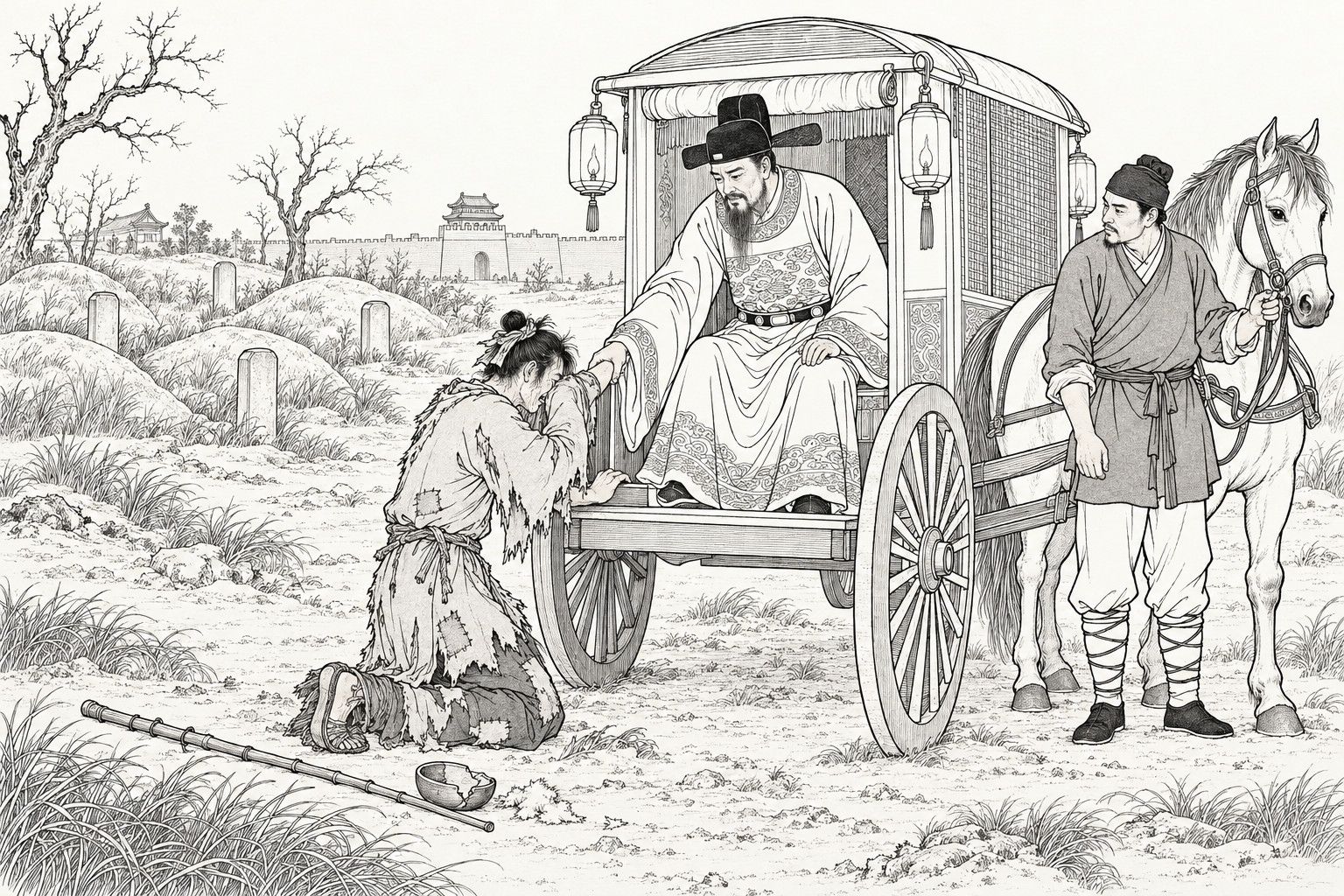
陳錫九,邳人。父子言,邑名士。富室周某,仰其聲望,訂為婚姻。陳累舉不第,家業蕭索,游學于秦,數年無信。周陰有悔心。以少女適王孝廉為繼室;王聘儀豐盛,僕馬甚都。以此愈憎錫九貧,堅意絕婚;問女,女不從。怒,以惡服飾遣歸錫九。日不舉火,周全不顧恤。一日,使傭媼以饁餉女,入門向母曰:「主人使某視小姑姑餓死否。」女恐母慚,強笑以亂其詞。因出榼中肴餌,列母前。媼止之曰:「無須爾!自小姑入人家,何曾交換出一杯溫涼水?吾家物,料姥姥亦無顏啗噉得。」母大恚,聲色俱變。媼不服,惡語相侵。紛紜間,錫九自外入,訊知大怒,撮毛批頰,撻逐出門而去。次日,周來逆女,女不肯歸;明日又來,增其人數,眾口呶呶,如將尋鬥。母強勸女去。女潸然拜母,登車而去。過數日,又使人來,逼索離婚書,母強錫九與之。惟望子言歸,以圖別處。周家有人自西安來,知子言已死,陳母哀憤成疾而卒。錫九哀迫中,尚望妻歸;久而渺然,悲憤益切。薄田數畝,鬻治葬具。葬畢,乞食赴秦,以求父骨。至西安,遍訪居人,或言數年前有書生死於逆旅,葬之東郊,今冢已沒。錫九無策,惟朝丐市廛,暮宿野寺,冀有知者。會晚經叢葬處,有數人遮道,逼索飯價。錫九曰:「我異鄉人,乞食城郭,何處少人飯價?」共怒,捽之仆地,以埋兒敗絮塞其口。力盡聲嘶,漸就危殆。忽共驚曰:「何處官府至矣!」釋手寂然。俄有車馬至,便問:「臥者何人?」即有數人扶至車下。車中人曰:「是吾兒也。孽鬼何敢爾!可悉縛來,勿致漏脫。」錫九覺有人去其塞,少定,細認,真其父也。大哭曰:「兒為父骨良苦。今固尚在人間耶!」父曰:「我非人,太行總管也。此來亦為吾兒。」錫九哭益哀。父慰諭之。錫九泣述岳家離婚。父曰:「無憂,今新婦亦在母所。母念兒甚,可暫一往。」遂與同車,馳如風雨。移時,至一官署,下車入重門,則母在焉。錫九痛欲絕,父止之。錫九啜泣聽命。見妻在母側,問母曰:「兒婦在此,得毋亦泉下耶?」母曰:「非也,是汝父接來,待汝歸家,當便送去。」錫九曰:「兒侍父母,不願歸矣。」母曰:「辛苦跋涉而來,為父骨耳。汝不歸,初志為何也?況汝孝行已達天帝,賜汝金萬斤,夫妻享受正遠,何言不歸?」錫九垂泣。父數數促行,錫九哭失聲。父怒曰:「汝不行耶!」錫九懼,收聲,始詢葬所。父挽之曰:「子行,我告之:去叢葬處百餘步,有子母白榆是也。」挽之甚急,竟不遑別母。門外有健僕,捉馬待之。既超乘,父囑曰:「日所宿處,有少資斧,可速辦裝歸,向岳索婦;不得婦,勿休也。」錫九諾而行。馬絕駛,雞鳴至西安。僕扶下,方將拜致父母,而人馬已杳。尋至舊宿處,倚壁假寐,以待天明。坐處有拳石礙股;曉而視之,白金也。市棺賃輿,尋雙榆下,得父骨而歸。合厝既畢,家徒四壁。幸里中憐其孝,共飯之。將往索婦,自度不能用武,與族兄十九往。及門,門者絕之。十九素無賴,出語穢褻。周使人勸錫九歸,願即送女去,錫九乃還。初,女之歸也,周對之罵婿及母,女不語,但向壁零涕。陳母死,亦不使聞。得離書,擲向女曰:「陳家出汝矣!」女曰:「我不曾悍逆,何為出我?」欲歸質其故,又禁閉之。後錫九如西安,遂造凶訃,以絕女志。此信一播,遂有杜中翰來議姻,竟許之。親迎有日,女始知,遂泣不食,以被韜面,氣如游絲。周正無法,忽聞錫九至,發語不遜,意料女必死,遂舁歸錫九,意將待女死以洩其憤。錫九歸,而送女者已至;猶恐錫九見其病而不內,甫入門,委之而去。鄰里代憂,共謀舁還;錫九不聽,扶置榻上,而氣已絕。始大恐。正遑迫間,周子率數人持械入,門窗盡毀。錫九逃匿,苦搜之。鄉人盡為不平;十九糾十餘人銳身急難,周子兄弟皆被夷傷,始鼠竄而去。周益怒,訟於官,捕錫九、十九等。錫九將行,以女尸囑鄰媼,忽聞榻上若息,近視之,秋波微動矣;少時,已能轉側。大喜,詣官自陳。宰怒周訟誣。周懼,啗以重賂,始得免。錫九歸,夫妻相見,悲喜交并。先是,女絕食奄臥,自矢必死。忽有人捉起曰:「我陳家人也,速從我去,夫妻可以相見;不然,無及矣!」不覺身已出門,兩人扶登肩輿,頃刻至官廨,見公姑俱在。問:「此何所?」母曰:「不必問,容當送汝歸。」一日,見錫九至,甚喜。一見遽別,心頗疑怪。公不知何事,恆數日不歸。昨夕忽歸,曰:「我在武夷,遲歸二日,難為保兒矣。可速送兒歸去。」遂以輿馬送女。忽見家門,遂如夢醒。女與錫九共述曩事,相與驚喜。由此夫妻相聚,但朝夕無以自給。錫九於村中設童蒙帳,兼自攻苦。每私語曰:「父言天賜黃金,今四堵空空,豈訓讀所能發蹟耶?」一日,自塾中歸,遇二人,問之曰:「君陳某耶?」錫九曰:「然。」二人即出鐵索縶之,錫九不解其故。少間,村人畢集,共詰之,始知郡盜所牽。眾憐其冤,醵錢賂役,途中得無苦。至郡見太守,歷述家世。太守愕然曰:「此名士之子,溫文爾雅,烏能作賊!」命脫縲絏,取盜嚴梏之,始供為周某賄囑。錫九又訴翁婿反面之由,太守更怒,立刻拘提。即延錫九至署,與論世好,蓋太守舊邳宰韓公之子,即子言受業門人也。贈燈火之費以百金;又以二騾代步,使不時趨郡,以課文藝。轉於各上官游揚其孝,自總制而下,皆有餽遺。錫九乘騾而歸,夫妻慰甚。一日,妻母哭至,見女伏地不起。女駭問之,始知周已被械在獄矣。女哀哭自咎,但欲覓死。錫九不得已,詣郡為之緩頰。太守釋令自贖,罰穀一百石,批賜孝子陳錫九。放歸,出倉粟,雜糠粃而輦運之。錫九謂女曰:「爾翁以小人之心度君子矣。烏知我必受之,而瑣瑣雜糠覈耶?」因笑卻之。錫九家雖小有,而垣牆陋蔽。一夜,群盜入。僕覺,大號,止竊兩騾而去。後半年餘,錫九夜讀,聞撾門聲,問之寂然。呼僕起視,則門一啟,兩騾躍入,乃向所亡也。直奔櫪下,咻咻汗喘。燭之,各負革囊;解視,則白鏹滿中。大異,不知其所自來。後聞是夜大盜劫周,盈裝出,適防兵追急,委其捆載而去。騾認故主,逕奔至家。周自獄中歸,刑創猶劇,又遭盜劫,大病而死。女夜夢父囚繫而至,曰:「吾生平所為,悔已無及。今受冥譴,非若翁莫能解脫,為我代求婿,致一函焉。」醒而嗚泣。詰之,具以告。錫九久欲一詣太行,即日遂發。既至,備牲物酹祝之,即露宿其處,冀有所見,終夜無異,遂歸。周死,母子逾貧,仰給於次婿。王孝廉考補縣尹,以墨敗,舉家徙瀋陽,益無所歸。錫九時顧卹之。
陈锡九,邳人。父子言,邑名士。富室周某,仰其声望,订为婚姻。陈累举不第,家业萧索,游学于秦,数年无信。周阴有悔心。以少女适王孝廉为继室;王聘仪丰盛,仆马甚都。以此愈憎锡九贫,坚意绝婚;问女,女不从。怒,以恶服饰遣归锡九。日不举火,周全不顾恤。一日,使佣媪以馌饷女,入门向母曰:「主人使某视小姑姑饿死否。」女恐母惭,强笑以乱其词。因出榼中肴饵,列母前。媪止之曰:「无须尔!自小姑入人家,何曾交换出一杯温凉水?吾家物,料姥姥亦无颜啗噉得。」母大恚,声色俱变。媪不服,恶语相侵。纷纭间,锡九自外入,讯知大怒,撮毛批颊,挞逐出门而去。次日,周来逆女,女不肯归;明日又来,增其人数,众口呶呶,如将寻斗。母强劝女去。女潸然拜母,登车而去。过数日,又使人来,逼索离婚书,母强锡九与之。惟望子言归,以图别处。周家有人自西安来,知子言已死,陈母哀愤成疾而卒。锡九哀迫中,尚望妻归;久而渺然,悲愤益切。薄田数亩,鬻治葬具。葬毕,乞食赴秦,以求父骨。至西安,遍访居人,或言数年前有书生死于逆旅,葬之东郊,今冢已没。锡九无策,惟朝丐市廛,暮宿野寺,冀有知者。会晚经丛葬处,有数人遮道,逼索饭价。锡九曰:「我异乡人,乞食城郭,何处少人饭价?」共怒,捽之仆地,以埋儿败絮塞其口。力尽声嘶,渐就危殆。忽共惊曰:「何处官府至矣!」释手寂然。俄有车马至,便问:「卧者何人?」即有数人扶至车下。车中人曰:「是吾儿也。孽鬼何敢尔!可悉缚来,勿致漏脱。」锡九觉有人去其塞,少定,细认,真其父也。大哭曰:「儿为父骨良苦。今固尚在人间耶!」父曰:「我非人,太行总管也。此来亦为吾儿。」锡九哭益哀。父慰谕之。锡九泣述岳家离婚。父曰:「无忧,今新妇亦在母所。母念儿甚,可暂一往。」遂与同车,驰如风雨。移时,至一官署,下车入重门,则母在焉。锡九痛欲绝,父止之。锡九啜泣听命。见妻在母侧,问母曰:「儿妇在此,得毋亦泉下耶?」母曰:「非也,是汝父接来,待汝归家,当便送去。」锡九曰:「儿侍父母,不愿归矣。」母曰:「辛苦跋涉而来,为父骨耳。汝不归,初志为何也?况汝孝行已达天帝,赐汝金万斤,夫妻享受正远,何言不归?」锡九垂泣。父数数促行,锡九哭失声。父怒曰:「汝不行耶!」锡九惧,收声,始询葬所。父挽之曰:「子行,我告之:去丛葬处百余步,有子母白榆是也。」挽之甚急,竟不遑别母。门外有健仆,捉马待之。既超乘,父嘱曰:「日所宿处,有少资斧,可速办装归,向岳索妇;不得妇,勿休也。」锡九诺而行。马绝驶,鸡鸣至西安。仆扶下,方将拜致父母,而人马已杳。寻至旧宿处,倚壁假寐,以待天明。坐处有拳石碍股;晓而视之,白金也。市棺赁舆,寻双榆下,得父骨而归。合厝既毕,家徒四壁。幸里中怜其孝,共饭之。将往索妇,自度不能用武,与族兄十九往。及门,门者绝之。十九素无赖,出语秽亵。周使人劝锡九归,愿即送女去,锡九乃还。初,女之归也,周对之骂婿及母,女不语,但向壁零涕。陈母死,亦不使闻。得离书,掷向女曰:「陈家出汝矣!」女曰:「我不曾悍逆,何为出我?」欲归质其故,又禁闭之。后锡九如西安,遂造凶讣,以绝女志。此信一播,遂有杜中翰来议姻,竟许之。亲迎有日,女始知,遂泣不食,以被韬面,气如游丝。周正无法,忽闻锡九至,发语不逊,意料女必死,遂舁归锡九,意将待女死以泄其愤。锡九归,而送女者已至;犹恐锡九见其病而不内,甫入门,委之而去。邻里代忧,共谋舁还;锡九不听,扶置榻上,而气已绝。始大恐。正遑迫间,周子率数人持械入,门窗尽毁。锡九逃匿,苦搜之。乡人尽为不平;十九纠十余人锐身急难,周子兄弟皆被夷伤,始鼠窜而去。周益怒,讼于官,捕锡九、十九等。锡九将行,以女尸嘱邻媪,忽闻榻上若息,近视之,秋波微动矣;少时,已能转侧。大喜,诣官自陈。宰怒周讼诬。周惧,啗以重赂,始得免。锡九归,夫妻相见,悲喜交并。先是,女绝食奄卧,自矢必死。忽有人捉起曰:「我陈家人也,速从我去,夫妻可以相见;不然,无及矣!」不觉身已出门,两人扶登肩舆,顷刻至官廨,见公姑俱在。问:「此何所?」母曰:「不必问,容当送汝归。」一日,见锡九至,甚喜。一见遽别,心颇疑怪。公不知何事,恒数日不归。昨夕忽归,曰:「我在武夷,迟归二日,难为保儿矣。可速送儿归去。」遂以舆马送女。忽见家门,遂如梦醒。女与锡九共述曩事,相与惊喜。由此夫妻相聚,但朝夕无以自给。锡九于村中设童蒙帐,兼自攻苦。每私语曰:「父言天赐黄金,今四堵空空,岂训读所能发迹耶?」一日,自塾中归,遇二人,问之曰:「君陈某耶?」锡九曰:「然。」二人即出铁索絷之,锡九不解其故。少间,村人毕集,共诘之,始知郡盗所牵。众怜其冤,醵钱赂役,途中得无苦。至郡见太守,历述家世。太守愕然曰:「此名士之子,温文尔雅,乌能作贼!」命脱缧絏,取盗严梏之,始供为周某贿嘱。锡九又诉翁婿反面之由,太守更怒,立刻拘提。即延锡九至署,与论世好,盖太守旧邳宰韩公之子,即子言受业门人也。赠灯火之费以百金;又以二骡代步,使不时趋郡,以课文艺。转于各上官游扬其孝,自总制而下,皆有餽遗。锡九乘骡而归,夫妻慰甚。一日,妻母哭至,见女伏地不起。女骇问之,始知周已被械在狱矣。女哀哭自咎,但欲觅死。锡九不得已,诣郡为之缓颊。太守释令自赎,罚谷一百石,批赐孝子陈锡九。放归,出仓粟,杂糠粃而辇运之。锡九谓女曰:「尔翁以小人之心度君子矣。乌知我必受之,而琐琐杂糠核耶?」因笑却之。锡九家虽小有,而垣墙陋蔽。一夜,群盗入。仆觉,大号,止窃两骡而去。后半年余,锡九夜读,闻挝门声,问之寂然。呼仆起视,则门一启,两骡跃入,乃向所亡也。直奔枥下,咻咻汗喘。烛之,各负革囊;解视,则白镪满中。大异,不知其所自来。后闻是夜大盗劫周,盈装出,适防兵追急,委其捆载而去。骡认故主,径奔至家。周自狱中归,刑创犹剧,又遭盗劫,大病而死。女夜梦父囚系而至,曰:「吾生平所为,悔已无及。今受冥谴,非若翁莫能解脱,为我代求婿,致一函焉。」醒而呜泣。诘之,具以告。锡九久欲一诣太行,即日遂发。既至,备牲物酹祝之,即露宿其处,冀有所见,终夜无异,遂归。周死,母子逾贫,仰给于次婿。王孝廉考补县尹,以墨败,举家徙沈阳,益无所归。锡九时顾恤之。
Chen Xijiu was a man of Pi. His father, Ziyan, was a scholar of note in the county. A rich man named Zhou, who looked up to the father’s fame, arranged a match between their children. Chen Ziyan sat the examinations again and again without passing; the family fortunes dwindled, and he went to Qin to study and teach. For several years no word came from him. Zhou began secretly to regret the match. He married his youngest daughter to a provincial graduate named Wang as his second wife; Wang’s betrothal gifts were lavish, his servants and horses very fine. This made Zhou despise Xijiu’s poverty all the more, and he set his mind on breaking off the match. He asked his daughter; she would not agree. In a rage, he sent her off to Xijiu in shabby clothes and trinkets. There were days when no fire was lit in Xijiu’s kitchen, and Zhou did nothing at all to help. One day he sent a hired old woman with food for his daughter. She came in and said to Xijiu’s mother, “The master sent me to see whether the young miss has starved to death yet.” The daughter, afraid her mother-in-law would be shamed, forced a laugh to cover the words, took the dishes and cakes out of the hamper, and set them before the old lady. The servant stopped her. “No need for that! Since the young miss came into this house, when has anyone here sent back so much as a cup of water, hot or cold? This is our family’s food. I’d think the old madam wouldn’t have the face to eat it.” The mother was furious; her voice and face changed. The servant would not give way, and answered with abuse. In the middle of the uproar Xijiu came in. When he learned what had happened he flew into a rage, seized the woman by the hair, slapped her face, and beat her out of the door. The next day Zhou came to take his daughter home. She would not go. The day after, he came again with more people, all shouting at once as if spoiling for a fight. The mother pressed the girl to go. In tears, she bowed to her mother-in-law and got into the carriage. A few days later Zhou sent people again to demand a letter of divorce, and the mother made Xijiu give it. Her only hope was that Ziyan would come home and find some other way. Then someone of the Zhou household came back from Xi’an, and they learned that Ziyan was dead. Grief and anger made Xijiu’s mother ill, and she died. In his grief and straits Xijiu still hoped his wife would come back; as time went on with no sign of her, his grief and bitterness grew sharper. He sold his few mu of poor land to pay for the funeral. When it was over he set out for Qin, begging his way, to find his father’s bones. At Xi’an he asked everyone he could. Someone said that a few years before, a scholar had died at an inn and been buried in the eastern outskirts, but the mound was gone now. Xijiu was at a loss. He begged in the market by day and slept in a lonely temple by night, hoping someone would know. One evening, as he passed a field of common graves, several men blocked his way and demanded he pay for his meals. “I am a stranger here, begging my food in the city,” said Xijiu. “Where would I owe anyone for meals?” They grew angry, threw him to the ground, and stuffed his mouth with rotten cotton wadding that had been buried with a dead child. His strength gave out, his voice went hoarse, and he was close to death. Suddenly they cried in alarm, “Some official is coming!” They let go of him, and all was silent. In a moment carriages and horses arrived, and a voice asked, “Who is that lying there?” At once several men helped him up to the carriage. “It is my son,” said the man in the carriage. “How dare these wicked ghosts! Tie them up, every one, and let none escape.” Xijiu felt someone take the gag from his mouth. When he had steadied a little he looked closely: it really was his father. He burst into tears. “I have suffered so much looking for your bones, Father. So you are still in the world of the living!” “I am not a living man,” said his father. “I am Superintendent of the Taihang Mountains. I came this way for your sake.” Xijiu wept harder. His father comforted him. Weeping, Xijiu told how his wife’s family had broken the marriage. “Don’t worry,” said his father. “Your wife is with your mother now. Your mother misses you very much. Come with me for a little while.” They rode together in the carriage, flying along like wind and rain. After a while they came to an official residence. They got down and went through gate after gate, and there was his mother. Xijiu’s grief nearly overwhelmed him; his father checked him, and sobbing, Xijiu obeyed. Seeing his wife at his mother’s side, he asked, “My wife is here — is she dead too, down at the Yellow Springs?” “No,” said his mother. “Your father brought her here. When you go home she will be sent back.” “I will stay and serve you both,” said Xijiu. “I don’t want to go back.” “You toiled all this way for your father’s bones,” said his mother. “If you don’t go back, what becomes of what you set out to do? Besides, word of your devotion has reached the Emperor on High, and he has granted you ten thousand catties of gold. You and your wife have long years of enjoyment ahead. How can you talk of not going back?” Xijiu hung his head and wept. His father urged him again and again to go, and Xijiu sobbed aloud. “Will you not go?” his father said angrily. Frightened, Xijiu stopped crying, and only then asked where the grave was. His father pulled him along. “Go, and I’ll tell you. A hundred-odd paces from the common graves there are two white elms, a mother and her child. That is the place.” He hurried him off so fast that Xijiu had no time even to say goodbye to his mother. Outside the gate a sturdy servant stood waiting with a horse. When Xijiu had leapt into the saddle his father told him, “Where you have been sleeping there is a little money for the road. Make ready quickly and go home, and demand your wife from her father. Don’t rest until you have her.” Xijiu promised and set off. The horse went extremely fast; by cockcrow he was at Xi’an. The servant helped him down, and he was about to bow and send his respects to his parents when man and horse were gone. He found his way to the place where he used to sleep and dozed against the wall, waiting for dawn. A stone the size of a fist where he sat dug into his thigh. When it grew light he looked at it: it was silver. He bought a coffin and hired a cart, found the two elms, and under them found his father’s bones, and went home. When he had buried his father with his mother, there was nothing left in the house but the four walls. Luckily the neighbours pitied him for his devotion and fed him between them. He meant to go and demand his wife, but knowing he could not use force himself, he took with him a clansman, an elder cousin called Shijiu. At the gate the gatekeeper turned them away. Shijiu had always been a ruffian, and he let loose a stream of filth. Zhou sent someone to urge Xijiu to go home, promising to send the girl to him at once, and Xijiu went back. When the daughter had first come home, Zhou had cursed her husband and his mother to her face; she said nothing, only turned to the wall and wept. When Chen’s mother died, they did not even let her hear of it. When Zhou got the letter of divorce he flung it at her: “The Chens have put you out!” “I have never been shrewish or disobedient,” she said. “Why should they put me out?” She wanted to go back and ask the reason, but he locked her up. Later, when Xijiu went to Xi’an, Zhou made up news of his death to put an end to her hopes. Once the news got about, a Secretary Du came to propose marriage, and Zhou actually accepted. The day was set for the groom to come for her before she found out. Then she wept and would not eat, and lay with the quilt over her face until her breath was as faint as a thread of gossamer. Zhou was at his wits’ end when he heard that Xijiu had come and was using insulting language. Reckoning the girl was sure to die, he had her carried to Xijiu’s, meaning to let her die there and so vent his spite. Xijiu reached home to find the bearers already there. Afraid he would see how ill she was and refuse to take her in, they set her down the moment they were through the door and left. The neighbours were worried for him and talked of carrying her back, but Xijiu would not hear of it. He lifted her onto the bed — and her breath had already stopped. Only then was he truly frightened. While he was in this panic, Zhou’s son burst in with several men carrying weapons and smashed every door and window. Xijiu ran and hid, and they searched hard for him. The villagers were all outraged. Shijiu gathered a dozen or more men and threw himself into the fight; Zhou’s sons were all wounded and fled like rats. Zhou, angrier than ever, brought a suit before the magistrate, and warrants went out for Xijiu, Shijiu and the rest. As Xijiu was about to go, he asked an old woman next door to watch over the body. Suddenly he heard what seemed to be breathing from the bed. He went close: her eyes were faintly moving. Before long she could turn over. Overjoyed, he went to the magistrate and gave his account. The magistrate was angry that Zhou had brought a false charge. Zhou took fright, and only by bribing him heavily got off. Xijiu went home, and husband and wife met again, grief and joy together. Earlier, as she lay starving and near death, sworn to die, someone had suddenly pulled her up, saying, “I am from the Chen household. Come with me quickly and you can see your husband; otherwise it will be too late!” Before she knew it she was out of the door. Two people helped her into a sedan chair, and in no time she reached an official residence, where she found her husband’s father and mother both. “What place is this?” she asked. “No need to ask,” said her mother-in-law. “In due course you will be sent home.” One day she saw Xijiu arrive and was overjoyed; but no sooner had she seen him than he was gone, which puzzled her. Her father-in-law was away on some business or other and often stayed away for days. Then, the evening before, he came back suddenly and said, “I was at Mount Wuyi, and getting back two days late, it has been hard to keep the child alive. Send her home at once.” So they sent her off with chair and horses. Suddenly she saw the gate of home, and it was as if she woke from a dream. She and Xijiu told each other all that had happened, marvelling and rejoicing. From then on husband and wife were together, but they had nothing to live on from one day to the next. Xijiu opened a school for small children in the village and studied hard himself besides. He often said to himself, “Father said Heaven had granted me gold, yet here are my four bare walls. Can teaching children to read ever make my fortune?” One day, coming home from the school, he met two men who asked, “Are you Chen So-and-so?” “I am,” said Xijiu. At once they brought out iron chains and bound him, and he had no idea why. Soon the whole village had gathered and questioned them, and it came out that a robber held at the prefecture had named him. Pitying him for the injustice, they pooled money to bribe the runners, so that he was spared ill-treatment on the road. At the prefecture he was brought before the prefect and gave a full account of his family. The prefect was astonished. “This is the son of a noted scholar, gentle and well-bred. How could he be a thief?” He ordered the chains taken off, had the robber brought and harshly tortured, and the man confessed that Zhou had bribed him to do it. Xijiu then explained how he and his father-in-law had fallen out. The prefect, angrier still, had Zhou arrested at once. Then he invited Xijiu into his residence and talked of the old ties between their families: the prefect was the son of Lord Han, a former magistrate of Pi, and had studied under Ziyan. He gave Xijiu a hundred taels for lamp oil, and two mules to ride, so that he could come to the prefecture often to have his essays examined. He also spread word of Xijiu’s devotion among his superiors, and from the governor-general down they all sent gifts. Xijiu rode home on his mule, and husband and wife were much comforted. One day his wife’s mother came weeping, threw herself down before her daughter and would not get up. Alarmed, the daughter asked what was wrong, and learned that Zhou was in prison in fetters. She wept bitterly and blamed herself, wanting only to die. Xijiu had no choice but to go to the prefecture and put in a word for him. The prefect let Zhou redeem himself with a fine of a hundred shi of grain, and wrote an order that it be given to Chen Xijiu, the devoted son. Once free, Zhou took grain from his granary, mixed it with husks and chaff, and had it carted over. Xijiu said to his wife, “Your father is measuring a gentleman by the heart of a petty man. How does he know I would accept it at all, that he should go to the petty trouble of mixing in chaff?” And he laughed and sent it back. Though Xijiu’s household now had a little, its walls were poor and broken down. One night a band of thieves got in. The servant woke and yelled, and they made off with nothing but the two mules. More than six months later, as Xijiu sat reading one night, he heard a pounding at the gate. He called out, but there was only silence. He called the servant to go and see. The moment the gate was opened, two mules leapt in — the very mules they had lost. They went straight to their stall, sweating and panting hard. By candlelight he saw that each carried a leather bag; untied, the bags proved full of silver. He was amazed and could not think where it had come from. Later he heard that on that night a band of robbers had raided Zhou’s house and come away fully laden, but with soldiers of the guard hot on their heels they abandoned the loads and fled; and the mules, knowing their old master, ran straight home. Zhou had come home from prison still suffering badly from the wounds of torture; now robbed as well, he fell gravely ill and died. One night the daughter dreamed her father came to her in chains. “I repent of what I did in my life, but it is too late. Now I am being punished in the underworld, and no one but your father-in-law can set me free. Ask your husband to plead for me: have him send a letter.” She woke sobbing. When Xijiu asked why, she told him everything. Xijiu had long wanted to make the journey to the Taihang, and he set out that very day. When he arrived he laid out offerings, poured libations and prayed, and slept out in the open there, hoping to see something. All night nothing strange happened, and he went home. After Zhou’s death his widow and sons grew poorer and poorer and lived on what the second son-in-law gave them. Wang, the provincial graduate, passed the examination for office and was made a county magistrate, but he was disgraced for corruption and his whole family was banished to Shenyang. Then they had nowhere at all to turn. Xijiu helped them from time to time.