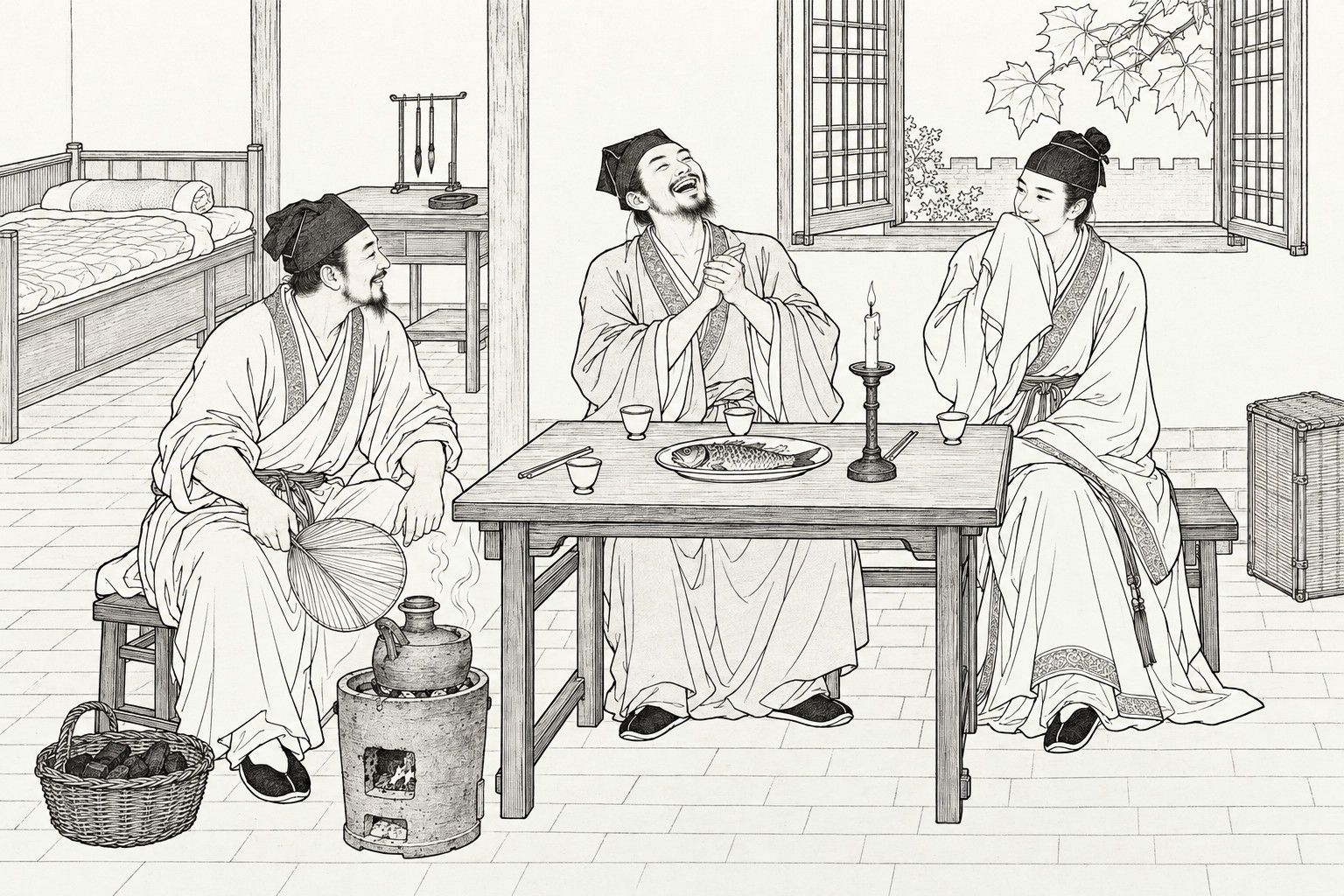
北平陶聖俞,名下士。順治間,赴鄉試,寓居郊郭。偶出戶,見一人負笈㑌儴,似卜居未就者。略詰之,遂釋負於道,相與傾語,言論有名士風。陶大說之,請與同居。客喜,攜囊入,遂同棲止。客自言:「順天人,姓于,字去惡。」以陶差長,兄之。于性不喜游矚,常獨坐一室,而案頭無書卷。陶不與談,則默臥而已。陶疑之,搜其囊篋,則筆研之外,更無長物。怪而問之。笑曰:「吾輩讀書,豈臨渴始掘井耶?」一日,就陶借書去,閉戶抄甚疾,終日五十餘紙,亦不見其摺疊成卷。竊窺之,則每一稿脫,輒燒灰吞之。愈益怪焉,詰其故。曰:「我以此代讀耳。」便誦所抄書,頃刻數篇,一字無訛。陶悅,欲傳其術,于以為不可。陶疑其吝,詞涉誚讓,于曰:「兄誠不諒我之深矣。欲不言,則此心無以自剖;驟言之,又恐驚為異怪。奈何?」陶固謂:「不妨。」于曰:「我非人,是鬼耳。今冥中以科目授官,七月十四日奉詔考簾官,十五日士子入闈,月盡榜放矣。」陶問:「考簾官為何?」曰:「此上帝慎重之意,無論鳥吏鱉官,皆考之。能文者以內簾用,不通者不得與焉。蓋陰之有諸神,猶陽之有守、令也。得志諸公,目不睹墳、典,不過少年持敲門磚,獵取功名,門既開,則棄去;再司簿書十數年,即文學士,胸中尚有字耶!陽世所以陋劣倖進,而英雄失志者,惟少此一考耳。」陶深然之,由是益加敬畏。一日,自外來,有憂色,歎曰:「僕生而貧賤,自謂死後可免;不謂迍邅先生相從地下!」陶請其故。曰:「文昌奉命都羅國封王,簾官之考遂罷。數十年游神耗鬼,雜入衡文,吾輩寧有望耶?」陶問:「此輩皆誰何人?」曰:「即言之,君亦不識。略舉一二人,大概可知:樂正師曠、司庫和嶠是也。僕自念命不可憑,文不可恃,不如休耳。」言已怏怏,遂將治任。陶挽而慰之,乃止。至中元之夕,謂陶曰:「我將入闈。煩於昧爽時,持香炷於東野。三呼去惡,我便至。」乃出門去。陶沽酒烹鮮以待之。東方既白,敬如所囑。無何,于偕一少年來。問其姓字。于曰:「此方子晉,是我良友。適於場中相邂逅。聞兄盛名,深欲拜識。」同至寓,秉燭為禮。少年亭亭似玉,意度謙婉,陶甚愛之。便問:「子晉佳作,當大快意?」于曰:「言之可笑!闈中七則,作過半矣;細審主司姓名,裹具徑出。奇人也!」陶扇爐進酒,因問:「闈中何題?去惡魁解否?」于曰:「書藝、經論各一,夫人而能之。策問:『自古邪僻固多,而世風至今日,奸情醜態,愈不可名,不惟十八獄所不得盡,抑非十八獄所能容。是果何術而可?或謂宜量加一二獄,然殊失上帝好生之心。其宜增與、否與,或別有道以清其源,爾多士其悉言勿隱。』弟策雖不佳,頗為痛快。表:『擬天魔殄滅,賜群臣龍馬天衣有差。』次則『瑤台應制詩』、『西池桃花賦』。此三種,自謂場中無兩矣!」言已鼓掌。方笑曰:「此時快心,放兄獨步矣;數辰後,不痛哭始為男子也。」天明,方欲辭去。陶留與同寓,方不可,但期暮至。三日,竟不復來。陶使于往尋之。于曰:「無須。子晉拳拳,非無意者。」日既西,方果來。出一卷授陶,曰:「三日失約。敬錄舊藝百餘作,求一品題。」陶捧讀大喜,一句一贊,略盡一二首,遂藏諸笥。談至更深,方遂留,與于共榻寢。自此為常;方無夕不至,陶亦無方不懽也。一夕,倉皇而入,向陶曰:「地榜已揭,于五兄落第矣!」于方臥,聞言驚起,泫然流涕。二人極意慰藉,涕始止。然相對默默,殊不可堪。方曰:「適聞大巡環張桓侯將至,恐失志者之造言也;不然,文場尚有翻覆。」于聞之,色喜。陶詢其故。曰:「桓侯翼德,三十年一巡陰曹,三十五年一巡陽世,兩間之不平,待此老而一消也。」乃起,拉方俱去。兩夜始返,方喜謂陶曰:「君不賀五兄耶?桓侯前夕至,裂碎地榜,榜上名字,止存三之一。遍閱遺卷,得五兄甚喜,薦作交南巡海使,旦晚輿馬可到。」陶大喜,置酒稱賀。酒數行,于問陶曰:「君家有閒舍否?」問:「將何為?」曰:「子晉孤無鄉土,又不忍恝然於兄。弟意欲假館相依。」陶喜曰:「如此,為幸多矣。即無多屋宇,同榻何礙。但有嚴君,須先關白。」于曰:「審知尊大人慈厚可依。兄場闈有日,子晉如不能待,先歸何如?」陶留伴逆旅,以待同歸。次日,方暮,有車馬至門,接于蒞任。于起握手曰:「從此別矣。一言欲告,又恐阻銳進之志。」問:「何言?」曰:「君命淹蹇,生非其時。此科之分十之一;後科桓侯臨世,公道初彰,十之三;三科始可望也。」陶聞,欲中止。于曰:「不然,此皆天數。即明知不可,而註定之艱苦,亦要歷盡耳。」又顧方曰:「勿淹滯,今朝年、月、日、時皆良,即以輿蓋送君歸。僕馳馬自去。」方忻然拜別。陶中心迷亂,不知所囑,但揮涕送之。見輿馬分途,頃刻都散。始悔子晉北旋,未致一字,而已無及矣。三場畢,不甚滿志,奔波而歸。入門問子晉,家中並無知者。因為父述之,父喜曰:「若然,則客至久矣。」先是陶翁晝臥,夢輿蓋止於其門,一美少年自車中出,登堂展拜。訝問所來。答云:「大哥許假一舍,以入闈不得偕來。我先至矣。」言已,請入拜母。翁方謙卻,適家媼入曰:「夫人產公子矣。」恍然而醒,大奇之。是日陶言,適與夢符,乃知兒即子晉後身也。父子各喜,名之小晉。兒初生,善夜啼,母苦之。陶曰:「倘是子晉,我見之,啼當止。」俗忌客忤,故不令陶見。母患啼不可耐,乃呼陶入。陶嗚之曰:「子晉勿爾!我來矣!」兒啼正急,聞聲輟止,停睇不瞬,如審顧狀。陶摩頂而去。自是竟不復啼。數月後,陶不敢見之;一見,則折腰索抱,走去,則啼不可止。陶亦狎愛之。四歲離母,輒就兄眠;兄他出,則假寐以俟其歸。兄於枕上教毛詩,誦聲呢喃,夜盡四十餘行。以子晉遺文授之,欣然樂讀,過口成誦;試之他文,不能也。八九歲,眉目朗徹,宛然一子晉矣。陶兩入闈,皆不第。丁酉,文場事發,簾官多遭誅遣,貢舉之途一肅,乃張巡環力也。陶下科中副車,尋貢。遂灰志前途,隱居教弟。常語人曰:「吾有此樂,翰苑不易也。」
北平陶圣俞,名下士。顺治间,赴乡试,寓居郊郭。偶出户,见一人负笈㑌儴,似卜居未就者。略诘之,遂释负于道,相与倾语,言论有名士风。陶大说之,请与同居。客喜,携囊入,遂同栖止。客自言:「顺天人,姓于,字去恶。」以陶差长,兄之。于性不喜游瞩,常独坐一室,而案头无书卷。陶不与谈,则默卧而已。陶疑之,搜其囊箧,则笔研之外,更无长物。怪而问之。笑曰:「吾辈读书,岂临渴始掘井耶?」一日,就陶借书去,闭户抄甚疾,终日五十余纸,亦不见其折叠成卷。窃窥之,则每一稿脱,辄烧灰吞之。愈益怪焉,诘其故。曰:「我以此代读耳。」便诵所抄书,顷刻数篇,一字无讹。陶悦,欲传其术,于以为不可。陶疑其吝,词涉诮让,于曰:「兄诚不谅我之深矣。欲不言,则此心无以自剖;骤言之,又恐惊为异怪。奈何?」陶固谓:「不妨。」于曰:「我非人,是鬼耳。今冥中以科目授官,七月十四日奉诏考帘官,十五日士子入闱,月尽榜放矣。」陶问:「考帘官为何?」曰:「此上帝慎重之意,无论鸟吏鳖官,皆考之。能文者以内帘用,不通者不得与焉。盖阴之有诸神,犹阳之有守、令也。得志诸公,目不睹坟、典,不过少年持敲门砖,猎取功名,门既开,则弃去;再司簿书十数年,即文学士,胸中尚有字耶!阳世所以陋劣幸进,而英雄失志者,惟少此一考耳。」陶深然之,由是益加敬畏。一日,自外来,有忧色,叹曰:「仆生而贫贱,自谓死后可免;不谓迍邅先生相从地下!」陶请其故。曰:「文昌奉命都罗国封王,帘官之考遂罢。数十年游神耗鬼,杂入衡文,吾辈宁有望耶?」陶问:「此辈皆谁何人?」曰:「即言之,君亦不识。略举一二人,大概可知:乐正师旷、司库和峤是也。仆自念命不可凭,文不可恃,不如休耳。」言已怏怏,遂将治任。陶挽而慰之,乃止。至中元之夕,谓陶曰:「我将入闱。烦于昧爽时,持香炷于东野。三呼去恶,我便至。」乃出门去。陶沽酒烹鲜以待之。东方既白,敬如所嘱。无何,于偕一少年来。问其姓字。于曰:「此方子晋,是我良友。适于场中相邂逅。闻兄盛名,深欲拜识。」同至寓,秉烛为礼。少年亭亭似玉,意度谦婉,陶甚爱之。便问:「子晋佳作,当大快意?」于曰:「言之可笑!闱中七则,作过半矣;细审主司姓名,裹具径出。奇人也!」陶扇炉进酒,因问:「闱中何题?去恶魁解否?」于曰:「书艺、经论各一,夫人而能之。策问:『自古邪僻固多,而世风至今日,奸情丑态,愈不可名,不惟十八狱所不得尽,抑非十八狱所能容。是果何术而可?或谓宜量加一二狱,然殊失上帝好生之心。其宜增与、否与,或别有道以清其源,尔多士其悉言勿隐。』弟策虽不佳,颇为痛快。表:『拟天魔殄灭,赐群臣龙马天衣有差。』次则『瑶台应制诗』、『西池桃花赋』。此三种,自谓场中无两矣!」言已鼓掌。方笑曰:「此时快心,放兄独步矣;数辰后,不痛哭始为男子也。」天明,方欲辞去。陶留与同寓,方不可,但期暮至。三日,竟不复来。陶使于往寻之。于曰:「无须。子晋拳拳,非无意者。」日既西,方果来。出一卷授陶,曰:「三日失约。敬录旧艺百余作,求一品题。」陶捧读大喜,一句一赞,略尽一二首,遂藏诸笥。谈至更深,方遂留,与于共榻寝。自此为常;方无夕不至,陶亦无方不懽也。一夕,仓皇而入,向陶曰:「地榜已揭,于五兄落第矣!」于方卧,闻言惊起,泫然流涕。二人极意慰藉,涕始止。然相对默默,殊不可堪。方曰:「适闻大巡环张桓侯将至,恐失志者之造言也;不然,文场尚有翻覆。」于闻之,色喜。陶询其故。曰:「桓侯翼德,三十年一巡阴曹,三十五年一巡阳世,两间之不平,待此老而一消也。」乃起,拉方俱去。两夜始返,方喜谓陶曰:「君不贺五兄耶?桓侯前夕至,裂碎地榜,榜上名字,止存三之一。遍阅遗卷,得五兄甚喜,荐作交南巡海使,旦晚舆马可到。」陶大喜,置酒称贺。酒数行,于问陶曰:「君家有闲舍否?」问:「将何为?」曰:「子晋孤无乡土,又不忍恝然于兄。弟意欲假馆相依。」陶喜曰:「如此,为幸多矣。即无多屋宇,同榻何碍。但有严君,须先关白。」于曰:「审知尊大人慈厚可依。兄场闱有日,子晋如不能待,先归何如?」陶留伴逆旅,以待同归。次日,方暮,有车马至门,接于莅任。于起握手曰:「从此别矣。一言欲告,又恐阻锐进之志。」问:「何言?」曰:「君命淹蹇,生非其时。此科之分十之一;后科桓侯临世,公道初彰,十之三;三科始可望也。」陶闻,欲中止。于曰:「不然,此皆天数。即明知不可,而注定之艰苦,亦要历尽耳。」又顾方曰:「勿淹滞,今朝年、月、日、时皆良,即以舆盖送君归。仆驰马自去。」方忻然拜别。陶中心迷乱,不知所嘱,但挥涕送之。见舆马分途,顷刻都散。始悔子晋北旋,未致一字,而已无及矣。三场毕,不甚满志,奔波而归。入门问子晋,家中并无知者。因为父述之,父喜曰:「若然,则客至久矣。」先是陶翁昼卧,梦舆盖止于其门,一美少年自车中出,登堂展拜。讶问所来。答云:「大哥许假一舍,以入闱不得偕来。我先至矣。」言已,请入拜母。翁方谦却,适家媪入曰:「夫人产公子矣。」恍然而醒,大奇之。是日陶言,适与梦符,乃知儿即子晋后身也。父子各喜,名之小晋。儿初生,善夜啼,母苦之。陶曰:「倘是子晋,我见之,啼当止。」俗忌客忤,故不令陶见。母患啼不可耐,乃呼陶入。陶呜之曰:「子晋勿尔!我来矣!」儿啼正急,闻声辍止,停睇不瞬,如审顾状。陶摩顶而去。自是竟不复啼。数月后,陶不敢见之;一见,则折腰索抱,走去,则啼不可止。陶亦狎爱之。四岁离母,辄就兄眠;兄他出,则假寐以俟其归。兄于枕上教毛诗,诵声呢喃,夜尽四十余行。以子晋遗文授之,欣然乐读,过口成诵;试之他文,不能也。八九岁,眉目朗彻,宛然一子晋矣。陶两入闱,皆不第。丁酉,文场事发,帘官多遭诛遣,贡举之途一肃,乃张巡环力也。陶下科中副车,寻贡。遂灰志前途,隐居教弟。常语人曰:「吾有此乐,翰苑不易也。」
Tao Shengyu of Beiping was a scholar of some name. In the Shunzhi reign he went to sit the provincial examination and took lodgings outside the city wall. Stepping out of his door one day, he saw a man with a book-box on his back, wandering about at a loss, like someone who had been looking for a place to stay and found none. Tao asked him a few questions. The man set his load down in the road, and they fell to talking freely. He talked like a true man of letters. Tao was delighted with him and asked him to share his lodgings. The stranger was glad to, carried his bags in, and from then on they lived together. He said of himself, “I am from Shuntian. My surname is Yu, my courtesy name Qu’e.” As Tao was a little older, Yu called him elder brother. Yu did not care for going about to see the sights. He sat alone in his room most of the time, yet there were no books on his desk. When Tao was not talking to him, he simply lay down in silence. Tao grew suspicious and searched his bags and boxes: apart from a brush and an inkstone there was nothing at all. Puzzled, he asked about it. Yu laughed. “Do people like us wait till we are thirsty to dig a well?” One day he borrowed some books from Tao, shut his door and copied very fast, more than fifty sheets in a day; yet Tao never saw him fold them into volumes. Tao peeped in secretly. Each time Yu finished a sheet, he burned it and swallowed the ashes. More puzzled than ever, Tao asked him why. “This is how I do my reading,” said Yu. And he recited what he had copied, several pieces in a moment, without a word wrong. Tao was delighted and wanted to learn the art. Yu said it could not be done. Tao suspected him of being stingy and said something reproachful. “You really do misjudge me, brother,” said Yu. “If I don’t tell you, I have no way to lay my heart open. If I tell you outright, I am afraid you will be frightened and think me some monster. What am I to do?” “Tell me,” Tao insisted. “I won’t mind.” “I am not a man,” said Yu. “I am a ghost. In the underworld now, offices are given by examination. On the fourteenth day of the seventh month, by imperial decree, the examiners are to be tested; on the fifteenth the candidates enter the examination hall; and at the end of the month the list of passes is posted.” “Why test the examiners?” asked Tao. “It shows the care of the Lord on High. Every official, bird clerk or turtle officer, is tested. Those who can write are appointed to the inner curtain; those who can’t are given no part in it. For the gods of the dark world are like the prefects and magistrates of the world of light. The gentlemen who have made their way have never set eyes on the ancient classics. In their youth they took up a brick to knock at the gate and hunted down rank and fame; once the gate opened, they threw the brick away. Then after ten years or more of handling ledgers and papers, even a real scholar — has he a single character left in his head? The reason why, in the world of the living, the base and the useless get on by luck while men of talent are thwarted, is simply that this one examination is missing.” Tao agreed with all his heart, and from then on he held Yu in still greater respect and awe. One day Yu came in looking worried and sighed. “In life I was poor and lowly. I thought I would be free of that after death. Who would have thought Master Hard Luck would follow me underground!” Tao asked what had happened. “The God of Literature has been sent to the Kingdom of Duluo to invest its king, and so the examiners’ test has been called off. Idle spirits and worthless ghosts who have drifted about for decades will be mixed in among the graders. What hope is there for people like us?” “Who are they?” asked Tao. “Even if I told you, you would not know them. I’ll name one or two and you’ll get the general idea: Shi Kuang as Master of Music, He Qiao as Keeper of the Treasury. I’ve come to think that fate can’t be counted on and writing can’t be relied on. I had better give it up.” With that he fell into a gloom and began to pack for the road. Tao held him back and comforted him, and he stayed. On the evening of the Ghost Festival, Yu said to Tao, “I am going into the examination hall. Would you take a stick of incense to the fields east of town at first light and call ‘Qu’e’ three times? I will come.” And he went out the door. Tao bought wine and cooked fish and waited for him. When the east grew pale, he did just as he had been asked. Before long Yu came with a young man. Tao asked his name. “This is Fang Zijin, a good friend of mine,” said Yu. “We met by chance in the examination grounds just now. He has heard of your great name and very much wanted to meet you.” They went back to the lodging together and greeted each other properly by candlelight. The young man was tall and fine as jade, modest and gentle in manner, and Tao took a great liking to him. “Zijin,” he asked, “your essays must have pleased you very much?” “It’s laughable!” said Yu. “Of the seven pieces in the hall, he had written more than half. Then he took a good look at the names of the chief examiners, bundled up his things and walked straight out. A strange fellow!” Tao fanned the stove and served the wine. “What were the topics?” he asked. “Will you come out first, Qu’e?” “One essay on the Four Books and one discourse on the Classics — anyone could do those. Then the policy question: ‘Since ancient times wickedness has certainly been plentiful, but the ways of the world have now come to such a pass that villainy and vileness are beyond naming. Not only can the eighteen hells not deal with all of it; the eighteen hells cannot hold it. What means will serve? Some say one or two more hells should be added as needed, but that would go sorely against the Lord on High’s love of life. Whether hells should be added or not, or whether there is some other way to cleanse the source, let all you scholars speak your minds in full and hold nothing back.’ My answer was not good, but I had a fine time letting fly. The memorial: ‘The Heavenly Demons having been wiped out, the ministers are granted dragon steeds and celestial robes, each according to rank.’ Then ‘A Poem Composed by Command on the Jasper Terrace’ and ‘A Rhapsody on the Peach Blossoms of the Western Pool’. On those three I’d say no one in the hall could match me!” With that he clapped his hands. Fang laughed. “Enjoy it now. I’ve left the field to you. A few days from now, if you don’t weep bitterly, you’re a real man.” At daybreak Fang wanted to leave. Tao asked him to stay and lodge with them, but Fang would not; he only promised to come in the evening. Three days went by and he did not come back. Tao asked Yu to go and find him. “No need,” said Yu. “Zijin is sincere. He means to come.” When the sun had gone down in the west, Fang did come. He took out a scroll and gave it to Tao. “I broke my word for three days. I have copied out more than a hundred of my old essays, and beg you to judge them.” Tao read them reverently and was delighted, praising every line; after reading one or two pieces through, he put them away in his chest. They talked late into the night, and Fang stayed and shared a bed with Yu. From then on it was always so: there was not an evening Fang did not come, and Tao was never happy without him. One evening Fang burst in in a fluster and said to Tao, “The underworld list is up, and Fifth Brother Yu has failed!” Yu was lying down. At the news he started up, and the tears ran down his face. The two of them did all they could to console him, and at last he stopped crying. But they sat facing one another in silence, which was hard to bear. “I heard just now that the Grand Inspector, Zhang, Marquis Huan, is coming,” said Fang. “It may be a rumour made up by the failed candidates. If not, the examination may still be overturned.” Yu brightened at this. Tao asked why. “Marquis Huan, Zhang Yide, tours the underworld once every thirty years and the world of the living once every thirty-five. All the injustice of both worlds waits for the old man to clear it away at a stroke.” He got up and went off with Fang. They came back only after two nights. Fang said happily to Tao, “Won’t you congratulate Fifth Brother? The marquis arrived the night before last and tore the underworld list to shreds. Of the names on it, only a third were kept. He went through all the rejected papers, and when he found Fifth Brother’s he was delighted and recommended him as Sea Inspector of Jiaonan. Any day now the carriage and horses will come for him.” Tao was overjoyed and set out wine to congratulate him. After a few rounds Yu asked, “Is there a spare room in your house?” “What for?” said Tao. “Zijin is alone and has no home to go back to, and he can’t bear to turn coldly away from you. I thought he might lodge with you and stay by you.” “That would be a great happiness,” said Tao. “Even if we haven’t many rooms, he can share my bed. But my father is living, and I must ask him first.” “I know for certain that your honoured father is kind and generous and can be relied on,” said Yu. “Your examination is still some days off. If Zijin can’t wait, why not let him go home ahead of you?” But Tao kept him at the inn for company, so that they could go home together. The next day, just at dusk, a carriage and horses came to the door to take Yu to his post. Yu rose and clasped Tao’s hands. “Here we part. There is something I want to tell you, but I fear it will blunt your eagerness to press on.” “What is it?” “Your fate is a hard one; you were born at the wrong time. This session your chance is one in ten. Next session, when Marquis Huan comes to the world of the living and fairness first begins to show, it will be three in ten. Only at the third session can you hope.” Hearing this, Tao wanted to give up. “No,” said Yu. “It is all fixed by Heaven. Even if you know for certain it cannot be done, you must still go through every hardship that is fated for you.” Then he turned to Fang. “Don’t linger. Today the year, the month, the day and the hour are all lucky. I’ll send you home in the canopied carriage and ride off on horseback myself.” Fang gladly bowed his farewell. Tao’s mind was in a whirl; he did not know what parting words to give, and only wiped away his tears as he saw them off. He watched the carriage and the horse take different roads, and in a moment both were gone. Only then did he regret that Zijin had gone north without a word from him to carry home. But it was too late. When the three sessions were over, not very pleased with himself, he hurried home. The moment he came in he asked about Zijin, but no one in the house knew anything about him. So he told his father the whole story. His father was delighted. “If that is so, the guest arrived long ago.” Some time before, old Mr. Tao had been napping in the daytime and dreamed that a canopied carriage stopped at his gate. A handsome young man stepped out of it, came up into the hall and bowed to him. Surprised, the old man asked where he came from. “Big Brother promised to lend me a room,” he answered. “He is in the examination and couldn’t come with me, so I have come ahead.” Then he asked to go in and pay his respects to the lady of the house. The old man was politely declining when a maidservant came in and said, “The mistress has given birth to a son!” He woke with a start and thought it very strange. Now what Tao told him matched the dream exactly, and they knew the baby was Zijin reborn. Father and son were both overjoyed and named him Xiaojin, Little Jin. As a newborn the baby cried a great deal at night, and his mother was worn out. Tao said, “If he is Zijin, he will stop crying when he sees me.” But custom held that a visitor could upset a newborn, so they kept Tao away. In the end the mother could no longer bear the crying and called Tao in. Tao crooned to him, “Zijin, don’t! I’m here!” The baby was crying hard, but at the sound he stopped and stared without blinking, as if looking him over. Tao stroked his head and left. From then on the baby never cried again. After a few months Tao did not dare show himself to the child: whenever he did, the baby leaned forward from the waist to be held, and when Tao went away he cried and could not be stopped. Tao, for his part, doted on him. At four the boy left his mother and slept with his brother; when his brother was out, he would lie pretending to sleep until he came home. His brother taught him the Book of Songs on the pillow. He recited in a soft murmur, getting through more than forty lines a night. Given Zijin’s old essays, he read them with delight and knew them by heart after a single reading; tried on other writing, he could not do it. At eight or nine, with his clear, bright features, he was Zijin to the life. Tao sat the examination twice and failed both times. In the dingyou year the examination scandal broke. Many examiners were executed or banished, and the road to office was swept clean at a stroke. That was Inspector Zhang’s doing. At the next session Tao was placed on the supplementary list, and soon after was made a tribute student. Then he gave up all hopes for his future, lived in retirement and taught his little brother. He often said, “I have this joy. I would not trade it for the Hanlin Academy.”