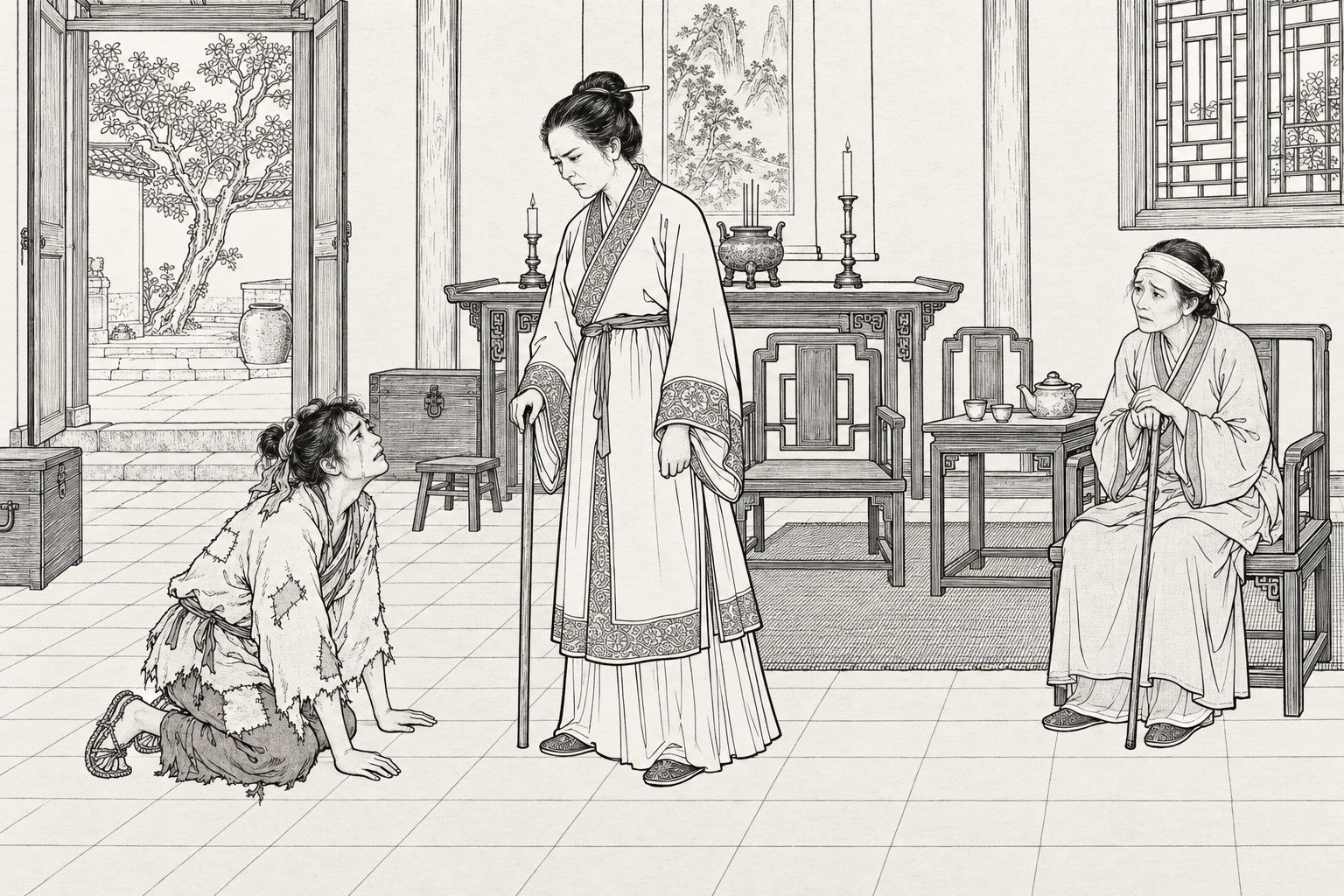
仇仲,晉人,忘其郡邑。值大亂,為寇俘去。二子福、祿俱幼;繼室邵氏,撫雙孤,遺業能溫飽。而歲屢祲,豪強者復凌藉之,遂至食息不保。仲叔尚廉利其嫁,屢勸駕,而邵氏矢志不搖。廉陰券於大姓,欲強奪之;關說已成,而他人不之知也。里人魏名夙狡獪,與仲家積不相能,事事思中傷之。因邵寡,偽造浮言以相敗辱。大姓聞之,惡其不德而止。久之,廉之陰謀與外之飛語,邵漸聞之,冤結胸懷,朝夕隕涕,四體漸以不仁,委身床榻。福甫十六歲,因縫紉無人,遂急為畢姻。婦,姜秀才屺瞻之女,頗稱賢能,百事賴以經紀。由此用漸裕,乃使祿從師讀。魏忌嫉之,而陽與善,頻招福飲,福倚為腹心交。魏乘間告曰:「尊堂病廢,不能理家人生產;弟坐食,一無所操作:賢夫婦何為作牛馬哉!且弟買婦,將大耗金錢。為君計,不如早析,則貧在弟而富在君也。」福歸,謀諸婦;婦咄之。奈魏日以微言相漸漬,福惑焉,直以己意告母。母怒,詬罵之。福益恚,輒視金粟為他人之物也者而委棄之。魏乘機誘與博賭,倉粟漸空,婦知而未敢言。既至糧絕,被母駭問,始以實告。母憤怒而無如何,遂析之。幸姜女賢,旦夕為母執炊,奉事一如平日。福既析,益無顧忌,大肆淫賭。數月間,田產悉償戲債,而母與妻皆不及知。福貲既罄,無所為計,因券妻代貲,而苦無受者。邑人趙閻羅,原漏網之巨盜,武斷一鄉,固不畏福言之食也,慨然假貲。福持去,數日復空。意踟躕,將背券盟。趙橫目相加。福大懼,賺妻付之。魏聞竊喜,急奔告姜,實將傾敗仇也。姜怒,訟興。福懼甚,亡去。姜女至趙家,始知為婿所賣,大哭,但欲覓死。趙初慰諭之,不聽;既而威逼之,益罵;大怒,鞭撻之,終不肯服。因拔笄自刺其喉,急救,已透食管,血溢出。趙急以帛束其項,猶冀從容而挫折焉。明日,拘牒已至,趙行行殊不置意。官驗女傷重,命笞之,隸相顧無敢用刑。官久聞其橫暴,至此益信,大怒,喚家人出,立斃之。姜遂舁女歸。自姜之訟也,邵氏始知福不肖狀,一號幾絕,冥然大漸。祿時年十五,煢煢無以自主。先是,仲有前室女大娘,嫁於遠郡,性剛猛,每歸寧,餽贈不滿其志,輒迕父母,往往以憤去,仲以是怒惡之;又因道遠,遂數載不一存問。邵氏垂危,魏欲使招之來而啟其爭。適有貿販者,與大娘同里,便託寄語大娘,且歆以家之可圖。數日,大娘果與少子至。入門,見幼弟侍病母,景象慘澹,不覺愴惻。因問弟福,祿備告之。大娘聞之,忿氣塞吭,曰:「家無成人,遂任人蹂躪至此!吾家田產,諸賊何得賺去!」因入廚下,爇火炊糜,先供母,而後呼弟及子共啖之。啖已,忿出,詣邑投狀,訟諸博徒。眾懼,斂金賂大娘。大娘受其金而仍訟之。邑令拘甲、乙等,各加杖責,田產殊置不問。大娘憤不已,率子赴郡。郡守最惡博者。大娘力陳孤苦,及諸惡局騙之狀,情詞慷慨。守為之動,判令邑宰追田給主;仍懲仇福,以儆不肖。既歸,邑宰奉令敲比,於是故產盡反。大娘時已久寡,乃遣少子歸,且囑從兄務業,勿得復來。大娘由此止母家,養母教弟,內外有條。母大慰,病漸瘥,家務悉委大娘。里中豪強,少見陵暴,輒握刃登門,侃侃爭論,罔不屈服。居年餘,田產日增。時市藥餌珍肴,餽遺姜女。又見祿漸長成,頻囑媒為之覓姻。魏告人曰:「仇家產業,悉屬大娘,恐將來不可復返矣。」人咸信之,故無肯與論婚者。有范公子子文,家中名園,為晉第一。園中名花夾路,直通內室。或不知而悞入之,值公子私宴,怒執為盜,杖幾死。會清明,祿自塾中歸,魏引與遊遨,遂至園所。魏故與園丁有舊,放令入,周歷亭榭。俄至一處,溪水洶湧,有畫橋朱檻,通一漆門;遙望門內,繁花如錦,蓋即公子內齋也。魏紿之曰:「君請先入,我適欲私焉。」祿信之,尋橋入戶,至一院落,聞女子笑聲。方停步間,一婢出,窺見之,旋踵即返。祿始駭奔。無何,公子出,叱家人綰索逐之。祿大窘,自投溪中。公子反怒為笑,命諸僕引出。見其容裳都雅,便令易其衣履,曳入一亭,詰其姓氏。藹容溫語,意甚親暱。俄趨入內;旋出,笑握祿手,過橋,漸達曩所。祿不解其意,逡巡不敢入。公子強曳入之,見花籬內隱隱有美人窺伺。既坐,則群婢行酒。祿辭曰:「童子無知,悞踐閨闥,得蒙赦宥,已出非望。但願釋令早歸,受恩非淺。」公子不聽。俄頃,肴炙紛紜。祿又起,辭以醉飽,公子捺坐,笑曰:「僕有一樂拍名,若能對之,即放君行。」祿唯唯請教。公子云:「拍名『渾不似』。」祿默思良久,對曰:「銀成『沒奈何』。」公子大笑曰:「真石崇也!」祿殊不解。蓋公子有女名蕙娘,美而知書,日擇良耦。夜夢一人告之曰:「石崇,汝婿也。」問:「何在?」曰:「明日落水矣。」早告父母,共以為異。祿適符夢兆,故邀入內舍,使夫人女輩共覘之也。公子聞對而喜,乃曰:「拍名乃小女所擬,屢思而無其偶,今得屬對,亦有天緣。僕欲以息女奉箕帚;寒舍不乏第宅,更無煩親迎耳。」祿惶然遜謝,且以母病不能入贅為辭。公子姑令歸謀,遂遣圉人負溼衣,送之以馬。既歸告母,母驚為不詳。於是始知魏氏險;然因凶得吉,亦置不仇,但戒子遠絕而已。踰數日,公子又使人致意母,母終不敢應。大娘應之,即倩雙媒納采焉。未幾,祿贅入公子家。年餘游泮,才名籍甚。妻弟長成,敬少弛;祿怒,攜婦而歸。母已杖而能行。頻歲賴大娘經紀,第宅亦頗完好。新婦既歸,婢僕如雲,宛然大家有風焉。魏又見絕,嫉妒益深,恨無瑕之可蹈,乃引旗下逃人誣祿寄貲。國初立法最嚴,祿依令徙口外。范公子上下賄託,僅以蕙娘免行;田產盡沒入官。幸大娘執析產書,銳身告理,新增良沃若如干頃,悉罣福名,母女始得安居。祿自分不返,遂書離婚字付岳家,伶仃自去。行數日,至都北,飯於旅肆。有丐子怔營戶外,貌絕類兄;近致訊詰,果兄。祿因自述,兄弟悲慘。祿解複衣,分數金,囑令歸。福泣受而別。祿至關外,寄將軍帳下為奴。因祿文弱,俾主支籍,與諸僕同棲止。僕輩研問家世,祿悉告之。內一人驚曰:「是吾兒也!」蓋仇仲初為寇家牧馬,後寇投誠,賣仲旗下,時從主屯關外。向祿緬述,始知真為父子,抱首悲哀,一室為之酸辛。已而憤曰:「何物逃東,遂詐吾兒!」因泣告將軍。將軍即命祿攝書記;函致親王,付仲詣都。仲伺車駕出,先投冤狀。親王為之婉轉,遂得昭雪,命地方官贖業歸仇。仲返,父子各喜。祿細問家口,為贖身計。乃知仲入旗下,兩易配而無所出,時方鰥也。祿遂治任返。初,福別弟歸,蒲伏自投。大娘奉母坐堂上,操杖問之:「汝願受扑責,便可姑留;不然,汝田產既盡,亦無汝噉飯之所,請仍去。」福涕泣伏地,願受笞。大娘投杖曰:「賣婦之人,亦不足懲。但宿案未消,再犯首官可耳。」即使人往告姜,姜女罵曰:「我是仇氏何人,而相告耶!」大娘頻述告福而揶揄之,福慚愧不敢出氣。居半年,大娘雖給奉周備,而役同廝養。福操作無怨詞,託以金錢輒不苟。大娘察其無他,乃白母,求姜女復歸。母意其不可復挽。大娘曰:「不然。渠如肯事二主,楚毒豈肯自罹?要不能不有此忿耳。」遂率弟躬往負荊。岳父母誚讓良切。大娘叱使長跪,然後請見姜女。請之再四,堅避不出;大娘搜捉以出。女乃指福唾罵,福慚汗無地自容。姜母始曳令起。大娘請問歸期。女曰:「向受姊惠綦多,今承尊命,豈復有異言?但恐不能保其不再賣也!且恩義已絕,更何顏與黑心無賴子共生活哉?請別營一室,妾往奉事老母,較勝披削足矣。」大娘代白其悔,為翼日之約而別。次朝,以乘輿取歸,母逆於門而跪拜之。女伏地大哭。大娘勸止,置酒為歡,命福坐案側,乃執爵而言曰:「我苦爭者,非自利也。今弟悔過,貞婦復還,請以簿籍交納;我以一身來,仍以一身去耳。」夫婦皆興席改容,羅拜哀泣,大娘乃止。居無何,昭雪之命下,不數日,田宅悉還故主。魏大駭,不知其故,自恨無術可以復施。適西鄰有回祿之變,魏託救焚而往,暗以編菅爇祿第,風又暴作,延燒幾盡;止餘福居兩三屋,舉家依聚其中。未幾祿至,相見悲喜。初,范公子得離書,持商蕙娘。蕙娘痛哭,碎而投諸地。父從其志,不復強。祿歸,聞其未嫁,喜如岳所。公子知其災,欲留之;祿不可,遂辭而退。大娘幸有藏金,出葺敗堵。福負鍤營築,掘見窖鏹,夜與弟共發之,石池盈丈,滿中皆不動尊也。由是鳩工大作,樓舍群起,壯麗擬於世冑。祿感將軍義,備千金往贖父。福請行,因遣健僕輔之以去。祿乃迎蕙娘歸。未幾,父兄同歸,一門歡騰。大娘自居母家,禁子省視,恐人議其私也。父既歸,堅辭欲去。兄弟不忍。父乃析產而三之:子得二,女得一也。大娘固辭。兄弟皆泣曰:「吾等非姊,烏有今日!」大娘乃安之。遣人招子,移家共居焉。或問大娘:「異母兄弟,何遂關切如此?」大娘曰:「知有母而不知有父者,惟禽獸如此耳,豈以人而效之?」福、祿聞之皆流涕。使工人治其第,皆與己等。魏自計十餘年,禍之而益福之,深自愧悔。又仰其富,思交歡之,因以賀仲階進,備物而往。福欲卻之;仲不忍拂,受雞酒焉。雞以布縷縛足,逸入灶;灶火燃布,往棲積薪,僮婢見之而未顧也。俄而薪焚災舍,一家惶駭。幸手指眾多,一時撲滅,而廚中百物俱空矣。兄弟皆謂其物不祥。後值父壽,魏復餽牽羊。卻之不得,繫羊庭樹。夜有僮被僕毆,忿趨樹下,解羊索自經死。兄弟嘆曰:「其福之不如其禍之也!」自是魏雖殷勤,竟不敢受其寸縷,寧厚酬之而已。後魏老,貧而作丐,每周以布粟而德報之。
仇仲,晋人,忘其郡邑。值大乱,为寇俘去。二子福、禄俱幼;继室邵氏,抚双孤,遗业能温饱。而岁屡祲,豪强者复凌借之,遂至食息不保。仲叔尚廉利其嫁,屡劝驾,而邵氏矢志不摇。廉阴券于大姓,欲强夺之;关说已成,而他人不之知也。里人魏名夙狡狯,与仲家积不相能,事事思中伤之。因邵寡,伪造浮言以相败辱。大姓闻之,恶其不德而止。久之,廉之阴谋与外之飞语,邵渐闻之,冤结胸怀,朝夕陨涕,四体渐以不仁,委身床榻。福甫十六岁,因缝纫无人,遂急为毕姻。妇,姜秀才屺瞻之女,颇称贤能,百事赖以经纪。由此用渐裕,乃使禄从师读。魏忌嫉之,而阳与善,频招福饮,福倚为腹心交。魏乘间告曰:「尊堂病废,不能理家人生产;弟坐食,一无所操作:贤夫妇何为作牛马哉!且弟买妇,将大耗金钱。为君计,不如早析,则贫在弟而富在君也。」福归,谋诸妇;妇咄之。奈魏日以微言相渐渍,福惑焉,直以己意告母。母怒,诟骂之。福益恚,辄视金粟为他人之物也者而委弃之。魏乘机诱与博赌,仓粟渐空,妇知而未敢言。既至粮绝,被母骇问,始以实告。母愤怒而无如何,遂析之。幸姜女贤,旦夕为母执炊,奉事一如平日。福既析,益无顾忌,大肆淫赌。数月间,田产悉偿戏债,而母与妻皆不及知。福赀既罄,无所为计,因券妻代赀,而苦无受者。邑人赵阎罗,原漏网之巨盗,武断一乡,固不畏福言之食也,慨然假赀。福持去,数日复空。意踟蹰,将背券盟。赵横目相加。福大惧,赚妻付之。魏闻窃喜,急奔告姜,实将倾败仇也。姜怒,讼兴。福惧甚,亡去。姜女至赵家,始知为婿所卖,大哭,但欲觅死。赵初慰谕之,不听;既而威逼之,益骂;大怒,鞭挞之,终不肯服。因拔笄自刺其喉,急救,已透食管,血溢出。赵急以帛束其项,犹冀从容而挫折焉。明日,拘牒已至,赵行行殊不置意。官验女伤重,命笞之,隶相顾无敢用刑。官久闻其横暴,至此益信,大怒,唤家人出,立毙之。姜遂舁女归。自姜之讼也,邵氏始知福不肖状,一号几绝,冥然大渐。禄时年十五,茕茕无以自主。先是,仲有前室女大娘,嫁于远郡,性刚猛,每归宁,餽赠不满其志,辄迕父母,往往以愤去,仲以是怒恶之;又因道远,遂数载不一存问。邵氏垂危,魏欲使招之来而启其争。适有贸贩者,与大娘同里,便托寄语大娘,且歆以家之可图。数日,大娘果与少子至。入门,见幼弟侍病母,景象惨澹,不觉怆恻。因问弟福,禄备告之。大娘闻之,忿气塞吭,曰:「家无成人,遂任人蹂躏至此!吾家田产,诸贼何得赚去!」因入厨下,爇火炊糜,先供母,而后呼弟及子共啖之。啖已,忿出,诣邑投状,讼诸博徒。众惧,敛金赂大娘。大娘受其金而仍讼之。邑令拘甲、乙等,各加杖责,田产殊置不问。大娘愤不已,率子赴郡。郡守最恶博者。大娘力陈孤苦,及诸恶局骗之状,情词慷慨。守为之动,判令邑宰追田给主;仍惩仇福,以儆不肖。既归,邑宰奉令敲比,于是故产尽反。大娘时已久寡,乃遣少子归,且嘱从兄务业,勿得复来。大娘由此止母家,养母教弟,内外有条。母大慰,病渐瘥,家务悉委大娘。里中豪强,少见陵暴,辄握刃登门,侃侃争论,罔不屈服。居年余,田产日增。时市药饵珍肴,餽遗姜女。又见禄渐长成,频嘱媒为之觅姻。魏告人曰:「仇家产业,悉属大娘,恐将来不可复返矣。」人咸信之,故无肯与论婚者。有范公子子文,家中名园,为晋第一。园中名花夹路,直通内室。或不知而悮入之,值公子私宴,怒执为盗,杖几死。会清明,禄自塾中归,魏引与游遨,遂至园所。魏故与园丁有旧,放令入,周历亭榭。俄至一处,溪水汹涌,有画桥朱槛,通一漆门;遥望门内,繁花如锦,盖即公子内斋也。魏绐之曰:「君请先入,我适欲私焉。」禄信之,寻桥入户,至一院落,闻女子笑声。方停步间,一婢出,窥见之,旋踵即返。禄始骇奔。无何,公子出,叱家人绾索逐之。禄大窘,自投溪中。公子反怒为笑,命诸仆引出。见其容裳都雅,便令易其衣履,曳入一亭,诘其姓氏。蔼容温语,意甚亲暱。俄趋入内;旋出,笑握禄手,过桥,渐达曩所。禄不解其意,逡巡不敢入。公子强曳入之,见花篱内隐隐有美人窥伺。既坐,则群婢行酒。禄辞曰:「童子无知,悮践闺闼,得蒙赦宥,已出非望。但愿释令早归,受恩非浅。」公子不听。俄顷,肴炙纷纭。禄又起,辞以醉饱,公子捺坐,笑曰:「仆有一乐拍名,若能对之,即放君行。」禄唯唯请教。公子云:「拍名『浑不似』。」禄默思良久,对曰:「银成『没奈何』。」公子大笑曰:「真石崇也!」禄殊不解。盖公子有女名蕙娘,美而知书,日择良耦。夜梦一人告之曰:「石崇,汝婿也。」问:「何在?」曰:「明日落水矣。」早告父母,共以为异。禄适符梦兆,故邀入内舍,使夫人女辈共觇之也。公子闻对而喜,乃曰:「拍名乃小女所拟,屡思而无其偶,今得属对,亦有天缘。仆欲以息女奉箕帚;寒舍不乏第宅,更无烦亲迎耳。」禄惶然逊谢,且以母病不能入赘为辞。公子姑令归谋,遂遣圉人负湿衣,送之以马。既归告母,母惊为不详。于是始知魏氏险;然因凶得吉,亦置不仇,但戒子远绝而已。逾数日,公子又使人致意母,母终不敢应。大娘应之,即倩双媒纳采焉。未几,禄赘入公子家。年余游泮,才名籍甚。妻弟长成,敬少弛;禄怒,携妇而归。母已杖而能行。频岁赖大娘经纪,第宅亦颇完好。新妇既归,婢仆如云,宛然大家有风焉。魏又见绝,嫉妒益深,恨无瑕之可蹈,乃引旗下逃人诬禄寄赀。国初立法最严,禄依令徙口外。范公子上下贿托,仅以蕙娘免行;田产尽没入官。幸大娘执析产书,锐身告理,新增良沃若如干顷,悉罣福名,母女始得安居。禄自分不返,遂书离婚字付岳家,伶仃自去。行数日,至都北,饭于旅肆。有丐子怔营户外,貌绝类兄;近致讯诘,果兄。禄因自述,兄弟悲惨。禄解复衣,分数金,嘱令归。福泣受而别。禄至关外,寄将军帐下为奴。因禄文弱,俾主支籍,与诸仆同栖止。仆辈研问家世,禄悉告之。内一人惊曰:「是吾儿也!」盖仇仲初为寇家牧马,后寇投诚,卖仲旗下,时从主屯关外。向禄缅述,始知真为父子,抱首悲哀,一室为之酸辛。已而愤曰:「何物逃东,遂诈吾儿!」因泣告将军。将军即命禄摄书记;函致亲王,付仲诣都。仲伺车驾出,先投冤状。亲王为之婉转,遂得昭雪,命地方官赎业归仇。仲返,父子各喜。禄细问家口,为赎身计。乃知仲入旗下,两易配而无所出,时方鳏也。禄遂治任返。初,福别弟归,蒲伏自投。大娘奉母坐堂上,操杖问之:「汝愿受扑责,便可姑留;不然,汝田产既尽,亦无汝噉饭之所,请仍去。」福涕泣伏地,愿受笞。大娘投杖曰:「卖妇之人,亦不足惩。但宿案未消,再犯首官可耳。」即使人往告姜,姜女骂曰:「我是仇氏何人,而相告耶!」大娘频述告福而揶揄之,福惭愧不敢出气。居半年,大娘虽给奉周备,而役同厮养。福操作无怨词,托以金钱辄不苟。大娘察其无他,乃白母,求姜女复归。母意其不可复挽。大娘曰:「不然。渠如肯事二主,楚毒岂肯自罹?要不能不有此忿耳。」遂率弟躬往负荆。岳父母诮让良切。大娘叱使长跪,然后请见姜女。请之再四,坚避不出;大娘搜捉以出。女乃指福唾骂,福惭汗无地自容。姜母始曳令起。大娘请问归期。女曰:「向受姊惠綦多,今承尊命,岂复有异言?但恐不能保其不再卖也!且恩义已绝,更何颜与黑心无赖子共生活哉?请别营一室,妾往奉事老母,较胜披削足矣。」大娘代白其悔,为翼日之约而别。次朝,以乘舆取归,母逆于门而跪拜之。女伏地大哭。大娘劝止,置酒为欢,命福坐案侧,乃执爵而言曰:「我苦争者,非自利也。今弟悔过,贞妇复还,请以簿籍交纳;我以一身来,仍以一身去耳。」夫妇皆兴席改容,罗拜哀泣,大娘乃止。居无何,昭雪之命下,不数日,田宅悉还故主。魏大骇,不知其故,自恨无术可以复施。适西邻有回禄之变,魏托救焚而往,暗以编菅爇禄第,风又暴作,延烧几尽;止余福居两三屋,举家依聚其中。未几禄至,相见悲喜。初,范公子得离书,持商蕙娘。蕙娘痛哭,碎而投诸地。父从其志,不复强。禄归,闻其未嫁,喜如岳所。公子知其灾,欲留之;禄不可,遂辞而退。大娘幸有藏金,出葺败堵。福负锸营筑,掘见窖镪,夜与弟共发之,石池盈丈,满中皆不动尊也。由是鸠工大作,楼舍群起,壮丽拟于世胄。禄感将军义,备千金往赎父。福请行,因遣健仆辅之以去。禄乃迎蕙娘归。未几,父兄同归,一门欢腾。大娘自居母家,禁子省视,恐人议其私也。父既归,坚辞欲去。兄弟不忍。父乃析产而三之:子得二,女得一也。大娘固辞。兄弟皆泣曰:「吾等非姊,乌有今日!」大娘乃安之。遣人招子,移家共居焉。或问大娘:「异母兄弟,何遂关切如此?」大娘曰:「知有母而不知有父者,惟禽兽如此耳,岂以人而效之?」福、禄闻之皆流涕。使工人治其第,皆与己等。魏自计十余年,祸之而益福之,深自愧悔。又仰其富,思交欢之,因以贺仲阶进,备物而往。福欲却之;仲不忍拂,受鸡酒焉。鸡以布缕缚足,逸入灶;灶火燃布,往栖积薪,僮婢见之而未顾也。俄而薪焚灾舍,一家惶骇。幸手指众多,一时扑灭,而厨中百物俱空矣。兄弟皆谓其物不祥。后值父寿,魏复餽牵羊。却之不得,系羊庭树。夜有僮被仆殴,忿趋树下,解羊索自经死。兄弟叹曰:「其福之不如其祸之也!」自是魏虽殷勤,竟不敢受其寸缕,宁厚酬之而已。后魏老,贫而作丐,每周以布粟而德报之。
Qiu Zhong was a man of Jin; I have forgotten his county. In a time of great disorder he was carried off by bandits. His two sons, Fu and Lu, were both small. His second wife, Mrs. Shao, brought up the two orphans, and what he had left was enough to keep them fed and clothed. But year after year the harvests failed, and the local bullies preyed on them besides, until they could hardly be sure of food from one day to the next. Zhong’s uncle, Shanglian, hoped to profit by marrying her off and kept urging her to remarry, but Mrs. Shao had sworn not to and would not be moved. Shanglian secretly signed a contract with a powerful family, meaning to have her carried off by force. The deal was made, and no one else knew of it. A man of the village named Wei Ming, crafty from the first, had long been on bad terms with Zhong’s family and was always looking for a way to do them harm. Since Mrs. Shao was a widow, he made up idle talk to disgrace her. The powerful family heard it, disliked her for her lack of virtue, and let the matter drop. In time Mrs. Shao came to hear of both Shanglian’s plot and the slanders outside. The wrong lay knotted in her breast. She wept morning and night, her limbs slowly lost their feeling, and she took to her bed. Fu was just sixteen. Since there was no one to do the sewing, they hurried to marry him off. His wife, the daughter of a licentiate named Jiang Qizhan, was known as good and capable, and everything came to depend on her management. From then on they grew a little better off, and Lu was sent to study with a teacher. Wei envied them, but outwardly made friends, often inviting Fu to drink, and Fu came to think of him as his closest friend. Seeing his chance, Wei said, “Your mother is crippled with illness and cannot manage the household’s living. Your brother eats and does no work at all. Why should a worthy couple like you toil like oxen and horses? Besides, when your brother takes a wife, it will cost a great deal of money. If I were you, I’d split the household now. Then the poverty will be his and the wealth yours.” Fu went home and talked it over with his wife; she scolded him. But Wei kept wearing at him day after day with hints, and Fu was led astray. He went straight to his mother and told her what he wanted. She flew into a rage and cursed him. Fu grew more resentful still, and began treating the family’s money and grain as if they belonged to someone else, and throwing them away. Wei seized the moment and lured him into gambling. The granary slowly emptied. His wife knew, but did not dare say anything. When the grain ran out at last and his mother demanded in alarm to know why, she told her the truth. His mother was furious, but there was nothing to be done, so she divided the household. Luckily Jiang’s daughter was good: morning and evening she cooked for her mother-in-law and served her just as before. Once the household was divided, Fu had nothing to hold him back and gave himself up to whoring and gambling. Within a few months all his land had gone to pay his gambling debts, and neither his mother nor his wife knew of it. When his money was gone and he had no other way out, he wrote a contract pledging his wife in place of money, but no one would take her. A man of the county known as Zhao Yama, a great bandit who had slipped through the net, lorded it over the district. He had no fear that Fu would go back on his word, and readily lent him the money. Fu took it away, and in a few days it was gone. He wavered, and thought of breaking the contract. Zhao glared at him. Terrified, Fu tricked his wife into going and handed her over. Wei heard of it and was secretly delighted. He hurried to tell Jiang — in truth, to bring the Qiu family to ruin. Jiang was furious and went to law. Fu, terrified, ran away. Jiang’s daughter arrived at Zhao’s house and only then learned that her husband had sold her. She wept and wailed and wanted only to die. At first Zhao tried to soothe her and reason with her; she would not listen. Then he tried threats; she cursed him all the more. In a rage he whipped her, but she would not give in. She pulled the pin from her hair and stabbed herself in the throat. They rushed to save her, but it had already pierced her gullet, and blood was spilling out. Zhao quickly bound her neck with silk, still hoping to break her in time. The next day the warrant for his arrest arrived, and Zhao swaggered in without a care. The magistrate saw how badly the woman was wounded and ordered Zhao flogged, but the runners looked at one another and none dared lay a hand on him. The magistrate had long heard of his violence, and now he believed it. In a great rage he called out his own household men and had Zhao beaten to death on the spot. Jiang then carried his daughter home. When Jiang brought his suit, Mrs. Shao learned for the first time what a wastrel Fu was. She gave one cry and nearly died, and sank into a stupor, close to the end. Lu was fifteen then, alone, with no one to turn to. Now, Zhong had a daughter by his first wife, Daniang, who had married into a distant prefecture. She was hard and fierce by nature. Whenever she came home to visit, if the gifts she was given were not to her liking, she would quarrel with her parents and often left in anger, and Zhong had come to hate her for it. She lived far away besides, so for several years no one had once sent to ask after her. As Mrs. Shao lay near death, Wei wanted to have Daniang called home to set the family quarrelling. It happened that a peddler came from the same village as Daniang, so Wei asked him to take her a message, tempting her with word that the family property was there for the taking. A few days later, sure enough, Daniang arrived with her younger son. As she came through the door she saw her little brother tending their sick mother. Everything looked bleak, and despite herself she was moved to grief. She asked after her brother Fu, and Lu told her everything. When Daniang heard it, rage stopped her throat. “There is no grown man in the house, so people trample it like this! Our family’s land — how did these thieves come to cheat us of it?” She went into the kitchen, lit a fire and cooked gruel. First she served their mother, then called her brother and her son to eat with her. When they had eaten she went out in a fury to the county seat and filed a complaint against the gamblers. They were frightened and pooled money to bribe her. Daniang took their money and went on with the suit all the same. The county magistrate arrested so-and-so and so-and-so and had each one beaten, but did nothing at all about the land. Still enraged, Daniang took her son to the prefecture. The prefect hated gamblers above all. Daniang laid out in full how helpless and alone they were and how the villains had cheated them, speaking with passion. The prefect was moved, and ordered the county magistrate to recover the land and return it to its owners, and also to punish Qiu Fu as a warning to wastrels. When she came home, the magistrate carried out the order, pressing with the rod, and all the old property came back. Daniang had long been a widow by then. She sent her younger son home and told him to follow his elder brother and tend to the family’s work, and not to come again. From then on Daniang lived in her mother’s house. She looked after her mother and taught her brother, and kept everything in order inside and out. Their mother was greatly comforted, and as she slowly recovered she left all the household business to Daniang. If any bully in the village tried the least bit of violence, Daniang would take a knife in her hand, go to his door and argue it out boldly, and none failed to back down. After a year or so their land was growing every day. She often bought medicines and delicacies and sent them to Jiang’s daughter. Seeing that Lu was growing up, she kept asking matchmakers to find him a wife. Wei told people, “All the Qiu property belongs to Daniang now. I’m afraid it will never come back to them.” Everyone believed him, so no one was willing to talk of a match. There was a Master Fan Ziwen whose family garden was famous, the finest in all Jin. Rare flowers lined its paths right up to the inner rooms. Once a man who did not know wandered in by mistake while Fan was holding a private party; Fan, angry, had him seized as a thief and beaten nearly to death. At the spring festival of Qingming, Lu came home from school, and Wei took him out on a pleasure trip until they came to the garden. Wei was an old acquaintance of the gardener, who let them in, and they went all round the pavilions and terraces. Soon they reached a place where a stream ran fast, with a painted bridge and red railings leading to a lacquered gate. Looking through the gate from a distance, they saw flowers massed like brocade: it was Fan’s inner quarters. Wei tricked him: “You go in first, sir. I need to relieve myself.” Lu believed him, crossed the bridge and went through the gate into a courtyard, where he heard women laughing. As he stopped short, a maid came out, caught sight of him, and turned straight back. Only then did Lu take fright and run. Before long Fan came out and shouted to his men to bring ropes and go after him. Lu, at his wits’ end, threw himself into the stream. Fan’s anger turned to laughter, and he had the servants pull him out. Seeing that the boy’s looks and clothes were elegant, he had him change his clothes and shoes, drew him into a pavilion, and asked his name. His face was kind and his words gentle, and he seemed very friendly. Soon he hurried inside; he came back at once, took Lu’s hand with a smile, crossed the bridge, and brought him by degrees to the place he had been before. Lu did not understand what he meant and hung back, not daring to go in. Fan pulled him in by force. Lu could dimly make out beautiful women peeping at him from behind a hedge of flowers. When they were seated, a crowd of maids served wine. Lu excused himself: “I am an ignorant boy, and I trespassed on the women’s quarters. To be pardoned is already more than I could hope for. If only you would let me go home now, I would be deeply grateful.” Fan would not hear of it. In a moment dish after dish of meat was brought. Lu rose again, saying he had had enough to eat and drink, but Fan pressed him back into his seat. “I have a name from music,” he said with a smile. “If you can match it, I’ll let you go.” Lu respectfully asked to hear it. “The music is named Not-at-All-Alike,” said Fan. Lu thought in silence for a long while, then answered, “The silver is cast as No-Help-for-It.” Fan roared with laughter. “A true Shi Chong!” Lu had no idea what he meant. Fan had a daughter named Huiniang, beautiful and well read, and he was looking every day for a good match for her. One night she dreamed that someone told her, “Shi Chong is your husband.” “Where is he?” she asked. “Tomorrow he will fall into the water.” In the morning she told her parents, and they all thought it strange. Lu happened to fit the dream, so Fan had invited him into the inner rooms for his wife and daughter to have a look at him. Hearing the answer, Fan was delighted. “The line was made up by my daughter,” he said. “She thought about it many times and could find no match for it. Now that you have matched it, that too is a bond made in heaven. I would like to give you my daughter to hold the dustpan and broom for you. My poor home has no lack of rooms, so there is no need even to come and fetch the bride.” Lu, flustered, declined modestly, and said that since his mother was ill he could not marry into the family. Fan told him to go home for now and talk it over, and had a groom carry his wet clothes and see him home on horseback. When he got home and told his mother, she was alarmed and thought it a bad omen. Only then did they understand how treacherous Wei was; but since ill had turned to good fortune, she let it go and did not treat him as an enemy, only warning her son to keep well away from him. A few days later Fan sent someone to put the proposal to the mother, but she still did not dare accept. Daniang accepted it, and at once engaged two matchmakers to send the betrothal gifts. Not long after, Lu married into Fan’s family. After a year or so he entered the county school as a licentiate, and his talent became widely known. When his wife’s younger brother grew up, he showed Lu less respect. Lu was angry and took his wife home. Their mother could walk now with a cane. Thanks to Daniang’s management over the years, the house too was in good repair. Once the new bride arrived, there were maids and servants in crowds, quite the style of a great family. Wei, cut off once more, grew more jealous still, and fretted that there was no flaw to exploit. So he got a runaway from the Banners to accuse Lu falsely of keeping money for him. At the start of the dynasty the law was very harsh, and Lu was banished beyond the Great Wall as the law required. Master Fan bribed high and low, but could only get Huiniang excused from going. All the land was confiscated. Luckily Daniang held the deed dividing the property and boldly went to argue the case: all the good rich land newly added had been registered in Fu’s name, and so mother and daughter could stay at home in peace. Lu reckoned he would never come back, so he wrote a letter of divorce and sent it to his wife’s family, and went off alone. After several days on the road he came north of the capital and stopped to eat at an inn. A beggar was hovering anxiously outside who looked just like his brother. He went closer and questioned him; it was his brother. Lu told his own story, and the two brothers grieved. Lu opened his lined coat, shared out a few taels of silver, and told him to go home. Fu took it weeping, and they parted. Beyond the passes, Lu was taken as a slave into a general’s household. Because Lu was a scholar and not strong, he was put in charge of the accounts and lodged with the other servants. The servants asked about his family, and Lu told them everything. One of them cried out in astonishment, “This is my son!” For Qiu Zhong had first herded horses for the bandits; later the bandits surrendered to the government and sold Zhong into the Banners, and he was now stationed beyond the passes with his master. As he told Lu his story in full, they found they truly were father and son. They held each other and wept, and the whole room was moved. Then Zhong said angrily, “What runaway wretch would dare cheat my son like this!” Weeping, he told the general. The general at once made Lu his acting secretary, and wrote a letter to a prince of the blood, which he sent with Zhong to the capital. Zhong waited for the carriage to come out and was the first to hand in his complaint. The prince spoke for him, and the wrong was set right: the local officials were ordered to buy back the property and return it to the Qiu family. Zhong came back, and father and son rejoiced. Lu asked closely about his father’s household, planning to buy his freedom. He learned that since entering the Banners Zhong had twice been given a wife, had no children, and was now a widower. Lu then packed up and went home. Earlier, when Fu had parted from his brother and come home, he crawled in and gave himself up. Daniang seated their mother in the hall, took up a stick, and asked him, “If you are willing to take a beating, you may stay for now. If not — your land is all gone, and there is nowhere here for you to eat. Please go away again.” Fu lay on the ground weeping and said he would take the beating. Daniang threw down the stick. “A man who sells his wife isn’t even worth punishing. But the old case is still open. Offend again, and I’ll simply report you to the authorities.” At once she sent word to Jiang. Jiang’s daughter cursed: “What am I to the Qius, that you tell me this?” Daniang told Fu what she had said again and again, to mock him, and Fu was too ashamed to breathe a word. Half a year passed. Daniang gave him all he needed, but worked him like a menial. Fu did his work without complaint, and when entrusted with money he was always scrupulous. When Daniang saw that he meant no harm, she spoke to their mother and asked to have Jiang’s daughter brought back. The mother thought there was no winning her back. “Not so,” said Daniang. “If she were willing to serve two masters, would she have brought such torment on herself? It’s only that she can’t help being angry.” So she took her brother in person to beg forgiveness. Fu’s parents-in-law rebuked them bitterly. Daniang ordered Fu to kneel up straight, and then asked to see Jiang’s daughter. She asked again and again, but the girl kept out of sight; Daniang searched for her and dragged her out. Then the girl pointed at Fu, spat and cursed him, and Fu, ashamed and sweating, did not know where to hide himself. Only then did her mother pull him to his feet. Daniang asked when she would come back. “I have received so much kindness from you, sister,” said the girl. “Now that you ask it, how could I say otherwise? But I’m afraid no one can promise he won’t sell me again! Besides, all bond between us is broken. How could I bear to live with that black-hearted scoundrel? Please set up a separate room. I’ll come and serve the old lady. That’s better than shaving my head as a nun, and it’s enough for me.” Daniang told her of Fu’s repentance on his behalf, and they parted, agreeing on the next day. The next morning they fetched her home in a sedan chair. The mother met her at the gate and knelt to her. The girl threw herself on the ground and wept aloud. Daniang calmed them and set out wine to celebrate. She had Fu sit at the side of the table, and raising her cup she said, “I fought so hard, but not for my own gain. Now my brother has mended his ways and his faithful wife has come back, let me hand over the account books. I came alone, and alone I’ll go.” Husband and wife both rose from their seats, their faces changed; they knelt around her, weeping and pleading, and Daniang stayed. Before long the order setting right the wrong came down, and within a few days all the land and houses went back to their old owners. Wei was greatly alarmed and could not make out why, and cursed himself that he had no more tricks to try. Just then a fire broke out at the neighbour’s to the west. Wei went over pretending to help put it out, and secretly set Lu’s house alight with a bundle of plaited grass. Then the wind rose violently, and the fire spread until nearly everything burned. Only Fu’s two or three rooms were left, and the whole family crowded together in them. Soon Lu arrived, and they met with grief and joy. Earlier, when Master Fan received the letter of divorce, he took it to talk it over with Huiniang. Huiniang wept bitterly, tore it to pieces and threw it on the ground. Her father went along with her wishes and did not press her. When Lu came back and heard she had not married again, he went happily to his father-in-law’s. Fan knew of their misfortune and wanted to keep him there; Lu would not stay, and took his leave. Luckily Daniang had money hidden away, and she brought it out to repair the ruined walls. Fu, with a spade on his shoulder, was working on the building when he dug up a buried store of silver. That night he and his brother dug it out together: a stone vault more than ten feet across, filled with “immovables.” With this they hired workmen and built on a grand scale; buildings rose one after another, as splendid as those of old noble houses. Lu, grateful for the general’s kindness, got together a thousand taels to go and buy his father’s freedom. Fu asked to go, so they sent sturdy servants along to help him. Lu then brought Huiniang home. Not long after, father and elder brother came home together, and the whole family was overjoyed. Since coming to live in her mother’s house, Daniang had forbidden her sons to visit her, for fear people would say she was favouring her own. Now that her father was home, she firmly insisted on leaving. Her brothers could not bear it. So their father divided the property into three: the sons got two shares, the daughter one. Daniang firmly refused. Both brothers wept: “If not for you, sister, where would we be today?” So Daniang accepted. She sent for her sons and moved her family to live with them. Someone asked Daniang, “They are your brothers by another mother. Why do you care for them so?” “Only birds and beasts know their mother and not their father,” said Daniang. “Should a human being behave like them?” Fu and Lu wept when they heard it. They had workmen build her a house equal to their own. Wei reckoned that for more than ten years every harm he had done them had only added to their good fortune, and he was deeply ashamed and sorry. He also looked up to their wealth and wanted to be friends, so he used the excuse of congratulating Zhong on his return as a way in, and came with gifts. Fu wanted to refuse them; Zhong could not bear to rebuff him, and accepted a chicken and wine. The chicken’s feet were tied with strips of cloth. It got loose and ran into the stove; the fire caught the cloth, and it went to roost on the woodpile. The servants saw it but paid no attention. Soon the woodpile was burning and the house caught fire, and the whole family was in a panic. Luckily there were many hands, and they put it out at once, but everything in the kitchen was lost. The brothers both said the gift was unlucky. Later, on their father’s birthday, Wei sent a goat on a lead. They could not refuse it, and tied it to a tree in the courtyard. That night a servant boy who had been beaten by another servant went in anger to the tree, untied the goat’s rope, and hanged himself with it. The brothers sighed: “Better he harm us than bless us!” From then on, however attentive Wei was, they never dared accept so much as a thread from him; they would rather pay him back generously. Later, when Wei was old and poor and had become a beggar, they often helped him with cloth and grain, repaying him with kindness.