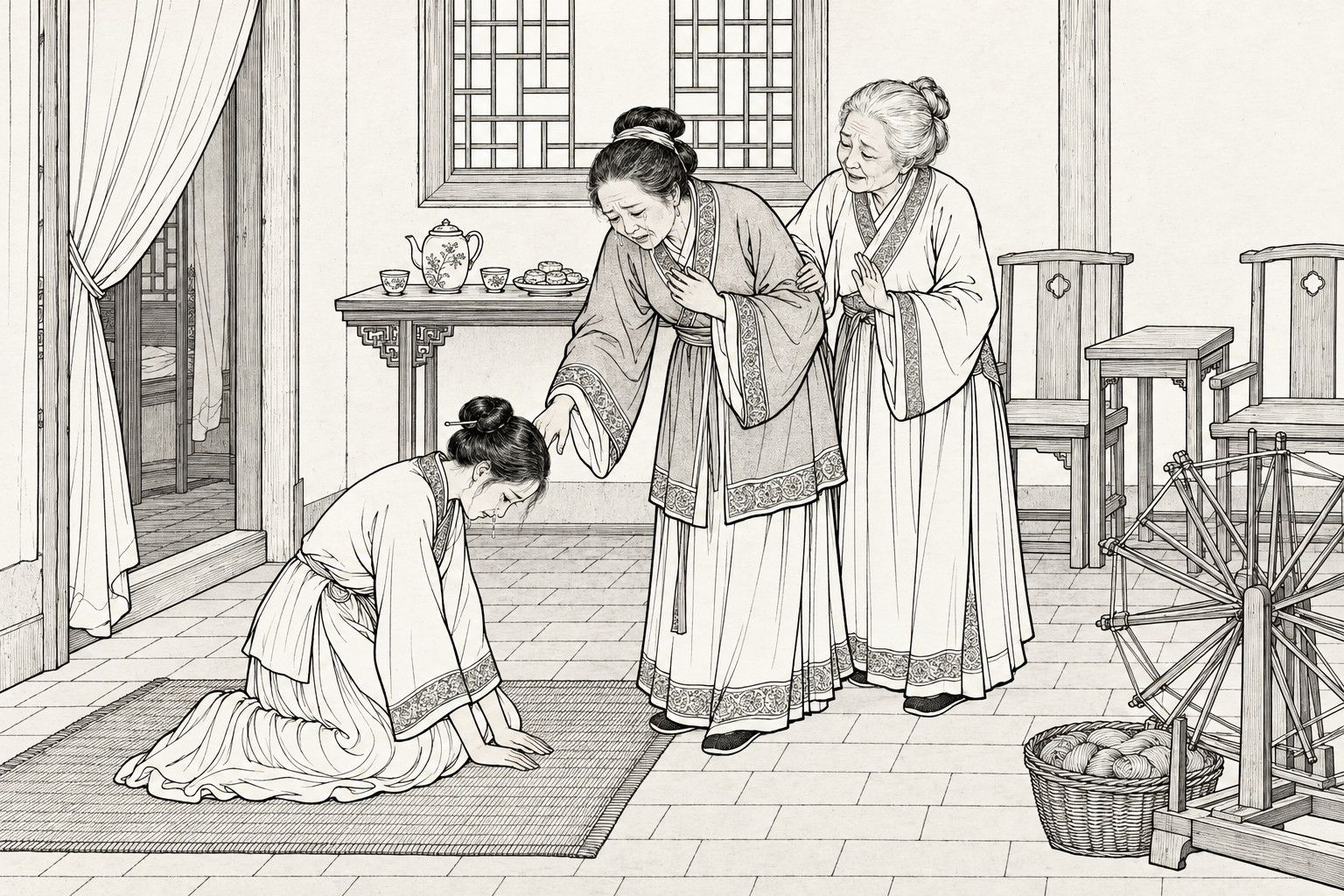
安生大成,重慶人。父孝廉,早卒。弟二成,幼。生娶陳氏,小字珊瑚,性嫻淑。而生母沈,悍謬不仁,遇之虐,珊瑚無怨色。每早旦,靚妝往朝。值生疾,母謂其誨淫,詬責之。珊瑚退,毀妝以進。母益怒,投顙自撾。生素孝,鞭婦,母始少解。自此益憎婦。婦雖奉事惟謹,終不與交一語。生知母怒,亦寄宿他所,示與婦絕。久之,母終不快,觸物類而罵之,意皆在珊瑚。生曰:「娶妻以奉姑嫜,今若此,何以妻為!」遂出珊瑚,使老嫗送諸其家。方出里門,珊瑚泣曰:「為女子不能作婦,歸何以見雙親?不如死!」袖中出翦刀刺喉。急救之,血溢沾衿。扶歸生族嬸家。嬸王氏,寡居無耦,遂止焉。媼歸,生囑隱其情,而心竊恐母知。過數日,探知珊瑚創漸平,登王氏門,使勿留珊瑚。王召之入;不入,但盛氣逐珊瑚。無何,王率珊瑚出,見生,便問:「珊瑚何罪?」生責其不能事母。珊瑚脈脈不作一言,惟俯首嗚泣,淚皆赤,素衫盡染,生慘惻不能盡詞而退。又數日,母已聞之,怒詣王,惡言誚讓。王傲不相下,反數其惡;且言:「婦已出,尚屬安家何人?我自留陳氏女,非留安氏婦也,何煩強與他家事!」母怒甚而窮於詞,又見意氣詾詾,慚沮大哭而返。珊瑚意不自安,思他適。先是,生有母姨于媼,即沈姊也。年六十餘,子死,止一幼孫及寡媳;又嘗善視珊瑚。遂辭王往投媼。媼詰得故,極道妹子昏暴,即欲送之還。珊瑚力言其不可,兼囑勿言,於是與于媼居,類姑婦焉。珊瑚有兩兄,聞而憐之,欲移之歸而嫁之。珊瑚執不肯,惟從于媼紡績以自度。生自出婦,母多方為子謀婚,而悍聲流播,遠近無與為耦。積三四年,二成漸長,遂先為畢姻。二成妻臧姑,驕悍戾沓,尤倍於母。母或怒以色,則臧姑怒以聲。二成又懦,不敢為左右袒。於是母威頓減,莫敢攖,反望色笑而承迎之,猶不能得臧姑懽。臧姑役母若婢;生不敢言,惟身代母操作,滌器灑掃之事皆與焉。母子恆於無人處,相對飲泣。無何,母以鬱積病,委頓在床,便溺轉側皆須生;生晝夜不得寐,兩目盡赤。呼弟代役,甫入門,臧姑輒喚去之。生於是奔告于媼,冀媼臨存。入門,泣且訴。訴未畢,珊瑚自幃中出。生大慚,禁聲欲出。珊瑚以兩手叉扉。生窘急,自肘下沖出而歸,亦不敢以告母。無何,于媼至,母喜止之。由此媼家無日不以人來,來輒以甘旨餉媼。媼寄語寡媳:「此處不餓,後勿復爾。」而家中餽遺,卒無少間。媼不肯少嘗食,緘留以進病者。母病亦漸瘥。媼幼孫又以母命將佳餌來問疾。沈嘆曰:「賢哉婦乎!姊何修者!」媼曰:「妹以去婦何如人?」曰:「嘻!誠不至夫己氏之甚也!然烏如甥婦賢!」媼曰:「婦在,汝不知勞;汝怒,婦不知怨:惡乎弗如?」沈乃泣下,且告之悔,曰:「珊瑚嫁也未者?」答云:「不知,請訪之。」又數日,病良已。媼欲別。沈泣曰:「恐姊去,我仍死耳!」媼乃與生謀,析二成居。二成告臧姑。臧姑不樂,語侵兄,兼及媼。生願以良田悉歸二成,臧姑乃喜。立析產書已,媼始去。明日,以車乘來迎沈。沈至其家,先求見甥婦,極道甥婦德。媼曰:「小女子百善,何遂無一疵?余固能容之。子即有婦如吾婦,恐亦不能享也。」沈曰:「鳴呼冤哉!謂我木石鹿豕耶!具有口鼻,豈有觸香臭而不知者?」媼曰:「被出如珊瑚,不知念子作何語?」曰:「罵之耳。」媼曰:「誠反躬無可罵,亦惡乎而罵之?」曰:「瑕疵人所時有,惟其不能賢,是以知其罵也。」媼曰:「當怨者不怨,則德焉者可知;當去者不去,則撫焉者可知。向之所餽遺而奉事者,固非予婦也,而婦也。」沈驚曰:「如何?」曰:「珊瑚寄此久矣。向之所供,皆渠夜績之所貽也。」沈聞之,泣數行下,曰:「我何以見吾婦矣!」媼乃呼珊瑚。珊瑚含涕而出,伏地下。母慚痛自撾,媼力勸始止,遂為姑媳如初。十餘日偕歸,家中薄田數畝,不足自給,惟恃生以筆耕,婦以針耨。二成稱饒足,然兄不之求,弟亦不之顧也。臧姑以嫂之出也鄙之;嫂亦惡其悍,置不齒。兄弟隔院居。臧姑時有凌虐,一家盡掩其耳。臧姑無所用虐,虐夫及婢。婢一日自經死。婢父訟臧姑,二成代婦質理,大受扑責,仍坐拘臧姑。生上下為之營脫,卒不免。臧姑械十指,肉盡脫。官貪暴,索望良奢。二成質田貸貲,如數納入,始釋歸。而債家責負日亟,不得已,悉以良田鬻於村中任翁。翁以田半屬大成所讓,要生署券。生往,翁忽自言:「我安孝廉也。任某何人,敢市吾業!」又顧生曰:「冥間感汝夫妻孝,故使我暫歸一面。」生出涕曰:「父有靈,急救吾弟!」曰:「逆子悍婦,不足惜也!歸家速辦金,贖吾血產。」生曰:「母子僅自存活,安得多金?」曰:「紫薇樹下有藏金,可以取用。」欲再問之,翁已不語;少時而醒,茫不自知。生歸告母,亦未深信。臧姑已率數人往發窖,坎地四五尺,止見磚石,並無所謂金者,失意而去。生聞其掘藏,戒母及妻勿往視。後知其無所獲,母竊往窺之,見磚石雜土中,遂返。珊瑚繼至,則見土內悉白鏹;呼生往驗之,果然。生以先人所遺,不忍私,召二成均分之。數適得揭取之二,各囊之而歸。二成與臧姑共驗之,啟囊則瓦礫滿中,大駭。疑二成為兄所愚,使二成往窺兄,兄方陳金几上,與母相慶。因實告兄,生亦駭,而心甚憐之,舉金而並賜之。二成乃喜,往酬債訖,甚德兄。臧姑曰:「即此益知兄詐。若非自愧於心,誰肯以瓜分者復讓人乎?」二成疑信半之。次日,債主遣僕來,言所償皆偽金,將執以首官。夫妻皆失色。臧姑曰:「如何哉!我固謂兄賢不至於此,是將以殺汝也!」二成懼,往哀債主,主怒不釋。二成乃券田於主,聽其自售,始得原金而歸。細視之,見斷金二鋌,僅裹真金一韭葉許,中盡銅耳。臧姑因與二成謀:留其斷者,餘仍返諸兄以覘之。且教之言曰:「屢承讓德,實所不忍。薄留二鋌,以見推施之義。所存物產,尚與兄等。余無庸多田也,業已棄之,贖否在兄。」生不知其意,固讓之。二成辭甚決,生乃受。稱之,少五兩餘。命珊瑚質匳妝以滿其數,攜付債主。主疑似舊金,以翦刀斷驗之,紋色俱足,無少差謬,遂收金,與生易券。二成還金後,意其必有參差;既聞舊業已贖,大奇之。臧姑疑發掘時,兄先隱其真金,忿詣兄所,責數詬厲。生乃悟返金之故。珊瑚逆而笑曰:「產固在耳,何怒為?」使生出券付之。二成一夜夢父責之曰:「汝不孝不弟,冥限已迫,寸土皆非己有,占賴將以奚為!」醒告臧姑,欲以田歸兄。臧姑嗤其愚。是時二成有兩男,長七歲,次三歲。無何,長男病痘死。臧姑始懼,使二成退券於兄,言之再三,生不受。未幾,次男又死。臧姑益懼,自以券置嫂所。春將盡,田蕪穢不耕,生不得已,種治之。臧姑自此改行,定省如孝子,敬嫂亦至。未半年而母病卒。臧姑哭之慟,至勺飲不入口。向人曰:「姑早死,使我不得事,是天不許我自贖也!」產十胎皆不育,遂以兄子為子。夫妻皆壽終。生三子,皆舉進士。人以為孝友之報云。
安生大成,重庆人。父孝廉,早卒。弟二成,幼。生娶陈氏,小字珊瑚,性娴淑。而生母沈,悍谬不仁,遇之虐,珊瑚无怨色。每早旦,靓妆往朝。值生疾,母谓其诲淫,诟责之。珊瑚退,毁妆以进。母益怒,投颡自挝。生素孝,鞭妇,母始少解。自此益憎妇。妇虽奉事惟谨,终不与交一语。生知母怒,亦寄宿他所,示与妇绝。久之,母终不快,触物类而骂之,意皆在珊瑚。生曰:「娶妻以奉姑嫜,今若此,何以妻为!」遂出珊瑚,使老妪送诸其家。方出里门,珊瑚泣曰:「为女子不能作妇,归何以见双亲?不如死!」袖中出翦刀刺喉。急救之,血溢沾衿。扶归生族婶家。婶王氏,寡居无耦,遂止焉。媪归,生嘱隐其情,而心窃恐母知。过数日,探知珊瑚创渐平,登王氏门,使勿留珊瑚。王召之入;不入,但盛气逐珊瑚。无何,王率珊瑚出,见生,便问:「珊瑚何罪?」生责其不能事母。珊瑚脉脉不作一言,惟俯首呜泣,泪皆赤,素衫尽染,生惨恻不能尽词而退。又数日,母已闻之,怒诣王,恶言诮让。王傲不相下,反数其恶;且言:「妇已出,尚属安家何人?我自留陈氏女,非留安氏妇也,何烦强与他家事!」母怒甚而穷于词,又见意气詾詾,惭沮大哭而返。珊瑚意不自安,思他适。先是,生有母姨于媪,即沈姊也。年六十余,子死,止一幼孙及寡媳;又尝善视珊瑚。遂辞王往投媪。媪诘得故,极道妹子昏暴,即欲送之还。珊瑚力言其不可,兼嘱勿言,于是与于媪居,类姑妇焉。珊瑚有两兄,闻而怜之,欲移之归而嫁之。珊瑚执不肯,惟从于媪纺绩以自度。生自出妇,母多方为子谋婚,而悍声流播,远近无与为耦。积三四年,二成渐长,遂先为毕姻。二成妻臧姑,骄悍戾沓,尤倍于母。母或怒以色,则臧姑怒以声。二成又懦,不敢为左右袒。于是母威顿减,莫敢撄,反望色笑而承迎之,犹不能得臧姑懽。臧姑役母若婢;生不敢言,惟身代母操作,涤器洒扫之事皆与焉。母子恒于无人处,相对饮泣。无何,母以郁积病,委顿在床,便溺转侧皆须生;生昼夜不得寐,两目尽赤。呼弟代役,甫入门,臧姑辄唤去之。生于是奔告于媪,冀媪临存。入门,泣且诉。诉未毕,珊瑚自帏中出。生大惭,禁声欲出。珊瑚以两手叉扉。生窘急,自肘下冲出而归,亦不敢以告母。无何,于媪至,母喜止之。由此媪家无日不以人来,来辄以甘旨饷媪。媪寄语寡媳:「此处不饿,后勿复尔。」而家中餽遗,卒无少间。媪不肯少尝食,缄留以进病者。母病亦渐瘥。媪幼孙又以母命将佳饵来问疾。沈叹曰:「贤哉妇乎!姊何修者!」媪曰:「妹以去妇何如人?」曰:「嘻!诚不至夫己氏之甚也!然乌如甥妇贤!」媪曰:「妇在,汝不知劳;汝怒,妇不知怨:恶乎弗如?」沈乃泣下,且告之悔,曰:「珊瑚嫁也未者?」答云:「不知,请访之。」又数日,病良已。媪欲别。沈泣曰:「恐姊去,我仍死耳!」媪乃与生谋,析二成居。二成告臧姑。臧姑不乐,语侵兄,兼及媪。生愿以良田悉归二成,臧姑乃喜。立析产书已,媪始去。明日,以车乘来迎沈。沈至其家,先求见甥妇,极道甥妇德。媪曰:「小女子百善,何遂无一疵?余固能容之。子即有妇如吾妇,恐亦不能享也。」沈曰:「鸣呼冤哉!谓我木石鹿豕耶!具有口鼻,岂有触香臭而不知者?」媪曰:「被出如珊瑚,不知念子作何语?」曰:「骂之耳。」媪曰:「诚反躬无可骂,亦恶乎而骂之?」曰:「瑕疵人所时有,惟其不能贤,是以知其骂也。」媪曰:「当怨者不怨,则德焉者可知;当去者不去,则抚焉者可知。向之所餽遗而奉事者,固非予妇也,而妇也。」沈惊曰:「如何?」曰:「珊瑚寄此久矣。向之所供,皆渠夜绩之所贻也。」沈闻之,泣数行下,曰:「我何以见吾妇矣!」媪乃呼珊瑚。珊瑚含涕而出,伏地下。母惭痛自挝,媪力劝始止,遂为姑媳如初。十余日偕归,家中薄田数亩,不足自给,惟恃生以笔耕,妇以针耨。二成称饶足,然兄不之求,弟亦不之顾也。臧姑以嫂之出也鄙之;嫂亦恶其悍,置不齿。兄弟隔院居。臧姑时有凌虐,一家尽掩其耳。臧姑无所用虐,虐夫及婢。婢一日自经死。婢父讼臧姑,二成代妇质理,大受扑责,仍坐拘臧姑。生上下为之营脱,卒不免。臧姑械十指,肉尽脱。官贪暴,索望良奢。二成质田贷赀,如数纳入,始释归。而债家责负日亟,不得已,悉以良田鬻于村中任翁。翁以田半属大成所让,要生署券。生往,翁忽自言:「我安孝廉也。任某何人,敢市吾业!」又顾生曰:「冥间感汝夫妻孝,故使我暂归一面。」生出涕曰:「父有灵,急救吾弟!」曰:「逆子悍妇,不足惜也!归家速办金,赎吾血产。」生曰:「母子仅自存活,安得多金?」曰:「紫薇树下有藏金,可以取用。」欲再问之,翁已不语;少时而醒,茫不自知。生归告母,亦未深信。臧姑已率数人往发窖,坎地四五尺,止见砖石,并无所谓金者,失意而去。生闻其掘藏,戒母及妻勿往视。后知其无所获,母窃往窥之,见砖石杂土中,遂返。珊瑚继至,则见土内悉白镪;呼生往验之,果然。生以先人所遗,不忍私,召二成均分之。数适得揭取之二,各囊之而归。二成与臧姑共验之,启囊则瓦砾满中,大骇。疑二成为兄所愚,使二成往窥兄,兄方陈金几上,与母相庆。因实告兄,生亦骇,而心甚怜之,举金而并赐之。二成乃喜,往酬债讫,甚德兄。臧姑曰:「即此益知兄诈。若非自愧于心,谁肯以瓜分者复让人乎?」二成疑信半之。次日,债主遣仆来,言所偿皆伪金,将执以首官。夫妻皆失色。臧姑曰:「如何哉!我固谓兄贤不至于此,是将以杀汝也!」二成惧,往哀债主,主怒不释。二成乃券田于主,听其自售,始得原金而归。细视之,见断金二铤,仅裹真金一韭叶许,中尽铜耳。臧姑因与二成谋:留其断者,余仍返诸兄以觇之。且教之言曰:「屡承让德,实所不忍。薄留二铤,以见推施之义。所存物产,尚与兄等。余无庸多田也,业已弃之,赎否在兄。」生不知其意,固让之。二成辞甚决,生乃受。称之,少五两余。命珊瑚质匳妆以满其数,携付债主。主疑似旧金,以翦刀断验之,纹色俱足,无少差谬,遂收金,与生易券。二成还金后,意其必有参差;既闻旧业已赎,大奇之。臧姑疑发掘时,兄先隐其真金,忿诣兄所,责数诟厉。生乃悟返金之故。珊瑚逆而笑曰:「产固在耳,何怒为?」使生出券付之。二成一夜梦父责之曰:「汝不孝不弟,冥限已迫,寸土皆非己有,占赖将以奚为!」醒告臧姑,欲以田归兄。臧姑嗤其愚。是时二成有两男,长七岁,次三岁。无何,长男病痘死。臧姑始惧,使二成退券于兄,言之再三,生不受。未几,次男又死。臧姑益惧,自以券置嫂所。春将尽,田芜秽不耕,生不得已,种治之。臧姑自此改行,定省如孝子,敬嫂亦至。未半年而母病卒。臧姑哭之恸,至勺饮不入口。向人曰:「姑早死,使我不得事,是天不许我自赎也!」产十胎皆不育,遂以兄子为子。夫妻皆寿终。生三子,皆举进士。人以为孝友之报云。
An Dacheng was a scholar of Chongqing. His father, a provincial graduate, had died young, and his younger brother, Ercheng, was still a child. An married a girl of the Chen family whose childhood name was Shanhu. She was gentle and good. But An’s mother, née Shen, was shrewish, perverse and unkind. She treated Shanhu cruelly, and Shanhu never showed resentment. Every morning Shanhu made herself up and went to pay her respects. Once, when An was ill, his mother said she was painting herself to lead him into lewdness, and scolded her. Shanhu withdrew, took off her make-up and came back. His mother grew angrier still, knocking her head on the ground and beating herself. An had always been a dutiful son. He whipped his wife, and only then was his mother somewhat appeased. From then on she hated the girl all the more. Though Shanhu served her with the utmost care, she would never speak a word to her. Knowing his mother was angry, An too slept elsewhere, to show he had broken with his wife. Time passed, and still his mother was not pleased. She cursed at anything that came her way, and all of it was meant for Shanhu. “A man takes a wife to wait on his parents,” said An. “If it is like this, what use is a wife?” So he divorced Shanhu and had an old woman take her back to her family. They had just gone out of the village gate when Shanhu said, weeping, “A woman who cannot be a wife — how can I go home and face my parents? Better to die!” She took scissors from her sleeve and stabbed her throat. The old woman rushed to save her, but blood welled out and soaked her collar. She helped her to the house of An’s clan aunt, Mrs. Wang, a widow who lived alone, and there Shanhu stayed. When the old woman came back, An told her to keep it quiet, but secretly he was afraid his mother would find out. Some days later, learning that Shanhu’s wound was healing, he went to Mrs. Wang’s door and told her not to keep Shanhu. Mrs. Wang asked him in. He would not come in, but angrily demanded that Shanhu be sent away. Before long Mrs. Wang came out with Shanhu. Seeing An, she asked straight off, “What has Shanhu done wrong?” An charged her with failing to serve his mother. Shanhu gazed at him without a word, only hung her head and sobbed. Her tears were all red, and her white jacket was stained through. An was so stricken that he could not finish what he had to say, and left. A few days later his mother heard of it. She went to Mrs. Wang in a rage and berated her. Mrs. Wang proudly refused to give an inch, and listed the mother’s own wrongs back at her. “The girl has been divorced,” she said. “What is she to the An family now? I am keeping a daughter of the Chens, not a wife of the Ans. Why should you go poking into other families’ business?” The mother was furious but at a loss for words; and seeing how fierce Mrs. Wang was, she went home ashamed and crushed, wailing. Shanhu felt uneasy staying there and thought of going elsewhere. Now An had an aunt on his mother’s side, old Mrs. Yu, Mrs. Shen’s elder sister. She was over sixty; her son had died, leaving her only a young grandson and her widowed daughter-in-law. She had always been kind to Shanhu. So Shanhu took leave of Mrs. Wang and went to her. The old woman questioned her and got the story. She railed at her sister for a muddle-headed brute and wanted to take Shanhu straight back. Shanhu insisted it would not do, and begged her to say nothing. So she lived with old Mrs. Yu, much like a daughter-in-law with her mother-in-law. Shanhu had two elder brothers. Hearing of this, they pitied her and wanted to bring her home and marry her off again. Shanhu would not have it, and supported herself by spinning and weaving with old Mrs. Yu. After An divorced his wife, his mother tried every way to find him another match, but her name as a shrew had spread, and no one near or far would marry into the family. Three or four years went by. Ercheng was growing up, so they married him off first. Ercheng’s wife, Zanggu, was arrogant, fierce, perverse and quarrelsome — twice as bad as the mother. If the mother showed anger in her face, Zanggu showed it in her voice. Ercheng, moreover, was a weakling and dared not take either side. So the mother’s authority crumbled at once. No one dared cross Zanggu; instead the mother watched her face for a smile and fawned on her, and still she could not please her. Zanggu worked the mother like a maid. An dared not say anything; he could only do the work in his mother’s place, washing the dishes, sprinkling and sweeping and all. Mother and son would often weep quietly together where no one could see. Before long the mother fell ill from pent-up grief and lay helpless in bed. She needed An to relieve herself and to turn over. Day and night he got no sleep, until both his eyes were red. He called his brother to take a turn, but Ercheng had no sooner come in the door than Zanggu called him away. So An ran to old Mrs. Yu, hoping she would come and look in on his mother. He came in weeping and poured out his troubles. Before he had finished, Shanhu came out from behind the curtain. An, deeply ashamed, fell silent and made to leave. Shanhu barred the door with both hands. In desperation An ducked under her elbow, dashed out and went home. He did not dare tell his mother either. Before long old Mrs. Yu arrived, and the mother gladly kept her there. From then on not a day passed without someone coming from old Mrs. Yu’s house, and each time they brought her delicacies. Old Mrs. Yu sent word to her widowed daughter-in-law: “I am not starving here. Do not do this any more.” But the gifts from home never stopped for a single day. The old woman would not taste a bite of them, but kept them all for the invalid, and the mother gradually got better. Old Mrs. Yu’s little grandson also came, at his mother’s bidding, with fine cakes, to ask after the invalid. Mrs. Shen sighed. “What a good daughter-in-law! Sister, what merit you must have stored up!” “And your divorced daughter-in-law, sister,” said old Mrs. Yu, “what sort of person did you think her?” “Ah! She was certainly not as bad as that so-and-so,” said Mrs. Shen. “But how could she be as good as my nephew’s wife?” “When she was with you,” said old Mrs. Yu, “you never knew what work was; when you were angry, she never knew what resentment was. How is she not as good?” At this Mrs. Shen wept, and told her sister she was sorry. “Has Shanhu married again?” she asked. “I don’t know,” said old Mrs. Yu. “Let me find out.” After a few more days Mrs. Shen was quite well, and old Mrs. Yu wanted to leave. “I am afraid if you go, sister, I will die after all,” said Mrs. Shen, weeping. So old Mrs. Yu and An agreed to set Ercheng up in a separate household. Ercheng told Zanggu. She was displeased and said insulting things about her brother-in-law, and about the old woman too. An offered to give all the good land to Ercheng, and then Zanggu was pleased. Only when the deed dividing the property had been drawn up did old Mrs. Yu leave. The next day she sent a carriage for Mrs. Shen. When Mrs. Shen arrived, the first thing she asked was to see her nephew’s wife, and she praised the woman’s virtues to the skies. “The girl has a hundred good points,” said old Mrs. Yu, “but how could she be without a single flaw? It is just that I can put up with them. Even if you had a daughter-in-law like mine, I am afraid you could not enjoy her.” “Oh, how unjust!” said Mrs. Shen. “Do you take me for wood or stone, a deer or a pig? I have a mouth and a nose like anyone — how could I not know fragrance from stench?” “When someone like Shanhu is put out of the house,” said old Mrs. Yu, “what do you suppose she says when she thinks of you?” “She curses me, no doubt.” “If you look into yourself and truly find nothing to curse,” said old Mrs. Yu, “why would she curse you?” “Everyone has faults at times,” said Mrs. Shen. “It is only because she was not good that I know she curses me.” “When one who has every reason to resent you does not,” said old Mrs. Yu, “you can tell how much goodness is in her. When one who has every reason to leave you does not, you can tell how devoted she is. The one who has been sending those gifts and serving you all this time was not my daughter-in-law. It was yours.” “What do you mean?” said Mrs. Shen, startled. “Shanhu has been living here a long time. Everything you were given came from her spinning at night.” Hearing this, Mrs. Shen wept streams of tears. “How can I face my daughter-in-law?” Old Mrs. Yu called Shanhu, who came out with tears in her eyes and prostrated herself on the ground. The mother, in shame and anguish, beat herself, and only stopped when old Mrs. Yu begged her hard. And so they were mother-in-law and daughter-in-law again, as before. After ten days or so they went home together. The family had only a few mu of poor land, not enough to live on, and depended on An ploughing with his brush and his wife hoeing with her needle. Ercheng was well enough off, but the elder brother asked nothing of him, and the younger gave him no thought. Zanggu despised her sister-in-law for having once been divorced; her sister-in-law, for her part, loathed Zanggu’s shrewishness and would have nothing to do with her. The brothers lived on opposite sides of a courtyard. Zanggu was given to fits of bullying, but the whole family simply stopped their ears. With no one else to vent her cruelty on, she turned it on her husband and her maid. One day the maid hanged herself. The maid’s father brought a suit against Zanggu. Ercheng answered the charge in his wife’s place and was soundly beaten for it, but Zanggu was arrested all the same. An went to everyone, high and low, to get her off, but in the end it was no use. Zanggu’s ten fingers were put in the finger-press, and the flesh came clean off them. The magistrate was greedy and cruel and expected a large bribe. Ercheng mortgaged his land and borrowed money, paid in the full sum, and only then was she released and sent home. But his creditors pressed harder every day, and he had no choice but to sell all his good land to an old man named Ren in the village. Because half the land had been ceded by Dacheng, old Ren insisted that An sign the deed. An went. Suddenly the old man said, “I am Provincial Graduate An. Who is this Ren, that he dares buy my estate?” Then he turned to An. “The underworld was moved by the filial piety of you and your wife, so they have let me come back for a moment to see you.” An burst into tears. “Father, if your spirit is here, save my brother, quickly!” “An unfilial son and a shrew of a wife — they are not worth pitying. Go home and get money together quickly, and buy back the land I sweated blood for.” “Mother and I barely keep ourselves alive,” said An. “Where would I get so much money?” “There is silver buried under the crape myrtle. You may dig it up and use it.” An wanted to ask more, but the old man had fallen silent. A little later he came to himself, with no idea what had happened. An went home and told his mother, but they did not set much store by it. Zanggu, though, had already taken several men to dig up the hoard. They dug four or five feet down and found only bricks and stones, no silver at all, and went away disappointed. When An heard she had been digging, he warned his mother and wife not to go and look. Later, learning she had found nothing, his mother stole over for a look, saw bricks and stones mixed in the earth, and came back. Then Shanhu went, and she saw that the earth was full of silver ingots. She called An to come and see, and it was true. Because it had been left by their father, An could not bear to keep it for himself, and called Ercheng to share it equally. The total was exactly twice the amount Ercheng had borrowed; they divided it equally; they each put their share in a bag and went home. Ercheng and Zanggu examined theirs together. When they opened the bag it was full of broken tiles and gravel. They were aghast. Suspecting that Ercheng had been duped by his brother, Zanggu sent him to spy on An. An was just laying out the silver on the table and rejoicing with his mother. So Ercheng told his brother the truth. An was astonished too, but he felt very sorry for him and gave him all the silver. Ercheng was delighted. He went and paid off his debts, and was very grateful to his brother. Zanggu said, “This only proves your brother is a cheat. If he did not have a guilty conscience, who would hand over his own share to someone else?” Ercheng half believed her and half did not. Next day the creditor sent a servant to say the silver they had paid him was all counterfeit, and he was going to take them before the magistrate. Husband and wife both turned pale. “What did I tell you?” said Zanggu. “I always said your brother was not as good as all that. He means to kill you!” Ercheng was frightened. He went and begged the creditor, but the man was angry and would not let it go. So Ercheng signed his land over to him, to sell as he pleased, and only then got the original silver back and went home. Looking at it closely, he found two ingots that had been cut open: they had only a skin of real silver the thickness of a chive leaf, and inside was nothing but copper. So Zanggu laid a plan with Ercheng: keep the cut ingots and give the rest back to his brother, to see what he would do. And she taught him what to say: “You have yielded to me so generously, so many times, I really cannot bear it. I am keeping just two ingots, as a token of your kindness in sharing. What property I have left is still as much as yours. I have no need of more land; I have already given it up. Whether to redeem it is up to you.” An did not see what he meant, and pressed him to keep the silver. Ercheng refused very firmly, so An accepted. When he weighed it, it was over five taels short. He had Shanhu pawn her dowry things to make up the sum, and took it to the creditor. The creditor suspected it was the same silver as before. He cut it with shears to test it: grain and colour were both full and true, without the slightest flaw. So he took the silver and exchanged the deed with An. After returning the silver, Ercheng had expected something would go wrong. When he heard the old land had been redeemed, he was amazed. Zanggu suspected that An had hidden away the real silver when it was dug up. She stormed over to his house and cursed and railed at him. Only then did An understand why the silver had been returned. Shanhu met her with a smile. “The land is still there. Why be angry?” And she had An bring out the deed and give it to her. One night Ercheng dreamed that his father rebuked him: “You are no good son and no good brother. Your days on the underworld’s reckoning are nearly up. Not an inch of land is yours. What use is it to grab and cling?” Waking, he told Zanggu and wanted to give the land back to his brother. Zanggu laughed at him for a fool. At that time Ercheng had two sons, the elder seven, the younger three. Before long the elder died of smallpox. Now Zanggu began to be afraid, and had Ercheng take the deed back to his brother. He urged it again and again, but An would not accept. Not long after, the younger son died too. Zanggu, more frightened still, took the deed herself and left it with her sister-in-law. Spring was nearly over and the fields lay weedy and unploughed, so An had no choice but to plant and tend them. From then on Zanggu mended her ways. She waited on her mother-in-law morning and evening like a dutiful child, and was all respect to her sister-in-law. Less than half a year later the mother fell ill and died. Zanggu mourned her bitterly, until she could not take even a spoonful of water. She told people, “My mother-in-law died too soon, before I could serve her. Heaven will not let me redeem myself!” She bore ten children, and none of them lived, so they adopted one of An’s sons as their own. Husband and wife both lived out their full span. An had three sons, and all of them passed the jinshi examination. People said it was the reward for filial piety and brotherly love.