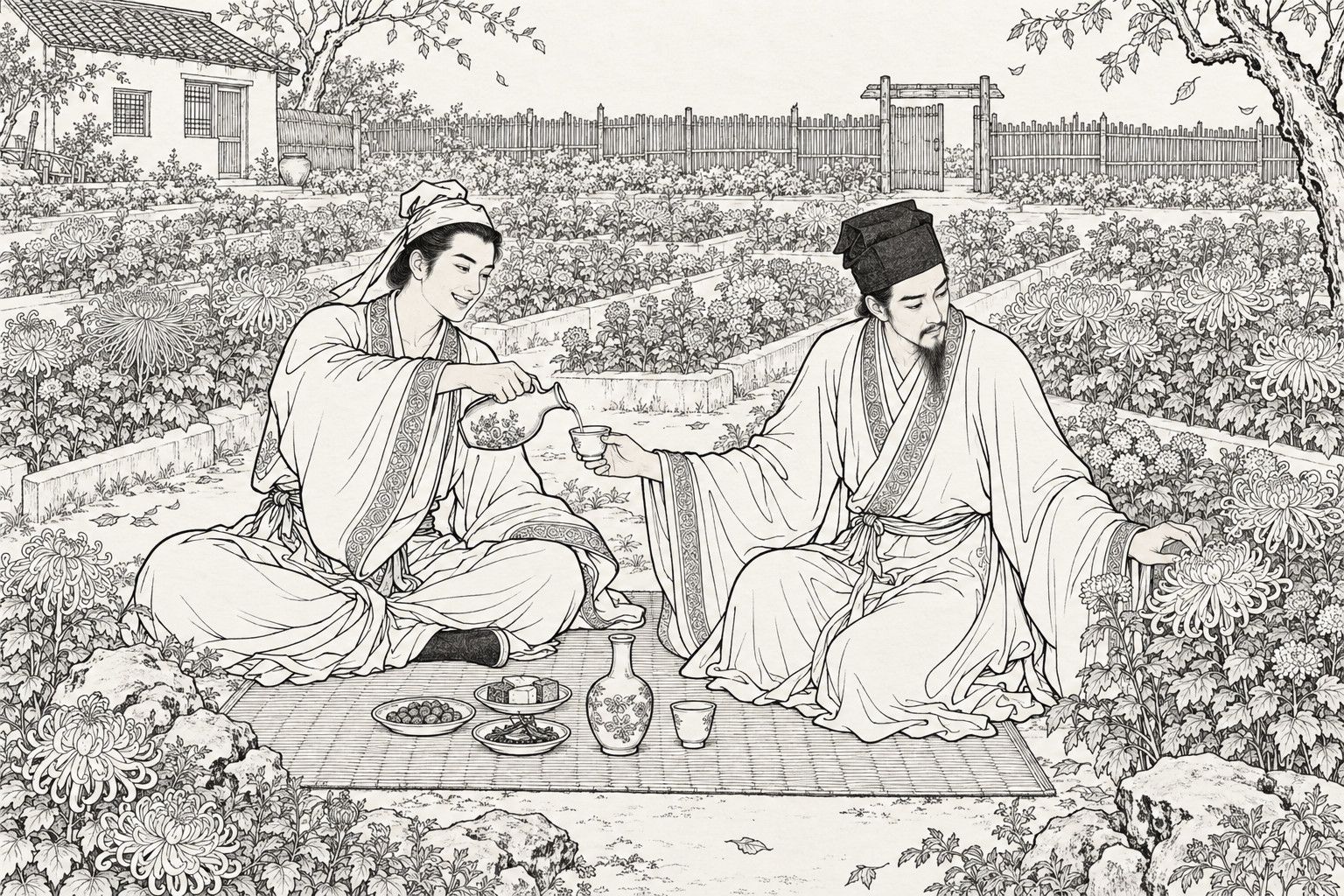
馬子才,順天人。世好菊,至才尤甚,聞有佳種,必購之,千里不憚。一日,有金陵客寓其家,自言其中表親有一二種,為北方所無。馬欣動,即刻治裝,從客至金陵。客多方為之營求,得兩芽,裹藏如寶。歸至中途,遇一少年,跨蹇從油碧車,丰姿灑落。漸近與語。少年自言:「陶姓。」談言騷雅。因問馬所自來,實告之。少年曰:「種無不佳,培溉在人。」因與論藝菊之法。馬大悅,問:「將何往?」答云:「姊厭金陵,欲卜居於河朔耳。」馬欣然曰:「僕雖固貧,茅廬可以寄榻。不嫌荒陋,無煩他適。」陶趨車前,向姊咨稟。車中人推簾語,乃二十許絕世美人也。顧弟言:「屋不厭卑,而院宜得廣。」馬代諾之,遂與俱歸。第南有荒圃,僅小室三四椽,陶喜,居之。日過北院,為馬治菊。菊已枯,拔根再植之,無不活。然家清貧,陶日與馬共食飲,而察其家似不舉火。馬妻呂,亦愛陶姊,不時以升斗餽卹之。陶姊小字黃英,雅善談,輒過呂所,與共紉績。陶一日謂馬曰:「君家固不豐,僕日以口腹累知交,胡可為常。為今計,賣菊亦足謀生。」馬素介,聞陶言,甚鄙之,曰:「僕以君風流高士,當能安貧;今作是論,則以東籬為市井,有辱黃花矣。」陶笑曰:「自食其力不為貪,販花為業不為俗。人固不可苟求富,然亦不必務求貧也。」馬不語,陶起而出。自是,馬所棄殘枝劣種,陶悉掇拾而去。由此不復就馬寢食,招之始一至。未幾,菊將開,聞其門囂喧如市。怪之,過而窺焉,見市人買花者,車載肩負,道相屬也。其花皆異種,目所未睹。心厭其貪,欲與絕;而又恨其私祕佳本,遂款其扉,將就誚讓。陶出,握手曳入。見荒庭半畝皆菊畦,數椽之外無曠土。斸去者,則折別枝插補之;其蓓蕾在畦者,罔不佳妙:而細認之,皆向所拔棄也。陶入屋,出酒饌,設席畦側,曰:「僕貧不能守清戒,連朝幸得微貲,頗足供醉。」少間,房中呼「三郎」,陶諾而去。俄獻佳肴,烹飪良精。因問:「貴姊胡以不字?」答云:「時未至。」問:「何時?」曰:「四十三月。」又詰:「何說?」但笑不言,盡歡始散。過宿,又詣之,新插者已盈尺矣。大奇之,苦求其術。陶曰:「此固非可言傳;且君不以謀生,焉用此?」又數日,門庭略寂,陶乃以蒲席包菊,捆載數車而去。踰歲,春將半,始載南中異卉而歸,於都中設花肆,十日盡售,復歸藝菊。問之去年買花者,留其根,次年盡變而劣,乃復購於陶。陶由此日富:一年增舍,二年起夏屋。興作從心,更不謀諸主人。漸而舊日花畦,盡為廊舍。更於牆外買田一區,築墉四周,悉種菊。至秋,載花去,春盡不歸。而馬妻病卒。意屬黃英,微使人風示之。黃英微笑,意似允許,惟專候陶歸而已。年餘,陶竟不至。黃英課僕種菊,一如陶。得金益合商賈,村外治膏田二十頃,甲第益壯。忽有客自東粵來,寄陶生函信,發之,則囑姊歸馬。考其寄書之日,即妻死之日;回憶園中之飲,適四十三月也,大奇之。以書示英,請問「致聘何所」。英辭不受采。又以故居陋,欲使就南第居,若贅焉。馬不可,擇日行親迎禮。黃英既適馬,於間壁開扉通南第,日過課其僕。馬恥以妻富,恆囑黃英作南北籍,以防淆亂。而家所須,黃英輒取諸南第。不半歲,家中觸類皆陶家物。馬立遣人一一齎還之,戒勿復取。未浹旬,又雜之。凡數更,馬不勝煩。黃英笑曰:「陳仲子毋乃勞乎?」馬慙,不復稽,一切聽諸黃英。鳩工庀料,土木大作,馬不能禁。經數月,樓舍連亙,兩第竟合為一,不分疆界矣。然遵馬教,閉門不復業菊,而享用過於世家。馬不自安,曰:「僕三十年清德,為卿所累。今視息人間,徒依裙帶而食,真無一毫丈夫氣矣。人皆祝富,我但祝窮耳!」黃英曰:「妾非貪鄙;但不少致豐盈,遂令千載下人,謂淵明貧賤骨,百世不能發跡,故聊為我家彭澤解嘲耳。然貧者願富,為難;富者求貧,固亦甚易。床頭金任君揮去之,妾不靳也。」馬曰:「捐他人之金,抑亦良醜。」英曰:「君不願富,妾亦不能貧也。無已,析君居:清者自清,濁者自濁,何害?」乃於園中築茅茨,擇美婢往侍馬。馬安之。然過數日,苦念黃英。招之,不肯至;不得已,反就之。隔宿輒至,以為常。黃英笑曰:「東食西宿,廉者當不如是。」馬亦自笑,無以對,遂復合居如初。會馬以事客金陵,適逢菊秋。早過花肆,見肆中盆列甚煩,款朵佳勝,心動,疑類陶製。少間,主人出,果陶也。喜極,具道契闊,遂止宿焉。要之歸,陶曰:「金陵,吾故土,將婚於是。積有薄貲,煩寄吾姊。我歲杪當暫去。」馬不聽,請之益苦。且曰:「家幸充盈,但可坐享,無須復賈。」坐肆中,使僕代論價,廉其直,數日盡售。逼促囊裝,賃舟遂北。入門,則姊已除舍,床榻裀褥皆設,若預知弟也歸者。陶自歸,解裝課役,大修亭園,惟日與馬共棋酒,更不復結一客。為之擇婚,辭不願。姊遣兩婢侍其寢處,居三四年,生一女。陶飲素豪,從不見其沉醉。有友人曾生,量亦無對。適過馬,馬使與陶相較飲。二人縱飲甚歡,相得恨晚。自辰以迄四漏,計各盡百壺。曾爛醉如泥,沉睡座間。陶起歸寢,出門踐菊畦,玉山傾倒,委衣於側,即地化為菊,高如人;花十餘朵,皆大於拳。馬駭絕,告黃英。英急往,拔置地上,曰:「胡醉至此!」覆以衣,要馬俱去,戒勿視。既明而往,則陶臥畦邊。馬乃悟姊弟菊精也,益愛敬之。而陶自露跡,飲益放,恆自折柬招曾,因與莫逆。值花朝,曾來造訪,以兩僕舁藥浸白酒一罈,約與共盡。罈將竭,二人猶未甚醉。馬潛以一瓻續入之,二人又盡之。曾醉已憊,諸僕負之以去。陶臥地,又化為菊。馬見慣不驚,如法拔之,守其旁以觀其變。久之,葉益憔悴。大懼,始告黃英。英聞駭曰:「殺吾弟矣!」奔視之,根株已枯。痛絕,掐其梗,埋盆中,攜入閨中,日灌溉之。馬悔恨欲絕,甚怨曾。越數日,聞曾已醉死矣。盆中花漸萌,九月既開,短幹粉朵,嗅之有酒香,名之「醉陶」,澆以酒則茂。後女長成,嫁於世家。黃英終老、亦無他異。
马子才,顺天人。世好菊,至才尤甚,闻有佳种,必购之,千里不惮。一日,有金陵客寓其家,自言其中表亲有一二种,为北方所无。马欣动,即刻治装,从客至金陵。客多方为之营求,得两芽,裹藏如宝。归至中途,遇一少年,跨蹇从油碧车,丰姿洒落。渐近与语。少年自言:「陶姓。」谈言骚雅。因问马所自来,实告之。少年曰:「种无不佳,培溉在人。」因与论艺菊之法。马大悦,问:「将何往?」答云:「姊厌金陵,欲卜居于河朔耳。」马欣然曰:「仆虽固贫,茅庐可以寄榻。不嫌荒陋,无烦他适。」陶趋车前,向姊咨禀。车中人推帘语,乃二十许绝世美人也。顾弟言:「屋不厌卑,而院宜得广。」马代诺之,遂与俱归。第南有荒圃,仅小室三四椽,陶喜,居之。日过北院,为马治菊。菊已枯,拔根再植之,无不活。然家清贫,陶日与马共食饮,而察其家似不举火。马妻吕,亦爱陶姊,不时以升斗餽恤之。陶姊小字黄英,雅善谈,辄过吕所,与共纫绩。陶一日谓马曰:「君家固不丰,仆日以口腹累知交,胡可为常。为今计,卖菊亦足谋生。」马素介,闻陶言,甚鄙之,曰:「仆以君风流高士,当能安贫;今作是论,则以东篱为市井,有辱黄花矣。」陶笑曰:「自食其力不为贪,贩花为业不为俗。人固不可苟求富,然亦不必务求贫也。」马不语,陶起而出。自是,马所弃残枝劣种,陶悉掇拾而去。由此不复就马寝食,招之始一至。未几,菊将开,闻其门嚣喧如市。怪之,过而窥焉,见市人买花者,车载肩负,道相属也。其花皆异种,目所未睹。心厌其贪,欲与绝;而又恨其私秘佳本,遂款其扉,将就诮让。陶出,握手曳入。见荒庭半亩皆菊畦,数椽之外无旷土。斸去者,则折别枝插补之;其蓓蕾在畦者,罔不佳妙:而细认之,皆向所拔弃也。陶入屋,出酒馔,设席畦侧,曰:「仆贫不能守清戒,连朝幸得微赀,颇足供醉。」少间,房中呼「三郎」,陶诺而去。俄献佳肴,烹饪良精。因问:「贵姊胡以不字?」答云:「时未至。」问:「何时?」曰:「四十三月。」又诘:「何说?」但笑不言,尽欢始散。过宿,又诣之,新插者已盈尺矣。大奇之,苦求其术。陶曰:「此固非可言传;且君不以谋生,焉用此?」又数日,门庭略寂,陶乃以蒲席包菊,捆载数车而去。逾岁,春将半,始载南中异卉而归,于都中设花肆,十日尽售,复归艺菊。问之去年买花者,留其根,次年尽变而劣,乃复购于陶。陶由此日富:一年增舍,二年起夏屋。兴作从心,更不谋诸主人。渐而旧日花畦,尽为廊舍。更于墙外买田一区,筑墉四周,悉种菊。至秋,载花去,春尽不归。而马妻病卒。意属黄英,微使人风示之。黄英微笑,意似允许,惟专候陶归而已。年余,陶竟不至。黄英课仆种菊,一如陶。得金益合商贾,村外治膏田二十顷,甲第益壮。忽有客自东粤来,寄陶生函信,发之,则嘱姊归马。考其寄书之日,即妻死之日;回忆园中之饮,适四十三月也,大奇之。以书示英,请问「致聘何所」。英辞不受采。又以故居陋,欲使就南第居,若赘焉。马不可,择日行亲迎礼。黄英既适马,于间壁开扉通南第,日过课其仆。马耻以妻富,恒嘱黄英作南北籍,以防淆乱。而家所须,黄英辄取诸南第。不半岁,家中触类皆陶家物。马立遣人一一赍还之,戒勿复取。未浃旬,又杂之。凡数更,马不胜烦。黄英笑曰:「陈仲子毋乃劳乎?」马慙,不复稽,一切听诸黄英。鸠工庀料,土木大作,马不能禁。经数月,楼舍连亘,两第竟合为一,不分疆界矣。然遵马教,闭门不复业菊,而享用过于世家。马不自安,曰:「仆三十年清德,为卿所累。今视息人间,徒依裙带而食,真无一毫丈夫气矣。人皆祝富,我但祝穷耳!」黄英曰:「妾非贪鄙;但不少致丰盈,遂令千载下人,谓渊明贫贱骨,百世不能发迹,故聊为我家彭泽解嘲耳。然贫者愿富,为难;富者求贫,固亦甚易。床头金任君挥去之,妾不靳也。」马曰:「捐他人之金,抑亦良丑。」英曰:「君不愿富,妾亦不能贫也。无已,析君居:清者自清,浊者自浊,何害?」乃于园中筑茅茨,择美婢往侍马。马安之。然过数日,苦念黄英。招之,不肯至;不得已,反就之。隔宿辄至,以为常。黄英笑曰:「东食西宿,廉者当不如是。」马亦自笑,无以对,遂复合居如初。会马以事客金陵,适逢菊秋。早过花肆,见肆中盆列甚烦,款朵佳胜,心动,疑类陶制。少间,主人出,果陶也。喜极,具道契阔,遂止宿焉。要之归,陶曰:「金陵,吾故土,将婚于是。积有薄赀,烦寄吾姊。我岁杪当暂去。」马不听,请之益苦。且曰:「家幸充盈,但可坐享,无须复贾。」坐肆中,使仆代论价,廉其直,数日尽售。逼促囊装,赁舟遂北。入门,则姊已除舍,床榻裀褥皆设,若预知弟也归者。陶自归,解装课役,大修亭园,惟日与马共棋酒,更不复结一客。为之择婚,辞不愿。姊遣两婢侍其寝处,居三四年,生一女。陶饮素豪,从不见其沉醉。有友人曾生,量亦无对。适过马,马使与陶相较饮。二人纵饮甚欢,相得恨晚。自辰以迄四漏,计各尽百壶。曾烂醉如泥,沉睡座间。陶起归寝,出门践菊畦,玉山倾倒,委衣于侧,即地化为菊,高如人;花十余朵,皆大于拳。马骇绝,告黄英。英急往,拔置地上,曰:「胡醉至此!」覆以衣,要马俱去,戒勿视。既明而往,则陶卧畦边。马乃悟姊弟菊精也,益爱敬之。而陶自露迹,饮益放,恒自折柬招曾,因与莫逆。值花朝,曾来造访,以两仆舁药浸白酒一坛,约与共尽。坛将竭,二人犹未甚醉。马潜以一瓻续入之,二人又尽之。曾醉已惫,诸仆负之以去。陶卧地,又化为菊。马见惯不惊,如法拔之,守其旁以观其变。久之,叶益憔悴。大惧,始告黄英。英闻骇曰:「杀吾弟矣!」奔视之,根株已枯。痛绝,掐其梗,埋盆中,携入闺中,日灌溉之。马悔恨欲绝,甚怨曾。越数日,闻曾已醉死矣。盆中花渐萌,九月既开,短干粉朵,嗅之有酒香,名之「醉陶」,浇以酒则茂。后女长成,嫁于世家。黄英终老、亦无他异。
Ma Zicai was a man of Shuntian. His family had loved chrysanthemums for generations, and Zicai loved them most of all. Whenever he heard of a fine variety he had to buy it, and he thought nothing of going a thousand li for it. One day a guest from Jinling stayed at his house and told him that a cousin of his had one or two varieties not to be found in the north. Ma was all eagerness. He packed that very moment and went with the guest to Jinling. The guest tried every means on his behalf and got him two shoots, which Ma wrapped up and kept hidden like treasure. Halfway home he met a young man riding a donkey behind a carriage with green oiled curtains, a figure of easy grace. Ma drew alongside and fell to talking with him. The young man said his surname was Tao. His talk was refined and poetic. He asked where Ma had come from, and Ma told him the truth. “There is no variety that is not good,” said the young man. “It all depends on the one who tends and waters it.” And he talked with Ma about the art of growing chrysanthemums. Ma was delighted. “Where are you going?” he asked. “My sister is tired of Jinling,” he answered. “She wants to find a place to live north of the Yellow River.” “I am poor, it is true,” said Ma gladly, “but my thatched cottage has a bed for you. If you don’t mind how bare it is, there is no need to go anywhere else.” Tao hurried up to the carriage to ask his sister. The person inside pushed aside the curtain to speak: she was a beauty without equal, about twenty years old. She looked at her brother and said, “The house can be as low as it likes, but the yard should be wide.” Ma promised for him, and they all went home together. South of Ma’s house was an overgrown garden with only a small cottage of three or four bays. Tao was pleased and moved in. Every day he came over to the north courtyard and tended Ma’s chrysanthemums. Plants that had already withered he pulled up by the roots and planted again, and every one of them lived. But they were poor: Tao ate and drank with Ma every day, and Ma noticed that no cooking fire ever seemed to be lit in their house. Ma’s wife, Mrs. Lü, grew fond of Tao’s sister too, and from time to time sent them a pint or a peck of grain to help. Tao’s sister’s girlhood name was Huang Ying. She was a graceful talker, and often went over to Mrs. Lü’s rooms to sew and spin with her. One day Tao said to Ma, “Your household is far from rich, and here I am every day burdening a friend with my mouth and belly. How can it go on? As things stand, selling chrysanthemums would be enough to make a living.” Ma had always been fastidious, and when he heard this he despised it. “I took you for a man of taste and lofty spirit,” he said, “who could rest content in poverty. To talk like this is to turn the eastern hedge into a marketplace and disgrace the yellow flowers.” Tao laughed. “To live by one’s own labour is not greed. To sell flowers for a living is not vulgar. A man must not grasp after wealth by any means, but neither need he strive to be poor.” Ma said nothing, and Tao got up and went out. From then on Tao gathered up and carried off all the broken stems and poor plants Ma threw away. And from then on he no longer came to eat or sleep at Ma’s, and came only when he was asked. Before long, when the chrysanthemums were about to open, Ma heard a din at Tao’s gate like a market. Puzzled, he went over to peep, and saw people from the market buying flowers and carrying them off in carts and on their shoulders, one after another along the road. The flowers were all rare varieties he had never set eyes on. He was disgusted at Tao’s greed and wanted to break with him; he also resented him for keeping the fine stock secret. So he knocked at the door, meaning to scold him. Tao came out, took him by the hand and drew him in. Ma saw that the half mu of waste ground was all chrysanthemum beds; apart from the few rooms there was not a patch of bare earth. Where plants had been dug up and sold, cuttings from others had been stuck in to fill the gaps. The buds in the beds were every one of them lovely — and when Ma looked closely, they were all plants he had pulled up and thrown away. Tao went into the house and brought out wine and food, and set a table beside the beds. “I am poor and cannot keep the rule of purity,” he said. “These last few days I have been lucky enough to make a little money — quite enough to get us drunk.” After a while a voice in the room called, “Sanlang!” Tao answered and went in. Soon he brought out fine dishes, beautifully cooked. Ma asked, “Why is your sister not betrothed?” “Her time has not come,” Tao answered. “When will it?” “In forty-three months.” “What do you mean?” Ma pressed him, but Tao only laughed and would not say. They enjoyed themselves to the full before they parted. The next day Ma went again: the new cuttings were already a foot high. He was amazed and begged hard to learn the secret. “It is not something that can be taught in words,” said Tao. “Besides, you don’t mean to make a living from it. What use would it be to you?” A few days later, when things were a little quieter at his gate, Tao wrapped chrysanthemums in rush matting, loaded several carts and went away. A year went by. When spring was half over he came back at last, bringing rare flowers from the south. He set up a flower shop in the capital, sold out in ten days, and came home to grow chrysanthemums again. Those who had bought flowers the year before and kept the roots found that the next year they had all turned into poor plants, so they bought again from Tao. Tao grew richer by the day. In the first year he added rooms; in the second he built a great house. He built as he pleased and no longer consulted his host. Little by little the old flower beds all became halls and rooms. He also bought a plot of land outside the wall, walled it all round and planted it all with chrysanthemums. In the autumn he loaded up the flowers and went away, and when spring was over he had still not come back. Meanwhile Ma’s wife fell ill and died. Ma’s heart was set on Huang Ying, and he had someone drop a hint to her. Huang Ying smiled, as if she would agree, but she was only waiting for Tao to come back. A year and more passed, and still Tao did not come. Huang Ying directed the servants in growing chrysanthemums just as Tao had done. With the money she made she went into partnership with merchants and bought two thousand mu of rich land outside the village, and her mansion grew grander than ever. Then a traveller arrived from Eastern Yue with a letter from Tao. Ma opened it: Tao told his sister to marry Ma. Ma looked at the day the letter was written: it was the very day his wife had died. He thought back to the drinking in the garden: it was exactly forty-three months. He was astonished. He showed the letter to Huang Ying and asked where he should send the betrothal gifts. Huang Ying would not accept any gifts. And because his old house was so poor, she wanted him to come and live in the south mansion, as if he were marrying into her family. Ma would not, chose a day and went through the rite of fetching the bride. Once she was married to Ma, Huang Ying opened a door in the dividing wall through to the south mansion, and went over every day to direct her servants. Ma was ashamed to be made rich by his wife, and was always telling Huang Ying to keep separate lists for the south house and the north so that nothing got mixed up. But whatever the household needed, Huang Ying fetched from the south mansion. Within half a year everything in the house belonged to the Taos. Ma at once sent servants to carry every item back and warned them never to take anything again. Within ten days things were mixed up again. This happened several times, until Ma could not stand the bother. Huang Ying laughed. “Isn’t Chen Zhongzi working rather hard?” Ma was abashed. He stopped checking and left everything to Huang Ying. She gathered workmen and materials and began building on a grand scale, and Ma could not stop her. After some months the towers and halls ran into one another, and the two houses became one, with no boundary between them. But she did as Ma wished: she shut the gate and grew chrysanthemums for sale no more. Even so, they lived better than old families of rank. Ma was uneasy. “For thirty years I kept my honour clean,” he said, “and you have ruined it for me. Here I am, alive in the world, living off my wife’s skirts, without a hair’s breadth of manhood left. Everyone prays to be rich. I only pray to be poor!” “I am not greedy or mean,” said Huang Ying. “But if I did not make us a little wealthy, people a thousand years from now would say that Yuanming had the bones of a pauper and his family could not rise in a hundred generations. So I am only doing this to clear the name of our own Tao of Pengze. Besides, it is hard for the poor to become rich, but very easy for the rich to become poor. There is money by the bed: throw it away as you like, I won’t begrudge it.” “To throw away other people’s money would be shameful too,” said Ma. “You don’t want to be rich,” said Huang Ying, “and I cannot be poor. There is nothing for it but to give you a house of your own. Let the clean keep clean and the muddy stay muddy — what harm is there in that?” So she built a thatched hut in the garden and chose a pretty maid to go and wait on Ma. Ma was content. But after a few days he missed Huang Ying badly. He sent for her, and she would not come; he had no choice but to go to her. After that he came every other night, and this became the custom. Huang Ying laughed. “Eating in the east and sleeping in the west — an honest man ought not to behave so.” Ma laughed at himself too and had no answer, and so they lived together again as before. It happened that Ma went to Jinling on business, and was staying there in chrysanthemum season. Early one morning he passed a flower shop and saw pots set out in great numbers, their blooms of the finest kinds. His heart stirred: he suspected they were Tao’s work. In a moment the owner came out, and it was indeed Tao. Ma was overjoyed. He told Tao all that had happened while they were apart, and stayed the night there. He asked Tao to come home with him. “Jinling is my native place,” said Tao. “I mean to marry here. I have saved a little money; please take it to my sister. At the end of the year I will come for a short visit.” Ma would not listen and pleaded all the harder. “We are well off now,” he said. “You can just sit and enjoy it. There is no need to trade any more.” He sat in the shop and had his servant sell for Tao, setting the prices low, and in a few days everything was sold. He hurried Tao into packing, hired a boat and went north. When they came in at the gate, his sister had already got rooms ready, with bed, couch, cushions and quilts all laid out, as if she had known her brother was coming home. Once home, Tao unpacked, set the servants to work, and made great improvements to the pavilions and gardens. After that he only spent his days at chess and wine with Ma, and never made friends with another guest. Ma tried to find him a wife, but he declined and said he did not want one. His sister sent two maids to look after his bed and rooms, and after three or four years he had a daughter. Tao had always been a mighty drinker, and no one had ever seen him really drunk. Ma had a friend, a scholar named Zeng, whose capacity also had no equal. Zeng happened to call on Ma, and Ma had him match cups with Tao. The two of them drank freely and with great delight, sorry only that they had not met sooner. From early morning until the fourth watch of the night they drank a hundred pots each. Zeng was dead drunk and fell sound asleep where he sat. Tao got up to go to bed. As he went out of the door he stepped onto the chrysanthemum beds, toppled like a jade mountain, his clothes slipping off beside him, and there on the ground he turned into a chrysanthemum, as tall as a man, with a dozen flowers, every one bigger than a fist. Ma was horrified and told Huang Ying. Huang Ying hurried there, pulled it up and laid it on the ground. “How could you get so drunk?” she said. She covered it with the clothes, asked Ma to come away with her, and warned him not to look. When they went back at daylight, Tao was lying beside the bed. Then Ma understood that the brother and sister were chrysanthemum spirits, and he loved and respected them all the more. But now that Tao had shown what he was, he drank more freely than ever. He often wrote invitations to Zeng himself, and the two became the closest of friends. At the Flower Festival Zeng came to call, with two servants carrying a jar of white spirit steeped in herbs between them, and proposed that he and Tao finish it together. When the jar was nearly empty the two of them were still not very drunk. Ma secretly poured in another flask, and they finished that too. Zeng was drunk and worn out, and his servants carried him off on their backs. Tao lay on the ground and turned into a chrysanthemum again. Ma had seen it before and was not alarmed. He pulled it up the way she had, and kept watch beside it to see it change. After a long time the leaves grew more and more withered. Ma was terrified, and only then told Huang Ying. Huang Ying was aghast when she heard. “You have killed my brother!” She ran to look: the roots and stalk had already died. In the depths of her grief she pinched off a stem, buried it in a pot, took it into her own room and watered it every day. Ma was sick with remorse and bitterly blamed Zeng. A few days later he heard that Zeng had died of drink. The flower in the pot slowly put out shoots, and in the ninth month it bloomed: a short stem and pink flowers that smelled of wine when you sniffed them. They named it Drunken Tao. Watered with wine, it flourished. Later the daughter grew up and married into an old family of rank. Huang Ying lived to old age, and nothing else strange happened.