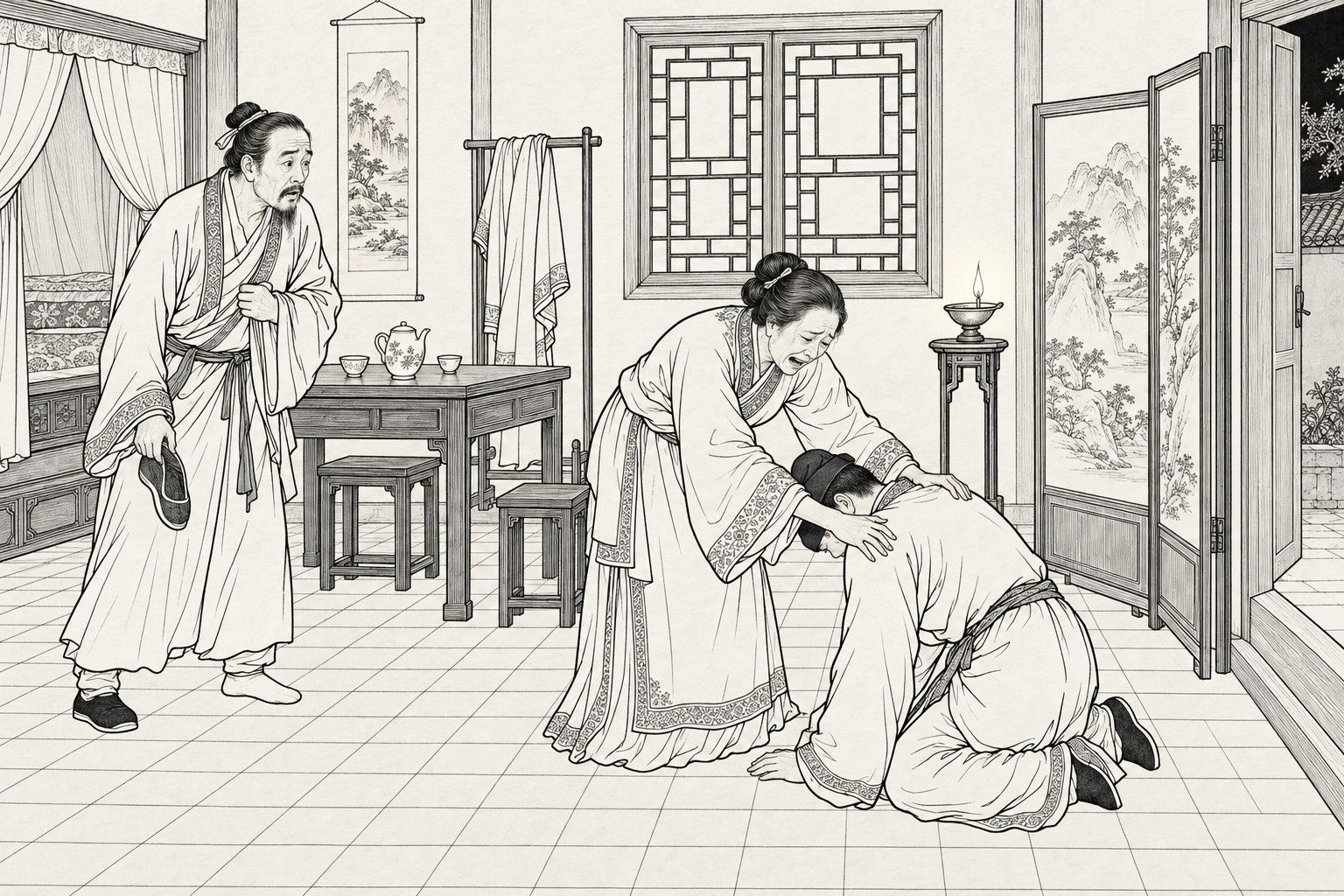
奚成列,成都士人也。有一妻一妾。妾何氏,小字昭容。妻早沒,繼娶申氏,性妒,虐遇何,因並及奚;終日嘵聒,恆不聊生。奚怒,亡去。去後,何生一子大男。奚去不返,申擯何不與同炊,計日授粟。大男漸長,用不給,何紡績佐食。大男見塾中諸兒吟誦,亦欲讀。母以其太穉,姑送詣讀。大男慧,所讀倍諸兒。師奇之,願不索束脩。何乃使從師,薄相酬。積二三年,經書全通。一日歸,謂母曰:「塾中五六人,皆從父乞錢買餅,我何獨無?」母曰:「待汝長,告汝知。」大男曰:「今方七八歲,何時長也?」母曰:「汝往塾,路經關帝廟,當拜之,祐汝速長。」大男信之,每過必入拜。母知之,問曰:「汝所祝何詞?」笑云:「但祝明年便使我十六七歲。」母笑之。然大男學與軀長並速:至十歲,便如十三四歲者;其所為文竟成章。一日,謂母曰:「昔謂我壯大,當告父處,今可矣。」母曰:「尚未,尚未。」又年餘,居然成人,研詰益頻,母乃緬述之。大男悲不自勝,欲往尋父。母曰:「兒太幼,汝父存亡未知,何遽可尋?」大男無言而去,至午不歸。往塾問師,則辰餐未復。母大驚,出貲傭役,到處冥搜,杳無蹤蹟。大男出門,循途奔去,茫然不知何往。適遇一人將如夔州,言姓錢。大男丐食相從。錢病其緩,為賃代步,資斧耗竭。至夔,同食,錢陰投毒食中,大男瞑不覺。錢載至大剎,託為己子,偶病絕貲,賣諸僧。僧見其丰姿秀異,爭購之。錢得金竟去。僧飲之,略醒。長老知而詣視,奇其相,研詰,始得顛末。甚憐之,贈貲使去。有瀘州蔣秀才,下第歸,途中問得故,嘉其孝,攜與同行。至瀘,主其家。月餘,遍加諮訪。或言閩商有奚姓者,乃辭蔣,欲之閩。蔣贈以衣履,里黨皆斂貲助之。途遇二布客,欲往福清,邀與同侶。行數程,客窺囊金,引至空所,摯其手足,解奪而去。適有永福陳翁過其地,脫其縛,載歸其家。翁豪富,諸路商賈,多出其門,翁囑南北客代訪奚耗。留大男伴諸兒讀。大男遂住翁家,不復游。然去家愈遠,音益梗矣。何昭容孤居三四年,申氏減其費,抑勒令嫁。何志不搖。申強賣於重慶賈,賈劫取而去。至夜,以刀自劙。賈不敢逼,俟創瘥,又轉鬻於鹽亭賈。至鹽亭,自刺心頭,洞見臟腑。賈大懼,敷以藥,創平,求為尼。賈曰:「我有商侶,身無淫具,每欲得一人主縫紉。此與作尼無異,亦可少償吾值。」何諾。賈輿送去。入門,主人趨出,則奚生也。蓋奚已棄儒為商,賈以其無婦,故贈之也。相見悲駭,各述苦況,始知有兒尋父未歸。奚乃囑諸客旅,偵察大男。而昭容遂以妾為妻矣。然自歷艱苦,痾痛多疾,不能操作,勸奚納妾。奚鑒前禍,不從所請。何曰:「妾如爭床第者,數年來固已從人生子,尚得與君有今日耶?且人加我者,隱痛在心,豈及諸身而自蹈之?」奚乃囑客侶,為買三十餘老妾。踰半年,客果為買妾歸,入門,則妻申氏。各相駭異。先是,申獨居年餘,兄苞勸令再適。申從之。惟田產為子姪所阻,不得售。鬻諸所有,積數百金,攜歸兄家。有保寧賈,聞其富有匳資,以多金啗苞,賺娶之。而賈老廢不能人。申怨兄,不安於室,懸梁投井,不堪其擾。賈怒,搜括其貲,將賣作妾。聞者皆嫌其老。賈將適夔,乃載與俱去。遇奚同肆,適中其意,遂貨之而去。既見奚,慙懼不出一語。奚問同肆商,略知梗概。因曰:「使遇健男,則在保寧,無再見之期,此亦數也。然今日我買妾,非娶妻,可先拜昭容,修嫡庶禮。」申恥之。奚曰:「昔日汝作嫡,何如哉!」何勸止之。奚不可,操杖臨偪。申不得已,拜之。然終不屑承奉,但操作別室。何悉優容之,亦不忍課其勤惰。奚每與昭容談讌,輒使役使其側;何更代以婢,不聽前。會陳公嗣宗宰鹽亭。奚與里人有小爭,里人以逼妻作妾揭訟奚。公不准理,叱逐之。奚喜,方與何竊頌公德。一漏既盡,僮呼叩扉,入報曰:「邑令公至。」奚駭極,急覓衣履,則公已至寢門;益駭,不知所為。何審之,急出曰:「是吾兒也!」遂哭。公乃伏地悲哽。蓋大男從陳翁姓,業為官矣。初,公至自都,迂道過故里,始知兩母皆醮,伏膺哀痛。族人知大男已貴,反其田廬。公留僕營造,冀父復還。既而授任鹽亭,又欲棄官尋父,陳翁苦勸止之。會有卜者,使筮焉。卜者曰:「小者居大,少者為長;求雄得雌,求一得兩:為官吉。」公乃之任。為不得親,居官不茹葷酒。是日,得里人狀,睹奚姓名,疑之。陰遣內使細訪,果父。乘夜微行而出。見母,益信卜者之神。臨去,囑勿播,出金二百,啟父辦裝歸里。父抵家,門戶一新,廣畜僕馬,居然大家矣。申見大男貴盛,益自斂。兄苞不憤,告官,為妹爭嫡。官廉得其情,怒曰:「貪貲勸嫁,已更二夫,尚何顏爭昔年嫡庶耶!」重笞苞。由此名分益定。而申妹何,何姊之。衣服飲食,悉不自私。申初懼其復仇,今益愧悔。奚亦忘其舊惡,俾內外皆呼以太母,但誥命不及耳。
奚成列,成都士人也。有一妻一妾。妾何氏,小字昭容。妻早没,继娶申氏,性妒,虐遇何,因并及奚;终日哓聒,恒不聊生。奚怒,亡去。去后,何生一子大男。奚去不返,申摈何不与同炊,计日授粟。大男渐长,用不给,何纺绩佐食。大男见塾中诸儿吟诵,亦欲读。母以其太穉,姑送诣读。大男慧,所读倍诸儿。师奇之,愿不索束脩。何乃使从师,薄相酬。积二三年,经书全通。一日归,谓母曰:「塾中五六人,皆从父乞钱买饼,我何独无?」母曰:「待汝长,告汝知。」大男曰:「今方七八岁,何时长也?」母曰:「汝往塾,路经关帝庙,当拜之,祐汝速长。」大男信之,每过必入拜。母知之,问曰:「汝所祝何词?」笑云:「但祝明年便使我十六七岁。」母笑之。然大男学与躯长并速:至十岁,便如十三四岁者;其所为文竟成章。一日,谓母曰:「昔谓我壮大,当告父处,今可矣。」母曰:「尚未,尚未。」又年余,居然成人,研诘益频,母乃缅述之。大男悲不自胜,欲往寻父。母曰:「儿太幼,汝父存亡未知,何遽可寻?」大男无言而去,至午不归。往塾问师,则辰餐未复。母大惊,出赀佣役,到处冥搜,杳无踪迹。大男出门,循途奔去,茫然不知何往。适遇一人将如夔州,言姓钱。大男丐食相从。钱病其缓,为赁代步,资斧耗竭。至夔,同食,钱阴投毒食中,大男瞑不觉。钱载至大刹,托为己子,偶病绝赀,卖诸僧。僧见其丰姿秀异,争购之。钱得金竟去。僧饮之,略醒。长老知而诣视,奇其相,研诘,始得颠末。甚怜之,赠赀使去。有泸州蒋秀才,下第归,途中问得故,嘉其孝,携与同行。至泸,主其家。月余,遍加咨访。或言闽商有奚姓者,乃辞蒋,欲之闽。蒋赠以衣履,里党皆敛赀助之。途遇二布客,欲往福清,邀与同侣。行数程,客窥囊金,引至空所,挚其手足,解夺而去。适有永福陈翁过其地,脱其缚,载归其家。翁豪富,诸路商贾,多出其门,翁嘱南北客代访奚耗。留大男伴诸儿读。大男遂住翁家,不复游。然去家愈远,音益梗矣。何昭容孤居三四年,申氏减其费,抑勒令嫁。何志不摇。申强卖于重庆贾,贾劫取而去。至夜,以刀自劙。贾不敢逼,俟创瘥,又转鬻于盐亭贾。至盐亭,自刺心头,洞见脏腑。贾大惧,敷以药,创平,求为尼。贾曰:「我有商侣,身无淫具,每欲得一人主缝纫。此与作尼无异,亦可少偿吾值。」何诺。贾舆送去。入门,主人趋出,则奚生也。盖奚已弃儒为商,贾以其无妇,故赠之也。相见悲骇,各述苦况,始知有儿寻父未归。奚乃嘱诸客旅,侦察大男。而昭容遂以妾为妻矣。然自历艰苦,疴痛多疾,不能操作,劝奚纳妾。奚鉴前祸,不从所请。何曰:「妾如争床第者,数年来固已从人生子,尚得与君有今日耶?且人加我者,隐痛在心,岂及诸身而自蹈之?」奚乃嘱客侣,为买三十余老妾。逾半年,客果为买妾归,入门,则妻申氏。各相骇异。先是,申独居年余,兄苞劝令再适。申从之。惟田产为子姪所阻,不得售。鬻诸所有,积数百金,携归兄家。有保宁贾,闻其富有匳资,以多金啗苞,赚娶之。而贾老废不能人。申怨兄,不安于室,悬梁投井,不堪其扰。贾怒,搜括其赀,将卖作妾。闻者皆嫌其老。贾将适夔,乃载与俱去。遇奚同肆,适中其意,遂货之而去。既见奚,慙惧不出一语。奚问同肆商,略知梗概。因曰:「使遇健男,则在保宁,无再见之期,此亦数也。然今日我买妾,非娶妻,可先拜昭容,修嫡庶礼。」申耻之。奚曰:「昔日汝作嫡,何如哉!」何劝止之。奚不可,操杖临偪。申不得已,拜之。然终不屑承奉,但操作别室。何悉优容之,亦不忍课其勤惰。奚每与昭容谈䜩,辄使役使其侧;何更代以婢,不听前。会陈公嗣宗宰盐亭。奚与里人有小争,里人以逼妻作妾揭讼奚。公不准理,叱逐之。奚喜,方与何窃颂公德。一漏既尽,僮呼叩扉,入报曰:「邑令公至。」奚骇极,急觅衣履,则公已至寝门;益骇,不知所为。何审之,急出曰:「是吾儿也!」遂哭。公乃伏地悲哽。盖大男从陈翁姓,业为官矣。初,公至自都,迂道过故里,始知两母皆醮,伏膺哀痛。族人知大男已贵,反其田庐。公留仆营造,冀父复还。既而授任盐亭,又欲弃官寻父,陈翁苦劝止之。会有卜者,使筮焉。卜者曰:「小者居大,少者为长;求雄得雌,求一得两:为官吉。」公乃之任。为不得亲,居官不茹荤酒。是日,得里人状,睹奚姓名,疑之。阴遣内使细访,果父。乘夜微行而出。见母,益信卜者之神。临去,嘱勿播,出金二百,启父办装归里。父抵家,门户一新,广畜仆马,居然大家矣。申见大男贵盛,益自敛。兄苞不愤,告官,为妹争嫡。官廉得其情,怒曰:「贪赀劝嫁,已更二夫,尚何颜争昔年嫡庶耶!」重笞苞。由此名分益定。而申妹何,何姊之。衣服饮食,悉不自私。申初惧其复仇,今益愧悔。奚亦忘其旧恶,俾内外皆呼以太母,但诰命不及耳。
Xi Chenglie was a scholar of Chengdu. He had a wife and a concubine. The concubine was a woman named He, whose girlhood name was Zhaorong. The wife died young, and Xi married again, a woman named Shen. Shen was jealous by nature. She ill-treated Zhaorong, and went on from her to Xi himself. She nagged and shrilled from morning to night until life was unbearable. Xi lost his temper and ran away. After he left, Zhaorong gave birth to a son, Da Nan. Xi never came back. Shen shut Zhaorong out, would not let her cook at the same stove, and doled out grain to her by the day. As Da Nan grew there was not enough to go round, and Zhaorong spun and wove to eke out their food. Da Nan saw the boys at the village school chanting their lessons and wanted to study too. His mother thought him too small, but sent him along for the time being. Da Nan was clever and learned twice as much as the other boys. The teacher marvelled at him and offered to teach him without a fee. So Zhaorong let him stay on, and paid the teacher a little. In two or three years he had mastered the Classics. One day he came home and said to his mother, “There are five or six boys at school, and they all beg money from their fathers to buy cakes. Why am I the only one who hasn’t got one?” “I’ll tell you when you are grown up,” said his mother. “I’m only seven or eight now,” said Da Nan. “When will I be grown up?” “On your way to school you pass the temple of Lord Guan,” said his mother. “Bow to him, and he will help you grow up fast.” Da Nan believed her, and every time he passed he went in and bowed. His mother found out and asked, “What do you pray for?” He laughed. “I just pray that next year he’ll make me sixteen or seventeen.” His mother laughed at him. But Da Nan’s learning and his body grew together, and both grew fast. At ten he looked thirteen or fourteen, and the essays he wrote were real compositions. One day he said to his mother, “You used to say that when I was big you would tell me where my father was. You can tell me now.” “Not yet, not yet,” said his mother. After another year and more he was to all appearances a grown man, and he pressed her more and more often, until she told him the whole story from the beginning. Da Nan was overcome with grief and wanted to go and find his father. “You are too young, child,” said his mother. “No one knows whether your father is alive or dead. How can you just go off and find him?” Da Nan left without a word, and by noon he had not come home. She went to the school to ask the teacher: he had not come back since breakfast. His mother was terrified. She paid men to search for him high and low, but there was no trace of him. Da Nan had gone out of the gate and run off down the road, with no idea where he was going. He happened to meet a man on his way to Kuizhou, who said his name was Qian, and tagged along with him, begging his food. Qian found him too slow and hired him a mount, and the money for the road ran out. At Kuizhou they ate together. Qian secretly put poison in his food, and Da Nan fell senseless. Qian carried him to a great monastery, said he was his own son, who had fallen ill when their money ran out, and sold him to the monks. Seeing how handsome and uncommon the boy looked, the monks vied to buy him. Qian took the money and was gone. The monks gave Da Nan something to drink, and he came round a little. The abbot heard of it and came to see him. Struck by his looks, he questioned him closely and got the whole story. He pitied him deeply, gave him money and sent him on his way. A licentiate named Jiang, of Luzhou, on his way home after failing the examinations, learned the boy’s story on the road. Admiring his filial devotion, he took him along. At Luzhou he put him up in his house, and for a month and more made inquiries everywhere. Someone said there was a merchant in Fujian named Xi, so Da Nan took his leave of Jiang, meaning to go there. Jiang gave him clothes and shoes, and the neighbours all took up a collection for him. On the road he met two cloth traders bound for Fuqing, who invited him to travel with them. After a few stages they spied the money in his bag. They led him to a lonely place, tied him hand and foot, took the money and left. An old man named Chen, of Yongfu, happened to pass that way. He untied the boy and took him home. Old Chen was very rich, and merchants from every road were, many of them, his dependents; he asked the traders going north and south to look out for news of Xi. He kept Da Nan to study with his own sons. So Da Nan lived in the old man’s house and travelled no more. But he was farther from home than ever, and news was harder to come by. He Zhaorong lived alone for three or four years. Shen cut her allowance and tried to force her to remarry. Zhaorong would not be shaken. Shen sold her by force to a merchant from Chongqing, who carried her off. That night she slashed herself with a knife. The merchant did not dare press her. He waited for the wound to heal and sold her on to a merchant from Yanting. At Yanting she stabbed herself in the breast, so deep that her insides could be seen. The merchant was terrified and dressed the wound. When it had closed, she asked to become a nun. “I have a trading partner who hasn’t the parts for lust,” said the merchant. “He has always wanted someone to see to his sewing. That would be no different from being a nun, and I’d get back a little of what I paid for you.” Zhaorong agreed, and the merchant sent her off in a sedan chair. When she came in at the gate, the master of the house hurried out, and it was Xi. Xi had given up scholarship for trade, and because he had no woman the merchant had made him a present of her. They were stricken and amazed to see each other. Each told what they had suffered, and only then did Xi learn that he had a son who had gone looking for his father and never come back. Xi asked all the travelling merchants to watch out for Da Nan. And Zhaorong, from concubine, became wife. But after all her hardships she was full of aches and often ill, and could not do the work, so she urged Xi to take a concubine. Remembering the trouble before, Xi would not. “If I were the kind to fight over a bed,” said Zhaorong, “I would have gone with another man years ago and borne him children. Would I have this day with you? Besides, what others did to me is a hidden pain in my heart. Now that it is in my own hands, would I do the same?” So Xi asked his trading partners to buy him an older concubine, past thirty. Over half a year later a partner did come back with one he had bought. She came in at the gate: it was his wife, Shen. Both were astounded. Earlier, after Shen had lived alone for a year or so, her brother Bao urged her to remarry, and she agreed. Only the land she could not sell, because the young men of Xi’s family blocked it. She sold everything else, gathered several hundred taels, and took it to her brother’s house. A merchant from Baoning, hearing that she had a rich dowry, baited Bao with a large sum and tricked her into marriage. But the merchant was old and worn out and could not perform as a man. Shen blamed her brother and would not settle down. She tried hanging herself from a beam and throwing herself down a well, until the merchant could not stand the trouble. In a rage he took every bit of her money and set out to sell her as a concubine. Everyone who heard of her thought her too old. The merchant was going to Kuizhou, so he took her along. There he met a man who kept shop with Xi; she was just what the man wanted, and the merchant sold her and went his way. When she saw Xi she was too ashamed and frightened to say a word. Xi asked his shop partner and learned roughly what had happened. Then he said, “If you had met a lusty man, you would be in Baoning and we would never have met again. This too is fate. But today I have bought a concubine, not married a wife. You will first bow to Zhaorong, with the courtesies a concubine owes a principal wife.” Shen felt the shame of it. “And how was it in the old days, when you were the wife?” said Xi. Zhaorong tried to talk him out of it, but Xi would not hear of it. He took up a stick and stood over Shen. She had no choice and bowed. But she would never stoop to waiting on Zhaorong, and only did her work in another room. Zhaorong bore with all of it generously, and had not the heart to check whether she worked or idled. Whenever Xi sat talking and feasting with Zhaorong, he made Shen wait on them; but Zhaorong put a maid in her place and would not let her come near. Now a Lord Chen Sizong was appointed county magistrate of Yanting. Xi had a small quarrel with a neighbour, and the neighbour brought a suit against him for forcing his wife to be a concubine. His lordship refused to hear the case and drove the man out with a scolding. Xi was delighted. He was privately praising the magistrate’s virtue with Zhaorong when, just as the first watch ran out, a servant boy called and knocked at the door and came in to announce, “His Honour the magistrate is here!” Xi was terrified and scrambled for his clothes and shoes, but the magistrate was already at the bedroom door. More frightened still, Xi did not know what to do. Zhaorong looked hard at the visitor, rushed out and cried, “It’s my son!” and burst into tears. The magistrate threw himself on the ground, choking with grief. For Da Nan had taken old Chen’s surname and was now an official. Earlier, coming from the capital, he had gone out of his way to visit his old home and learned that both his mothers had remarried. He beat his breast in grief. When the clan learned that Da Nan had risen high, they gave back his land and house. He left servants to rebuild, hoping his father would return. Then he was posted to Yanting, and wanted once more to give up office and look for his father, but old Chen talked him out of it. A diviner happened by, and Da Nan had him cast the stalks. The diviner said: “The small dwells in the great, the young becomes the elder; seek a male and find a female, seek one and find two. Taking office is auspicious.” So he went to his post. Because he had not found his parents, in office he ate no meat and drank no wine. That day, when the neighbour’s complaint came in and he saw Xi’s name, he grew suspicious. He secretly sent a trusted servant to make careful inquiries: it was indeed his father. He slipped out by night in plain clothes. Finding his mother as well, he believed all the more in the diviner’s powers. As he left he asked them not to spread the news, and gave them two hundred taels, begging his father to pack and go home. When his father reached home, the gates and buildings were all new; with servants and horses in plenty, he was now a great family. Seeing Da Nan so high and mighty, Shen kept herself still more in check. But her brother Bao was resentful and went to the authorities to fight for his sister’s place as principal wife. The official looked into it, learned the truth, and said angrily, “You were greedy for money and talked her into remarrying. She has had two husbands since. How have you the face to fight over who was wife and who concubine years ago?” He had Bao soundly flogged. After that everyone’s place in the household was settled for good. Shen called Zhaorong younger sister, and Zhaorong called her elder sister. In clothes and food Zhaorong kept nothing to herself. Shen had at first feared her revenge; now she was all the more ashamed and sorry. Xi too forgot her old wrongs, and had the whole household, inside and out, call her the Old Mistress. Only the imperial patent did not reach her.