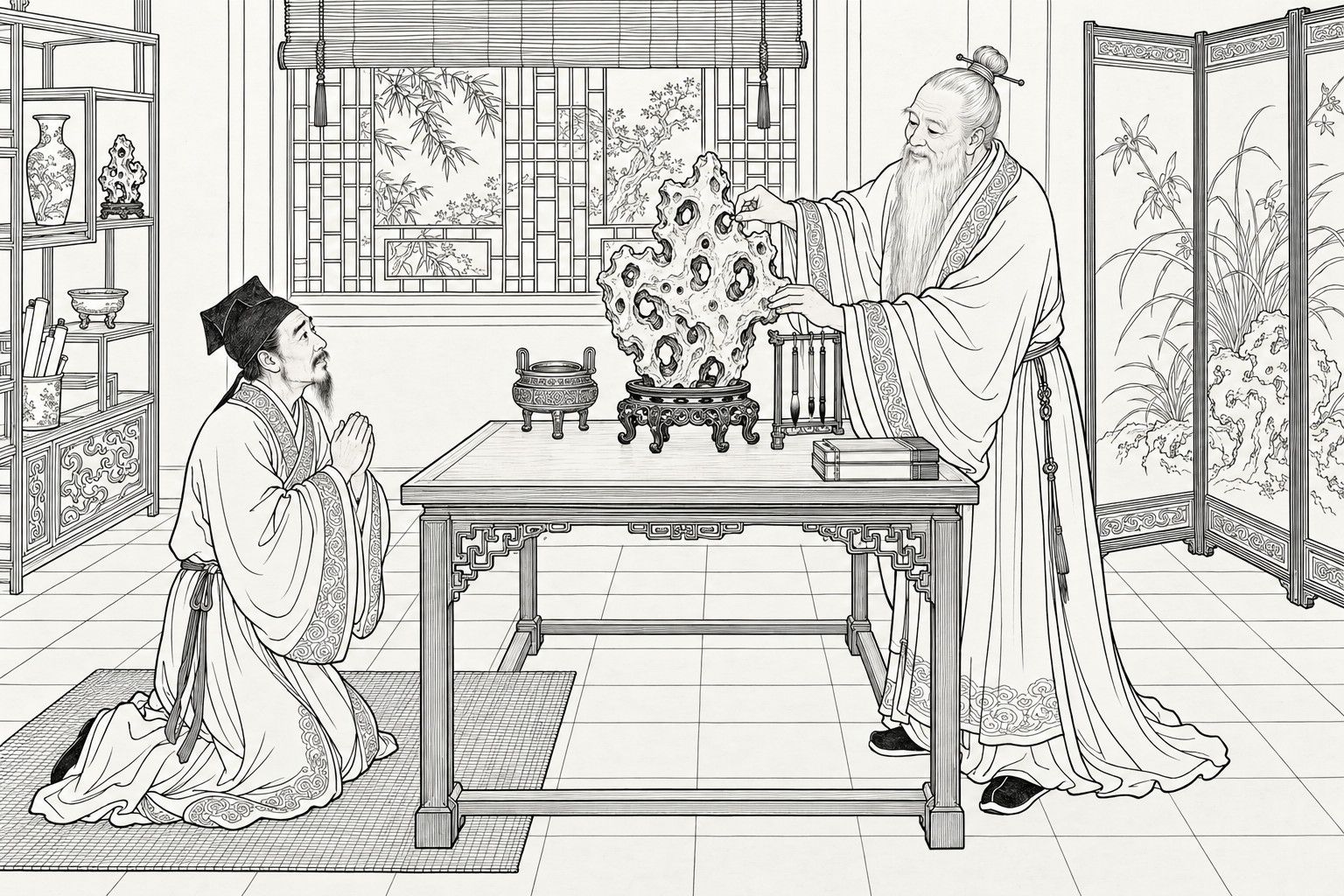
邢雲飛,順天人。好石,見佳石,不惜重直。偶漁於河,有物挂網,沉而取之,則石徑尺,四面玲瓏,峰巒疊秀。喜極,如獲異珍。既歸,雕紫檀為座,供諸案頭。每值天欲雨,則孔孔生雲,遙望如塞新絮。有勢豪某,踵門求觀。既見,舉付健僕,策馬徑去。邢無奈,頓足悲憤而已。僕負石至河濱,息肩橋上,忽失手,墮諸河。豪怒,鞭僕。即出金,僱善泅者,百計冥搜,竟不可見。乃懸金署約而去。由是尋石者日盈於河,迄無獲者。後邢至落石處,臨流於邑,但見河水清澈,則石固在水中。邢大喜,解衣入水,抱之而出。攜歸,不敢設諸廳所,潔治內室供之。一日,有老叟款門而請。邢託言石失已久。叟笑曰:「客舍非耶?」邢便請入舍,以實其無,及入,則石果陳几上。愕不能言。叟撫石曰:「此吾家故物,失去已久,今固在此耶。既見之,請即賜還。」邢窘甚,遂與爭作石主。叟笑曰:「既汝家物,有何驗證?」邢不能答。叟曰:「僕則故識之。前後九十二竅,巨孔中五字云:『清虛天石供。』」邢審視,孔中果有小字,細如粟米,竭目力裁可辨認;又數其竅,果如所言。邢無以對,但執不與。叟笑曰:「誰家物,而憑君作主耶!」拱手而出。邢送至門外;既還,已失石所在。邢急追叟,則叟緩步未遠。奔牽其袂而哀之。叟曰:「奇哉!經尺之石,豈可以手握袂藏者耶?」邢知其神,強曳之歸,長跽請之。叟乃曰:「石果君家者耶、僕家者耶?」答曰:「誠屬君家,但求割愛耳。」叟曰:「既然,石固在是。」入室,則石已在故處。叟曰:「天下之寶,當與愛惜之人。此石能自擇主,僕亦喜之。然彼急於自見,其出也早,則魔劫未除。實將攜去,待三年後,始以奉贈。既欲留之,當減三年壽數,乃可與君相終始。君願之乎?」曰:「願。」叟乃以兩指捏一竅,竅軟如泥,隨手而閉。閉三竅,已,曰:「石上竅數,即君壽也。」作別欲去。邢苦留之,辭甚堅;問其姓字,亦不言,遂去。積年餘,邢以故他出,夜有賊入室,諸無所失,惟竊石而去。邢歸,悼喪欲死。訪察購求,全無蹤跡。積有數年,偶入報國寺,見賣石者,則故物也,將便認取。賣者不服,因負石至官。官問:「何所質驗?」賣石者能言竅數。邢問其他,則茫然矣。邢乃言竅中五字及三指痕,理遂得伸。官欲杖責賣石者,賣石者自言以二十金買諸市,遂釋之。邢得石歸,裹以錦,藏櫝中,時出一賞,先焚異香而後出之。有尚書某,購以百金。邢曰:「雖萬金不易也。」尚書怒,陰以他事中傷之。邢被收,典質田產。尚書託他人風示其子。子告邢,邢願以死殉石。妻竊與子謀,獻石尚書家。邢出獄始知,罵妻毆子,屢欲自經,家人覺救,得不死。夜夢一丈夫來,自言:「石清虛。」戒邢勿戚:「特與君年餘別耳。明年八月二十日,昧爽時,可詣海岱門,以兩貫相贖。」邢得夢,喜,謹誌其日。其石在尚書家,更無出雲之異,久亦不甚貴重之。明年,尚書以罪削職,尋死。邢如期至海岱門,則其家人竊石出售,因以兩貫市歸。後邢至八十九歲,自治葬具;又囑子,必以石殉。及卒,子遵遺教,瘞石墓中。半年許,賊發墓,劫石去。子知之,莫可追詰。越二三日,同僕在道,忽見兩人,奔躓汗流,望空投拜,曰:「邢先生,勿相逼!我二人將石去,不過賣四兩銀耳。」遂縶送到官,一訊即伏。問石,則鬻宮氏。取石至,官愛玩,欲得之,命寄諸庫。吏舉石,石忽墮地,碎為數十餘片。皆失色。官乃重械兩盜論死。邢子拾碎石出,仍瘞墓中。
邢雲飛是順天人。他喜歡石頭,見到好石頭,無論價錢多高都捨得買。有一次,他在河裡捕魚,有個東西掛住了漁網。他潛入水中,把那東西撈了上來,原來是一塊直徑一尺的石頭,四面都有相通的孔洞,形狀如同層層山峰,十分秀美。他高興極了,像是得到了稀世珍寶。回家後,他用紫檀雕了一個底座,把石頭擺在案頭。每當天將下雨,石頭的每個孔洞裡都會冒出雲氣,遠遠看去,像塞滿了新棉絮。有個仗勢欺人的豪強登門,要看這塊石頭。他一見石頭,就把它交給一個強壯的僕人,自己催馬徑直走了。邢雲飛毫無辦法,只能跺腳,悲憤不已。僕人揹著石頭來到河邊,在橋上放下石頭歇肩,不料一失手,把石頭掉進了河裡。豪強大怒,鞭打了僕人,又拿出銀子,僱來善於游泳的人,想盡辦法潛入水中搜尋,始終找不到。他於是貼出懸賞告示,寫明酬金,便離開了。從此,每天都有許多人到河裡找石頭,可一直沒有人找到。後來,邢雲飛來到石頭落水的地方,站在河邊哽咽哭泣,只見河水清澈,石頭分明就在水裡。他大喜,脫下衣服下水,把石頭抱了出來。帶回家後,他不敢再把它擺在廳堂裡,便把內室收拾乾淨,將石頭擺在那裡。一天,一個老翁敲門,請求看石頭。邢雲飛推說石頭早已丟失。老翁笑著說:「不是就在你家裡嗎?」邢雲飛便請他進屋,想讓他親眼看看,證明石頭不在。誰知進屋一看,石頭竟擺在桌上。邢雲飛驚得說不出話。老翁撫摸著石頭說:「這是我家原有的東西,已經丟失很久,原來就在這裡啊。既然找到了,就請你還給我吧。」邢雲飛十分窘迫,便和老翁爭論,都說自己是石頭的主人。老翁笑著說:「既然是你家的東西,你有什麼證據?」邢雲飛答不上來。老翁說:「我倒是早就熟悉它。它前前後後一共有九十二個孔洞,最大的孔洞裡有五個字,寫的是『清虛天石供』。」邢雲飛仔細看去,孔洞裡果然有小字,細得像小米粒,竭盡目力才勉強辨認出來。他又數了數孔洞,果然和老翁說的一樣。邢雲飛無話可說,卻仍抓住石頭不肯交出。老翁笑著說:「這究竟是誰家的東西,竟由你來做主!」說完拱手告辭,走了出去。邢雲飛送他到門外,回來時,石頭已經不見了。邢雲飛急忙去追,老翁走得很慢,還沒有走遠。他跑上去拉住老翁的衣袖,苦苦哀求。老翁說:「奇怪啊!一塊直徑一尺的石頭,難道能握在手裡,藏在袖子裡嗎?」邢雲飛知道他是神仙,硬拉著他回家,直起身子跪著,求他歸還石頭。老翁這才說:「這塊石頭究竟是你家的,還是我家的?」邢雲飛回答:「確實是您家的,我只是求您割愛。」老翁說:「既然這樣,石頭就在這裡。」進屋一看,石頭已經回到了原處。老翁說:「天下的寶物,應當交給愛惜它的人。這塊石頭能自己選擇主人,我也很高興。不過,它急著顯露自己,出來得太早,遭受劫難的命運還沒有過去。我本來要把它帶走,等三年以後再送給你。你既然想現在就留下它,就得減去三年的壽命,它才能陪伴你一生。你願意嗎?」邢雲飛說:「願意。」老翁便用兩根手指捏住一個孔洞,那孔洞軟得像泥,隨著他的手指合攏了。他一共封住三個孔洞,然後說:「石頭上有多少個孔洞,你就能活多少歲。」說完便要告辭。邢雲飛苦苦挽留,他卻堅決不肯留下。邢雲飛問他的姓名,他也不說,就這樣走了。一年多以後,邢雲飛有事外出。夜裡有賊進了屋,別的東西都沒有丟,只偷走了石頭。邢雲飛回來後,傷心得幾乎要死。他四處打聽查詢,懸賞求購,卻沒有一點蹤跡。又過了幾年,他偶然走進報國寺,看見一個賣石頭的人,賣的正是自己那塊石頭,便要認領回來。賣石頭的人不肯,於是把石頭背到官府,請官員裁斷。官員問:「有什麼證據可以證明?」賣石頭的人能說出石頭的孔洞數目,邢雲飛問他別的,他就什麼也不知道了。邢雲飛於是說出孔洞裡的五個字,以及三處手指捏過的痕跡,這才證明了石頭確實屬於自己。官員想用板子責打賣石頭的人,那人說自己是在集市上花二十兩銀子買來的,官員便放了他。邢雲飛把石頭帶回家,用錦緞包好,藏在匣子裡,時常拿出來欣賞一番,每次都先點上名貴的香,再把石頭取出來。有個尚書想用一百兩銀子買這塊石頭。邢雲飛說:「就是一萬兩銀子,我也不賣。」尚書大怒,暗地裡借別的事情陷害他。邢雲飛被捕入獄,田地家產也拿去抵押了。尚書託人向邢雲飛的兒子暗示,要他獻出石頭。兒子把這事告訴邢雲飛,邢雲飛卻寧願為石頭而死。妻子偷偷和兒子商量,把石頭獻到了尚書家。邢雲飛出獄後才知道,便罵妻子、打兒子,幾次想上吊自盡,都被家人及時發現救下,這才沒有死。夜裡,他夢見一個男子前來,自稱石清虛,勸邢雲飛不要悲傷,說:「我只是和你分別一年多罷了。明年八月二十日,天剛亮的時候,你可以到海岱門,用兩貫錢把我贖回來。」邢雲飛做了這個夢,非常高興,認真記下了日期。石頭到了尚書家,再也沒有出現過冒出雲氣的奇景,時間一久,尚書也就不怎麼珍惜它了。第二年,尚書因罪被免去官職,不久便死了。邢雲飛如期來到海岱門,正遇上尚書家的僕人偷了石頭出來賣,便花兩貫錢買了回去。後來,邢雲飛活到八十九歲,親自準備自己的喪葬用品,又囑咐兒子,一定要把石頭給自己陪葬。等他去世,兒子遵照遺囑,把石頭埋進墓裡。大約半年後,盜賊挖開墳墓,搶走了石頭。兒子得知此事,卻無從追查。過了兩三天,兒子和僕人在路上,忽然看見兩個人跑得踉踉蹌蹌,滿身是汗,朝著空中跪拜,說:「邢先生,別再逼我們了!我們兩個人把石頭拿走,也不過賣了四兩銀子啊。」兒子於是把兩人捆起來,送到官府,一審問,他們就認了罪。問起石頭的下落,兩人說賣給了宮氏。石頭被取來後,官員很喜歡,想據為己有,便命人暫存在庫房裡。差役搬起石頭,石頭忽然掉到地上,碎成了幾十片。在場的人都嚇得變了臉色。官員於是給兩個盜賊戴上沉重的刑具,判了死罪。邢雲飛的兒子拾起碎石,帶了出去,仍舊埋在父親的墓裡。
邢云飞,顺天人。好石,见佳石,不惜重直。偶渔于河,有物挂网,沉而取之,则石径尺,四面玲珑,峰峦叠秀。喜极,如获异珍。既归,雕紫檀为座,供诸案头。每值天欲雨,则孔孔生云,遥望如塞新絮。有势豪某,踵门求观。既见,举付健仆,策马径去。邢无奈,顿足悲愤而已。仆负石至河滨,息肩桥上,忽失手,堕诸河。豪怒,鞭仆。即出金,雇善泅者,百计冥搜,竟不可见。乃悬金署约而去。由是寻石者日盈于河,迄无获者。后邢至落石处,临流於邑,但见河水清澈,则石固在水中。邢大喜,解衣入水,抱之而出。携归,不敢设诸厅所,洁治内室供之。一日,有老叟款门而请。邢托言石失已久。叟笑曰:「客舍非耶?」邢便请入舍,以实其无,及入,则石果陈几上。愕不能言。叟抚石曰:「此吾家故物,失去已久,今固在此耶。既见之,请即赐还。」邢窘甚,遂与争作石主。叟笑曰:「既汝家物,有何验证?」邢不能答。叟曰:「仆则故识之。前后九十二窍,巨孔中五字云:『清虚天石供。』」邢审视,孔中果有小字,细如粟米,竭目力裁可辨认;又数其窍,果如所言。邢无以对,但执不与。叟笑曰:「谁家物,而凭君作主耶!」拱手而出。邢送至门外;既还,已失石所在。邢急追叟,则叟缓步未远。奔牵其袂而哀之。叟曰:「奇哉!经尺之石,岂可以手握袂藏者耶?」邢知其神,强曳之归,长跽请之。叟乃曰:「石果君家者耶、仆家者耶?」答曰:「诚属君家,但求割爱耳。」叟曰:「既然,石固在是。」入室,则石已在故处。叟曰:「天下之宝,当与爱惜之人。此石能自择主,仆亦喜之。然彼急于自见,其出也早,则魔劫未除。实将携去,待三年后,始以奉赠。既欲留之,当减三年寿数,乃可与君相终始。君愿之乎?」曰:「愿。」叟乃以两指捏一窍,窍软如泥,随手而闭。闭三窍,已,曰:「石上窍数,即君寿也。」作别欲去。邢苦留之,辞甚坚;问其姓字,亦不言,遂去。积年余,邢以故他出,夜有贼入室,诸无所失,惟窃石而去。邢归,悼丧欲死。访察购求,全无踪迹。积有数年,偶入报国寺,见卖石者,则故物也,将便认取。卖者不服,因负石至官。官问:「何所质验?」卖石者能言窍数。邢问其他,则茫然矣。邢乃言窍中五字及三指痕,理遂得伸。官欲杖责卖石者,卖石者自言以二十金买诸市,遂释之。邢得石归,裹以锦,藏椟中,时出一赏,先焚异香而后出之。有尚书某,购以百金。邢曰:「虽万金不易也。」尚书怒,阴以他事中伤之。邢被收,典质田产。尚书托他人风示其子。子告邢,邢愿以死殉石。妻窃与子谋,献石尚书家。邢出狱始知,骂妻殴子,屡欲自经,家人觉救,得不死。夜梦一丈夫来,自言:「石清虚。」戒邢勿戚:「特与君年余别耳。明年八月二十日,昧爽时,可诣海岱门,以两贯相赎。」邢得梦,喜,谨志其日。其石在尚书家,更无出云之异,久亦不甚贵重之。明年,尚书以罪削职,寻死。邢如期至海岱门,则其家人窃石出售,因以两贯市归。后邢至八十九岁,自治葬具;又嘱子,必以石殉。及卒,子遵遗教,瘗石墓中。半年许,贼发墓,劫石去。子知之,莫可追诘。越二三日,同仆在道,忽见两人,奔踬汗流,望空投拜,曰:「邢先生,勿相逼!我二人将石去,不过卖四两银耳。」遂絷送到官,一讯即伏。问石,则鬻宫氏。取石至,官爱玩,欲得之,命寄诸库。吏举石,石忽堕地,碎为数十余片。皆失色。官乃重械两盗论死。邢子拾碎石出,仍瘗墓中。
邢云飞是顺天人。他喜欢石头,见到好石头,无论价钱多高都舍得买。有一次,他在河里捕鱼,有个东西挂住了渔网。他潜入水中,把那东西捞了上来,原来是一块直径一尺的石头,四面都有相通的孔洞,形状如同层层山峰,十分秀美。他高兴极了,像是得到了稀世珍宝。回家后,他用紫檀雕了一个底座,把石头摆在案头。每当天将下雨,石头的每个孔洞里都会冒出云气,远远看去,像塞满了新棉絮。有个仗势欺人的豪强登门,要看这块石头。他一见石头,就把它交给一个强壮的仆人,自己催马径直走了。邢云飞毫无办法,只能跺脚,悲愤不已。仆人背着石头来到河边,在桥上放下石头歇肩,不料一失手,把石头掉进了河里。豪强大怒,鞭打了仆人,又拿出银子,雇来善于游泳的人,想尽办法潜入水中搜寻,始终找不到。他于是贴出悬赏告示,写明酬金,便离开了。从此,每天都有许多人到河里找石头,可一直没有人找到。后来,邢云飞来到石头落水的地方,站在河边哽咽哭泣,只见河水清澈,石头分明就在水里。他大喜,脱下衣服下水,把石头抱了出来。带回家后,他不敢再把它摆在厅堂里,便把内室收拾干净,将石头摆在那里。一天,一个老翁敲门,请求看石头。邢云飞推说石头早已丢失。老翁笑着说:“不是就在你家里吗?”邢云飞便请他进屋,想让他亲眼看看,证明石头不在。谁知进屋一看,石头竟摆在桌上。邢云飞惊得说不出话。老翁抚摸着石头说:“这是我家原有的东西,已经丢失很久,原来就在这里啊。既然找到了,就请你还给我吧。”邢云飞十分窘迫,便和老翁争论,都说自己是石头的主人。老翁笑着说:“既然是你家的东西,你有什么证据?”邢云飞答不上来。老翁说:“我倒是早就熟悉它。它前前后后一共有九十二个孔洞,最大的孔洞里有五个字,写的是‘清虚天石供’。”邢云飞仔细看去,孔洞里果然有小字,细得像小米粒,竭尽目力才勉强辨认出来。他又数了数孔洞,果然和老翁说的一样。邢云飞无话可说,却仍抓住石头不肯交出。老翁笑着说:“这究竟是谁家的东西,竟由你来做主!”说完拱手告辞,走了出去。邢云飞送他到门外,回来时,石头已经不见了。邢云飞急忙去追,老翁走得很慢,还没有走远。他跑上去拉住老翁的衣袖,苦苦哀求。老翁说:“奇怪啊!一块直径一尺的石头,难道能握在手里,藏在袖子里吗?”邢云飞知道他是神仙,硬拉着他回家,直起身子跪着,求他归还石头。老翁这才说:“这块石头究竟是你家的,还是我家的?”邢云飞回答:“确实是您家的,我只是求您割爱。”老翁说:“既然这样,石头就在这里。”进屋一看,石头已经回到了原处。老翁说:“天下的宝物,应当交给爱惜它的人。这块石头能自己选择主人,我也很高兴。不过,它急着显露自己,出来得太早,遭受劫难的命运还没有过去。我本来要把它带走,等三年以后再送给你。你既然想现在就留下它,就得减去三年的寿命,它才能陪伴你一生。你愿意吗?”邢云飞说:“愿意。”老翁便用两根手指捏住一个孔洞,那孔洞软得像泥,随着他的手指合拢了。他一共封住三个孔洞,然后说:“石头上有多少个孔洞,你就能活多少岁。”说完便要告辞。邢云飞苦苦挽留,他却坚决不肯留下。邢云飞问他的姓名,他也不说,就这样走了。一年多以后,邢云飞有事外出。夜里有贼进了屋,别的东西都没有丢,只偷走了石头。邢云飞回来后,伤心得几乎要死。他四处打听查找,悬赏求购,却没有一点踪迹。又过了几年,他偶然走进报国寺,看见一个卖石头的人,卖的正是自己那块石头,便要认领回来。卖石头的人不肯,于是把石头背到官府,请官员裁断。官员问:“有什么证据可以证明?”卖石头的人能说出石头的孔洞数目,邢云飞问他别的,他就什么也不知道了。邢云飞于是说出孔洞里的五个字,以及三处手指捏过的痕迹,这才证明了石头确实属于自己。官员想用板子责打卖石头的人,那人说自己是在集市上花二十两银子买来的,官员便放了他。邢云飞把石头带回家,用锦缎包好,藏在匣子里,时常拿出来欣赏一番,每次都先点上名贵的香,再把石头取出来。有个尚书想用一百两银子买这块石头。邢云飞说:“就是一万两银子,我也不卖。”尚书大怒,暗地里借别的事情陷害他。邢云飞被捕入狱,田地家产也拿去抵押了。尚书托人向邢云飞的儿子暗示,要他献出石头。儿子把这事告诉邢云飞,邢云飞却宁愿为石头而死。妻子偷偷和儿子商量,把石头献到了尚书家。邢云飞出狱后才知道,便骂妻子、打儿子,几次想上吊自尽,都被家人及时发现救下,这才没有死。夜里,他梦见一个男子前来,自称石清虚,劝邢云飞不要悲伤,说:“我只是和你分别一年多罢了。明年八月二十日,天刚亮的时候,你可以到海岱门,用两贯钱把我赎回来。”邢云飞做了这个梦,非常高兴,认真记下了日期。石头到了尚书家,再也没有出现过冒出云气的奇景,时间一久,尚书也就不怎么珍惜它了。第二年,尚书因罪被免去官职,不久便死了。邢云飞如期来到海岱门,正遇上尚书家的仆人偷了石头出来卖,便花两贯钱买了回去。后来,邢云飞活到八十九岁,亲自准备自己的丧葬用品,又嘱咐儿子,一定要把石头给自己陪葬。等他去世,儿子遵照遗嘱,把石头埋进墓里。大约半年后,盗贼挖开坟墓,抢走了石头。儿子得知此事,却无从追查。过了两三天,儿子和仆人在路上,忽然看见两个人跑得踉踉跄跄,满身是汗,朝着空中跪拜,说:“邢先生,别再逼我们了!我们两个人把石头拿走,也不过卖了四两银子啊。”儿子于是把两人捆起来,送到官府,一审问,他们就认了罪。问起石头的下落,两人说卖给了宫氏。石头被取来后,官员很喜欢,想据为己有,便命人暂存在库房里。差役搬起石头,石头忽然掉到地上,碎成了几十片。在场的人都吓得变了脸色。官员于是给两个盗贼戴上沉重的刑具,判了死罪。邢云飞的儿子拾起碎石,带了出去,仍旧埋在父亲的墓里。
Xing Yunfei was a man of Shuntian. He loved stones, and when he saw a fine one he never grudged a high price. Once, as he was fishing in the river, something caught in his net. He dived down and brought it up: it was a stone a foot across, pierced through and through on every side, with peaks and ridges rising in lovely tiers. He was overjoyed, as if he had found a rare treasure. When he got home, he had a stand carved for it out of red sandalwood and set it up on his desk. Whenever rain was on the way, clouds rose from every hole, so that from a distance it looked stuffed with fresh cotton floss. A certain powerful bully came to his door asking to see it. As soon as he saw it, he handed it to a burly servant, whipped up his horse and rode straight off. Xing could do nothing but stamp his feet in grief and rage. The servant carried the stone on his back as far as the river. While he was resting his shoulders on the bridge, his grip suddenly slipped and it fell into the river. The bully was furious and whipped the servant. Then he paid good money to hire skilled swimmers, who searched blindly by every means they could think of, but it was nowhere to be found. So he posted a reward with a signed notice and went away. After that the river was crowded every day with people hunting for the stone, but no one ever found it. Later Xing came to the spot where the stone had fallen. As he stood by the water sobbing, he saw that the river had turned crystal clear, and there was the stone in the water. Overjoyed, Xing took off his clothes, went into the water and came out with the stone in his arms. He took it home. Not daring to set it in the front hall, he cleaned out an inner room and kept it there. One day an old man knocked at the gate and asked to see it. Xing pretended that the stone had been lost long ago. The old man smiled. “Isn’t it in your guest room?” Xing invited him into the room to prove it was not there; but when they went in, there was the stone, set out on the table. Xing was too astonished to speak. The old man stroked the stone. “This is an old possession of my family’s,” he said. “It was lost long ago — so this is where it has been! Now that I have found it, please be so kind as to give it back.” Xing was at his wits’ end, and argued with him over whose stone it was. The old man smiled. “If it belongs to your family, what proof have you?” Xing could not answer. “I, on the other hand, know it of old,” said the old man. “Front and back it has ninety-two holes, and inside the biggest hole are five characters: ‘An offering stone of the Heaven of Pure Emptiness.’” Xing looked closely. Inside the hole there were indeed tiny characters, small as grains of millet, that he could just make out by straining his eyes. He counted the holes too, and there were just as many as the old man had said. Xing had nothing to say, but held on to it and would not give it up. The old man laughed. “Whose is it, that you should be the one to decide?” He cupped his hands in farewell and went out. Xing saw him out of the gate. When he came back, the stone was gone. Xing hurried after the old man, who was strolling along and had not gone far. He ran up, caught him by the sleeve and pleaded with him. “How strange!” said the old man. “A stone a foot across — can a man hold it in his hand or hide it in his sleeve?” Xing knew then that he was a god. He dragged him back home by force and knelt upright before him, begging. Then the old man said, “Is the stone really yours, or mine?” “It truly belongs to you,” Xing answered. “I only beg you to part with what you love.” “In that case,” said the old man, “the stone is right here.” They went into the room, and the stone was back in its old place. “The treasures of this world,” said the old man, “should go to those who love and cherish them. This stone can choose its own master, and I am glad of that too. But it was in too much of a hurry to show itself. It came out too early, and its trials are not yet over. I really meant to take it away and give it to you three years from now. If you want to keep it now, you must give up three years of your life; then it can stay with you to the end. Are you willing?” “I am,” said Xing. The old man pinched one of the holes between two fingers. It was as soft as mud and closed up at his touch. When he had closed three holes, he said, “The number of holes in the stone is the number of your years.” Then he said goodbye and made to leave. Xing begged him to stay, but he firmly refused. Xing asked his name, but he would not give it, and went away. A year or so later Xing was away from home on some business. One night a thief broke in and took nothing but the stone. When Xing came home, he grieved as if he would die. He searched and inquired and offered money for it, but there was no trace of it at all. Several years went by. One day he happened to go into the Baoguo Temple and saw a man selling stones, and there was his own stone. He was about to claim it, but the seller would not give way, so they carried the stone to the magistrate. “What proof do you have?” the magistrate asked. The stone-seller could say how many holes it had, but when Xing asked him anything else, he was at a loss. Then Xing told of the five characters inside the hole and the three fingermarks, and his claim was upheld. The magistrate was going to have the seller beaten, but the man said he had bought the stone in the market for twenty taels, so he was let go. Xing brought the stone home, wrapped it in brocade and kept it in a box. Now and then he took it out to admire it, but always burned rare incense first. A certain minister offered him a hundred taels for it. “I wouldn’t part with it for ten thousand,” said Xing. The minister was angry, and in secret had him charged over some other matter. Xing was arrested, and his land and property had to be pawned. The minister had others drop a hint to Xing’s son. The son told Xing, but Xing said he would rather die for the stone. His wife plotted secretly with the son, and they gave the stone to the minister’s household. Only when Xing came out of prison did he learn of it. He cursed his wife and beat his son, and several times tried to hang himself, but each time the household found him and saved him, so he did not die. One night he dreamed that a man came to him and gave his name: “Shi Qingxu.” He told Xing not to grieve. “We shall be parted only a year or so. Next year, on the twentieth of the eighth month, at first light, go to the Haidai Gate, and you can buy me back for two strings of cash.” Xing woke happy from the dream and made careful note of the date. In the minister’s house the stone never again gave forth clouds, and in time the minister came to think little of it. The next year the minister was stripped of office for some crime, and soon died. Xing went to the Haidai Gate on the appointed day. A servant of the minister’s house had stolen the stone and was selling it, and Xing bought it for two strings of cash and took it home. Later, when Xing reached the age of eighty-nine, he got his own burial things ready, and told his son that the stone must be buried with him. When he died, his son obeyed his last wishes and buried the stone in his grave. About half a year later, robbers broke open the grave and made off with the stone. His son learned of it but had no way to track them down. Two or three days later, he was on the road with a servant when he suddenly saw two men running and stumbling, streaming with sweat, throwing themselves down and bowing to the empty air. “Mr. Xing, don’t hound us!” they cried. “The two of us took the stone, but we only sold it for four taels of silver!” So the son had them tied up and taken to the magistrate, and at the first questioning they confessed. Asked about the stone, they said they had sold it to a man named Gong. The stone was fetched. The magistrate loved it and wanted it for himself, and ordered it lodged in the storehouse. As a clerk lifted it, the stone suddenly fell to the ground and broke into dozens of pieces. Everyone went pale. Then the magistrate had the two robbers put in heavy fetters and sentenced to death. Xing’s son gathered up the broken pieces and took them away, and buried them again in the grave.