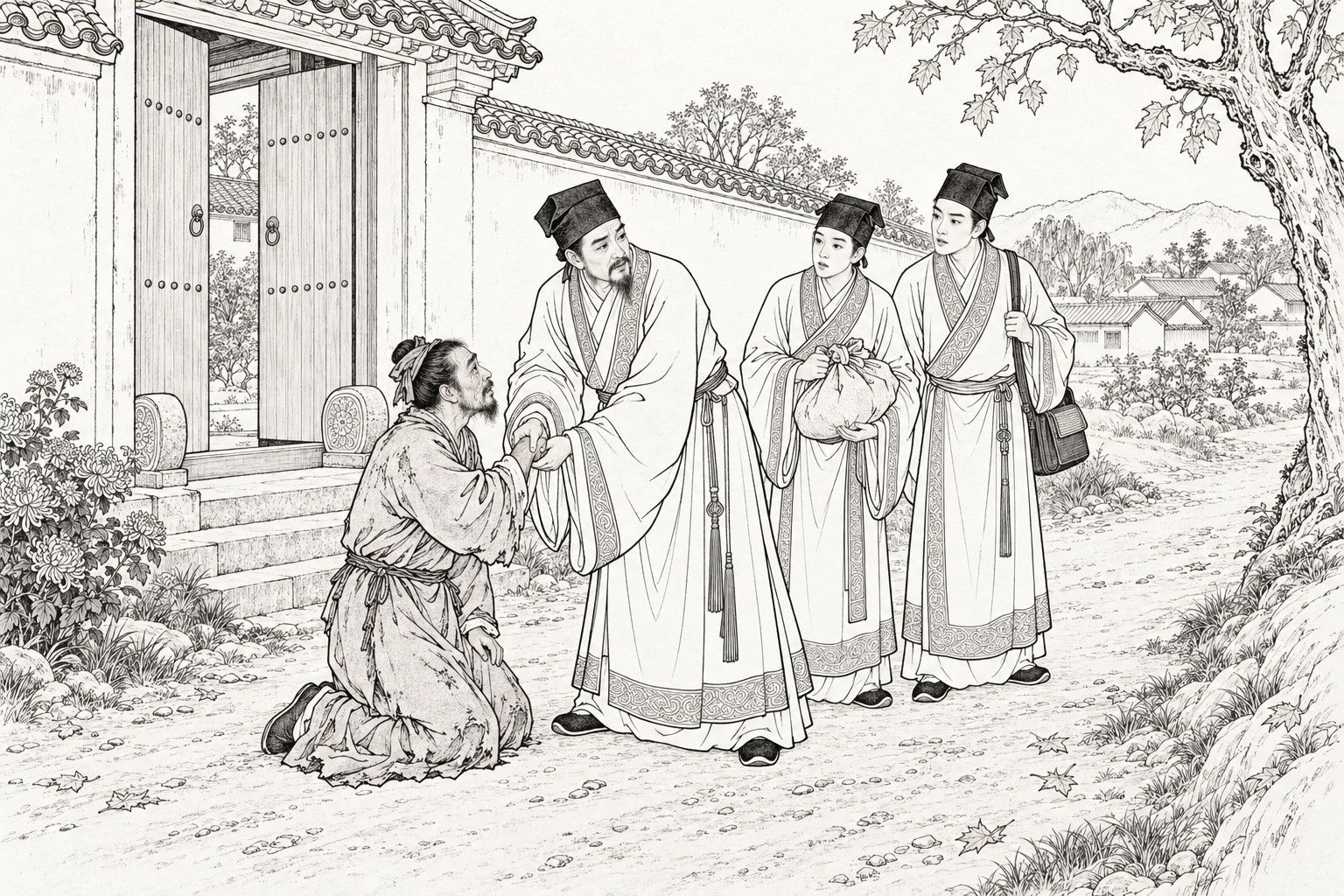
曾翁,昆陽故家也。翁初死未殮,兩眶中淚出如瀋,有子六,莫解所以。次子悌,字友于,邑名士,以為不祥,戒諸兄弟各自惕,勿貽痛於先人;而兄弟半迂笑之。先是,翁嫡配生長子成,至七八歲,母子為強寇擄去。娶繼室,生三子:曰孝,曰忠,曰信。妾生三子:曰悌,曰仁,曰義。孝以悌等出身賤,鄙不齒,因連結忠、信為黨。即與客飲,悌等過堂下,亦傲不為禮。仁、義皆忿,與友于謀,欲相仇。友于百詞寬譬,不從所謀;而仁、義年最少,因兄言,亦遂止。孝有女,適邑周氏,病死。糾悌等往撻其姑,悌不從。孝憤然,令忠、信合族中無賴子,往捉周妻,搒掠無算,拋粟毀器,盎盂無存。周告官。官怒,拘孝等囚繫之,將行申黜。友于懼,見宰自投。友于品行,素為宰重,諸兄弟以是得無苦。友于乃詣周所負荊,周亦器重友于,訟遂止。孝歸,終不德友于。無何,友于母張夫人卒,孝等不為服,宴飲如故。仁、義益忿。友于曰:「此彼之無禮,於我何損焉。」及葬,把持墓門,不使合厝。友于乃瘞母隧道中。未幾,孝妻亡,友于招仁、義同往奔喪。二人曰:「『期』且不論,『功』于何有!」再勸之,鬨然散去。友于乃自往,臨哭盡哀。隔牆聞仁、義鼓且吹,孝怒,糾諸弟往毆之。友于操杖先從。入其家,仁覺先逃。義方踰垣,友于自後擊仆之。孝等拳杖交加,毆不止。友于橫身障阻之。孝怒,讓友于。友于曰:「責之者,以其無禮也,然罪固不至死。我不怙弟惡,亦不助兄暴。如怒不解,身代之。」孝遂反杖撻友于,忠、信亦相助毆兄,聲震里黨,群集勸解,乃散去。友于即扶杖詣兄請罪。孝逐去之,不令居喪次。而義創甚,不復食飲。仁代具詞訟官,訴其不為庶母行服。官簽拘孝、忠、信,而令友于陳狀。友于以面目損傷,不能詣署,但作詞稟白,哀求寢息,宰遂銷案。義亦尋愈。由是仇怨益深。仁、義皆幼弱,輒被敲楚。怨友于曰:「人皆有兄弟,我獨無!」友于曰:「此兩語,我宜言之,兩弟何云!」因苦勸之,卒不聽。友于遂扃戶,攜妻子借寓他所,離家五十餘里,冀不相聞。友于在家,雖不助弟,而孝等尚稍有顧忌;既去,諸兄一不當,輒叫罵其門,辱侵母諱。仁、義度不能抗,惟杜門思乘間刺殺之,行則懷刃。一日,寇所掠長兄成,忽攜婦亡歸。諸兄弟以家久析,聚謀三日,竟無處可以置之。仁、義竊喜,招去共養之。往告友于。友于喜,歸,共出田宅居成。諸兄怒其市惠,登門窘辱。而成久在寇中,習於威猛,大怒曰:「我歸,更無人肯置一屋;幸三弟念手足,又罪責之。是欲逐我耶!」以石投孝,孝仆。仁、義各以杖出,捉忠、信,撻無數。成乃訟宰,宰又使人請教友于。友于詣宰,俛首不言,但有流涕。宰問之,曰:「惟求公斷。」宰乃判孝等各出田產歸成,使七分相準。自此仁、義與成倍加愛敬,談及葬母事,因並泣下。成恚曰:「如此不仁,真禽獸也!」遂欲啟壙,更為改葬。仁奔告友于,友于急歸諫止。成不聽,刻期發墓,作齋於塋。以刀削樹,謂諸弟曰:「所不衰麻相從者,有如此樹!」眾唯唯。於是一門皆哭臨,安厝盡禮。自此兄弟相安。而成性剛烈,輒批撻諸弟,於孝尤甚。惟重友于,雖盛怒,友于至,一言即解。孝有所行,成輒不平之,故孝無一日不至友于所,潛對友于詬詛。友于婉諫,卒不納。友于不堪其擾,又遷居三泊,去家益遠,音跡遂疏。又二年,諸弟皆畏成,久而相習。而孝年四十六,生五子:長繼業,三繼德,嫡出;次繼功,四繼績,庶出;又婢生繼祖。皆成立。效父舊行,各為黨,日相競,孝亦不能呵止。惟祖無兄弟,年又最幼,諸兄皆得而詬厲之。岳家近三泊,會詣岳,迂道詣叔。入門,見叔家兩兄一弟,絃誦怡怡,樂之,久居不言歸。叔促之,哀求寄居。叔曰:「汝父母皆不知,我豈惜甌飯瓢飲乎!」乃歸。過數月,夫妻往壽岳母。告父曰:「兒此行不歸矣。」父詰之,因吐微隱。父慮與叔有夙隙,計難久居。祖曰:「父慮過矣。二叔,聖賢也。」遂去,攜妻之三泊。友于除舍居之,以齒兒行,使執卷從長子繼善。祖最慧,寄籍三泊年餘,入雲南郡庠。與善閉戶研讀,祖又諷誦最苦。友于甚愛之。自祖居三泊,家中兄弟益不相能。一日,微反脣,業詬辱庶母。功怒,刺殺業。官收功,重械之,數日死獄中。業妻馮氏,猶日以罵代哭。功妻劉聞之,怒曰:「汝家男子死,誰家男子活耶!」操刀入,擊殺馮,自投井死。馮父大立,悼女死慘,率諸子弟,藏兵衣底,往捉孝妻,裸撻道上以辱之。成怒曰:「我家死人如麻,馮氏何得復爾!」吼奔而出。諸曾從之,諸馮盡靡。成首捉大立,割其兩耳。其子護救,繼、績以鐵杖橫擊,折其兩股。諸馮各被夷傷,鬨然盡散。惟馮子猶臥道周。成夾之以肘,置諸馮村而還。遂呼績詣官自首。馮狀亦至。於是諸曾被收。惟忠亡去,至三泊,徘徊門外。適友于率一子一姪鄉試歸,見忠,驚曰:「弟何來?」忠未語先淚,長跪道左。友于握手曳入,詰得其情,大驚曰:「似此奈何!然一門乖戾,逆知奇禍久矣;不然,我何以竄蹟至此。但我離家久,與大令無聲氣之通,今即蒲伏而往,徒取辱耳。但得馮父子傷重不死,吾三人中倖有捷者,則此禍或可少解。」乃留之,晝與同餐,夜與共寢。忠頗感愧。居十餘日,見其叔姪如父子,兄弟如同胞,悽然下淚曰:「今始知從前非人也。」友于喜其悔悟,相對酸惻。俄報友于父子同科,祖亦副榜。大喜。不赴鹿鳴,先歸展墓。明季科甲最重,諸馮皆為斂息。友于乃託親友賂以金粟,資其醫藥,訟乃息。舉家泣感友于,求其復歸。友于乃與兄弟焚香約誓,俾各滌慮自新,遂移家還。祖從叔不願歸其家。孝乃謂友于曰:「我不德,不應有亢宗之子;弟又善教,俾姑為汝子。有寸進時,可賜還也。」友于從之。又三年,祖果舉於鄉。使移家去,夫妻皆痛哭而去。不數日,祖有子方三歲,亡歸友于家,藏繼善室,不肯返;捉去輒逃。孝乃令祖異居,與友于鄰。祖開戶通叔家。兩間定省如一焉。時成漸老,家事皆取決於友于。從此門庭雍穆,稱孝友焉。
曾老翁出身昆陽的世家。他剛去世,還沒有入殮,兩隻眼眶裡便流出汁液般的淚水。他有六個兒子,誰也不明白這是為什麼。次子曾悌,字友于,是縣裡有名的讀書人,認為這是不祥的徵兆,告誡兄弟們各自警醒,不要讓亡父傷心;兄弟中卻有一半人笑他迂腐。早先,曾老翁的正妻生下長子成。成七八歲時,母子倆被強盜擄走。老翁又娶了繼室,生下三個兒子,叫孝、忠、信;妾也生下三個兒子,叫悌、仁、義。孝認為悌等人出身低賤,瞧不起他們,不肯把他們當成平等的兄弟,便和忠、信結成一夥。即使他正和客人喝酒,悌等人從堂下經過,他也傲慢無禮,不肯招呼。仁、義都很氣憤,和友于商量,想報復他們。友于百般勸解,不肯同意;仁、義年紀最小,聽了哥哥的話,也就作罷。孝有個女兒,嫁給縣裡的周家,後來病死了。孝召集悌等人,要去打女兒的婆婆,悌不肯跟著去。孝氣憤地叫忠、信糾集族裡的無賴,前去抓住周家的妻子,打得不知多少下,又把糧食撒得滿地都是,砸毀器具,連一個盆碗都沒留下。周家告到官府。縣令大怒,把孝等人抓來關進牢裡,準備申報革除他們的功名。友于害怕了,主動到縣令面前投案。縣令一向看重友于的品行,兄弟們因此沒有受到嚴厲懲治。友于又到周家負荊請罪,周家也敬重友于,官司便停止了。孝回家後,卻始終不感激友于。不久,友于的母親張夫人去世,孝等人不肯為她服喪,仍像平日一樣宴飲。仁、義更加氣憤。友于說:「這是他們失禮,對我們有什麼損害呢?」等到下葬,孝等人守住墓門,不許張夫人與父親合葬,友于便把母親埋在墓道里。不久,孝的妻子去世,友于叫仁、義一起去奔喪。兩人說:「他們連一年之喪都不講,還談什麼九個月之喪!」友于再次勸他們,他們吵嚷著走開了。友于便獨自前往,在靈前哭得十分悲痛。隔著牆,卻傳來仁、義敲鼓吹樂的聲音。孝大怒,召集幾個弟弟去打他們。友于拿著木杖,走在前面跟著去了。進了他們家,仁察覺後先逃了。義正在翻牆,友于從後面把他打倒。孝等人拳腳木杖一齊落下,打個不停。友于橫身護住義,擋著他們。孝生氣地責備友于。友于說:「責罰他,是因為他失禮,可他的罪本來不至於死。我不偏袒弟弟的過錯,也不幫助哥哥施暴。你們要是還不解氣,就打我吧。」孝便轉過木杖打友于,忠、信也上來一起毆打哥哥。吵鬧聲驚動了鄰里,眾人聚來勸解,他們才散去。友于隨即拄著木杖,到哥哥那裡請罪。孝卻把他趕走,不許他留在守喪的地方。義傷得很重,再也吃不下東西,喝不下水。仁替他寫了訴狀,到官府控告孝等人不為父親的妾服喪。縣令發下拘票,抓捕孝、忠、信,又命友于陳述事情經過。友于臉上受了傷,不能到衙門去,只寫了一份稟狀說明情況,苦苦請求停止追究,縣令便撤了案。義也很快好了。從此,兄弟之間的仇怨越來越深。仁、義年紀小,勢力弱,動不動就捱打。他們埋怨友于說:「別人都有兄弟,偏偏我們沒有!」友于說:「這兩句話,該由我來說,你們兩個怎麼倒說起來了!」他苦苦勸說,兩人始終不聽。友于便鎖上家門,帶著妻子兒女到別處借住,離家五十多里,希望不再聽到這些事。友于在家時,雖然不幫助弟弟們,孝等人還稍有顧忌;他走後,幾個哥哥稍有不順心,就到仁、義門前叫罵,連他們母親的名字也拿來辱罵。仁、義知道自己抗不過他們,只好關著門,想著乘機把他們刺死,出門就帶著刀。一天,被強盜擄走的長兄成,忽然帶著妻子逃了回來。兄弟們因為家產早已分過,聚在一起商量了三天,竟沒有一處地方可以安置他。仁、義暗自高興,把成請去,兩人共同供養他,又去告訴友于。友于很高興,回到家裡,和他們一起拿出田地房屋,安頓成住下。幾個哥哥惱恨他們藉此討好成,登門刁難辱罵。成在強盜中生活了很久,習慣了威勢和強硬手段,便大怒說:「我回來了,竟沒有一個人肯給我一間房子。幸虧三個弟弟顧念手足之情,你們又來責罵他們。你們這是要趕我走嗎!」他拿石頭砸孝,把孝砸倒了。仁、義各自拿著木杖出來,抓住忠、信,不知打了多少下。成又告到縣令那裡,縣令再次派人徵求友于的意見。友于來到縣令面前,低著頭,一句話也不說,只是流淚。縣令問他,他說:「只求您公正裁決。」縣令便判孝等人各自拿出田產給成,使七個人的份額相等。從此,仁、義對成更加親愛敬重。談起母親下葬的事,幾個人一同流下淚來。成憤怒地說:「這樣不仁不義,真是禽獸!」於是打算打開墓穴,重新安葬張夫人。仁跑去告訴友于,友于急忙回來勸阻。成不聽,定下開墓的日期,在墓地舉行齋祭。他用刀砍著樹,對弟弟們說:「誰不穿上喪服,跟著來送葬,就像這棵樹一樣!」眾人連聲答應。於是全家都來到靈前哭祭,按照禮數重新安葬了張夫人。從此兄弟們相處安穩了。然而成性情剛烈,動不動就打弟弟們,尤其對孝厲害。他只敬重友于,即使正在大發脾氣,只要友于來了,說一句話,他就消氣。孝做什麼事,成常常看不順眼,所以孝沒有一天不到友于家裡,私下對著友于咒罵成。友于委婉勸他,他始終不聽。友于受不了他的糾纏,又搬到三泊,離家更遠,彼此的來往和訊息便少了。又過了兩年,弟弟們都很怕成,時間一久,也就習慣了。這時孝四十六歲,生有五個兒子:長子繼業、三子繼德,是正妻所生;次子繼功、四子繼績,是妾所生;還有一個婢女所生的繼祖。他們都已長大成人,學著父親過去的做法,各自結夥,每天爭鬥,孝也喝止不了。只有繼祖沒有同母兄弟,年紀又最小,幾個哥哥都可以辱罵欺負他。他岳父家離三泊很近,一回他去看望岳父,便繞路拜訪叔父。進門後,他看見叔父家的兩個哥哥和一個弟弟,彈琴讀書,和睦快樂,十分羨慕,住了很久也不提回家。叔父催他回去,他苦苦請求留下。叔父說:「你父母都不知道,我哪裡是捨不得你吃一碗飯、喝一瓢水呢!」他這才回家。幾個月後,他和妻子去給岳母祝壽,對父親說:「我這次出去,就不回來了。」父親追問,他才說出藏在心裡的打算。父親想到自己和友于素有嫌隙,擔心他無法長住。繼祖說:「父親多慮了。二叔是個聖賢。」於是帶著妻子去了三泊。友于收拾房屋讓他們住下,把繼祖按年齡排在自己的兒子中,讓他拿著書,跟長子繼善一起學習。繼祖非常聰明,遷籍三泊一年多後,考進了雲南府學。他和繼善關起門來鑽研學業,繼祖在誦讀上尤其刻苦,友于非常喜愛他。繼祖住到三泊以後,家裡的兄弟們越發不能相容。一天,兄弟間稍有幾句爭執,繼業便辱罵父親的妾。繼功大怒,刺死了繼業。官府抓了繼功,給他戴上沉重的刑具,幾天後他死在牢裡。繼業的妻子馮氏,仍每天以叫罵代替哭泣。繼功的妻子劉氏聽了,憤怒地說:「你家的男人死了,誰家的男人還活著呢!」她拿刀闖進去,殺了馮氏,自己又投井而死。馮氏的父親馮大立悲痛女兒死得悽慘,帶著兒子侄輩,把兵器藏在衣服下面,去抓住孝的妻子,在路上剝光衣服毆打她,羞辱她。成大怒,說:「我家死人已經這麼多,馮家怎麼還能這樣!」便吼叫著衝了出去。曾家眾人跟著他,馮家人全被打退。成先抓住馮大立,割掉他的兩隻耳朵。馮大立的兒子前來救護,繼德、繼績揮起鐵杖橫掃過去,打斷了他的兩條大腿。馮家人個個受傷,吵嚷著四散逃走,只有馮家的兒子還躺在路邊。成用胳膊夾著他,把他送到馮家村,便回來了,接著叫繼績去官府自首。馮家的訴狀也到了,於是曾家眾人都被抓了起來。只有忠逃走,來到三泊,在友于門外徘徊。恰好友于帶著一個兒子和一個侄子參加鄉試回來,看見忠,吃驚地說:「弟弟怎麼來了?」忠還沒說話,就先流下淚來,直挺挺地跪在路邊。友于握著他的手,把他拉進屋,問明瞭事情經過,大驚說:「弄成這樣,怎麼辦才好!不過,一家人乖戾不和,我早就知道遲早會有大禍,否則我為什麼要遠遠躲到這裡來?只是我離家已久,和縣令沒有來往,如今即使爬著去求他,也不過是自取羞辱。只要馮家父子傷得雖重,卻沒有死,我們三個人中又有誰僥倖考中,這場禍事或許還能減輕一些。」於是把忠留下,白天一起吃飯,夜裡一起睡覺。忠很受感動,也十分慚愧。住了十多天,他見友于叔侄相處如同父子,幾個兄弟相處如同一母所生,便悲傷地流著淚說:「我現在才知道,自己從前簡直不是人。」友于很高興他能悔悟,兩人相對,都感到辛酸悲痛。不久傳來訊息,友于父子在同一科鄉試中考中了舉人,繼祖也列入了副榜。大家非常高興,沒有參加鹿鳴宴,先回鄉祭掃祖墳。明朝末年極看重科舉功名,馮家人因此都收斂了。友于便托親友送給他們錢糧,負擔他們治傷的醫藥費用,官司這才停止。全家人流著淚感激友于,請求他搬回來。友于便和兄弟們焚香立誓,讓大家各自清除舊念,重新做人,這才把全家搬回來。繼祖跟著叔父,不願回自己家。孝便對友于說:「我沒有德行,不配有能光耀家門的兒子。弟弟又善於教導,暫且讓他做你的兒子吧。等他有些進步時,你再把他還給我。」友于答應了。又過了三年,繼祖果然考中了舉人。友于讓他搬回家,他和妻子都痛哭著離開。沒過幾天,繼祖那個才三歲的兒子便偷偷跑回友于家,藏在繼善的屋裡,不肯回去;把他抓回去,他又逃出來。孝便讓繼祖另住一處,和友于做鄰居。繼祖開了一道門,通往叔父家,對兩家都一樣早晚問候。這時成漸漸老了,家裡的事都交給友于決定。從此全家和睦安寧,被人稱讚孝順友愛。
曾翁,昆阳故家也。翁初死未殓,两眶中泪出如沈,有子六,莫解所以。次子悌,字友于,邑名士,以为不祥,戒诸兄弟各自惕,勿贻痛于先人;而兄弟半迂笑之。先是,翁嫡配生长子成,至七八岁,母子为强寇掳去。娶继室,生三子:曰孝,曰忠,曰信。妾生三子:曰悌,曰仁,曰义。孝以悌等出身贱,鄙不齿,因连结忠、信为党。即与客饮,悌等过堂下,亦傲不为礼。仁、义皆忿,与友于谋,欲相仇。友于百词宽譬,不从所谋;而仁、义年最少,因兄言,亦遂止。孝有女,适邑周氏,病死。纠悌等往挞其姑,悌不从。孝愤然,令忠、信合族中无赖子,往捉周妻,搒掠无算,抛粟毁器,盎盂无存。周告官。官怒,拘孝等囚系之,将行申黜。友于惧,见宰自投。友于品行,素为宰重,诸兄弟以是得无苦。友于乃诣周所负荆,周亦器重友于,讼遂止。孝归,终不德友于。无何,友于母张夫人卒,孝等不为服,宴饮如故。仁、义益忿。友于曰:「此彼之无礼,于我何损焉。」及葬,把持墓门,不使合厝。友于乃瘗母隧道中。未几,孝妻亡,友于招仁、义同往奔丧。二人曰:「『期』且不论,『功』于何有!」再劝之,哄然散去。友于乃自往,临哭尽哀。隔墙闻仁、义鼓且吹,孝怒,纠诸弟往殴之。友于操杖先从。入其家,仁觉先逃。义方逾垣,友于自后击仆之。孝等拳杖交加,殴不止。友于横身障阻之。孝怒,让友于。友于曰:「责之者,以其无礼也,然罪固不至死。我不怙弟恶,亦不助兄暴。如怒不解,身代之。」孝遂反杖挞友于,忠、信亦相助殴兄,声震里党,群集劝解,乃散去。友于即扶杖诣兄请罪。孝逐去之,不令居丧次。而义创甚,不复食饮。仁代具词讼官,诉其不为庶母行服。官签拘孝、忠、信,而令友于陈状。友于以面目损伤,不能诣署,但作词禀白,哀求寝息,宰遂销案。义亦寻愈。由是仇怨益深。仁、义皆幼弱,辄被敲楚。怨友于曰:「人皆有兄弟,我独无!」友于曰:「此两语,我宜言之,两弟何云!」因苦劝之,卒不听。友于遂扃户,携妻子借寓他所,离家五十余里,冀不相闻。友于在家,虽不助弟,而孝等尚稍有顾忌;既去,诸兄一不当,辄叫骂其门,辱侵母讳。仁、义度不能抗,惟杜门思乘间刺杀之,行则怀刃。一日,寇所掠长兄成,忽携妇亡归。诸兄弟以家久析,聚谋三日,竟无处可以置之。仁、义窃喜,招去共养之。往告友于。友于喜,归,共出田宅居成。诸兄怒其市惠,登门窘辱。而成久在寇中,习于威猛,大怒曰:「我归,更无人肯置一屋;幸三弟念手足,又罪责之。是欲逐我耶!」以石投孝,孝仆。仁、义各以杖出,捉忠、信,挞无数。成乃讼宰,宰又使人请教友于。友于诣宰,俛首不言,但有流涕。宰问之,曰:「惟求公断。」宰乃判孝等各出田产归成,使七分相准。自此仁、义与成倍加爱敬,谈及葬母事,因并泣下。成恚曰:「如此不仁,真禽兽也!」遂欲启圹,更为改葬。仁奔告友于,友于急归谏止。成不听,刻期发墓,作斋于茔。以刀削树,谓诸弟曰:「所不衰麻相从者,有如此树!」众唯唯。于是一门皆哭临,安厝尽礼。自此兄弟相安。而成性刚烈,辄批挞诸弟,于孝尤甚。惟重友于,虽盛怒,友于至,一言即解。孝有所行,成辄不平之,故孝无一日不至友于所,潜对友于诟诅。友于婉谏,卒不纳。友于不堪其扰,又迁居三泊,去家益远,音迹遂疏。又二年,诸弟皆畏成,久而相习。而孝年四十六,生五子:长继业,三继德,嫡出;次继功,四继绩,庶出;又婢生继祖。皆成立。效父旧行,各为党,日相竞,孝亦不能呵止。惟祖无兄弟,年又最幼,诸兄皆得而诟厉之。岳家近三泊,会诣岳,迂道诣叔。入门,见叔家两兄一弟,弦诵怡怡,乐之,久居不言归。叔促之,哀求寄居。叔曰:「汝父母皆不知,我岂惜瓯饭瓢饮乎!」乃归。过数月,夫妻往寿岳母。告父曰:「儿此行不归矣。」父诘之,因吐微隐。父虑与叔有夙隙,计难久居。祖曰:「父虑过矣。二叔,圣贤也。」遂去,携妻之三泊。友于除舍居之,以齿儿行,使执卷从长子继善。祖最慧,寄籍三泊年余,入云南郡庠。与善闭户研读,祖又讽诵最苦。友于甚爱之。自祖居三泊,家中兄弟益不相能。一日,微反唇,业诟辱庶母。功怒,刺杀业。官收功,重械之,数日死狱中。业妻冯氏,犹日以骂代哭。功妻刘闻之,怒曰:「汝家男子死,谁家男子活耶!」操刀入,击杀冯,自投井死。冯父大立,悼女死惨,率诸子弟,藏兵衣底,往捉孝妻,裸挞道上以辱之。成怒曰:「我家死人如麻,冯氏何得复尔!」吼奔而出。诸曾从之,诸冯尽靡。成首捉大立,割其两耳。其子护救,继、绩以铁杖横击,折其两股。诸冯各被夷伤,哄然尽散。惟冯子犹卧道周。成夹之以肘,置诸冯村而还。遂呼绩诣官自首。冯状亦至。于是诸曾被收。惟忠亡去,至三泊,徘徊门外。适友于率一子一姪乡试归,见忠,惊曰:「弟何来?」忠未语先泪,长跪道左。友于握手曳入,诘得其情,大惊曰:「似此奈何!然一门乖戾,逆知奇祸久矣;不然,我何以窜迹至此。但我离家久,与大令无声气之通,今即蒲伏而往,徒取辱耳。但得冯父子伤重不死,吾三人中幸有捷者,则此祸或可少解。」乃留之,昼与同餐,夜与共寝。忠颇感愧。居十余日,见其叔姪如父子,兄弟如同胞,凄然下泪曰:「今始知从前非人也。」友于喜其悔悟,相对酸恻。俄报友于父子同科,祖亦副榜。大喜。不赴鹿鸣,先归展墓。明季科甲最重,诸冯皆为敛息。友于乃托亲友赂以金粟,资其医药,讼乃息。举家泣感友于,求其复归。友于乃与兄弟焚香约誓,俾各涤虑自新,遂移家还。祖从叔不愿归其家。孝乃谓友于曰:「我不德,不应有亢宗之子;弟又善教,俾姑为汝子。有寸进时,可赐还也。」友于从之。又三年,祖果举于乡。使移家去,夫妻皆痛哭而去。不数日,祖有子方三岁,亡归友于家,藏继善室,不肯返;捉去辄逃。孝乃令祖异居,与友于邻。祖开户通叔家。两间定省如一焉。时成渐老,家事皆取决于友于。从此门庭雍穆,称孝友焉。
曾老翁出身昆阳的世家。他刚去世,还没有入殓,两只眼眶里便流出汁液般的泪水。他有六个儿子,谁也不明白这是为什么。次子曾悌,字友于,是县里有名的读书人,认为这是不祥的征兆,告诫兄弟们各自警醒,不要让亡父伤心;兄弟中却有一半人笑他迂腐。早先,曾老翁的正妻生下长子成。成七八岁时,母子俩被强盗掳走。老翁又娶了继室,生下三个儿子,叫孝、忠、信;妾也生下三个儿子,叫悌、仁、义。孝认为悌等人出身低贱,瞧不起他们,不肯把他们当成平等的兄弟,便和忠、信结成一伙。即使他正和客人喝酒,悌等人从堂下经过,他也傲慢无礼,不肯招呼。仁、义都很气愤,和友于商量,想报复他们。友于百般劝解,不肯同意;仁、义年纪最小,听了哥哥的话,也就作罢。孝有个女儿,嫁给县里的周家,后来病死了。孝召集悌等人,要去打女儿的婆婆,悌不肯跟着去。孝气愤地叫忠、信纠集族里的无赖,前去抓住周家的妻子,打得不知多少下,又把粮食撒得满地都是,砸毁器具,连一个盆碗都没留下。周家告到官府。县令大怒,把孝等人抓来关进牢里,准备申报革除他们的功名。友于害怕了,主动到县令面前投案。县令一向看重友于的品行,兄弟们因此没有受到严厉惩治。友于又到周家负荆请罪,周家也敬重友于,官司便停止了。孝回家后,却始终不感激友于。不久,友于的母亲张夫人去世,孝等人不肯为她服丧,仍像平日一样宴饮。仁、义更加气愤。友于说:“这是他们失礼,对我们有什么损害呢?”等到下葬,孝等人守住墓门,不许张夫人与父亲合葬,友于便把母亲埋在墓道里。不久,孝的妻子去世,友于叫仁、义一起去奔丧。两人说:“他们连一年之丧都不讲,还谈什么九个月之丧!”友于再次劝他们,他们吵嚷着走开了。友于便独自前往,在灵前哭得十分悲痛。隔着墙,却传来仁、义敲鼓吹乐的声音。孝大怒,召集几个弟弟去打他们。友于拿着木杖,走在前面跟着去了。进了他们家,仁察觉后先逃了。义正在翻墙,友于从后面把他打倒。孝等人拳脚木杖一齐落下,打个不停。友于横身护住义,挡着他们。孝生气地责备友于。友于说:“责罚他,是因为他失礼,可他的罪本来不至于死。我不偏袒弟弟的过错,也不帮助哥哥施暴。你们要是还不解气,就打我吧。”孝便转过木杖打友于,忠、信也上来一起殴打哥哥。吵闹声惊动了邻里,众人聚来劝解,他们才散去。友于随即拄着木杖,到哥哥那里请罪。孝却把他赶走,不许他留在守丧的地方。义伤得很重,再也吃不下东西,喝不下水。仁替他写了诉状,到官府控告孝等人不为父亲的妾服丧。县令发下拘票,抓捕孝、忠、信,又命友于陈述事情经过。友于脸上受了伤,不能到衙门去,只写了一份禀状说明情况,苦苦请求停止追究,县令便撤了案。义也很快好了。从此,兄弟之间的仇怨越来越深。仁、义年纪小,势力弱,动不动就挨打。他们埋怨友于说:“别人都有兄弟,偏偏我们没有!”友于说:“这两句话,该由我来说,你们两个怎么倒说起来了!”他苦苦劝说,两人始终不听。友于便锁上家门,带着妻子儿女到别处借住,离家五十多里,希望不再听到这些事。友于在家时,虽然不帮助弟弟们,孝等人还稍有顾忌;他走后,几个哥哥稍有不顺心,就到仁、义门前叫骂,连他们母亲的名字也拿来辱骂。仁、义知道自己抗不过他们,只好关着门,想着乘机把他们刺死,出门就带着刀。一天,被强盗掳走的长兄成,忽然带着妻子逃了回来。兄弟们因为家产早已分过,聚在一起商量了三天,竟没有一处地方可以安置他。仁、义暗自高兴,把成请去,两人共同供养他,又去告诉友于。友于很高兴,回到家里,和他们一起拿出田地房屋,安顿成住下。几个哥哥恼恨他们借此讨好成,登门刁难辱骂。成在强盗中生活了很久,习惯了威势和强硬手段,便大怒说:“我回来了,竟没有一个人肯给我一间房子。幸亏三个弟弟顾念手足之情,你们又来责骂他们。你们这是要赶我走吗!”他拿石头砸孝,把孝砸倒了。仁、义各自拿着木杖出来,抓住忠、信,不知打了多少下。成又告到县令那里,县令再次派人征求友于的意见。友于来到县令面前,低着头,一句话也不说,只是流泪。县令问他,他说:“只求您公正裁决。”县令便判孝等人各自拿出田产给成,使七个人的份额相等。从此,仁、义对成更加亲爱敬重。谈起母亲下葬的事,几个人一同流下泪来。成愤怒地说:“这样不仁不义,真是禽兽!”于是打算打开墓穴,重新安葬张夫人。仁跑去告诉友于,友于急忙回来劝阻。成不听,定下开墓的日期,在墓地举行斋祭。他用刀砍着树,对弟弟们说:“谁不穿上丧服,跟着来送葬,就像这棵树一样!”众人连声答应。于是全家都来到灵前哭祭,按照礼数重新安葬了张夫人。从此兄弟们相处安稳了。然而成性情刚烈,动不动就打弟弟们,尤其对孝厉害。他只敬重友于,即使正在大发脾气,只要友于来了,说一句话,他就消气。孝做什么事,成常常看不顺眼,所以孝没有一天不到友于家里,私下对着友于咒骂成。友于委婉劝他,他始终不听。友于受不了他的纠缠,又搬到三泊,离家更远,彼此的来往和消息便少了。又过了两年,弟弟们都很怕成,时间一久,也就习惯了。这时孝四十六岁,生有五个儿子:长子继业、三子继德,是正妻所生;次子继功、四子继绩,是妾所生;还有一个婢女所生的继祖。他们都已长大成人,学着父亲过去的做法,各自结伙,每天争斗,孝也喝止不了。只有继祖没有同母兄弟,年纪又最小,几个哥哥都可以辱骂欺负他。他岳父家离三泊很近,一回他去看望岳父,便绕路拜访叔父。进门后,他看见叔父家的两个哥哥和一个弟弟,弹琴读书,和睦快乐,十分羡慕,住了很久也不提回家。叔父催他回去,他苦苦请求留下。叔父说:“你父母都不知道,我哪里是舍不得你吃一碗饭、喝一瓢水呢!”他这才回家。几个月后,他和妻子去给岳母祝寿,对父亲说:“我这次出去,就不回来了。”父亲追问,他才说出藏在心里的打算。父亲想到自己和友于素有嫌隙,担心他无法长住。继祖说:“父亲多虑了。二叔是个圣贤。”于是带着妻子去了三泊。友于收拾房屋让他们住下,把继祖按年龄排在自己的儿子中,让他拿着书,跟长子继善一起学习。继祖非常聪明,迁籍三泊一年多后,考进了云南府学。他和继善关起门来钻研学业,继祖在诵读上尤其刻苦,友于非常喜爱他。继祖住到三泊以后,家里的兄弟们越发不能相容。一天,兄弟间稍有几句争执,继业便辱骂父亲的妾。继功大怒,刺死了继业。官府抓了继功,给他戴上沉重的刑具,几天后他死在牢里。继业的妻子冯氏,仍每天以叫骂代替哭泣。继功的妻子刘氏听了,愤怒地说:“你家的男人死了,谁家的男人还活着呢!”她拿刀闯进去,杀了冯氏,自己又投井而死。冯氏的父亲冯大立悲痛女儿死得凄惨,带着儿子侄辈,把兵器藏在衣服下面,去抓住孝的妻子,在路上剥光衣服殴打她,羞辱她。成大怒,说:“我家死人已经这么多,冯家怎么还能这样!”便吼叫着冲了出去。曾家众人跟着他,冯家人全被打退。成先抓住冯大立,割掉他的两只耳朵。冯大立的儿子前来救护,继德、继绩挥起铁杖横扫过去,打断了他的两条大腿。冯家人个个受伤,吵嚷着四散逃走,只有冯家的儿子还躺在路边。成用胳膊夹着他,把他送到冯家村,便回来了,接着叫继绩去官府自首。冯家的诉状也到了,于是曾家众人都被抓了起来。只有忠逃走,来到三泊,在友于门外徘徊。恰好友于带着一个儿子和一个侄子参加乡试回来,看见忠,吃惊地说:“弟弟怎么来了?”忠还没说话,就先流下泪来,直挺挺地跪在路边。友于握着他的手,把他拉进屋,问明了事情经过,大惊说:“弄成这样,怎么办才好!不过,一家人乖戾不和,我早就知道迟早会有大祸,否则我为什么要远远躲到这里来?只是我离家已久,和县令没有来往,如今即使爬着去求他,也不过是自取羞辱。只要冯家父子伤得虽重,却没有死,我们三个人中又有谁侥幸考中,这场祸事或许还能减轻一些。”于是把忠留下,白天一起吃饭,夜里一起睡觉。忠很受感动,也十分惭愧。住了十多天,他见友于叔侄相处如同父子,几个兄弟相处如同一母所生,便悲伤地流着泪说:“我现在才知道,自己从前简直不是人。”友于很高兴他能悔悟,两人相对,都感到辛酸悲痛。不久传来消息,友于父子在同一科乡试中考中了举人,继祖也列入了副榜。大家非常高兴,没有参加鹿鸣宴,先回乡祭扫祖坟。明朝末年极看重科举功名,冯家人因此都收敛了。友于便托亲友送给他们钱粮,负担他们治伤的医药费用,官司这才停止。全家人流着泪感激友于,请求他搬回来。友于便和兄弟们焚香立誓,让大家各自清除旧念,重新做人,这才把全家搬回来。继祖跟着叔父,不愿回自己家。孝便对友于说:“我没有德行,不配有能光耀家门的儿子。弟弟又善于教导,暂且让他做你的儿子吧。等他有些进步时,你再把他还给我。”友于答应了。又过了三年,继祖果然考中了举人。友于让他搬回家,他和妻子都痛哭着离开。没过几天,继祖那个才三岁的儿子便偷偷跑回友于家,藏在继善的屋里,不肯回去;把他抓回去,他又逃出来。孝便让继祖另住一处,和友于做邻居。继祖开了一道门,通往叔父家,对两家都一样早晚问候。这时成渐渐老了,家里的事都交给友于决定。从此全家和睦安宁,被人称赞孝顺友爱。
Old Mr. Zeng came of an old family of Kunyang. When he had just died and was not yet laid in his coffin, tears ran like sap from both his eye sockets. He had six sons, and none of them could make out what it meant. The second son, Zeng Ti, styled Youyu, was a well-known scholar in the county. He took it for an ill omen and warned his brothers each to watch himself and not bring grief on their late father. Half the brothers laughed at him for a pedant. Long before this, the old man’s first wife had borne him his eldest son, Cheng. When the boy was seven or eight, mother and son were carried off by bandits. Mr. Zeng married again, and his second wife bore him three sons: Xiao, Zhong and Xin. A concubine bore him three more: Ti, Ren and Yi. Because Youyu and his brothers were of low birth, Xiao despised them and would not count them as equals, and he joined with Zhong and Xin in a faction. Even when he was drinking with guests and Youyu and the others passed below the hall, he would not deign to greet them. Ren and Yi were both indignant. They went to Youyu with a plan to pay them back. Youyu used every argument he could to calm them and would have no part in it. Ren and Yi were the youngest, and at their brother’s word they too let it go. Xiao had a daughter who married into a Zhou family of the county and died of an illness. Xiao rounded up Youyu and the others to go and beat her mother-in-law. Youyu would not go. Xiao, in a rage, had Zhong and Xin gather the ne’er-do-wells of the clan. They went and seized Zhou’s wife and beat her past counting. They scattered the grain and smashed the household things until not a pot or bowl was left. Zhou went to the magistrate. The magistrate was angry. He had Xiao and the others arrested and locked up, and was going to have them stripped of their degrees. Youyu was alarmed. He went and presented himself before the magistrate. The magistrate had always thought highly of Youyu’s character, and because of this his brothers got off without suffering. Then Youyu went to Zhou to make a humble apology. Zhou too thought highly of Youyu, and the suit was dropped. Xiao came home, but he never felt grateful to Youyu. Before long Youyu’s mother, Lady Zhang, died. Xiao and his brothers would not put on mourning for her, and feasted and drank as before. Ren and Yi grew angrier still. Youyu said, “The discourtesy is theirs. What harm does it do me?” When it came to the burial, they held the gate of the family tomb and would not let her be buried with their father. So Youyu buried his mother in the tomb passage. Soon after, Xiao’s wife died. Youyu asked Ren and Yi to go with him to the funeral. “They kept no year’s mourning for ours,” the two said. “What lesser mourning do we owe them?” He urged them again, and they went off in an uproar. So Youyu went alone and wept at the coffin with all due grief. From the other side of the wall came the sound of Ren and Yi beating drums and blowing pipes. Xiao, in a rage, rounded up his brothers to go and beat them. Youyu took up a stick and went along at the front. When they got into the house, Ren saw them and ran off first. Yi was just climbing over the wall when Youyu struck him from behind and knocked him down. Xiao and the others rained fists and sticks on him and would not stop. Youyu threw himself across him to shield him. Xiao turned on Youyu angrily. “We punish him because he was disrespectful,” said Youyu, “but his offence does not deserve death. I will not stand by a younger brother in his wrongdoing, nor help an elder brother in his violence. If your anger is not spent, take it out on me.” So Xiao turned his stick on Youyu and beat him, and Zhong and Xin joined in beating their brother. The noise shook the neighbourhood. People crowded round to make peace, and at last they broke off. Youyu at once went, leaning on a stick, to beg his brother’s pardon. Xiao drove him away and would not let him take his place among the mourners. Yi was badly hurt and would neither eat nor drink. Ren drew up a complaint on his behalf and took it to the magistrate, accusing them of not wearing mourning for their father’s concubine. The magistrate issued a warrant for Xiao, Zhong and Xin, and ordered Youyu to give evidence. Youyu’s face was too battered for him to go to the yamen. He only sent in a written statement, begging that the matter be dropped, and the magistrate closed the case. Yi soon recovered too. After that the feud grew deeper. Ren and Yi were young and weak, and were forever being beaten. They complained to Youyu, “Everyone else has brothers. We alone have none!” “Those are words I should be saying,” said Youyu. “What cause have you two to say them?” He pleaded with them earnestly, but in the end they would not listen. So Youyu locked up his house and took his wife and children to live elsewhere, more than fifty li from home, hoping to hear no more of it. While Youyu was at home, though he did not take his younger brothers’ side, Xiao and the others still held back a little. Once he was gone, the moment anything displeased the elder brothers they would stand at the younger ones’ gate yelling abuse, insulting them even by their mother’s name. Ren and Yi knew they could not fight back. They kept their gate shut and thought only of finding a chance to stab them to death, and carried knives wherever they went. One day Cheng, the eldest brother whom the bandits had carried off, suddenly escaped and came home with a wife. Since the family property had long been divided, the brothers met and talked it over for three days, and found no place at all to put him. Ren and Yi were secretly pleased and took him in to provide for him together. They went to tell Youyu. Youyu was glad. He came home and joined them in giving Cheng land and a house to live in. The elder brothers were angry that they were buying favour, and came to the door to bully and insult them. But Cheng had lived long among the bandits and was used to violence. “When I came back,” he roared, “not one of you would give me so much as a room. Luckily my three brothers remembered we are brothers — and now you blame them for it! You want to drive me out, do you?” He threw a stone at Xiao and knocked him down. Ren and Yi each came out with a stick, seized Zhong and Xin, and gave them a beating past counting. Then Cheng took them to court. Again the magistrate sent to ask Youyu’s advice. Youyu went before the magistrate, bowed his head and said nothing, only wept. When the magistrate questioned him, he said, “I ask only for Your Honour’s judgement.” So the magistrate ruled that Xiao and the others must each give up land to Cheng, so that all seven shares were equal. From then on Ren and Yi loved and respected Cheng twice over. When they spoke of their mother’s burial, they all wept together. “To be so heartless!” said Cheng in a fury. “They are beasts indeed!” He decided to open the grave and bury her again. Ren ran to tell Youyu, and Youyu hurried home to talk him out of it. Cheng would not listen. He fixed a day to open the grave and held a service at the burial ground. Slashing a tree with his knife, he said to his brothers, “Whoever does not follow in sackcloth will end like this tree!” They all said yes, yes. So the whole family came and wailed, and she was laid to rest with full rites. From then on the brothers lived in peace. But Cheng was hard and fierce by nature and was always cuffing and beating his brothers, Xiao worst of all. Only Youyu did he respect: however great his rage, when Youyu came, one word from him would end it. Whatever Xiao did, Cheng would take exception to it, so not a day passed without Xiao coming to Youyu’s house to curse and rail in private. Youyu gently remonstrated, but Xiao never took his advice. Unable to bear the pestering, Youyu moved again, to Sanbo, still farther from home, and they seldom heard from each other. Two more years passed. The brothers all feared Cheng, and in time grew used to it. Xiao, now forty-six, had five sons. Jiye, the eldest, and Jide, the third, were his wife’s; Jigong, the second, and Jiji, the fourth, were a concubine’s; and a maid had borne him Jizu. All were grown. They followed their father’s old ways, each forming a faction, and quarrelled every day; Xiao could not scold them into stopping. Only Jizu had no full brothers, and he was the youngest too, so all his elder brothers could abuse him. His wife’s family lived near Sanbo. Once, going to visit his in-laws, he went out of his way to call on his uncle. When he came in, he saw his uncle’s two elder sons and one younger son at their books and strings together in happy harmony. He was so delighted that he stayed a long time and said nothing of going home. When his uncle urged him to go, he begged to be allowed to stay. “Your father and mother know nothing of this,” said his uncle. “It isn’t that I grudge you a bowl of rice and a dipper of water!” So he went home. Some months later, he and his wife went to wish his mother-in-law a long life on her birthday. He told his father, “This time I won’t be coming back.” His father questioned him, and he let out what he had in mind. His father feared that, with the old grudge against the uncle, he could not stay there long. “Father, you worry too much,” said Jizu. “Second Uncle is a sage.” And he went, taking his wife to Sanbo. Youyu cleared rooms for them to live in, ranked him among his own sons by age, and had him study with his eldest son, Jishan. Jizu was the cleverest of them. After he had been registered in Sanbo for a year or so, he entered the prefectural school of Yunnan. He and Jishan shut themselves in to study, and Jizu worked hardest of all at his recitation. Youyu was very fond of him. After Jizu went to live in Sanbo, the brothers at home got on worse than ever. One day, after a few sharp words, Jiye heaped abuse on their father’s concubine. Jigong, enraged, stabbed Jiye to death. The magistrate arrested Jigong and put him in heavy fetters, and in a few days he died in prison. Jiye’s wife, Mrs. Feng, still cursed every day instead of weeping. When Jigong’s wife, Mrs. Liu, heard it, she said in a fury, “Your man is dead — and whose man is alive?” She went in with a knife and killed Mrs. Feng, then threw herself down a well and died. Mrs. Feng’s father, Feng Dali, grieved over his daughter’s cruel death. He led his sons and nephews, weapons hidden under their clothes, to seize Xiao’s wife, and stripped her and beat her in the street to shame her. “Our family’s dead lie thick as hemp,” said Cheng in a fury, “and now the Fengs dare do this!” He rushed out roaring. The Zengs followed him, and the Fengs were routed. Cheng seized Feng Dali first and cut off both his ears. His son came to his rescue; Jide and Jiji swung iron staves at him and broke both his legs. Every one of the Fengs was wounded, and they scattered in an uproar. Only Feng’s son still lay by the roadside. Cheng tucked him under his arm, dropped him in the Feng village and came back. Then he called Jiji and had him go and give himself up to the magistrate. The Fengs’ complaint arrived too. So the Zengs were all arrested. Only Zhong escaped. He went to Sanbo and hung about outside the gate. Just then Youyu came home from the provincial examination with a son and a nephew. Seeing Zhong, he said in surprise, “What brings you here, brother?” Zhong wept before he could speak, and knelt upright by the roadside. Youyu took his hand and drew him inside, and when he had got the whole story out of him he was aghast. “What can be done about this? Our whole house has been at odds; I have long known some terrible disaster was coming — otherwise why would I have hidden myself away here? But I have been away from home a long time and have no dealings with the magistrate. If I went crawling to him now, I would only be humiliated. If only the Fengs, father and son, though badly hurt, don’t die, and if by luck one of us three passes, this disaster may be eased a little.” So he kept Zhong with him: by day they ate together and by night they slept together. Zhong was moved and ashamed. When he had stayed some ten days and seen that uncle and nephew were like father and son, and the cousins like brothers of one womb, he said sadly, in tears, “Only now do I see that I have not been human.” Youyu was glad that he repented, and the two of them faced each other in sorrow. Soon news came that Youyu and his son had passed in the same examination, and that Jizu was on the supplementary list as well. They were overjoyed. They did not go to the Deer Cry banquet, but went home first to visit the family graves. In the last years of the Ming, examination degrees counted for more than anything, and the Fengs all held their breath. Through relatives and friends Youyu sent them money and grain and paid for their doctoring, and the suit was dropped. The whole family wept in gratitude to Youyu and begged him to come home. Youyu burned incense with his brothers, and they swore an oath that each would wash his heart clean and start afresh. Then he moved his household back. Jizu followed his uncle and was unwilling to go back to his own home. So Xiao said to Youyu, “I have no virtue and don’t deserve a son who will bring our house honour. And you are a good teacher. Let him be your son for now. When he gets on a little, you can give him back.” Youyu agreed. Three years later Jizu did indeed pass the provincial examination. He was told to move his household home, and he and his wife both wept bitterly as they went. Within a few days, Jizu’s son, who was just three, ran away back to Youyu’s house and hid in Jishan’s room and would not go home; whenever he was taken back he ran off again. So Xiao let Jizu live apart, next door to Youyu. Jizu opened a door through to his uncle’s house, and paid the morning and evening respects in both houses alike. By then Cheng was growing old, and all family matters were decided by Youyu. From that time the household lived in harmony, and was known for filial piety and brotherly love.