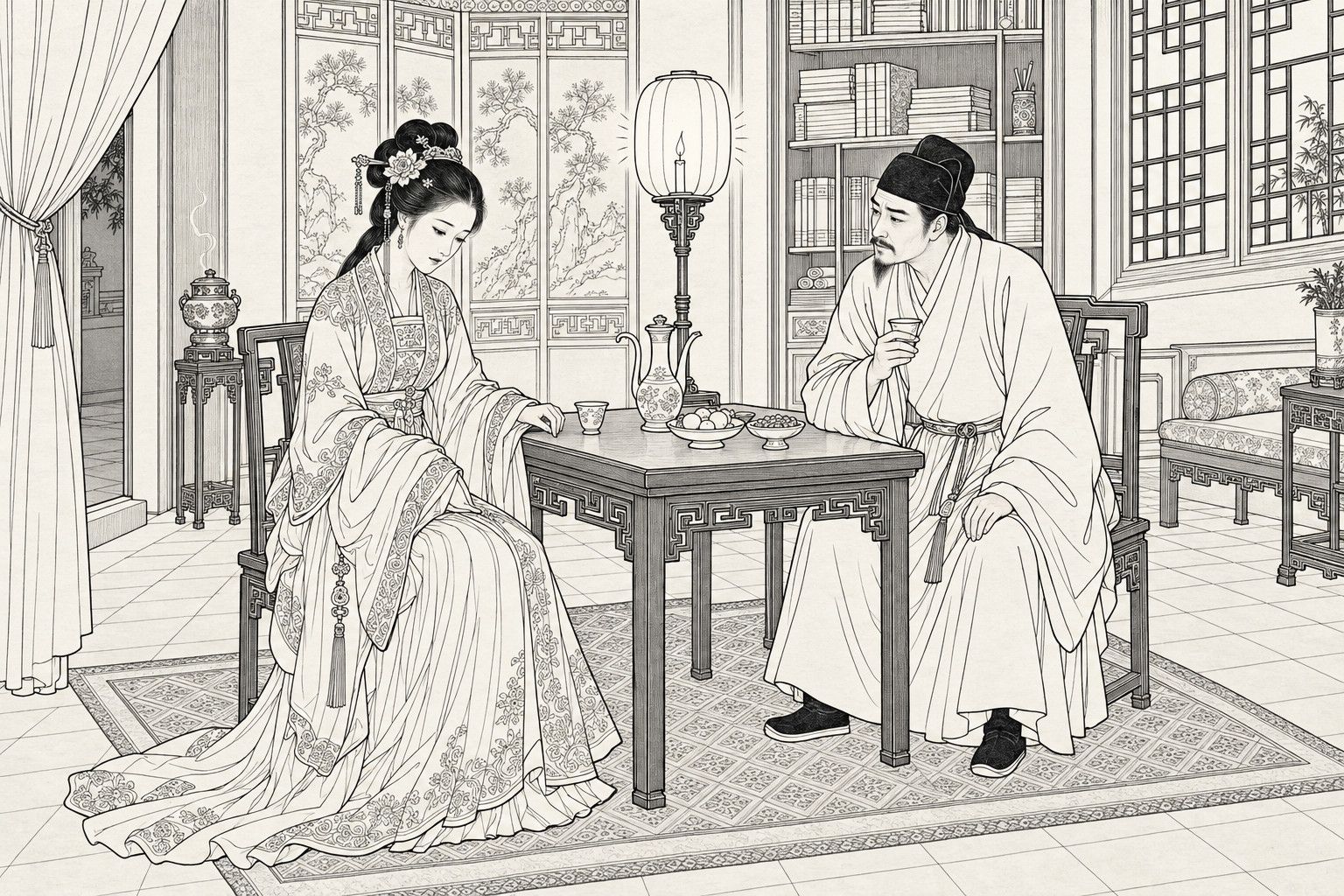
青州道陳公寶鑰,閩人。夜獨坐,有女子搴幃入。視之,不識;而艷絕,長袖宮裝。笑云:「清夜兀坐,得勿寂耶?」公驚問:「何人?」曰:「妾家不遠,近在西鄰。」公意其鬼,而心好之。捉袂挽坐,談詞風雅,大悅。擁之,不甚抗拒。顧曰:「他無人耶?」公急闔戶,曰:「無。」促其緩裳,意殊羞怯。公代為之慇懃。女曰:「妾年二十,猶處子也,狂將不堪。」狎褻既竟,流丹浹席。既而枕邊私語,自言「林四娘」。公詳詰之。曰:「一世堅貞,業為君輕薄殆盡矣。有心愛妾,但圖永好可耳,絮絮何為?」無何,雞鳴,遂起而去。由此夜夜必至。每與闔戶雅飲。談及音律,輒能剖悉宮商。公遂意其工于度曲。曰:「兒時之所習也。」公請一領雅奏,女曰:「久矣不托于音,節奏強半遺忘,恐為知者笑耳。」再強之,乃俯首擊節,唱伊涼之調,其聲哀婉。歌已,泣下。公亦為酸惻,抱而慰之曰:「卿勿為亡國之音,使人悒悒。」女曰:「聲以宣意,哀者不能使樂,亦猶樂者不能使哀。」兩人燕昵,過於琴瑟。
青州道陈公宝钥,闽人。夜独坐,有女子搴帏入。视之,不识;而艳绝,长袖宫装。笑云:「清夜兀坐,得勿寂耶?」公惊问:「何人?」曰:「妾家不远,近在西邻。」公意其鬼,而心好之。捉袂挽坐,谈词风雅,大悦。拥之,不甚抗拒。顾曰:「他无人耶?」公急阖户,曰:「无。」促其缓裳,意殊羞怯。公代为之慇懃。女曰:「妾年二十,犹处子也,狂将不堪。」狎亵既竟,流丹浃席。既而枕边私语,自言「林四娘」。公详诘之。曰:「一世坚贞,业为君轻薄殆尽矣。有心爱妾,但图永好可耳,絮絮何为?」无何,鸡鸣,遂起而去。由此夜夜必至。每与阖户雅饮。谈及音律,辄能剖悉宫商。公遂意其工于度曲。曰:「儿时之所习也。」公请一领雅奏,女曰:「久矣不托于音,节奏强半遗忘,恐为知者笑耳。」再强之,乃俯首击节,唱伊凉之调,其声哀婉。歌已,泣下。公亦为酸恻,抱而慰之曰:「卿勿为亡国之音,使人悒悒。」女曰:「声以宣意,哀者不能使乐,亦犹乐者不能使哀。」两人燕昵,过于琴瑟。
Lord Chen Baoyao, Circuit Intendant of Qingzhou, was a man of Fujian. One night as he sat alone, a woman lifted the curtain and came in. He looked at her and did not know her, but she was dazzlingly beautiful, in palace dress with long sleeves. She smiled. “Sitting up alone on so clear a night — aren’t you lonely?” Startled, Chen asked, “Who are you?” “My home is not far,” she said. “Just next door, to the west.” Chen guessed she was a ghost, but his heart went out to her. He caught her sleeve and drew her down to sit. Her talk was elegant and refined, and he was delighted. He put his arms around her, and she did not resist much. She glanced round. “Is there no one else here?” Chen hurriedly shut the door. “No one.” He urged her to loosen her skirt; she seemed very shy, and Chen attentively did it for her. “I am twenty,” she said, “and still a virgin. If you are wild, I won’t be able to bear it.” When they had done, red flowed and soaked the mat. Afterwards, whispering by the pillow, she said that she was Lin Siniang. Chen questioned her closely. “A whole life of chastity,” she said, “and you have already all but squandered it in your wantonness. If you love me, only think of how we may be happy for ever. Why all these questions?” Before long the cock crowed, and she got up and left. From then on she came every night without fail. Each time they shut the door and drank together in refined talk. When the talk turned to music, she could always analyse every note and mode. So Chen guessed that she was skilled at singing. “I learned it as a child,” she said. Chen asked to hear her sing. “It has been so long since I gave voice to music,” she said, “that I have forgotten more than half of it. I am afraid a connoisseur would laugh at me.” He pressed her again, and at last she bowed her head and, beating time, sang airs of Yizhou and Liangzhou. Her voice was sad and tender. When the song ended, she wept. Chen too was pained and moved. He held her and comforted her. “Don’t sing the music of a fallen kingdom, my dear. It makes one so melancholy.” “Music speaks what is in the heart,” she said. “A sad heart cannot make it joyful, just as a joyful heart cannot make it sad.” The two of them were closer and more loving than any husband and wife.
既久,家人竊聽之,聞其歌者,無不流涕。夫人窺見其容,疑人世無此妖麗,非鬼必狐;懼為厭蠱,勸公絕之。公不能聽,但固詰之。女愀然曰:「妾,衡府宮人也。遭難而死,十七年矣。以君高義,托為燕婉,然實不敢禍君。倘見疑畏,即從此辭。」公曰:「我不為嫌,但燕好若此,不可不知其實耳。」乃問宮中事。女緬述,津津可聽。談及式微之際,則哽嚥不能成語。女不甚睡,每夜輒起誦准提﹑金剛諸經咒。公問:「九原能自懺耶?」曰:「一也。妾思終身淪落,欲度來生耳。」又每與公評騭詩詞,瑕輒疵之;至好句,則曼聲嬌吟。意緒風流,使人忘倦。公問:「工詩乎?」曰:「生時亦偶為之。」公索其贈。笑曰:「兒女之語,烏足為高人道。」
既久,家人窃听之,闻其歌者,无不流涕。夫人窥见其容,疑人世无此妖丽,非鬼必狐;惧为厌蛊,劝公绝之。公不能听,但固诘之。女愀然曰:「妾,衡府宫人也。遭难而死,十七年矣。以君高义,托为燕婉,然实不敢祸君。倘见疑畏,即从此辞。」公曰:「我不为嫌,但燕好若此,不可不知其实耳。」乃问宫中事。女缅述,津津可听。谈及式微之际,则哽咽不能成语。女不甚睡,每夜辄起诵准提﹑金刚诸经咒。公问:「九原能自忏耶?」曰:「一也。妾思终身沦落,欲度来生耳。」又每与公评骘诗词,瑕辄疵之;至好句,则曼声娇吟。意绪风流,使人忘倦。公问:「工诗乎?」曰:「生时亦偶为之。」公索其赠。笑曰:「儿女之语,乌足为高人道。」
As time went on, the household listened in secret, and no one who heard her sing could keep from tears. Chen’s wife caught a glimpse of her face, and thought that so bewitching a beauty could not belong to the human world: if she was not a ghost, she must be a fox. Afraid she would cast a spell on him, she urged Chen to break with her. Chen would not listen, but he questioned the girl closely. Her face fell. “I was a palace lady in the household of the Prince of Heng. I died in the disaster, seventeen years ago. Moved by your noble spirit, I gave myself to you in love, but truly I would never dare bring you harm. If you suspect or fear me, I will leave you now.” “I don’t hold it against you,” said Chen. “But when we love each other like this, I must know the truth.” Then he asked her about life in the palace. She told it all in detail, and it was absorbing to hear. When she came to the time of the fall, she choked with sobs and could not go on. She slept little. Every night she would get up and recite the Cundi spell, the Diamond Sutra and other scriptures and spells. Chen asked, “Can the dead repent for themselves down there?” “It is the same there,” she said. “I think I am lost for good in this life, and I want to be saved in the next.” She would often discuss poetry with Chen, picking out every flaw; and when she came to a fine line she would chant it in a soft, lingering voice. Her feeling and grace made him forget all weariness. Chen asked, “Do you write poetry?” “Now and then, when I was alive.” He asked her for a poem. She laughed. “The words of a girl — how could they be worth showing to a man of refinement?”
居三年,一夕忽慘然告別。公驚問之。答云:「冥王以妾生前無罪,死猶不忘經咒,俾生王家。別在今宵,永無見期。」言已,愴然。公亦淚下。乃置酒相與痛飲。女慷慨而歌,為哀曼之音,一字百轉,每至悲處,輒便嗚咽。數停數起,而後終曲。飲不能暢。乃起,逡巡欲別。公固挽之,又坐少時。雞聲忽唱,乃曰:「必不可以久留矣。然君每怪妾不肯獻醜,今將長別,當率成一章。」索筆構成,曰:「心悲意亂,不能推敲,乖音錯節,慎勿出以示人。」掩袖而去。公送諸門外,湮然沒。公悵悼良久。視其詩,字態端好,珍而藏之。詩曰:
「靜鎖深宮十七年,誰將故國問青天?閑看殿宇封喬木,泣望君王化杜鵑。海國波濤斜夕照,漢家簫鼓靜烽煙。紅顏力弱難為厲,惠質心悲只問禪。日誦菩提千百句,閑看貝葉兩三篇。高唱梨園歌代哭,請君獨聽亦潸然。」
詩中重複脫節,疑有錯誤。
居三年,一夕忽惨然告别。公惊问之。答云:「冥王以妾生前无罪,死犹不忘经咒,俾生王家。别在今宵,永无见期。」言已,怆然。公亦泪下。乃置酒相与痛饮。女慷慨而歌,为哀曼之音,一字百转,每至悲处,辄便呜咽。数停数起,而后终曲。饮不能畅。乃起,逡巡欲别。公固挽之,又坐少时。鸡声忽唱,乃曰:「必不可以久留矣。然君每怪妾不肯献丑,今将长别,当率成一章。」索笔构成,曰:「心悲意乱,不能推敲,乖音错节,慎勿出以示人。」掩袖而去。公送诸门外,湮然没。公怅悼良久。视其诗,字态端好,珍而藏之。诗曰:
「静锁深宫十七年,谁将故国问青天?闲看殿宇封乔木,泣望君王化杜鹃。海国波涛斜夕照,汉家箫鼓静烽烟。红颜力弱难为厉,惠质心悲只问禅。日诵菩提千百句,闲看贝叶两三篇。高唱梨园歌代哭,请君独听亦潸然。」
诗中重复脱节,疑有错误。
After three years, one evening she came to him in sorrow to say goodbye. Startled, Chen asked her why. “The King of the Underworld finds that I did no wrong in life,” she said, “and that even in death I have not forgotten the sutras and spells, so he is letting me be reborn in a prince’s house. We part tonight, and we shall never meet again.” With that she was overcome with grief. Chen too shed tears. So they set out wine and drank deeply together. She sang with all her heart, a sad, lingering melody, every word turning a hundred times, and whenever she came to a sad passage she broke into sobs. She stopped and began again several times before the song was done. They could not drink with any joy. She got up and lingered, wanting to go. Chen held her back, and she sat a little longer. Suddenly the cock crowed. “I really cannot stay any longer,” she said. “But you always reproached me for refusing to show you my poor verses. Now that we part for ever, I will dash off a poem.” She asked for a brush and composed it. “My heart is grieved and my thoughts are confused,” she said. “I could not polish it. The tones are off and the rhythm is broken. Please, do not show it to anyone.” She covered her face with her sleeve and left. Chen saw her out of the gate, where she faded away and was gone. He grieved for her a long while. He looked at her poem: the handwriting was neat and graceful, and he treasured it and kept it. The poem said:
“Locked in silence in the deep palace seventeen years,who will ask blue Heaven about my fallen land?Idly I watch the palace halls sealed in by tall trees;weeping, I gaze at my prince, turned into a cuckoo.Over the sea kingdom’s waves the evening sun slants;the pipes and drums of the Han sound as the smoke of war subsides.A rosy face, too weak to become an avenging ghost,a gentle heart in grief, I only seek the way of Chan.Each day I chant the Bodhi words, a thousand lines and more;idly I read the palm-leaf sutras, two or three.I sing aloud the Pear Garden songs in place of weeping;listen alone, I pray you, sir, and you too will shed tears.”
The poem repeats itself and is broken in places; I suspect there are errors in it.